

Introduction
In many organizations, WebOps problems are misdiagnosed as tooling gaps or skill shortages. New platforms are introduced, processes are documented, and yet the same failures repeat. Releases create anxiety. SEO issues surface without clear causes. Incidents linger longer than expected.
More often than not, the root issue is structural: unclear roles, diffused accountability, and ambiguous decision rights. When WebOps ownership is undefined, systems degrade quietly. Everyone is involved, but no one is responsible.
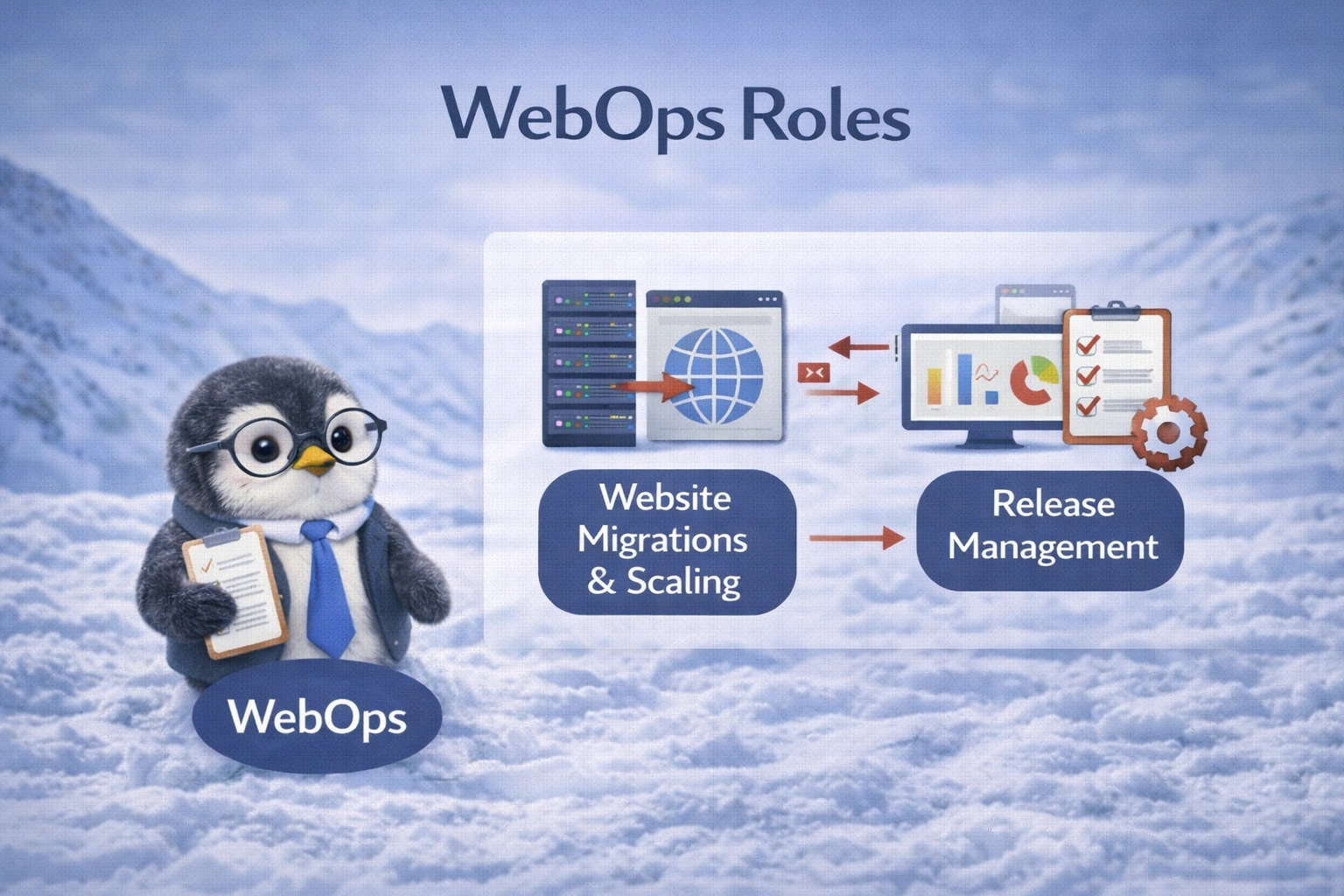
This article examines WebOps roles from a systems perspective, focusing on ownership models, accountability boundaries, and decision-making authority. It explains why role clarity is foundational to reliability, scalability, and predictable outcomes at enterprise scale.
Why Role Ambiguity Is a Systemic Risk
Web platforms sit at the intersection of engineering, marketing, product, infrastructure, and security. Without explicit role definitions, responsibility fragments naturally along team lines.
Common symptoms of role ambiguity include:
- SEO issues escalated without a clear owner
- Release decisions made without understanding the search or performance impact
- Incidents resolved tactically without systemic fixes
These are not execution failures. They are governance failures.
Roles Are About Decisions, Not Tasks
Organizations often define roles by what people do rather than what they decide.
Task-based role definitions lead to overlap and conflict. Decision-based definitions create clarity. In WebOps, the critical question is not who deploys changes, but who has authority to:
- Approve risk
- Define standards
- Block or delay releases
Without clear decision rights, accountability becomes symbolic.
The Difference Between Responsibility and Accountability
Responsibility is about execution. Accountability is about outcomes.
In immature WebOps models:
- Many teams are responsible for parts of the site
- No team is accountable for system-level behavior
This gap explains why issues recur even after they are “fixed.”
Core WebOps Role Archetypes
While titles vary across organizations, effective WebOps structures consistently cover a small set of role archetypes.
Platform Owner
The platform owner is accountable for how the website behaves as a system.
This role:
- Defines non-negotiable standards
- Owns long-term platform health
- Balances local needs against global consistency
Without this role, WebOps decisions default to short-term priorities.
Release Authority
Release authority is responsible for deciding when a change is safe to deploy.
This role:
- Assesses blast radius and risk
- Coordinates across engineering, SEO, and operations
- Has explicit power to delay or halt releases
When release authority is implicit, speed overrides stability.
SEO and Search Reliability Owner
This role ensures that search engines experience the site as intended.
Responsibilities include:
- Defining crawl and indexation expectations
- Identifying search-sensitive changes
- Participating in incident response and recovery
This is not a content role. It is a systems role.
Infrastructure and Delivery Owner
This role owns the mechanics of delivery: hosting, CDN, caching, and deployment pipelines.
Their decisions directly affect:
- Crawl reliability
- Rendering consistency
- Performance stability
Without coordination, infrastructure optimizations can undermine search behavior.
Why “Shared Ownership” Often Fails
Shared ownership is frequently used to avoid difficult conversations.
In practice, it leads to:
- Slow decisions
- Conflicting priorities
- Post-incident blame diffusion
Shared input is healthy. Shared accountability is not.
Decision Rights Must Be Explicit
In high-functioning WebOps organizations, decision rights are documented.
Examples include:
- Who can approve changes affecting crawl directives
- Who can override performance budgets
- Who decides rollback during incidents
Explicit decision rights reduce friction and prevent escalation during crises.
How Role Clarity Improves SEO Outcomes
Search engines reward consistency.
Role clarity enables:
- Predictable release behavior
- Stable crawl and indexation patterns
- Faster recovery from incidents
SEO improvements follow operational discipline, not the other way around.
Role Design in Multi-Team Environments
As organizations scale, roles must accommodate distributed teams.
Effective models:
- Separate global standards from local execution
- Assign clear local owners accountable to central governance
- Define escalation paths that bypass hierarchy during incidents
This prevents fragmentation without central bottlenecks.
Why Titles Matter Less Than Authority
A WebOps role without authority is symbolic.
If individuals cannot:
- Block unsafe releases
- Enforce standards
- Demand remediation of systemic issues
then the role exists only on paper.
Role Clarity Reduces Dependency on Individuals
Hero-driven WebOps systems are fragile.
When roles are clear:
- Knowledge is institutionalized
- Decisions are repeatable
- Turnover does not destabilize systems
This is essential for enterprise continuity.
Common Anti-Patterns in WebOps Role Design
Organizations often repeat the same mistakes:
- SEO consulted only after releases
- WebOps positioned as a ticket-processing layer
- No single owner for platform health
These patterns persist until governance is addressed directly.
Designing Roles for Change, Not Stability
Web platforms are never static.
Roles must be designed to:
- Evaluate change continuously
- Manage trade-offs explicitly
- Absorb growth without losing control
Stability emerges from controlled change, not frozen systems.
Conclusion
WebOps roles are not administrative details. They are control points.
Organizations that define ownership, accountability, and decision rights explicitly create systems that scale predictably. Those that leave roles implicit rely on individuals and luck, even with strong tooling.
At enterprise scale, clarity is not optional. It is the foundation on which reliable WebOps, resilient SEO, and sustainable growth are built.
