

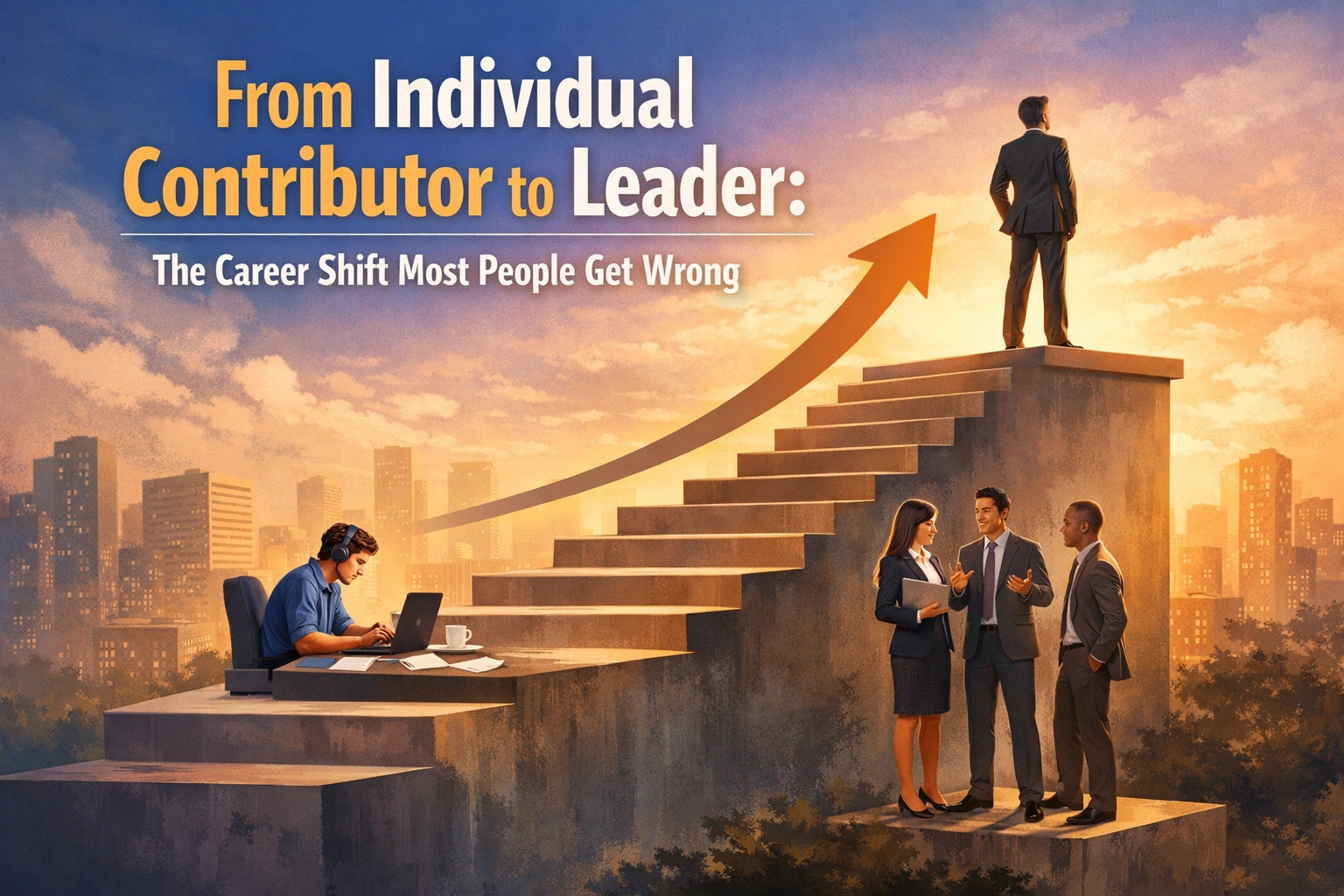
The Promotion Myth
In many organizations, leadership roles are treated as rewards for strong execution. The best engineer becomes the engineering manager. The strongest marketer becomes the marketing lead.
This approach assumes that leadership is simply “doing the same work at a higher level.” It is not.
Leadership is a fundamentally different job with different success criteria.
Why Top Performers Often Struggle as Leaders
High-performing individual contributors succeed by directly controlling outcomes.
Leadership removes that control.
New leaders often struggle because:
- They measure success by personal output
- They intervene too quickly
- They feel uncomfortable with ambiguity
What once created excellence can now create bottlenecks.
The Fundamental Shift in Responsibility
Individual contributors are responsible for tasks. Leaders are responsible for systems.
The leader’s job is to:
- Create clarity
- Align priorities
- Enable others to succeed
- Remove obstacles
Leadership success is measured by team outcomes—not personal contribution.
Letting Go of Doing the Work
One of the hardest leadership transitions is letting go of hands-on execution. Many new leaders continue doing the work because it feels safe and familiar.
However, this creates:
- Team dependency
- Slower decision-making
- Reduced ownership
Effective leaders move from “doing” to “designing.”
The New Skills Leadership Requires
Leadership success depends on skills rarely emphasized in IC roles.
These include:
- Clear communication
- Coaching and feedback
- Conflict navigation
- Decision-making under uncertainty
These skills must be learned deliberately.
The First 90 Days as a New Leader
The first 90 days set the tone for long-term leadership success. Effective new leaders focus on:
- Understanding the team’s context
- Building trust
- Clarifying expectations
- Listening more than directing
Rushing to “prove value” often undermines credibility.
Trust, Delegation, and Accountability
Delegation is not abdication. Strong leaders delegate outcomes, not just tasks. They:
- Define what success looks like
- Provide context and constraints
- Hold people accountable for results
Trust grows when expectations are clear and consistent.
Common Leadership Transition Mistakes
Many leadership transitions fail due to predictable mistakes:
- Micromanaging execution
- Avoiding difficult conversations
- Failing to prioritize team health
- Measuring success by activity
Awareness of these traps accelerates growth.
What Leadership Success Actually Looks Like
Successful leaders create environments where:
- Decisions happen at the right level
- People grow in capability
- Outcomes improve sustainably
When teams succeed without constant intervention, leadership is working.
A Practical IC-to-Leader Framework
- Redefine success as team outcomes
- Shift from execution to system design
- Develop communication and coaching skills
- Delegate ownership deliberately
- Continuously seek feedback
Leadership is not about control—it’s about enablement.
Final takeaway: The transition from individual contributor to leader succeeds when professionals accept that leadership is a new craft—one that must be learned, practiced, and refined.
