

Introduction
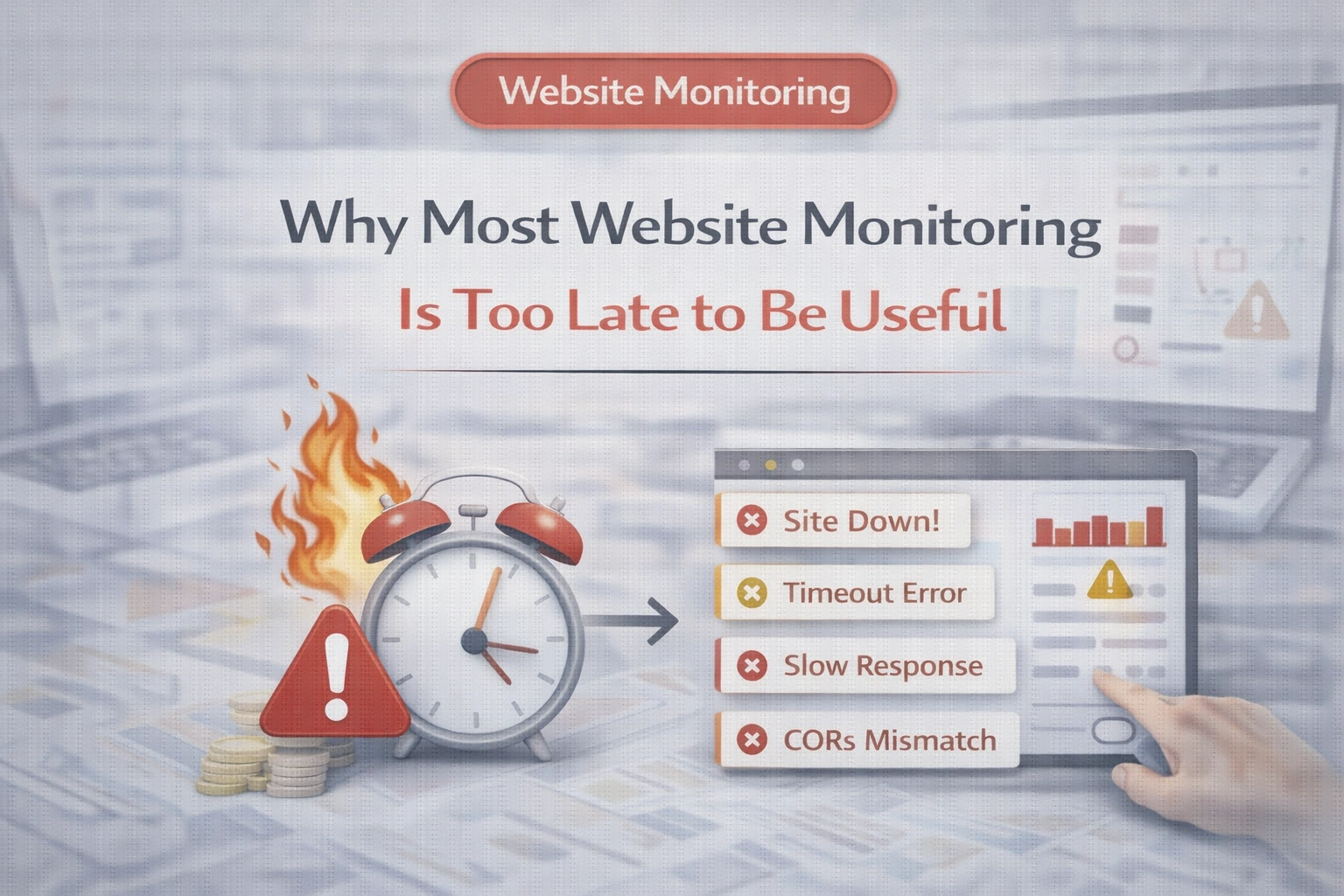
Most organizations believe they are monitoring their websites effectively. Dashboards are populated, alerts are configured, and reports are reviewed regularly. Yet critical issues still surface first as traffic drops, SEO volatility, or customer complaints rather than as early warnings.
The problem is not a lack of monitoring. It is the kind of monitoring being done. Most programs are built around lagging indicators that confirm failure after damage has already occurred. By the time alerts fire, search engines have already adapted to degraded behavior.
This article explains why traditional website monitoring is structurally late, how lagging indicators create false confidence, and what it means to design monitoring systems that surface problems while they are still small and recoverable.
Monitoring Is Often Confused With Reporting
Many monitoring setups are repurposed reporting systems.
They focus on:
- Traffic and conversion trends
- Aggregate performance metrics
- Availability and uptime percentages
These metrics describe outcomes, not system health. They explain what happened, not what is about to happen.
Why Lagging Indicators Dominate
Leading indicators are attractive because they are easy to understand and easy to justify.
Traffic loss, ranking drops, and error spikes are unambiguous. The problem is timing. These indicators move only after:
- Search engines have reduced trust
- Users have already encountered issues
- Recovery timelines have lengthened
At that point, monitoring has failed its primary purpose.
Search Engines Experience Failure Before Users Do
Search engines encounter websites continuously and systematically.
They detect:
- Inconsistent responses
- Rendering instability
- Performance variance under load
These signals accumulate long before user-facing metrics degrade. Monitoring that ignores crawler experience misses the earliest warnings.
Why Uptime Monitoring Is Insufficient
Uptime monitoring answers a narrow question: Is the site reachable?
SEO and performance failures often occur while uptime remains near 100 percent. Pages return 200 responses, but:
- Render incompletely
- Load too slowly for reliable crawling
- Behave inconsistently across regions
From a monitoring perspective, everything looks healthy.
The False Confidence of Averages
Most dashboards report averages.
Averages hide:
- Template-specific regressions
- Outliers that affect crawlers disproportionately
- Localized failures that spread gradually
Search engines do not experience averages. They experience individual pages over time.
Why Alerts Often Fire Too Late
Alert thresholds are typically based on absolute failure.
Examples include:
- Error rates exceeding a fixed percentage
- Response times breaching a set limit
- Traffic dropping below a defined baseline
These thresholds are crossed only after significant degradation has already occurred.
Early Failure Looks Like Anomaly, Not Error
Early-stage issues rarely manifest as outright failures.
They appear as:
- Subtle shifts in crawl distribution
- Small increases in render time variance
- Gradual changes in indexation ratios
Traditional monitoring systems are not designed to detect deviation from normal behavior.
Why SEO Teams Discover Problems First
SEO teams often notice issues before engineering alerts fire.
This happens because SEO:
- Observes long-term patterns
- Tracks search-specific behavior
- Notices inconsistencies across large URL sets
By the time SEO raises concerns, the system has already drifted.
Monitoring Without Context Creates Noise
Adding more alerts does not improve detection.
Without context:
- Alerts trigger too frequently
- Teams begin to ignore warnings
- Real issues are dismissed as false positives
Alert fatigue is often a symptom of poorly designed monitoring, not inattentive teams.
Leading Indicators Versus Lagging Indicators
Effective monitoring prioritizes leading indicators.
For websites, leading indicators include:
- Crawl behavior changes by template or section
- Indexation volatility without content changes
- Performance variance rather than absolute scores
These indicators shift before traffic does.
Why Monitoring Must Be System-Aware
Websites are composed of shared components.
Monitoring that does not understandthe system structure cannot localize issues. A problem in a shared template may affect thousands of pages, yet appear as a minor aggregate change.
Detection Versus Diagnosis
Monitoring should support diagnosis, not just detection.
This requires:
- Segmentation by page type
- Historical baselines
- Correlation with releases and configuration changes
Without these, alerts trigger an investigation without direction.
Why Late Detection Extends Recovery
When issues are detected late:
- Search engines have already adapted
- Root cause analysis is more complex
- Rollback windows have closed
Recovery becomes slower and less predictable.
Monitoring as a Control System
In mature WebOps models, monitoring is designed as a control system.
Its purpose is to:
- Detect deviation early
- Trigger an investigation before damage compounds
- Inform decisions about release and rollback
This shifts monitoring from observation to intervention.
Why Most Organizations Accept Late Detection
Late detection is often normalized.
Teams accept traffic loss as the first signal because:
- Earlier signals are harder to interpret
- Ownership for proactive monitoring is unclear
- Dashboards are built for reporting, not control
This acceptance perpetuates reactive operations.
Conclusion
Most website monitoring programs fail not because they lack data, but because they focus on confirmation rather than prevention.
Lagging indicators provide clarity only after trust has been lost. Organizations that redesign monitoring around leading indicators, deviation detection, and system behavior see issues earlier and recover faster.
At enterprise scale, monitoring is not about knowing what went wrong. It is about knowing when something starts to go wrong, while there is still time to act.
