Close Menu
blog.ykthakur.com

    Subscribe to Updates

    Get the latest creative news from FooBar about art, design and business.

    What's Hot

    Personal Branding Without the Cringe: Building Professional Credibility That Actually Works

    February 6, 2026

    Career Resilience: How to Build a Job That Survives Layoffs, AI, and Market Shifts

    February 6, 2026

    From Individual Contributor to Leader: The Career Shift Most People Get Wrong

    February 6, 2026
    Facebook X (Twitter) Instagram
    blog.ykthakur.com
    • Home
    • About Me
    • Case Studies
    • Services
    • Contact Us
    Facebook X (Twitter) Instagram
    Subscribe
    • Blog
    • Search & Growth
      1. SEO
      2. Technical SEO
      3. SEM
      4. Paid Advertisements
      5. View All

      Why SEO Fails Even With the Right Tools and Data

      January 31, 2026

      How to Refresh Old Content Without Losing Rankings

      January 31, 2026

      How to Build a Topic Authority Map for SEO

      January 31, 2026

      E-E-A-T Signals Explained: What Actually Influences Trust and Rankings

      January 31, 2026

      XML Sitemaps at Scale: Signaling Priority, Not Forcing Indexation

      February 3, 2026

      Robots.txt at Scale: Control, Risk, and the Limits of Crawl Directives

      February 3, 2026

      Monitoring, Alerting, and SEO Observability: Seeing Failures Before Traffic Drops

      February 3, 2026

      Migrations, Releases, and SEO Risk: How Technical Changes Break Search at Scale

      February 3, 2026

      Scaling SEM Without Burning Budget

      January 31, 2026

      SEM vs SEO: How Paid Search Should Support Organic Growth

      January 31, 2026

      Quality Score Demystified: What Actually Improves SEM Performance

      January 31, 2026

      Brand vs Non-Brand Search: Budget Allocation Reality

      January 31, 2026

      Personal Branding Without the Cringe: Building Professional Credibility That Actually Works

      February 6, 2026

      Career Resilience: How to Build a Job That Survives Layoffs, AI, and Market Shifts

      February 6, 2026

      From Individual Contributor to Leader: The Career Shift Most People Get Wrong

      February 6, 2026

      The Non-Linear Career: Why the Best Careers No Longer Follow a Straight Path

      February 6, 2026
    • Performance & Infrastructure
      1. Website Performance
      2. Core Web Vitals
      3. Hosting Architecture
      4. Web Application Infrastructure
      5. Load Balancing
      6. View All

      Performance Drift: How Sites Get Slower Without Any One Bad Change

      February 3, 2026

      Why passing scores still hide systemic performance risk

      February 3, 2026

      Performance Monitoring Beyond Core Web Vitals

      February 3, 2026

      Personal Branding Without the Cringe: Building Professional Credibility That Actually Works

      February 6, 2026

      Career Resilience: How to Build a Job That Survives Layoffs, AI, and Market Shifts

      February 6, 2026

      From Individual Contributor to Leader: The Career Shift Most People Get Wrong

      February 6, 2026

      The Non-Linear Career: Why the Best Careers No Longer Follow a Straight Path

      February 6, 2026
    • AI & Automation
      1. AI Content Systems
      2. AI in SEO & Marketing
      3. AI Search Analysis
      4. AI-Driven SEO Workflows
      5. Generative AI Strategy
      6. View All

      AI Content Systems: How to Scale Without Losing Quality or Trust

      February 3, 2026

      AI in Marketing Is a System, Not a Toolset

      February 3, 2026

      SEO in a Zero-Click World: Designing for AI Answers and Visibility

      February 3, 2026

      AI Search Analysis: How LLMs Interpret and Surface Content

      February 3, 2026

      Using AI for Technical SEO Analysis Without Breaking Trust

      February 3, 2026

      AI-Driven SEO Workflows: What to Automate and What Not To

      February 3, 2026

      SEO in a Zero-Click World: Designing for AI Answers and Visibility

      February 3, 2026

      AI Search Analysis: How LLMs Interpret and Surface Content

      February 3, 2026

      Using AI for Technical SEO Analysis Without Breaking Trust

      February 3, 2026

      AI-Driven SEO Workflows: What to Automate and What Not To

      February 3, 2026

      Why Most AI SEO Implementations Fail

      February 3, 2026

      Human-in-the-Loop SEO: Where AI Stops and Judgment Starts

      February 3, 2026

      Personal Branding Without the Cringe: Building Professional Credibility That Actually Works

      February 6, 2026

      Career Resilience: How to Build a Job That Survives Layoffs, AI, and Market Shifts

      February 6, 2026

      From Individual Contributor to Leader: The Career Shift Most People Get Wrong

      February 6, 2026

      The Non-Linear Career: Why the Best Careers No Longer Follow a Straight Path

      February 6, 2026
    • Analytics & Intelligence
      1. GA4 Architecture
      2. Adobe Analytics
      3. View All

      GA4 vs Adobe Analytics: Choosing the Right Tool for Your Organization

      February 2, 2026

      Consent, Privacy, and Measurement: What Changes After GDPR & GA4

      February 2, 2026

      GA4 Architecture Explained: Designing Events for Real Decisions

      February 2, 2026

      GA4 vs Adobe Analytics: Choosing the Right Tool for Your Organization

      February 2, 2026

      Personal Branding Without the Cringe: Building Professional Credibility That Actually Works

      February 6, 2026

      Career Resilience: How to Build a Job That Survives Layoffs, AI, and Market Shifts

      February 6, 2026

      From Individual Contributor to Leader: The Career Shift Most People Get Wrong

      February 6, 2026

      The Non-Linear Career: Why the Best Careers No Longer Follow a Straight Path

      February 6, 2026
    • WebOps & DevOps
      1. Web Operations
      2. WebOps Roles
      3. Website Migrations & Scaling
      4. Release Management
      5. Monitoring & Alerts
      6. Performance Monitoring
      7. Deployment Automation
      8. View All

      SEO and WebOps Monitoring: Aligning Health Signals Across Systems

      February 3, 2026

      Designing Alerts for WebOps: Signal, Severity, and Actionability

      February 3, 2026

      Why Most Website Monitoring Is Too Late to Be Useful

      February 3, 2026

      Release Cadence Versus Stability: Finding the Sustainable Balance

      February 3, 2026

      Website Migrations at Scale: Why Most Fail Before the First Redirect

      February 3, 2026

      Post-Migration Reality: Why SEO and Performance Losses Persist for Months

      February 3, 2026

      Scaling Websites Without Replatforming: When Migration Is the Wrong Answer

      February 3, 2026

      Release Cadence Versus Stability: Finding the Sustainable Balance

      February 3, 2026

      Why Website Releases Break SEO Even When Nothing “Major” Changes

      February 3, 2026

      Release Management for Websites: Coordinating Risk Across Teams

      February 3, 2026

      Release Pipelines and Search Risk: Why Velocity Without Guardrails Breaks Websites

      February 3, 2026

      SEO and WebOps Monitoring: Aligning Health Signals Across Systems

      February 3, 2026

      Designing Alerts for WebOps: Signal, Severity, and Actionability

      February 3, 2026

      Why Most Website Monitoring Is Too Late to Be Useful

      February 3, 2026

      Feature Flags, Experiments, and the SEO Blast Radius

      February 3, 2026

      Performance Drift: How Sites Get Slower Without Any One Bad Change

      February 3, 2026

      Performance Monitoring Beyond Core Web Vitals

      February 3, 2026

      Designing SEO-Safe Deployment Automation

      February 3, 2026

      Deployment Automation for Websites: What to Automate and What Not To

      February 3, 2026

      Personal Branding Without the Cringe: Building Professional Credibility That Actually Works

      February 6, 2026

      Career Resilience: How to Build a Job That Survives Layoffs, AI, and Market Shifts

      February 6, 2026

      From Individual Contributor to Leader: The Career Shift Most People Get Wrong

      February 6, 2026

      The Non-Linear Career: Why the Best Careers No Longer Follow a Straight Path

      February 6, 2026
    • Project Strategy

      Personal Branding Without the Cringe: Building Professional Credibility That Actually Works

      February 6, 2026

      Career Resilience: How to Build a Job That Survives Layoffs, AI, and Market Shifts

      February 6, 2026

      From Individual Contributor to Leader: The Career Shift Most People Get Wrong

      February 6, 2026

      The Non-Linear Career: Why the Best Careers No Longer Follow a Straight Path

      February 6, 2026

      How to Stay Relevant When Roles Are Changing Faster Than Job Descriptions

      February 6, 2026
    • Web Engineering
      1. Web Development
      2. Web Designing & UX
      3. CMS & Platforms
      4. Web Application Firewall
      5. View All

      Personal Branding Without the Cringe: Building Professional Credibility That Actually Works

      February 6, 2026

      Career Resilience: How to Build a Job That Survives Layoffs, AI, and Market Shifts

      February 6, 2026

      From Individual Contributor to Leader: The Career Shift Most People Get Wrong

      February 6, 2026

      The Non-Linear Career: Why the Best Careers No Longer Follow a Straight Path

      February 6, 2026
    blog.ykthakur.com
    Home»SEM»Keyword Bidding Models»Brand vs Non-Brand Search: Budget Allocation Reality
    Keyword Bidding Models

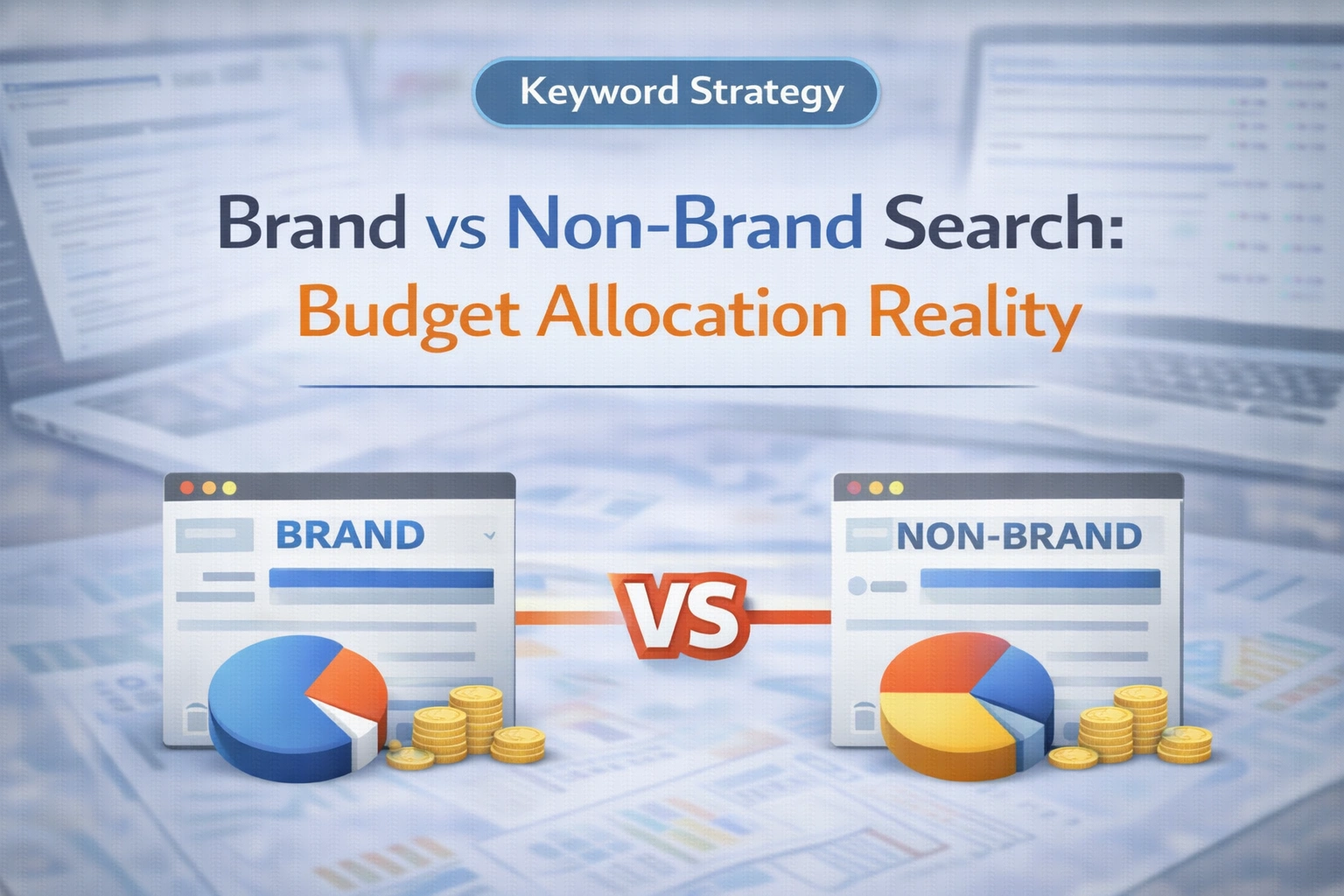
    Brand vs Non-Brand Search: Budget Allocation Reality

    yashwant160@gmail.comBy yashwant160@gmail.comJanuary 31, 2026Updated:February 1, 2026No Comments5 Mins Read
    Share Facebook Twitter Pinterest LinkedIn Tumblr Email
    Follow Us
    Google News Flipboard Threads
    Budget Allocation 1024x683
    Share
    Facebook Twitter LinkedIn Pinterest Email

    Introduction

    Few SEM decisions create more internal debate than how much budget should be allocated to brand versus non-brand search. Brand campaigns look efficient, convert easily, and show strong ROI. Non-brand campaigns are expensive, volatile, and harder to justify—especially under pressure. The mistake many teams make is treating this as a performance comparison instead of a strategic allocation problem. When budgets are misallocated, SEM performance becomes misleading and long-term growth suffers.

    This article explains the real budget allocation reality between brand and non-brand search, why brand efficiency can be deceptive, and how mature teams allocate spend to protect demand while still creating growth.

    What Brand and Non-Brand Search Actually Represent

    Before discussing budgets, it’s important to understand what each channel truly does.

    Brand search represents

    • Existing demand
    • Brand recognition
    • Prior marketing influence
    • Navigational intent

    Brand search is rarely demand creation.
    It is demand capture.

    Non-brand search represents

    • Problem discovery
    • Competitive consideration
    • New customer acquisition
    • Market expansion

    Non-brand search is where growth happens—but also where risk lives.

    Why Brand Search Always Looks Better on Paper

    Brand campaigns typically show:

    • Very high CTR
    • Very low CPC
    • High conversion rates
    • Strong ROAS

    Why this happens

    Users searching your brand:

    • Already trust you
    • Are closer to conversion
    • Require less persuasion

    This does not mean brand search is driving incremental growth.

    The Brand Search Illusion

    Brand search performance is often misinterpreted.

    Common flawed conclusion

    “Brand search is our best-performing campaign, so we should increase budget there.”

    The reality

    Brand search captures:

    • Demand created elsewhere
    • Users who would likely convert anyway
    • Traffic influenced by SEO, PR, email, referrals, or offline marketing

    Over-investing in brand search does not create more demand—it overpays to capture it.

    Why Non-Brand Search Looks Worse (But Matters More)

    Non-brand search typically shows:

    • Lower CTR
    • Higher CPC
    • Lower conversion rates
    • Longer decision cycles

    Why is this normal

    Non-brand users:

    • Are earlier in the funnel
    • Are comparing options
    • Require education
    • Have higher uncertainty

    Judging non-brand search by brand metrics guarantees underinvestment.

    The Real Budget Allocation Question

    The right question is not:

    “Which performs better?”

    It is:

    “Which role does each play in our growth model?”

    Brand protects.
    Non-brand expands.

    Step 1: Protect Brand Search (But Don’t Inflate It)

    Brand search should be:

    • Always present
    • Well-controlled
    • Efficient
    • Defensive

    Why brand protection matters

    • Competitors bid on your name
    • SERP layouts change
    • AI summaries may reduce organic visibility

    Brand campaigns ensure ownership of branded intent, not growth.

    Step 2: Cap Brand Spend Based on Demand Reality

    Brand budgets should:

    • Match actual branded search volume
    • Avoid aggressive bid inflation
    • Prevent unnecessary impression share chasing

    Warning signs of over-investment

    • Very deep impression share with low incremental lift
    • Rising CPCs without volume growth
    • Budget increases that don’t increase conversions

    Brand spend should stabilize—not scale endlessly.

    Step 3: Fund Non-Brand Search With Growth Expectations, Not Brand Benchmarks

    Non-brand search must be evaluated differently.

    Healthy non-brand expectations

    • Higher CPA than brand
    • Longer time to conversion
    • Greater volatility
    • Lower short-term ROAS

    This is the cost of growth, not inefficiency.

    Step 4: Segment Non-Brand Budgets by Intent

    Non-brand is not one bucket.

    Intent-based allocation example

    Non-Brand Segment Budget Role
    High intent Core acquisition
    Mid intent Assisted conversion
    Low intent Learning & reach

    This prevents:

    • Over-spending on low intent
    • Under-funding high-value opportunities
    • Blended metrics hiding inefficiency

    Step 5: Avoid Cannibalization Between Brand and Non-Brand

    Poor structure causes overlap.

    Common cannibalization patterns

    • Broad match keywords triggering brand queries
    • Brand terms included in non-brand campaigns
    • Shared budgets are distorting performance

    Why is this dangerous

    • Non-brand appears inefficient
    • Brand performance is artificially
    • Budget decisions become misleading

    Strict separation is essential.

    Step 6: Measure Incrementality, Not Just Efficiency

    Brand search must be measured through:

    • Incremental lift
    • Assisted conversions
    • Conversion paths
    • Attribution comparisons

    Key question

    “Would this conversion have happened without brand ads?”

    If the answer is often “yes,” efficiency is overstated.

    Step 7: Understand Competitive Pressure Dynamics

    Brand and non-brand respond differently to competition.

    Brand search risks

    • Competitor conquesting
    • SERP crowding
    • AI answer displacement

    Non-brand search risks

    • Rising CPCs
    • Auction volatility
    • Message fatigue

    Budgets must account for defensive and offensive pressures.

    Real-World Allocation Pattern (Mature Accounts)

    A common, healthy split looks like:

    Channel Typical Range
    Brand 15–30%
    Non-brand 70–85%

    Exact ratios depend on:

    • Brand strength
    • Market maturity
    • Competitive intensity
    • Growth goals

    Extreme imbalance is usually a warning sign.

    Why Leadership Often Pushes Too Much Brand Spend

    Brand search:

    • Looks safe
    • Converts easily
    • Is easy to justify in reports

    Non-brand search:

    • Feels risky
    • Requires patience
    • Needs explanation

    This pressure leads to short-term comfort at the expense of long-term growth.

    How Mature Teams Communicate Brand vs Non-Brand Performance

    They:

    • Report separately
    • Set different KPIs
    • Explain roles clearly
    • Avoid blended metrics

    Brand and non-brand serve different purposes—and should never be forced to compete internally.

    The Impact of AI Search on Brand vs Non-Brand

    AI-driven search:

    • Compresses informational queries
    • Strengthens known brands
    • Reduces visibility for weak authority

    This makes:

    • Brand protection is more important
    • Non-brand differentiation is more critical

    SEM budgets must reflect this shift.

    Common Budget Allocation Mistakes to Avoid

    • Scaling the brand because it “performs best.”
    • Cutting non-brand during downturns
    • Blending brand and non-brand metrics
    • Letting automation shift budget silently
    • Optimizing solely for short-term ROAS

    These mistakes quietly cap growth.

    Final Takeaway

    Brand search and non-brand search are not competitors.
    They are complementary growth levers.

    Brand search:

    • Protects demand
    • Captures existing intent
    • Stabilizes performance

    Non-brand search:

    • Creates opportunity
    • Drives growth
    • Expands reach

    Smart SEM programs don’t chase efficiency alone.
    They allocate budgets based on role, risk, and growth goals.

    Share. Facebook Twitter Pinterest LinkedIn Tumblr Email
    yashwant160@gmail.com
    • Website

    Related Posts

    Keyword Bidding Models Explained: Manual, Smart, and Hybrid

    January 31, 2026
    Leave A Reply Cancel Reply

    Don't Miss

    Personal Branding Without the Cringe: Building Professional Credibility That Actually Works

    yashwant160@gmail.comFebruary 6, 2026

    Personal branding has a reputation problem. Too often, it’s confused with self-promotion, performative posting, or…

    Career Resilience: How to Build a Job That Survives Layoffs, AI, and Market Shifts

    February 6, 2026

    From Individual Contributor to Leader: The Career Shift Most People Get Wrong

    February 6, 2026

    The Non-Linear Career: Why the Best Careers No Longer Follow a Straight Path

    February 6, 2026
    Stay In Touch
    • Facebook
    • Twitter
    • Pinterest
    • Instagram
    • YouTube
    • Vimeo

    Subscribe to Updates

    Get the latest creative news from SmartMag about art & design.

    About Us

    Results-driven digital professional with 15+ years of experience across Web Operations, Enterprise SEO, and large-scale digital platforms. I specialize in building, scaling, and optimizing complex websites where performance, search visibility, and operational reliability must work together—not in silos. My work sits at the intersection of strategy and execution, translating business goals into systems that teams can actually run.

    Facebook X (Twitter) Pinterest YouTube
    Our Picks

    Personal Branding Without the Cringe: Building Professional Credibility That Actually Works

    February 6, 2026

    Career Resilience: How to Build a Job That Survives Layoffs, AI, and Market Shifts

    February 6, 2026

    From Individual Contributor to Leader: The Career Shift Most People Get Wrong

    February 6, 2026
    Most Popular

    Top 15 popular link building methods you should consider before it’s too late

    March 24, 20180 Views

    Quality Score Demystified: What Actually Improves SEM Performance

    January 31, 20260 Views

    How SEO, SEM, Email, and Paid Social Should Work Together

    February 2, 20260 Views
    © 2026 All rights reserved. Y. K. Thakur.
    • Home
    • Technical SEO
    • World
    • Lifestyle
    • Buy Now

    Type above and press Enter to search. Press Esc to cancel.