

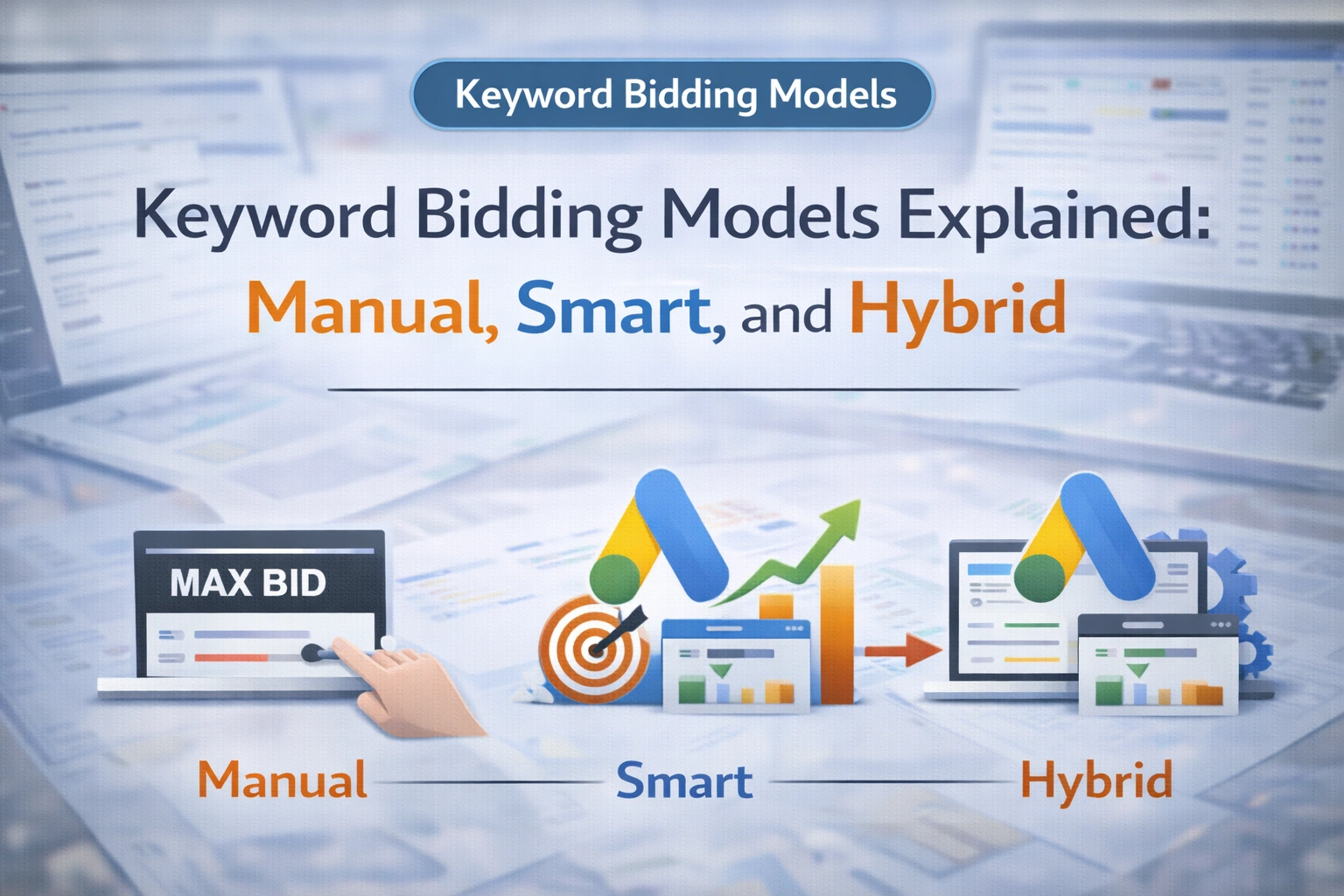
Introduction
Choosing the wrong bidding model is one of the fastest ways to destroy SEM performance—quietly and expensively. Many teams switch bidding strategies based on trends, platform recommendations, or pressure to “use automation,” without understanding how bidding models actually work under the hood. In reality, bidding models don’t create performance; they amplify the signals you feed them. When those signals are weak, even the most advanced automation fails.
This article explains manual, smart, and hybrid keyword bidding models, how each one behaves in real-world SEM accounts, when to use them, and how experienced teams transition between models safely as campaigns mature.
Why Bidding Models Matter More Than Most Teams Realize
Bidding controls:
- How aggressively you enter auctions
- Which users do you prioritize
- How the budget is distributed over time
- How algorithms interpret success
A mismatch between:
- Bidding model
- Campaign structure
- Signal quality
…leads to wasted spend—even with good ads and landing pages.
Bidding is not a tactic.
It’s a risk management decision.
The Three Core Bidding Models (High-Level Overview)
| Model | Control Level | Automation | Risk Profile |
| Manual | High | None | Low–Medium |
| Smart | Low | High | Medium–High |
| Hybrid | Medium | Selective | Low |
Each model solves a different problem.
No single model is “best” in all cases.
Manual Bidding: Maximum Control, Maximum Responsibility
What Manual Bidding Actually Does
Manual bidding allows you to:
- Set keyword-level bids
- Control CPC ceilings
- React immediately to performance changes
You are telling the platform:
“Do not make assumptions. Follow my instructions.”
When Manual Bidding Works Best
Manual bidding is most effective when:
- Campaigns are new
- Conversion data is limited
- Intent is clearly segmented
- Budgets are controlled
- Risk tolerance is low
It’s especially useful in:
- Brand campaigns
- High-cost verticals
- Regulated industries
- Early testing phases
Why Manual Bidding Still Matters in 2026
Despite automation advances, manual bidding excels at:
- Preventing overspend
- Maintaining CPC discipline
- Isolating intent performance
- Avoiding algorithmic drift
It forces intentional optimization, not reactive automation.
Limitations of Manual Bidding
Manual bidding struggles when:
- Scale increases
- Auction dynamics shift rapidly
- Conversion data grows complex
- Time constraints limit oversight
It does not adapt in real time, and that can cap upside.
Smart Bidding: Automation That Scales Signals
What Smart Bidding Actually Does
Smart bidding uses:
- Historical conversion data
- User signals
- Contextual factors
- Predictive modeling
To dynamically adjust bids in real time.
You are telling the platform:
“Optimize toward this outcome using all available signals.”
Common Smart Bidding Models (Conceptual)
- Maximize Conversions
- Target CPA
- Maximize Conversion Value
- Target ROAS
Each relies heavily on conversion accuracy and volume.
When Smart Bidding Works Well
Smart bidding performs best when:
- Conversion tracking is accurate
- Volume is sufficient (30–50+ conversions/month)
- Intent is cleanly segmented
- Landing pages convert consistently
- Budgets allow learning periods
It shines in:
- Mature non-brand campaigns
- E-commerce
- High-volume lead gen
- Stable markets
Why Smart Bidding Fails So Often
Smart bidding breaks when:
- Conversion data is noisy
- Low-quality leads are counted equally
- Intent is mixed within campaigns
- Budgets fluctuate unpredictably
In these cases, automation:
- Optimizes the wrong outcomes
- Scales low-quality traffic
- Inflates CPCs
- Hides inefficiencies
Automation doesn’t fail randomly—it follows instructions too well.
Hybrid Bidding: Control Where It Matters, Automation Where It Helps
What Hybrid Bidding Means in Practice
Hybrid bidding is not a platform setting—it’s a strategy.
It combines:
- Manual bidding for control-heavy campaigns
- Smart bidding for scale-ready campaigns
Based on:
- Intent maturity
- Data quality
- Risk tolerance
How Mature Teams Use Hybrid Models
A common hybrid setup:
| Campaign Type | Bidding Model |
| Brand | Manual |
| High Intent Non-Brand | Target CPA |
| Mid Intent | Maximize Conversions (capped) |
| Low Intent / Learning | Manual or limited automation |
This allows:
- Protection of high-value traffic
- Controlled experimentation
- Scalable growth without runaway spending
Step-by-Step: Choosing the Right Bidding Model
Step 1: Assess Signal Quality
Ask:
- Are conversions meaningful?
- Are low-quality leads filtered?
- Is attribution reliable?
If not → avoid full automation.
Step 2: Evaluate Volume and Consistency
Smart bidding needs:
- Consistent conversion flow
- Stable demand
- Time to learn
Low volume = poor predictions.
Step 3: Match Risk to Business Reality
High-margin businesses can tolerate:
- Learning inefficiency
- CPC volatility
Low-margin businesses cannot.
Bidding must reflect financial reality—not platform suggestions.
Step 4: Transition Gradually (Never Flip the Switch)
Avoid:
- Switching entire accounts at once
- Combining structural changes with bidding changes
Best practice:
- Test on one campaign
- Monitor for 2–4 weeks
- Compare against baseline
- Scale only after stability
Bidding Models and Intent Segmentation (Critical Link)
Bidding cannot compensate for poor structure.
Example
If a campaign mixes:
- “SEO services pricing.”
- “What is SEO?”
Smart bidding will:
- Chase cheaper conversions
- Overweight low-intent queries
- Reduce lead quality
Structure must come before bidding decisions.
Common Bidding Mistakes That Kill Performance
- Trusting automation too early
- Optimizing for volume instead of quality
- Changing bids too frequently
- Ignoring intent differences
- Using platform defaults blindly
Most failures are operational, not technical.
How Bidding Models Affect CPC, CPA, and Scale
| Outcome | Manual | Smart | Hybrid |
| CPC control | High | Low | Medium |
| CPA stability | Medium | High (if clean data) | High |
| Lead quality | High | Variable | High |
| Scalability | Limited | High | High |
| Risk exposure | Low | High | Controlled |
Advanced Insight: Why Platforms Push Automation
Automation benefits platforms because:
- It increases auction competition
- It raises average CPCs
- It reduces advertiser friction
That doesn’t mean automation is bad—but it must be governed.
Smart teams decide when to automate.
Weak teams are told to.
Final Takeaway
Bidding models don’t fix SEM problems—they amplify existing conditions.
- Manual bidding protects control
- Smart bidding scales clean signals
- Hybrid bidding balances growth and risk
The best SEM accounts don’t “pick a model.”
They earn the right to automate.
