
Introduction
Release cadence is often treated as a proxy for organizational maturity. Faster releases imply better tooling, stronger teams, and improved outcomes. In practice, velocity without stability creates fragile systems that are difficult to reason about and slow to recover when something goes wrong.
For websites, the cost of instability is not evenly distributed. Search engines observe behavior over time, not intent. Frequent, unbounded change increases variability in crawl patterns, indexation confidence, and performance signals. The result is gradual erosion rather than dramatic failure.
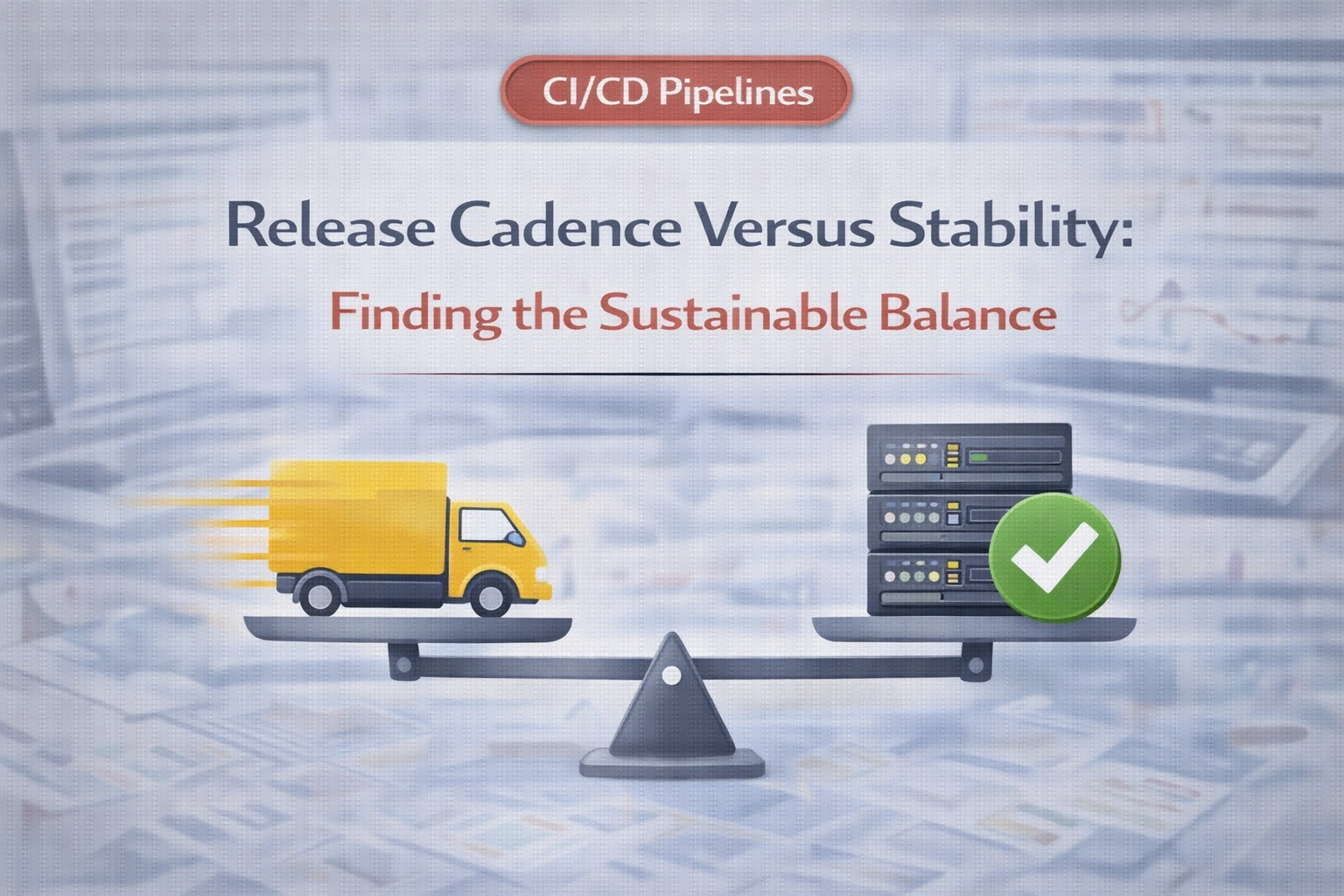
This article examines the tension between release cadence and stability, explains why more frequent releases do not automatically produce better outcomes, and outlines how mature organizations design cadence as a control mechanism rather than a throughput goal.
Why Faster Releases Became the Default Goal
Modern engineering practices emphasize continuous delivery.
The benefits are real:
- Smaller change sets
- Faster feedback loops
- Reduced deployment risk per change
However, these benefits assume that change is well-scoped, observable, and reversible. When those assumptions do not hold, frequency amplifies risk.
Stability Is an External Perception, Not an Internal Feeling
Internally, teams may feel stable because releases are completed successfully.
Externally, stability is defined by:
- Consistent responses to crawlers and users
- Predictable rendering and performance
- Minimal variance in site behavior over time
Search engines judge stability based on observed patterns, not deployment success.
The Hidden Cost of High-Frequency Change
High release frequency introduces subtle costs.
Common consequences include:
- Unclear behavioral baselines
- Difficulty attributing cause and effect
- Reduced willingness to roll back
When everything is always changing, nothing is clearly responsible.
Why SEO Is Sensitive to Cadence
SEO performance depends on long-term consistency.
Frequent changes can:
- Shift crawl allocation unpredictably
- Create indexation hesitation
- Delay recovery from minor regressions
Even positive changes require time to be evaluated and trusted.
Release Cadence Is a Risk Multiplier
Cadence does not create risk by itself. It multiplies existing risk.
In environments with:
- Weak validation
- Limited observability
- Unclear ownership
higher frequency accelerates degradation rather than improvement.
Why Fewer, Better Releases Often Perform Better
Organizations with lower release frequency often appear slower but behave more predictably.
Benefits include:
- Clearer baselines between releases
- Stronger pre-release validation
- More decisive rollback decisions
Predictability compounds trust with search engines.
Stabilization Windows Are Not Optional
After meaningful changes, systems need time to settle.
Stabilization windows allow:
- Search engines to re-crawl and reassess
- Teams to observe real-world behavior
- Regression signals should surface clearly
Without stabilization, new changes obscure the impact of previous ones.
Cadence Should Vary by Risk
Uniform cadence across all changes is inefficient.
Mature organizations differentiate cadence based on:
- SEO and performance sensitivity
- Blast radius of the change
- Reversibility
Low-risk changes can ship frequently. High-risk changes require slower, more deliberate cycles.
The Role of Validation in Supporting Frequency
Higher cadence is sustainable only with stronger validation.
This includes:
- Automated checks for SEO-critical behavior
- Performance budgets enforced pre-release
- Post-release monitoring tied to expectations
Without these, cadence outpaces control.
Why Rollback Culture Matters
Fast cadence without rollback discipline creates paralysis.
Teams hesitate to roll back because:
- Multiple releases are already live
- Dependencies are unclear
- Ownership is diffused
A healthy rollback culture restores confidence in change.
Cadence and Team Cognitive Load
Frequent releases increase cognitive load.
Teams struggle to:
- Track what changed
- Understand system behavior
- Learn from outcomes
Sustainable cadence preserves the ability to reason about the system.
Why “Always Shipping” Is Not a Strategy
Shipping continuously without intent leads to drift.
Effective cadence aligns with:
- Business priorities
- Search engine adaptation timelines
- Operational capacity to observe and respond
Cadence is a lever, not a virtue.
Designing Cadence as a Control System
In mature WebOps models, cadence is designed explicitly.
This includes:
- Defined release rhythms for different change types
- Protected stabilization periods
- Clear criteria for accelerating or slowing down
Control replaces habit.
SEO Stability as a Cadence Signal
SEO performance reflects whether cadence is sustainable.
Persistent volatility indicates:
- Too much change
- Too little validation
- Too little time between shifts
Ignoring this signal compounds risk.
Conclusion
Release cadence and stability are not opposing goals. They are variables that must be balanced deliberately.
Organizations that chase speed without control create fragile systems that degrade quietly. Those who design cadence around risk, validation, and stabilization achieve both velocity and predictability.
At enterprise scale, the right cadence is not the fastest possible. It is the one that allows the system to change while remaining understandable to both humans and search engines.
