Close Menu
blog.ykthakur.com

    Subscribe to Updates

    Get the latest creative news from FooBar about art, design and business.

    What's Hot

    Personal Branding Without the Cringe: Building Professional Credibility That Actually Works

    February 6, 2026

    Career Resilience: How to Build a Job That Survives Layoffs, AI, and Market Shifts

    February 6, 2026

    From Individual Contributor to Leader: The Career Shift Most People Get Wrong

    February 6, 2026
    Facebook X (Twitter) Instagram
    blog.ykthakur.com
    • Home
    • About Me
    • Case Studies
    • Services
    • Contact Us
    Facebook X (Twitter) Instagram
    Subscribe
    • Blog
    • Search & Growth
      1. SEO
      2. Technical SEO
      3. SEM
      4. Paid Advertisements
      5. View All

      Why SEO Fails Even With the Right Tools and Data

      January 31, 2026

      How to Refresh Old Content Without Losing Rankings

      January 31, 2026

      How to Build a Topic Authority Map for SEO

      January 31, 2026

      E-E-A-T Signals Explained: What Actually Influences Trust and Rankings

      January 31, 2026

      XML Sitemaps at Scale: Signaling Priority, Not Forcing Indexation

      February 3, 2026

      Robots.txt at Scale: Control, Risk, and the Limits of Crawl Directives

      February 3, 2026

      Monitoring, Alerting, and SEO Observability: Seeing Failures Before Traffic Drops

      February 3, 2026

      Migrations, Releases, and SEO Risk: How Technical Changes Break Search at Scale

      February 3, 2026

      Scaling SEM Without Burning Budget

      January 31, 2026

      SEM vs SEO: How Paid Search Should Support Organic Growth

      January 31, 2026

      Quality Score Demystified: What Actually Improves SEM Performance

      January 31, 2026

      Brand vs Non-Brand Search: Budget Allocation Reality

      January 31, 2026

      Personal Branding Without the Cringe: Building Professional Credibility That Actually Works

      February 6, 2026

      Career Resilience: How to Build a Job That Survives Layoffs, AI, and Market Shifts

      February 6, 2026

      From Individual Contributor to Leader: The Career Shift Most People Get Wrong

      February 6, 2026

      The Non-Linear Career: Why the Best Careers No Longer Follow a Straight Path

      February 6, 2026
    • Performance & Infrastructure
      1. Website Performance
      2. Core Web Vitals
      3. Hosting Architecture
      4. Web Application Infrastructure
      5. Load Balancing
      6. View All

      Performance Drift: How Sites Get Slower Without Any One Bad Change

      February 3, 2026

      Why passing scores still hide systemic performance risk

      February 3, 2026

      Performance Monitoring Beyond Core Web Vitals

      February 3, 2026

      Personal Branding Without the Cringe: Building Professional Credibility That Actually Works

      February 6, 2026

      Career Resilience: How to Build a Job That Survives Layoffs, AI, and Market Shifts

      February 6, 2026

      From Individual Contributor to Leader: The Career Shift Most People Get Wrong

      February 6, 2026

      The Non-Linear Career: Why the Best Careers No Longer Follow a Straight Path

      February 6, 2026
    • AI & Automation
      1. AI Content Systems
      2. AI in SEO & Marketing
      3. AI Search Analysis
      4. AI-Driven SEO Workflows
      5. Generative AI Strategy
      6. View All

      AI Content Systems: How to Scale Without Losing Quality or Trust

      February 3, 2026

      AI in Marketing Is a System, Not a Toolset

      February 3, 2026

      SEO in a Zero-Click World: Designing for AI Answers and Visibility

      February 3, 2026

      AI Search Analysis: How LLMs Interpret and Surface Content

      February 3, 2026

      Using AI for Technical SEO Analysis Without Breaking Trust

      February 3, 2026

      AI-Driven SEO Workflows: What to Automate and What Not To

      February 3, 2026

      SEO in a Zero-Click World: Designing for AI Answers and Visibility

      February 3, 2026

      AI Search Analysis: How LLMs Interpret and Surface Content

      February 3, 2026

      Using AI for Technical SEO Analysis Without Breaking Trust

      February 3, 2026

      AI-Driven SEO Workflows: What to Automate and What Not To

      February 3, 2026

      Why Most AI SEO Implementations Fail

      February 3, 2026

      Human-in-the-Loop SEO: Where AI Stops and Judgment Starts

      February 3, 2026

      Personal Branding Without the Cringe: Building Professional Credibility That Actually Works

      February 6, 2026

      Career Resilience: How to Build a Job That Survives Layoffs, AI, and Market Shifts

      February 6, 2026

      From Individual Contributor to Leader: The Career Shift Most People Get Wrong

      February 6, 2026

      The Non-Linear Career: Why the Best Careers No Longer Follow a Straight Path

      February 6, 2026
    • Analytics & Intelligence
      1. GA4 Architecture
      2. Adobe Analytics
      3. View All

      GA4 vs Adobe Analytics: Choosing the Right Tool for Your Organization

      February 2, 2026

      Consent, Privacy, and Measurement: What Changes After GDPR & GA4

      February 2, 2026

      GA4 Architecture Explained: Designing Events for Real Decisions

      February 2, 2026

      GA4 vs Adobe Analytics: Choosing the Right Tool for Your Organization

      February 2, 2026

      Personal Branding Without the Cringe: Building Professional Credibility That Actually Works

      February 6, 2026

      Career Resilience: How to Build a Job That Survives Layoffs, AI, and Market Shifts

      February 6, 2026

      From Individual Contributor to Leader: The Career Shift Most People Get Wrong

      February 6, 2026

      The Non-Linear Career: Why the Best Careers No Longer Follow a Straight Path

      February 6, 2026
    • WebOps & DevOps
      1. Web Operations
      2. WebOps Roles
      3. Website Migrations & Scaling
      4. Release Management
      5. Monitoring & Alerts
      6. Performance Monitoring
      7. Deployment Automation
      8. View All

      SEO and WebOps Monitoring: Aligning Health Signals Across Systems

      February 3, 2026

      Designing Alerts for WebOps: Signal, Severity, and Actionability

      February 3, 2026

      Why Most Website Monitoring Is Too Late to Be Useful

      February 3, 2026

      Release Cadence Versus Stability: Finding the Sustainable Balance

      February 3, 2026

      Website Migrations at Scale: Why Most Fail Before the First Redirect

      February 3, 2026

      Post-Migration Reality: Why SEO and Performance Losses Persist for Months

      February 3, 2026

      Scaling Websites Without Replatforming: When Migration Is the Wrong Answer

      February 3, 2026

      Release Cadence Versus Stability: Finding the Sustainable Balance

      February 3, 2026

      Why Website Releases Break SEO Even When Nothing “Major” Changes

      February 3, 2026

      Release Management for Websites: Coordinating Risk Across Teams

      February 3, 2026

      Release Pipelines and Search Risk: Why Velocity Without Guardrails Breaks Websites

      February 3, 2026

      SEO and WebOps Monitoring: Aligning Health Signals Across Systems

      February 3, 2026

      Designing Alerts for WebOps: Signal, Severity, and Actionability

      February 3, 2026

      Why Most Website Monitoring Is Too Late to Be Useful

      February 3, 2026

      Feature Flags, Experiments, and the SEO Blast Radius

      February 3, 2026

      Performance Drift: How Sites Get Slower Without Any One Bad Change

      February 3, 2026

      Performance Monitoring Beyond Core Web Vitals

      February 3, 2026

      Designing SEO-Safe Deployment Automation

      February 3, 2026

      Deployment Automation for Websites: What to Automate and What Not To

      February 3, 2026

      Personal Branding Without the Cringe: Building Professional Credibility That Actually Works

      February 6, 2026

      Career Resilience: How to Build a Job That Survives Layoffs, AI, and Market Shifts

      February 6, 2026

      From Individual Contributor to Leader: The Career Shift Most People Get Wrong

      February 6, 2026

      The Non-Linear Career: Why the Best Careers No Longer Follow a Straight Path

      February 6, 2026
    • Project Strategy

      Personal Branding Without the Cringe: Building Professional Credibility That Actually Works

      February 6, 2026

      Career Resilience: How to Build a Job That Survives Layoffs, AI, and Market Shifts

      February 6, 2026

      From Individual Contributor to Leader: The Career Shift Most People Get Wrong

      February 6, 2026

      The Non-Linear Career: Why the Best Careers No Longer Follow a Straight Path

      February 6, 2026

      How to Stay Relevant When Roles Are Changing Faster Than Job Descriptions

      February 6, 2026
    • Web Engineering
      1. Web Development
      2. Web Designing & UX
      3. CMS & Platforms
      4. Web Application Firewall
      5. View All

      Personal Branding Without the Cringe: Building Professional Credibility That Actually Works

      February 6, 2026

      Career Resilience: How to Build a Job That Survives Layoffs, AI, and Market Shifts

      February 6, 2026

      From Individual Contributor to Leader: The Career Shift Most People Get Wrong

      February 6, 2026

      The Non-Linear Career: Why the Best Careers No Longer Follow a Straight Path

      February 6, 2026
    blog.ykthakur.com
    Home»AI in SEO & Marketing»AI Search Analysis»AI Search Analysis: How LLMs Interpret and Surface Content
    AI Search Analysis

    AI Search Analysis: How LLMs Interpret and Surface Content

    yashwant160@gmail.comBy yashwant160@gmail.comFebruary 3, 2026Updated:February 26, 2026No Comments5 Mins Read
    Share Facebook Twitter Pinterest LinkedIn Tumblr Email
    Follow Us
    Google News Flipboard Threads
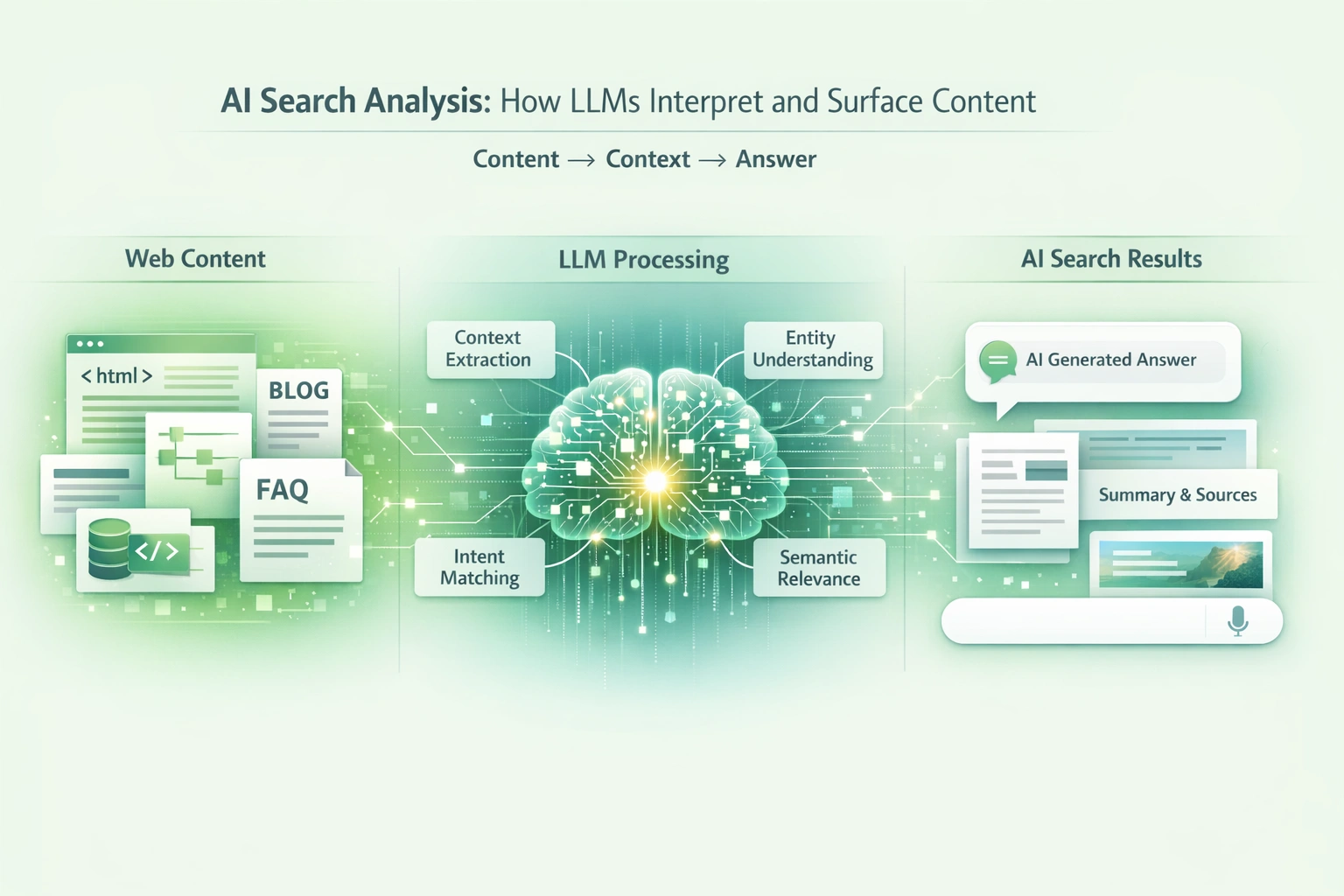
    AI Search Analysis How LLMs Interpret And Surface Content 1024x683
    Share
    Facebook Twitter LinkedIn Pinterest Email

    Introduction

    AI search systems do not retrieve content the way traditional search engines do. They interpret, abstract, and recombine information before deciding what to surface. For SEO leaders, this shift introduces a new challenge: visibility is no longer determined solely by ranking mechanics, but by how well content can be understood, trusted, and reused by large language models.

    AI search analysis is therefore not an extension of keyword research or SERP tracking. It is an examination of how LLMs ingest content, identify authority, and decide which sources are safe to synthesize into answers. Organizations that fail to understand this layer risk becoming invisible even when rankings appear stable.

    To operate effectively in AI-influenced search environments, SEO teams must understand how interpretation happens before surfacing ever begins.

    How LLM-Based Search Differs From Traditional Search

    Traditional search engines evaluate documents primarily for retrieval. AI-driven search systems evaluate them for comprehension.

    This distinction changes the role of content entirely.

    Retrieval Versus Interpretation

    Classic search ranks pages to present choices. LLM-based search attempts to resolve intent directly. Content is parsed, summarized, and abstracted before any decision about citation or attribution is made.

    Pages Are Inputs, Not Destinations

    In AI search, a page is often not the endpoint. It is a data source contributing to an answer. This means partial inclusion is common, and full-page visits are optional.

    Authority Is Evaluated Before Relevance

    If a source is not deemed trustworthy or internally consistent, relevance alone is insufficient. AI systems are risk-averse by design.

    How LLMs Ingest Content

    Understanding ingestion is critical for designing content that survives AI interpretation.

    Semantic Chunking

    LLMs break content into conceptual units rather than reading pages linearly. Headings, paragraph structure, and logical sequencing determine how meaning is segmented.

    Contextual Weighting

    Not all sections of a page are treated equally. Definitions, explanations, and constraints carry more weight than introductions or promotional language.

    Cross-Document Comparison

    AI systems evaluate consistency across multiple sources. Content that contradicts other authoritative material without justification is less likely to be surfaced.

    Why Some Content Is Invisible to AI Search

    Many sites produce content that performs adequately in traditional search but fails to appear in AI-generated answers.

    Common causes include:

    • Ambiguous or circular explanations
    • Overly marketing-driven language
    • Lack of clear conceptual boundaries
    • Inconsistent terminology across pages

    From an AI perspective, this content increases uncertainty and is therefore excluded.

    Interpretability Is the New Optimization Layer

    AI search systems favor content that can be interpreted deterministically.

    Interpretability depends on:

    • Explicit definitions of concepts
    • Clear cause-and-effect explanations
    • Logical progression without hidden assumptions

    This does not require simplification. It requires precision.

    How AI Decides What to Surface

    Surfacing is a selective process driven by confidence and coverage.

    Confidence Thresholds

    AI systems are more likely to surface content when multiple sources reinforce the same interpretation. Singular or uncorroborated perspectives are treated cautiously.

    Coverage of Intent

    Content that addresses only part of an intent may be used as supporting material, but not as a primary source. Comprehensive, bounded explanations are preferred.

    Risk Avoidance

    For sensitive or complex topics, AI systems avoid sources that overstate certainty or ignore trade-offs. Balanced explanations signal expertise.

    Entity Understanding and Topical Coherence

    LLMs reason heavily through entities and their relationships.

    Content ecosystems that clearly establish:

    • Who the organization is
    • What domains idoes t operate in
    • How concepts relate to one another

    are easier for AI systems to trust and reuse.

    Fragmented content strategies weaken this understanding, even if individual pages are well-written.

    Why Formatting Alone Is Not Enough

    There is a misconception that AI visibility can be improved primarily through formatting tricks such as lists, tables, or concise answers.

    While structure helps ingestion, it does not compensate for a weak substance. AI systems evaluate meaning before presentation.

    Well-structured ambiguity is still ambiguity.

    AI Search Analysis as an Ongoing Discipline

    Analyzing AI search visibility is not a one-time audit.

    It requires continuous evaluation of:

    • Which content is being referenced or paraphrased
    • Where interpretations diverge from the intended meaning
    • Which topics lack clear authoritative sources

    This analysis informs content refinement, consolidation, and governance decisions.

    Aligning Content Teams With AI Interpretation

    AI search analysis exposes gaps between how organizations think about their content and how it is actually understood.

    High-performing teams:

    • Design content around questions AI must answer
    • Standardize terminology and definitions
    • Reduce internal contradictions across assets

    This alignment improves both AI visibility and human comprehension.

    Measuring Success Beyond Rankings

    Traditional SEO reporting is insufficient for AI search analysis.

    More relevant signals include:

    • Inclusion in AI-generated responses
    • Consistency of interpretation across prompts
    • Brand and entity mentions without direct links

    These indicators reflect influence rather than navigation.

    Preparing for Continued Evolution

    AI search systems are still evolving. Interpretation logic, citation behavior, and surfacing rules will change.

    Organizations that focus on clarity, authority, and internal coherence will adapt more easily than those chasing specific behaviors.

    Conclusion

    AI search analysis is about understanding how meaning is extracted, evaluated, and reused.

    LLMs do not reward volume, formatting tricks, or isolated optimization. They surface content tthat  hey can confidently interpret and trust.

    SEO teams that design content for interpretability rather than retrieval will maintain visibility as search shifts from ranking pages to answering questions.

    Share. Facebook Twitter Pinterest LinkedIn Tumblr Email
    yashwant160@gmail.com
    • Website

    Related Posts

    SEO in a Zero-Click World: Designing for AI Answers and Visibility

    February 3, 2026

    Using AI for Technical SEO Analysis Without Breaking Trust

    February 3, 2026
    Leave A Reply Cancel Reply

    Don't Miss

    Personal Branding Without the Cringe: Building Professional Credibility That Actually Works

    yashwant160@gmail.comFebruary 6, 2026

    Personal branding has a reputation problem. Too often, it’s confused with self-promotion, performative posting, or…

    Career Resilience: How to Build a Job That Survives Layoffs, AI, and Market Shifts

    February 6, 2026

    From Individual Contributor to Leader: The Career Shift Most People Get Wrong

    February 6, 2026

    The Non-Linear Career: Why the Best Careers No Longer Follow a Straight Path

    February 6, 2026
    Stay In Touch
    • Facebook
    • Twitter
    • Pinterest
    • Instagram
    • YouTube
    • Vimeo

    Subscribe to Updates

    Get the latest creative news from SmartMag about art & design.

    About Us

    Results-driven digital professional with 15+ years of experience across Web Operations, Enterprise SEO, and large-scale digital platforms. I specialize in building, scaling, and optimizing complex websites where performance, search visibility, and operational reliability must work together—not in silos. My work sits at the intersection of strategy and execution, translating business goals into systems that teams can actually run.

    Facebook X (Twitter) Pinterest YouTube
    Our Picks

    Personal Branding Without the Cringe: Building Professional Credibility That Actually Works

    February 6, 2026

    Career Resilience: How to Build a Job That Survives Layoffs, AI, and Market Shifts

    February 6, 2026

    From Individual Contributor to Leader: The Career Shift Most People Get Wrong

    February 6, 2026
    Most Popular

    Top 15 popular link building methods you should consider before it’s too late

    March 24, 20180 Views

    Quality Score Demystified: What Actually Improves SEM Performance

    January 31, 20260 Views

    How SEO, SEM, Email, and Paid Social Should Work Together

    February 2, 20260 Views
    © 2026 All rights reserved. Y. K. Thakur.
    • Home
    • Technical SEO
    • World
    • Lifestyle
    • Buy Now

    Type above and press Enter to search. Press Esc to cancel.