
Close Menu
blog.ykthakur.com

    Subscribe to Updates

    Get the latest creative news from FooBar about art, design and business.

    What's Hot

    Personal Branding Without the Cringe: Building Professional Credibility That Actually Works

    February 6, 2026

    Career Resilience: How to Build a Job That Survives Layoffs, AI, and Market Shifts

    February 6, 2026

    From Individual Contributor to Leader: The Career Shift Most People Get Wrong

    February 6, 2026
    Facebook X (Twitter) Instagram
    blog.ykthakur.com
    • Home
    • About Me
    • Case Studies
    • Services
    • Contact Us
    Facebook X (Twitter) Instagram
    Subscribe
    • Blog
    • Search & Growth
      1. SEO
      2. Technical SEO
      3. SEM
      4. Paid Advertisements
      5. View All

      Why SEO Fails Even With the Right Tools and Data

      January 31, 2026

      How to Refresh Old Content Without Losing Rankings

      January 31, 2026

      How to Build a Topic Authority Map for SEO

      January 31, 2026

      E-E-A-T Signals Explained: What Actually Influences Trust and Rankings

      January 31, 2026

      XML Sitemaps at Scale: Signaling Priority, Not Forcing Indexation

      February 3, 2026

      Robots.txt at Scale: Control, Risk, and the Limits of Crawl Directives

      February 3, 2026

      Monitoring, Alerting, and SEO Observability: Seeing Failures Before Traffic Drops

      February 3, 2026

      Migrations, Releases, and SEO Risk: How Technical Changes Break Search at Scale

      February 3, 2026

      Scaling SEM Without Burning Budget

      January 31, 2026

      SEM vs SEO: How Paid Search Should Support Organic Growth

      January 31, 2026

      Quality Score Demystified: What Actually Improves SEM Performance

      January 31, 2026

      Brand vs Non-Brand Search: Budget Allocation Reality

      January 31, 2026

      Personal Branding Without the Cringe: Building Professional Credibility That Actually Works

      February 6, 2026

      Career Resilience: How to Build a Job That Survives Layoffs, AI, and Market Shifts

      February 6, 2026

      From Individual Contributor to Leader: The Career Shift Most People Get Wrong

      February 6, 2026

      The Non-Linear Career: Why the Best Careers No Longer Follow a Straight Path

      February 6, 2026
    • Performance & Infrastructure
      1. Website Performance
      2. Core Web Vitals
      3. Hosting Architecture
      4. Web Application Infrastructure
      5. Load Balancing
      6. View All

      Performance Drift: How Sites Get Slower Without Any One Bad Change

      February 3, 2026

      Why passing scores still hide systemic performance risk

      February 3, 2026

      Performance Monitoring Beyond Core Web Vitals

      February 3, 2026

      Personal Branding Without the Cringe: Building Professional Credibility That Actually Works

      February 6, 2026

      Career Resilience: How to Build a Job That Survives Layoffs, AI, and Market Shifts

      February 6, 2026

      From Individual Contributor to Leader: The Career Shift Most People Get Wrong

      February 6, 2026

      The Non-Linear Career: Why the Best Careers No Longer Follow a Straight Path

      February 6, 2026
    • AI & Automation
      1. AI Content Systems
      2. AI in SEO & Marketing
      3. AI Search Analysis
      4. AI-Driven SEO Workflows
      5. Generative AI Strategy
      6. View All

      AI Content Systems: How to Scale Without Losing Quality or Trust

      February 3, 2026

      AI in Marketing Is a System, Not a Toolset

      February 3, 2026

      SEO in a Zero-Click World: Designing for AI Answers and Visibility

      February 3, 2026

      AI Search Analysis: How LLMs Interpret and Surface Content

      February 3, 2026

      Using AI for Technical SEO Analysis Without Breaking Trust

      February 3, 2026

      AI-Driven SEO Workflows: What to Automate and What Not To

      February 3, 2026

      SEO in a Zero-Click World: Designing for AI Answers and Visibility

      February 3, 2026

      AI Search Analysis: How LLMs Interpret and Surface Content

      February 3, 2026

      Using AI for Technical SEO Analysis Without Breaking Trust

      February 3, 2026

      AI-Driven SEO Workflows: What to Automate and What Not To

      February 3, 2026

      Why Most AI SEO Implementations Fail

      February 3, 2026

      Human-in-the-Loop SEO: Where AI Stops and Judgment Starts

      February 3, 2026

      Personal Branding Without the Cringe: Building Professional Credibility That Actually Works

      February 6, 2026

      Career Resilience: How to Build a Job That Survives Layoffs, AI, and Market Shifts

      February 6, 2026

      From Individual Contributor to Leader: The Career Shift Most People Get Wrong

      February 6, 2026

      The Non-Linear Career: Why the Best Careers No Longer Follow a Straight Path

      February 6, 2026
    • Analytics & Intelligence
      1. GA4 Architecture
      2. Adobe Analytics
      3. View All

      GA4 vs Adobe Analytics: Choosing the Right Tool for Your Organization

      February 2, 2026

      Consent, Privacy, and Measurement: What Changes After GDPR & GA4

      February 2, 2026

      GA4 Architecture Explained: Designing Events for Real Decisions

      February 2, 2026

      GA4 vs Adobe Analytics: Choosing the Right Tool for Your Organization

      February 2, 2026

      Personal Branding Without the Cringe: Building Professional Credibility That Actually Works

      February 6, 2026

      Career Resilience: How to Build a Job That Survives Layoffs, AI, and Market Shifts

      February 6, 2026

      From Individual Contributor to Leader: The Career Shift Most People Get Wrong

      February 6, 2026

      The Non-Linear Career: Why the Best Careers No Longer Follow a Straight Path

      February 6, 2026
    • WebOps & DevOps
      1. Web Operations
      2. WebOps Roles
      3. Website Migrations & Scaling
      4. Release Management
      5. Monitoring & Alerts
      6. Performance Monitoring
      7. Deployment Automation
      8. View All

      SEO and WebOps Monitoring: Aligning Health Signals Across Systems

      February 3, 2026

      Designing Alerts for WebOps: Signal, Severity, and Actionability

      February 3, 2026

      Why Most Website Monitoring Is Too Late to Be Useful

      February 3, 2026

      Release Cadence Versus Stability: Finding the Sustainable Balance

      February 3, 2026

      Website Migrations at Scale: Why Most Fail Before the First Redirect

      February 3, 2026

      Post-Migration Reality: Why SEO and Performance Losses Persist for Months

      February 3, 2026

      Scaling Websites Without Replatforming: When Migration Is the Wrong Answer

      February 3, 2026

      Release Cadence Versus Stability: Finding the Sustainable Balance

      February 3, 2026

      Why Website Releases Break SEO Even When Nothing “Major” Changes

      February 3, 2026

      Release Management for Websites: Coordinating Risk Across Teams

      February 3, 2026

      Release Pipelines and Search Risk: Why Velocity Without Guardrails Breaks Websites

      February 3, 2026

      SEO and WebOps Monitoring: Aligning Health Signals Across Systems

      February 3, 2026

      Designing Alerts for WebOps: Signal, Severity, and Actionability

      February 3, 2026

      Why Most Website Monitoring Is Too Late to Be Useful

      February 3, 2026

      Feature Flags, Experiments, and the SEO Blast Radius

      February 3, 2026

      Performance Drift: How Sites Get Slower Without Any One Bad Change

      February 3, 2026

      Performance Monitoring Beyond Core Web Vitals

      February 3, 2026

      Designing SEO-Safe Deployment Automation

      February 3, 2026

      Deployment Automation for Websites: What to Automate and What Not To

      February 3, 2026

      Personal Branding Without the Cringe: Building Professional Credibility That Actually Works

      February 6, 2026

      Career Resilience: How to Build a Job That Survives Layoffs, AI, and Market Shifts

      February 6, 2026

      From Individual Contributor to Leader: The Career Shift Most People Get Wrong

      February 6, 2026

      The Non-Linear Career: Why the Best Careers No Longer Follow a Straight Path

      February 6, 2026
    • Project Strategy

      Personal Branding Without the Cringe: Building Professional Credibility That Actually Works

      February 6, 2026

      Career Resilience: How to Build a Job That Survives Layoffs, AI, and Market Shifts

      February 6, 2026

      From Individual Contributor to Leader: The Career Shift Most People Get Wrong

      February 6, 2026

      The Non-Linear Career: Why the Best Careers No Longer Follow a Straight Path

      February 6, 2026

      How to Stay Relevant When Roles Are Changing Faster Than Job Descriptions

      February 6, 2026
    • Web Engineering
      1. Web Development
      2. Web Designing & UX
      3. CMS & Platforms
      4. Web Application Firewall
      5. View All

      Personal Branding Without the Cringe: Building Professional Credibility That Actually Works

      February 6, 2026

      Career Resilience: How to Build a Job That Survives Layoffs, AI, and Market Shifts

      February 6, 2026

      From Individual Contributor to Leader: The Career Shift Most People Get Wrong

      February 6, 2026

      The Non-Linear Career: Why the Best Careers No Longer Follow a Straight Path

      February 6, 2026
    blog.ykthakur.com
    Home»Web Operations»Monitoring & Alerts»SEO and WebOps Monitoring: Aligning Health Signals Across Systems
    Monitoring & Alerts

    SEO and WebOps Monitoring: Aligning Health Signals Across Systems

    Connecting crawl, indexation, and infrastructure metrics
    yashwant160@gmail.comBy yashwant160@gmail.comFebruary 3, 2026Updated:February 27, 2026No Comments5 Mins Read
    Share Facebook Twitter Pinterest LinkedIn Tumblr Email
    Follow Us
    Google News Flipboard Threads
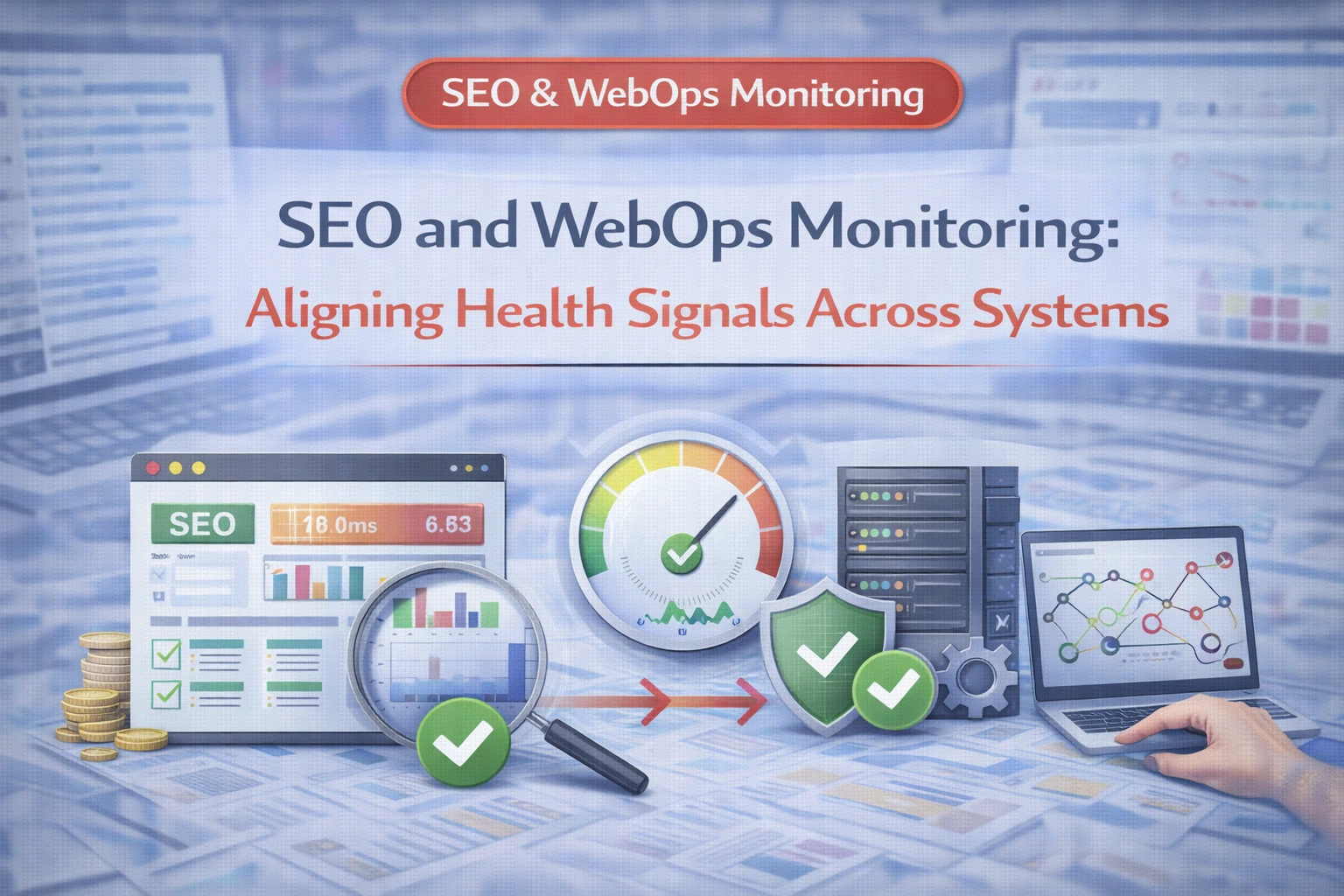
    SEO And WebOps Monitoring Aligning Health Signals Across Systems 1024x683
    Share
    Facebook Twitter LinkedIn Pinterest Email

    Introduction

    SEO and WebOps teams often monitor the same website through entirely different lenses. WebOps focuses on availability, latency, and error rates. SEO focuses on crawl behavior, indexation, and visibility. Each set of signals is valid on its own, yet problems persist because these views are rarely aligned.

    When monitoring systems are siloed, issues surface late and are difficult to diagnose. WebOps sees green dashboards while SEO observes gradual degradation. SEO flags volatility without clear operational triggers. Neither perspective alone captures how search engines experience the system over time.

    This article examines why SEO and WebOps monitoring frequently diverge, why that divergence creates blind spots, and how aligning health signals across systems enables earlier detection and faster resolution of issues.

    Why Monitoring Becomes Fragmented

    Monitoring fragmentation is usually organizational, not technical.

    SEO and WebOps teams:

    • Use different tools
    • Report to different stakeholders
    • Optimize for different outcomes

    As a result, signals that should reinforce each other are interpreted in isolation.

    What WebOps Typically Monitors

    WebOps monitoring emphasizes operational health.

    Common signals include:

    • Uptime and availability
    • Response times and latency
    • Error rates and infrastructure capacity

    These metrics are necessary but incomplete. They describe whether the site is reachable, not whether it is interpretable or trustworthy to search engines.

    What SEO Typically Monitors

    SEO monitoring focuses on how search engines interact with the site.

    Common signals include:

    • Crawl volume and distribution
    • Indexation coverage and volatility
    • Ranking and impression trends

    These metrics reveal outcomes but often lack direct linkage to operational causes.

    The Gap Between Operational Health and Search Health

    A site can be operationally healthy and search-unhealthy at the same time.

    Examples include:

    • Pages are returning 200 responses, but rendering inconsistently
    • Stable latency averages masking high variance
    • No errors logged while crawlers reduce activity

    Search engines respond to consistency and predictability, not just availability.

    Why SEO Issues Rarely Trigger WebOps Alerts

    SEO degradation often begins as deviation, not failure.

    Early signals include:

    • Shifts in crawl allocation
    • Selective deindexation
    • Template-level performance drift

    These changes rarely cross operational thresholds, so WebOps dashboards remain green.

    Why WebOps Issues Are Often Invisible to SEO

    Conversely, some operational issues do not surface immediately in SEO metrics.

    Short-lived incidents, regional instability, or crawler-specific throttling may:

    • Resolve before rankings change
    • Affect only subsets of pages
    • Be diluted in aggregate SEO reports

    By the time SEO impact is measurable, context is lost.

    Search Engines as Long-Running Monitors

    Search engines effectively act as continuous external monitors.

    They observe:

    • How oftendo  pages change
    • How reliably does content renders
    • How performance behaves over time

    SEO signals reflect this long-term observation, making them valuable early-warning indicators when interpreted correctly.

    Aligning Monitoring Around Shared Questions

    Alignment begins with shared questions rather than shared tools.

    Examples include:

    • Has system behavior deviated from normal?
    • Which templates or sections are affected?
    • Did a recent change alter the crawler experience?

    Both SEO and WebOps can contribute signals to answer these questions.

    Mapping SEO Signals to Operational Causes

    Effective alignment requires mapping relationships.

    For example:

    • Crawl drops are mapped to response time variance
    • Indexation volatility mapped to rendering changes
    • Ranking instability mapped to internal linking shifts

    This mapping turns SEO metrics from symptoms into diagnostics.

    Template-Level Monitoring as a Bridge

    Templates are a shared abstraction.

    Monitoring by template allows:

    • WebOps to see where issues originate
    • SEO to understand the scope and impact
    • Both teams to discuss problems concretely

    Template-level views reduce ambiguity.

    Why Aggregates Undermine Alignment

    Site-wide averages hide divergence.

    SEO and WebOps alignment improve when monitoring:

    • Segments by page type
    • Tracks variance, not just means
    • Preserves historical baselines

    Search engines react to outliers, not averages.

    Correlating Monitoring With Change

    Alignment improves when monitoring is explicitly tied to change.

    This includes:

    • Annotating releases and configuration updates
    • Comparing pre- and post-change behavior
    • Reviewing SEO and WebOps signals together

    Correlation replaces speculation.

    Shared Incident Reviews

    Post-incident reviews often remain siloed.

    Shared reviews:

    • Expose blind spots in monitoring
    • Clarify how issues were detected
    • Improve future signal design

    This strengthens both monitoring systems over time.

    Why Alignment Reduces Alert Fatigue

    Aligned monitoring produces fewer, higher-quality alerts.

    When SEO and WebOps signals reinforce each other:

    • Confidence in alerts increases
    • False positives decrease
    • Response becomes more decisive

    Noise is reduced by context, not by suppression.

    Organizational Implications of Aligned Monitoring

    Alignment requires cooperation beyond dashboards.

    Organizations must:

    • Recognize SEO as a system health signal
    • Give WebOps visibility into search behavior
    • Create shared accountability for outcomes

    Without this, monitoring remains fragmented.

    Monitoring as a Shared Language

    Aligned monitoring creates a common vocabulary.

    Instead of debating whether an issue is “SEO” or “infrastructure,” teams discuss:

    • Deviation from expected behavior
    • Scope and severity
    • Corrective action

    This reframing accelerates resolution.

    Conclusion

    SEO and WebOps monitoring fail when they operate in parallel without connection.

    Search engines experience websites as integrated systems, not as departmental outputs. Monitoring must reflect that reality. Organizations that align SEO and WebOps health signals detect issues earlier, diagnose them faster, and reduce long-term risk.

    At enterprise scale, effective monitoring is not about having more dashboards. It is about ensuring that the right signals reinforce each other before small deviations become structural problems.

    Share. Facebook Twitter Pinterest LinkedIn Tumblr Email
    yashwant160@gmail.com
    • Website

    Related Posts

    Designing Alerts for WebOps: Signal, Severity, and Actionability

    February 3, 2026

    Why Most Website Monitoring Is Too Late to Be Useful

    February 3, 2026

    Feature Flags, Experiments, and the SEO Blast Radius

    February 3, 2026
    Leave A Reply Cancel Reply

    Don't Miss

    Personal Branding Without the Cringe: Building Professional Credibility That Actually Works

    yashwant160@gmail.comFebruary 6, 2026

    Personal branding has a reputation problem. Too often, it’s confused with self-promotion, performative posting, or…

    Career Resilience: How to Build a Job That Survives Layoffs, AI, and Market Shifts

    February 6, 2026

    From Individual Contributor to Leader: The Career Shift Most People Get Wrong

    February 6, 2026

    The Non-Linear Career: Why the Best Careers No Longer Follow a Straight Path

    February 6, 2026
    Stay In Touch
    • Facebook
    • Twitter
    • Pinterest
    • Instagram
    • YouTube
    • Vimeo

    Subscribe to Updates

    Get the latest creative news from SmartMag about art & design.

    About Us

    Results-driven digital professional with 15+ years of experience across Web Operations, Enterprise SEO, and large-scale digital platforms. I specialize in building, scaling, and optimizing complex websites where performance, search visibility, and operational reliability must work together—not in silos. My work sits at the intersection of strategy and execution, translating business goals into systems that teams can actually run.

    Facebook X (Twitter) Pinterest YouTube
    Our Picks

    Personal Branding Without the Cringe: Building Professional Credibility That Actually Works

    February 6, 2026

    Career Resilience: How to Build a Job That Survives Layoffs, AI, and Market Shifts

    February 6, 2026

    From Individual Contributor to Leader: The Career Shift Most People Get Wrong

    February 6, 2026
    Most Popular

    Top 15 popular link building methods you should consider before it’s too late

    March 24, 20180 Views

    Quality Score Demystified: What Actually Improves SEM Performance

    January 31, 20260 Views

    How SEO, SEM, Email, and Paid Social Should Work Together

    February 2, 20260 Views
    © 2026 All rights reserved. Y. K. Thakur.
    • Home
    • Technical SEO
    • World
    • Lifestyle
    • Buy Now

    Type above and press Enter to search. Press Esc to cancel.