
Close Menu
blog.ykthakur.com

    Subscribe to Updates

    Get the latest creative news from FooBar about art, design and business.

    What's Hot

    Personal Branding Without the Cringe: Building Professional Credibility That Actually Works

    February 6, 2026

    Career Resilience: How to Build a Job That Survives Layoffs, AI, and Market Shifts

    February 6, 2026

    From Individual Contributor to Leader: The Career Shift Most People Get Wrong

    February 6, 2026
    Facebook X (Twitter) Instagram
    blog.ykthakur.com
    • Home
    • About Me
    • Case Studies
    • Services
    • Contact Us
    Facebook X (Twitter) Instagram
    Subscribe
    • Blog
    • Search & Growth
      1. SEO
      2. Technical SEO
      3. SEM
      4. Paid Advertisements
      5. View All

      Why SEO Fails Even With the Right Tools and Data

      January 31, 2026

      How to Refresh Old Content Without Losing Rankings

      January 31, 2026

      How to Build a Topic Authority Map for SEO

      January 31, 2026

      E-E-A-T Signals Explained: What Actually Influences Trust and Rankings

      January 31, 2026

      XML Sitemaps at Scale: Signaling Priority, Not Forcing Indexation

      February 3, 2026

      Robots.txt at Scale: Control, Risk, and the Limits of Crawl Directives

      February 3, 2026

      Monitoring, Alerting, and SEO Observability: Seeing Failures Before Traffic Drops

      February 3, 2026

      Migrations, Releases, and SEO Risk: How Technical Changes Break Search at Scale

      February 3, 2026

      Scaling SEM Without Burning Budget

      January 31, 2026

      SEM vs SEO: How Paid Search Should Support Organic Growth

      January 31, 2026

      Quality Score Demystified: What Actually Improves SEM Performance

      January 31, 2026

      Brand vs Non-Brand Search: Budget Allocation Reality

      January 31, 2026

      Personal Branding Without the Cringe: Building Professional Credibility That Actually Works

      February 6, 2026

      Career Resilience: How to Build a Job That Survives Layoffs, AI, and Market Shifts

      February 6, 2026

      From Individual Contributor to Leader: The Career Shift Most People Get Wrong

      February 6, 2026

      The Non-Linear Career: Why the Best Careers No Longer Follow a Straight Path

      February 6, 2026
    • Performance & Infrastructure
      1. Website Performance
      2. Core Web Vitals
      3. Hosting Architecture
      4. Web Application Infrastructure
      5. Load Balancing
      6. View All

      Performance Drift: How Sites Get Slower Without Any One Bad Change

      February 3, 2026

      Why passing scores still hide systemic performance risk

      February 3, 2026

      Performance Monitoring Beyond Core Web Vitals

      February 3, 2026

      Personal Branding Without the Cringe: Building Professional Credibility That Actually Works

      February 6, 2026

      Career Resilience: How to Build a Job That Survives Layoffs, AI, and Market Shifts

      February 6, 2026

      From Individual Contributor to Leader: The Career Shift Most People Get Wrong

      February 6, 2026

      The Non-Linear Career: Why the Best Careers No Longer Follow a Straight Path

      February 6, 2026
    • AI & Automation
      1. AI Content Systems
      2. AI in SEO & Marketing
      3. AI Search Analysis
      4. AI-Driven SEO Workflows
      5. Generative AI Strategy
      6. View All

      AI Content Systems: How to Scale Without Losing Quality or Trust

      February 3, 2026

      AI in Marketing Is a System, Not a Toolset

      February 3, 2026

      SEO in a Zero-Click World: Designing for AI Answers and Visibility

      February 3, 2026

      AI Search Analysis: How LLMs Interpret and Surface Content

      February 3, 2026

      Using AI for Technical SEO Analysis Without Breaking Trust

      February 3, 2026

      AI-Driven SEO Workflows: What to Automate and What Not To

      February 3, 2026

      SEO in a Zero-Click World: Designing for AI Answers and Visibility

      February 3, 2026

      AI Search Analysis: How LLMs Interpret and Surface Content

      February 3, 2026

      Using AI for Technical SEO Analysis Without Breaking Trust

      February 3, 2026

      AI-Driven SEO Workflows: What to Automate and What Not To

      February 3, 2026

      Why Most AI SEO Implementations Fail

      February 3, 2026

      Human-in-the-Loop SEO: Where AI Stops and Judgment Starts

      February 3, 2026

      Personal Branding Without the Cringe: Building Professional Credibility That Actually Works

      February 6, 2026

      Career Resilience: How to Build a Job That Survives Layoffs, AI, and Market Shifts

      February 6, 2026

      From Individual Contributor to Leader: The Career Shift Most People Get Wrong

      February 6, 2026

      The Non-Linear Career: Why the Best Careers No Longer Follow a Straight Path

      February 6, 2026
    • Analytics & Intelligence
      1. GA4 Architecture
      2. Adobe Analytics
      3. View All

      GA4 vs Adobe Analytics: Choosing the Right Tool for Your Organization

      February 2, 2026

      Consent, Privacy, and Measurement: What Changes After GDPR & GA4

      February 2, 2026

      GA4 Architecture Explained: Designing Events for Real Decisions

      February 2, 2026

      GA4 vs Adobe Analytics: Choosing the Right Tool for Your Organization

      February 2, 2026

      Personal Branding Without the Cringe: Building Professional Credibility That Actually Works

      February 6, 2026

      Career Resilience: How to Build a Job That Survives Layoffs, AI, and Market Shifts

      February 6, 2026

      From Individual Contributor to Leader: The Career Shift Most People Get Wrong

      February 6, 2026

      The Non-Linear Career: Why the Best Careers No Longer Follow a Straight Path

      February 6, 2026
    • WebOps & DevOps
      1. Web Operations
      2. WebOps Roles
      3. Website Migrations & Scaling
      4. Release Management
      5. Monitoring & Alerts
      6. Performance Monitoring
      7. Deployment Automation
      8. View All

      SEO and WebOps Monitoring: Aligning Health Signals Across Systems

      February 3, 2026

      Designing Alerts for WebOps: Signal, Severity, and Actionability

      February 3, 2026

      Why Most Website Monitoring Is Too Late to Be Useful

      February 3, 2026

      Release Cadence Versus Stability: Finding the Sustainable Balance

      February 3, 2026

      Website Migrations at Scale: Why Most Fail Before the First Redirect

      February 3, 2026

      Post-Migration Reality: Why SEO and Performance Losses Persist for Months

      February 3, 2026

      Scaling Websites Without Replatforming: When Migration Is the Wrong Answer

      February 3, 2026

      Release Cadence Versus Stability: Finding the Sustainable Balance

      February 3, 2026

      Why Website Releases Break SEO Even When Nothing “Major” Changes

      February 3, 2026

      Release Management for Websites: Coordinating Risk Across Teams

      February 3, 2026

      Release Pipelines and Search Risk: Why Velocity Without Guardrails Breaks Websites

      February 3, 2026

      SEO and WebOps Monitoring: Aligning Health Signals Across Systems

      February 3, 2026

      Designing Alerts for WebOps: Signal, Severity, and Actionability

      February 3, 2026

      Why Most Website Monitoring Is Too Late to Be Useful

      February 3, 2026

      Feature Flags, Experiments, and the SEO Blast Radius

      February 3, 2026

      Performance Drift: How Sites Get Slower Without Any One Bad Change

      February 3, 2026

      Performance Monitoring Beyond Core Web Vitals

      February 3, 2026

      Designing SEO-Safe Deployment Automation

      February 3, 2026

      Deployment Automation for Websites: What to Automate and What Not To

      February 3, 2026

      Personal Branding Without the Cringe: Building Professional Credibility That Actually Works

      February 6, 2026

      Career Resilience: How to Build a Job That Survives Layoffs, AI, and Market Shifts

      February 6, 2026

      From Individual Contributor to Leader: The Career Shift Most People Get Wrong

      February 6, 2026

      The Non-Linear Career: Why the Best Careers No Longer Follow a Straight Path

      February 6, 2026
    • Project Strategy

      Personal Branding Without the Cringe: Building Professional Credibility That Actually Works

      February 6, 2026

      Career Resilience: How to Build a Job That Survives Layoffs, AI, and Market Shifts

      February 6, 2026

      From Individual Contributor to Leader: The Career Shift Most People Get Wrong

      February 6, 2026

      The Non-Linear Career: Why the Best Careers No Longer Follow a Straight Path

      February 6, 2026

      How to Stay Relevant When Roles Are Changing Faster Than Job Descriptions

      February 6, 2026
    • Web Engineering
      1. Web Development
      2. Web Designing & UX
      3. CMS & Platforms
      4. Web Application Firewall
      5. View All

      Personal Branding Without the Cringe: Building Professional Credibility That Actually Works

      February 6, 2026

      Career Resilience: How to Build a Job That Survives Layoffs, AI, and Market Shifts

      February 6, 2026

      From Individual Contributor to Leader: The Career Shift Most People Get Wrong

      February 6, 2026

      The Non-Linear Career: Why the Best Careers No Longer Follow a Straight Path

      February 6, 2026
    blog.ykthakur.com
    Home»Website Performance»Performance Monitoring»Performance Monitoring Beyond Core Web Vitals
    Performance Monitoring

    Performance Monitoring Beyond Core Web Vitals

    Why passing scores still hide systemic performance risk
    yashwant160@gmail.comBy yashwant160@gmail.comFebruary 3, 2026Updated:February 26, 2026No Comments4 Mins Read
    Share Facebook Twitter Pinterest LinkedIn Tumblr Email
    Follow Us
    Google News Flipboard Threads
    Performance Monitoring Beyond Core Web Vitals 1024x683
    Share
    Facebook Twitter LinkedIn Pinterest Email

    Introduction

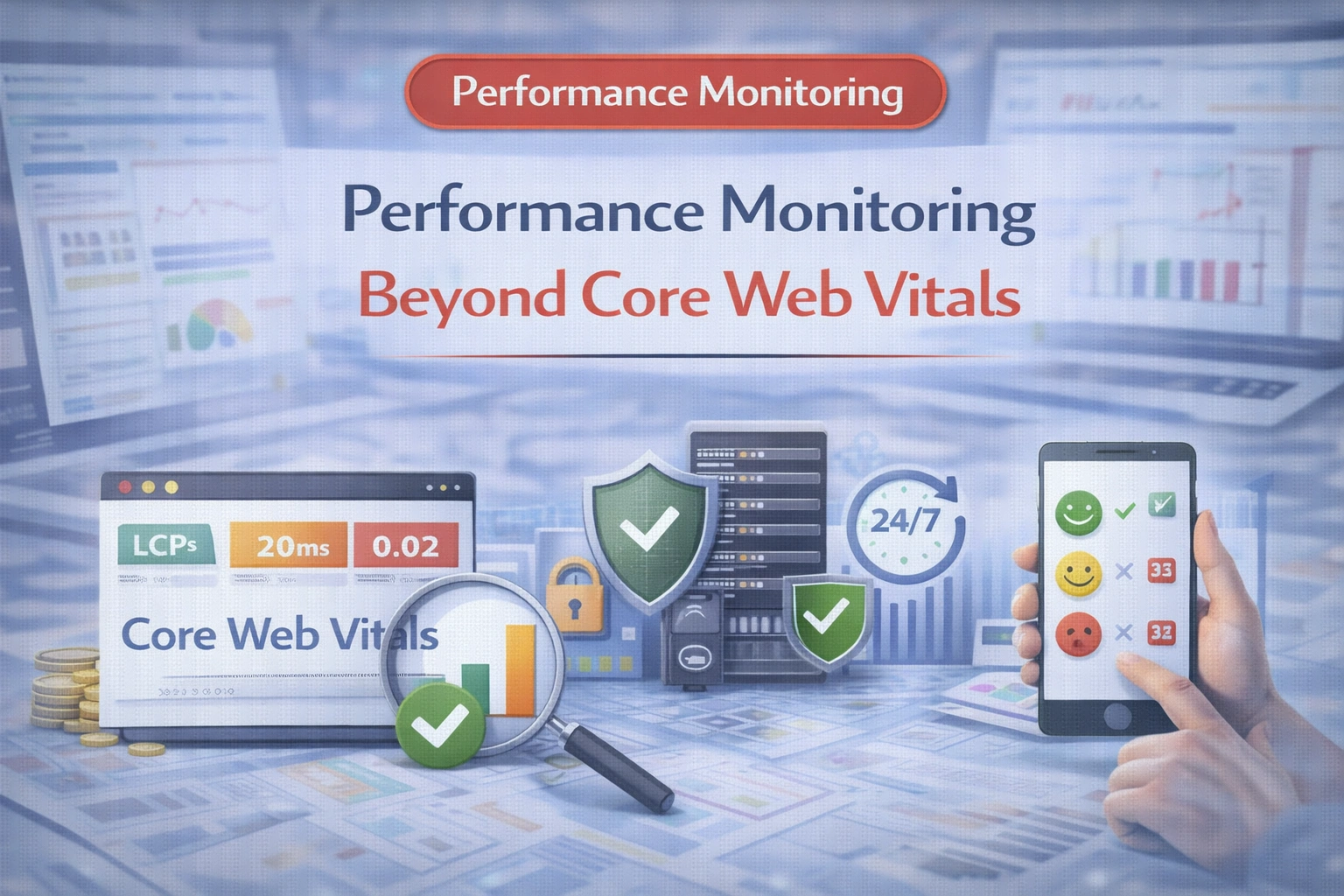
    Core Web Vitals brought long-overdue attention to performance as a measurable, user-facing concern. For many organizations, passing these metrics became synonymous with being “fast enough.” Dashboards turned green, reports improved, and performance was considered addressed.

    At enterprise scale, this interpretation is incomplete. Core Web Vitals are outcome indicators, not system diagnostics. They describe what users experienced in aggregate, not why the system behaves the way it does, nor how that behavior will change under future load, releases, or architectural shifts.

    This article explains why performance monitoring must extend beyond Core Web Vitals, how reliance on surface metrics creates blind spots, and what it means to monitor performance as a system property rather than a score.

    Why Core Web Vitals Became the Ceiling Instead of the Floor

    Core Web Vitals are attractive because they are standardized and externally validated.

    They offer:

    • Clear thresholds
    • Direct user experience relevance
    • Search visibility implications

    The problem arises when these metrics are treated as comprehensive. Passing thresholds becomes the goal, rather than understanding performance behavior.

    Outcome Metrics Versus Control Metrics

    Performance metrics fall into two categories.

    Outcome metrics describe results:

    • LCP, CLS, and INP distributions
    • Field data aggregates
    • Percentiles over time

    Control metrics describe causes:

    • Resource timing and dependency chains
    • JavaScript execution cost
    • Cache effectiveness and variance

    Core Web Vitals are outcomes. They do not provide control.

    Why Passing Scores Can Mask Structural Risk

    A site can pass Core Web Vitals while becoming increasingly fragile.

    Common scenarios include:

    • Performance buffers are shrinking release by release
    • Rising variance hidden by acceptable medians
    • Critical paths are becoming longer but still under thresholds

    When buffers disappear, small changes cause disproportionate regressions.

    The Problem With Aggregate Performance Reporting

    Most performance dashboards aggregate data at the site level.

    This hides:

    • Template-specific regressions
    • Regional or device-specific issues
    • Crawler experience divergence

    Search engines and users do not experience the site as average. They experience individual pages repeatedly.

    Performance Variance Matters More Than Absolute Speed

    Consistency is a stronger signal than peak performance.

    High variance indicates:

    • Unstable rendering paths
    • Conditional logic that behaves unpredictably
    • Infrastructure unevenness across regions

    Variance erodes trust even when average metrics look healthy.

    Why Crawlers Experience Performance Differently

    Search crawlers are not typical users.

    They:

    • Request pages at scale
    • Encounter cold caches more frequently
    • Interact with server-side limits differently

    Performance monitoring that ignores crawler behavior misses search-specific degradation.

    Template-Level Performance Monitoring

    Templates are the unit of scale.

    Monitoring by template allows teams to:

    • Identify which page types are degrading
    • Correlate changes to shared components
    • Prioritize fixes by impact and scope

    Template-level insight is far more actionable than page-level anecdotes.

    Critical Rendering Paths Change Over Time

    Rendering paths are rarely static.

    They evolve as:

    • Third-party scripts are added
    • Personalization logic increases
    • Client-side frameworks expand

    Monitoring must detect when the critical path lengthens, not just when it fails.

    Why Performance Regressions Are Often Delayed

    Performance issues frequently emerge after release.

    Reasons include:

    • Traffic scaling beyond test conditions
    • Gradual cache fragmentation
    • Cumulative JavaScript cost

    Monitoring that focuses only on immediate post-release data misses these trends.

    Performance Budgets as Monitoring Inputs

    Performance budgets are often discussed as build-time constraints.

    They are more powerful as monitoring signals.

    Tracking budget consumption over time reveals:

    • Which teams or components consume capacity
    • How close the system is to failure thresholds
    • Whether optimization gains are preserved

    Budgets make performance drift visible.

    Why “Green” Dashboards Create Complacency

    Green dashboards communicate success.

    They rarely communicate risk.

    When performance monitoring is reduced to pass/fail indicators, teams lose awareness of how close the system is to regression. Optimization stops once thresholds are met.

    Performance as a Long-Term Trust Signal

    Search engines evaluate performance longitudinally.

    They respond to:

    • Consistency across time
    • Predictability under load
    • Absence of frequent regressions

    Short-term improvements do not compensate for long-term instability.

    Integrating Performance Monitoring With Release Management

    Performance monitoring is most effective when tied to change.

    This requires:

    • Baseline comparisons before and after releases
    • Clear ownership for regressions
    • Defined rollback or remediation paths

    Without this integration, monitoring informs but does not influence outcomes.

    Why Performance Is a WebOps Responsibility

    Performance is often treated as a front-end concern.

    In reality, it reflects:

    • Infrastructure decisions
    • Caching strategy
    • Release discipline

    WebOps governance determines whether performance improvements persist.

    Designing Performance Monitoring for Scale

    At scale, performance monitoring must:

    • Preserve historical baselines
    • Segment by meaningful system units
    • Detect drift, not just failure

    This shifts monitoring from validation to prevention.

    Conclusion

    Core Web Vitals are necessary, but they are not sufficient.

    Organizations that stop at passing scores gain short-term reassurance but lose long-term control. Performance monitoring must reveal how the system behaves, how close it is to degradation, and how change alters that behavior over time.

    At enterprise scale, performance is not a metric to pass. It is a system property to manage continuously.

    Share. Facebook Twitter Pinterest LinkedIn Tumblr Email
    yashwant160@gmail.com
    • Website

    Related Posts

    Performance Drift: How Sites Get Slower Without Any One Bad Change

    February 3, 2026
    Leave A Reply Cancel Reply

    Don't Miss

    Personal Branding Without the Cringe: Building Professional Credibility That Actually Works

    yashwant160@gmail.comFebruary 6, 2026

    Personal branding has a reputation problem. Too often, it’s confused with self-promotion, performative posting, or…

    Career Resilience: How to Build a Job That Survives Layoffs, AI, and Market Shifts

    February 6, 2026

    From Individual Contributor to Leader: The Career Shift Most People Get Wrong

    February 6, 2026

    The Non-Linear Career: Why the Best Careers No Longer Follow a Straight Path

    February 6, 2026
    Stay In Touch
    • Facebook
    • Twitter
    • Pinterest
    • Instagram
    • YouTube
    • Vimeo

    Subscribe to Updates

    Get the latest creative news from SmartMag about art & design.

    About Us

    Results-driven digital professional with 15+ years of experience across Web Operations, Enterprise SEO, and large-scale digital platforms. I specialize in building, scaling, and optimizing complex websites where performance, search visibility, and operational reliability must work together—not in silos. My work sits at the intersection of strategy and execution, translating business goals into systems that teams can actually run.

    Facebook X (Twitter) Pinterest YouTube
    Our Picks

    Personal Branding Without the Cringe: Building Professional Credibility That Actually Works

    February 6, 2026

    Career Resilience: How to Build a Job That Survives Layoffs, AI, and Market Shifts

    February 6, 2026

    From Individual Contributor to Leader: The Career Shift Most People Get Wrong

    February 6, 2026
    Most Popular

    Top 15 popular link building methods you should consider before it’s too late

    March 24, 20180 Views

    Quality Score Demystified: What Actually Improves SEM Performance

    January 31, 20260 Views

    How SEO, SEM, Email, and Paid Social Should Work Together

    February 2, 20260 Views
    © 2026 All rights reserved. Y. K. Thakur.
    • Home
    • Technical SEO
    • World
    • Lifestyle
    • Buy Now

    Type above and press Enter to search. Press Esc to cancel.