
The Myth of the Career Ladder
The traditional career ladder promised stability: start at the bottom, move up step by step, and retire at the top.
This model worked when organizations were stable, roles were long-lived, and industries changed slowly.
Today, that ladder is fragile. Companies restructure, roles disappear, and entire functions are redefined. Following a single vertical path now carries more risk—not less.
Why Careers Became Non-Linear
Several forces have reshaped careers into non-linear paths:
- Rapid technological change and automation
- Remote and global work opportunities
- The rise of freelance, consulting, and portfolio careers
- Shorter company lifespans and frequent reorganizations
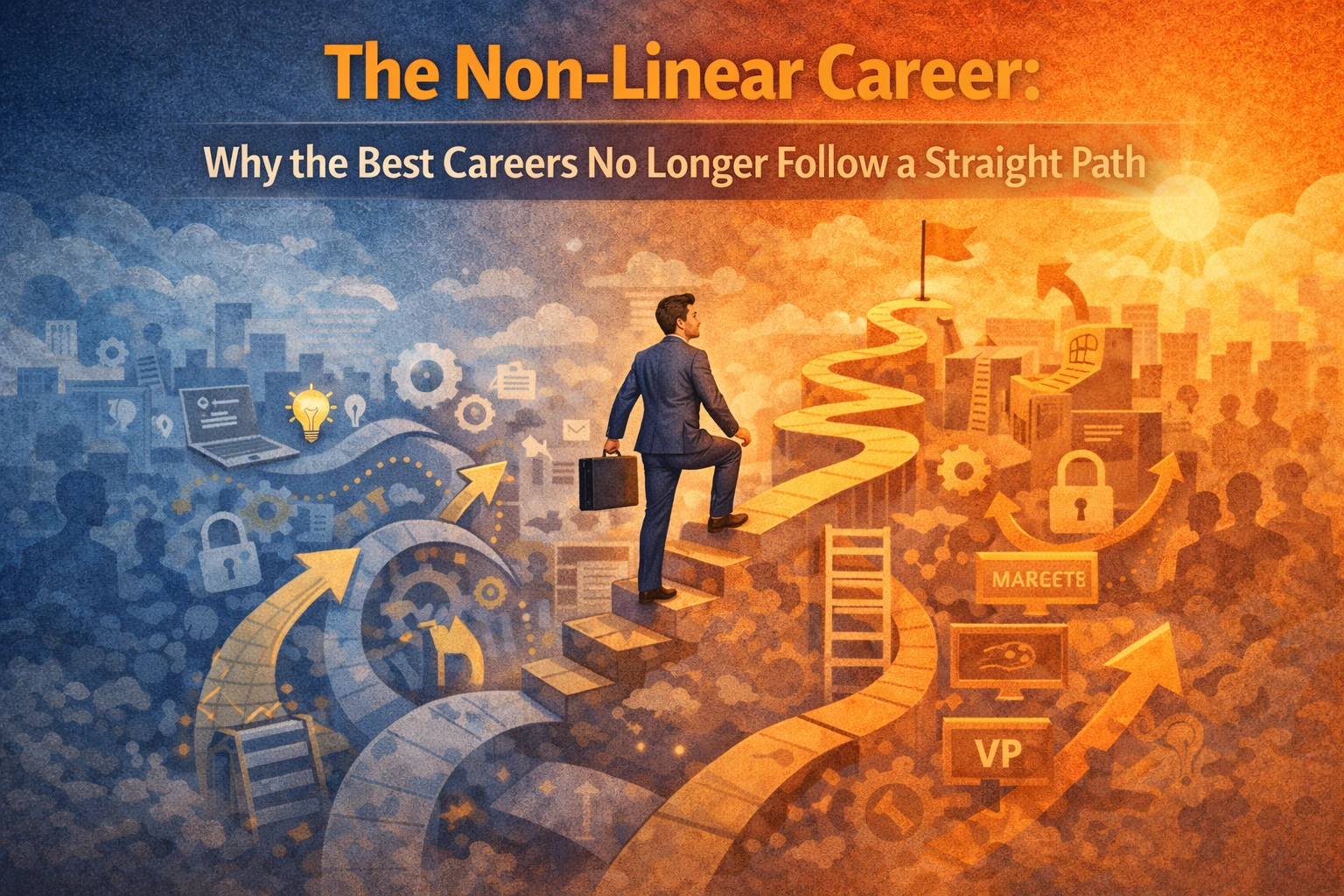
As a result, careers now resemble networks rather than ladders.
What a Modern Career Actually Looks Like
Modern careers often include:
- Lateral moves across functions or industries
- Temporary step-backs to gain new skills
- Periods of independent or freelance work
- Role redefinition inside the same organization
Progress is measured by capability, optionality, and satisfaction—not just hierarchy.
Pivots, Pauses, and Plateaus
Non-linear careers include phases that traditional advice labels as “mistakes.” In reality, these phases often create long-term leverage.
Pivots allow professionals to redirect toward higher-value or more meaningful work.
Pauses—for learning, caregiving, or recovery—often prevent burnout and enable reinvention.
Plateaus can be periods of deep skill building rather than stagnation.
Risk, Stability, and Long-Term Reward
Non-linear careers are often perceived as risky, but linear careers now carry hidden risks.
Staying too long in a narrow role can:
- Limit transferable skills
- Reduce adaptability
- Increase vulnerability during layoffs
Non-linear paths distribute risk across skills, industries, and work models.
Transferable Skills as Career Glue
What connects a non-linear career is not the title—it’s transferable capability.
High-value transferable skills include:
- Problem-solving and systems thinking
- Communication and influence
- Execution under ambiguity
- Learning and adaptation speed
These skills allow professionals to move across contexts without starting over.
Owning Your Career Narrative
Non-linear careers require intentional storytelling.
Without a clear narrative, pivots can look like inconsistency. With one, they look like a strategy.
A strong career narrative explains:
- Why did you make each move
- What you learned at each stage
- How those experiences connect
What Non-Linear Career Success Looks Like
Success in a non-linear career is defined by:
- Increased optionality
- Greater autonomy
- Stronger alignment with values
- Sustained employability
It is less about speed and more about direction.
Common Non-Linear Career Mistakes
Non-linear paths fail when professionals:
- Jump randomly without building skill depth
- Fail to document and communicate impact
- Avoid committing long enough to learn deeply
Non-linear does not mean unintentional.
A Practical Non-Linear Career Framework
- Identify transferable skills you want to compound
- Choose moves that stretch those skills
- Allow for pauses and lateral shifts
- Document learning and outcomes
- Continuously refine your career narrative
Careers are no longer climbed—they are designed.
Final takeaway: The most successful modern careers are not straight lines. They are thoughtful journeys shaped by learning, adaptability, and intentional choice.
