Close Menu
blog.ykthakur.com

    Subscribe to Updates

    Get the latest creative news from FooBar about art, design and business.

    What's Hot

    Personal Branding Without the Cringe: Building Professional Credibility That Actually Works

    February 6, 2026

    Career Resilience: How to Build a Job That Survives Layoffs, AI, and Market Shifts

    February 6, 2026

    From Individual Contributor to Leader: The Career Shift Most People Get Wrong

    February 6, 2026
    Facebook X (Twitter) Instagram
    blog.ykthakur.com
    • Home
    • About Me
    • Case Studies
    • Services
    • Contact Us
    Facebook X (Twitter) Instagram
    Subscribe
    • Blog
    • Search & Growth
      1. SEO
      2. Technical SEO
      3. SEM
      4. Paid Advertisements
      5. View All

      Why SEO Fails Even With the Right Tools and Data

      January 31, 2026

      How to Refresh Old Content Without Losing Rankings

      January 31, 2026

      How to Build a Topic Authority Map for SEO

      January 31, 2026

      E-E-A-T Signals Explained: What Actually Influences Trust and Rankings

      January 31, 2026

      XML Sitemaps at Scale: Signaling Priority, Not Forcing Indexation

      February 3, 2026

      Robots.txt at Scale: Control, Risk, and the Limits of Crawl Directives

      February 3, 2026

      Monitoring, Alerting, and SEO Observability: Seeing Failures Before Traffic Drops

      February 3, 2026

      Migrations, Releases, and SEO Risk: How Technical Changes Break Search at Scale

      February 3, 2026

      Scaling SEM Without Burning Budget

      January 31, 2026

      SEM vs SEO: How Paid Search Should Support Organic Growth

      January 31, 2026

      Quality Score Demystified: What Actually Improves SEM Performance

      January 31, 2026

      Brand vs Non-Brand Search: Budget Allocation Reality

      January 31, 2026

      Personal Branding Without the Cringe: Building Professional Credibility That Actually Works

      February 6, 2026

      Career Resilience: How to Build a Job That Survives Layoffs, AI, and Market Shifts

      February 6, 2026

      From Individual Contributor to Leader: The Career Shift Most People Get Wrong

      February 6, 2026

      The Non-Linear Career: Why the Best Careers No Longer Follow a Straight Path

      February 6, 2026
    • Performance & Infrastructure
      1. Website Performance
      2. Core Web Vitals
      3. Hosting Architecture
      4. Web Application Infrastructure
      5. Load Balancing
      6. View All

      Performance Drift: How Sites Get Slower Without Any One Bad Change

      February 3, 2026

      Why passing scores still hide systemic performance risk

      February 3, 2026

      Performance Monitoring Beyond Core Web Vitals

      February 3, 2026

      Personal Branding Without the Cringe: Building Professional Credibility That Actually Works

      February 6, 2026

      Career Resilience: How to Build a Job That Survives Layoffs, AI, and Market Shifts

      February 6, 2026

      From Individual Contributor to Leader: The Career Shift Most People Get Wrong

      February 6, 2026

      The Non-Linear Career: Why the Best Careers No Longer Follow a Straight Path

      February 6, 2026
    • AI & Automation
      1. AI Content Systems
      2. AI in SEO & Marketing
      3. AI Search Analysis
      4. AI-Driven SEO Workflows
      5. Generative AI Strategy
      6. View All

      AI Content Systems: How to Scale Without Losing Quality or Trust

      February 3, 2026

      AI in Marketing Is a System, Not a Toolset

      February 3, 2026

      SEO in a Zero-Click World: Designing for AI Answers and Visibility

      February 3, 2026

      AI Search Analysis: How LLMs Interpret and Surface Content

      February 3, 2026

      Using AI for Technical SEO Analysis Without Breaking Trust

      February 3, 2026

      AI-Driven SEO Workflows: What to Automate and What Not To

      February 3, 2026

      SEO in a Zero-Click World: Designing for AI Answers and Visibility

      February 3, 2026

      AI Search Analysis: How LLMs Interpret and Surface Content

      February 3, 2026

      Using AI for Technical SEO Analysis Without Breaking Trust

      February 3, 2026

      AI-Driven SEO Workflows: What to Automate and What Not To

      February 3, 2026

      Why Most AI SEO Implementations Fail

      February 3, 2026

      Human-in-the-Loop SEO: Where AI Stops and Judgment Starts

      February 3, 2026

      Personal Branding Without the Cringe: Building Professional Credibility That Actually Works

      February 6, 2026

      Career Resilience: How to Build a Job That Survives Layoffs, AI, and Market Shifts

      February 6, 2026

      From Individual Contributor to Leader: The Career Shift Most People Get Wrong

      February 6, 2026

      The Non-Linear Career: Why the Best Careers No Longer Follow a Straight Path

      February 6, 2026
    • Analytics & Intelligence
      1. GA4 Architecture
      2. Adobe Analytics
      3. View All

      GA4 vs Adobe Analytics: Choosing the Right Tool for Your Organization

      February 2, 2026

      Consent, Privacy, and Measurement: What Changes After GDPR & GA4

      February 2, 2026

      GA4 Architecture Explained: Designing Events for Real Decisions

      February 2, 2026

      GA4 vs Adobe Analytics: Choosing the Right Tool for Your Organization

      February 2, 2026

      Personal Branding Without the Cringe: Building Professional Credibility That Actually Works

      February 6, 2026

      Career Resilience: How to Build a Job That Survives Layoffs, AI, and Market Shifts

      February 6, 2026

      From Individual Contributor to Leader: The Career Shift Most People Get Wrong

      February 6, 2026

      The Non-Linear Career: Why the Best Careers No Longer Follow a Straight Path

      February 6, 2026
    • WebOps & DevOps
      1. Web Operations
      2. WebOps Roles
      3. Website Migrations & Scaling
      4. Release Management
      5. Monitoring & Alerts
      6. Performance Monitoring
      7. Deployment Automation
      8. View All

      SEO and WebOps Monitoring: Aligning Health Signals Across Systems

      February 3, 2026

      Designing Alerts for WebOps: Signal, Severity, and Actionability

      February 3, 2026

      Why Most Website Monitoring Is Too Late to Be Useful

      February 3, 2026

      Release Cadence Versus Stability: Finding the Sustainable Balance

      February 3, 2026

      Website Migrations at Scale: Why Most Fail Before the First Redirect

      February 3, 2026

      Post-Migration Reality: Why SEO and Performance Losses Persist for Months

      February 3, 2026

      Scaling Websites Without Replatforming: When Migration Is the Wrong Answer

      February 3, 2026

      Release Cadence Versus Stability: Finding the Sustainable Balance

      February 3, 2026

      Why Website Releases Break SEO Even When Nothing “Major” Changes

      February 3, 2026

      Release Management for Websites: Coordinating Risk Across Teams

      February 3, 2026

      Release Pipelines and Search Risk: Why Velocity Without Guardrails Breaks Websites

      February 3, 2026

      SEO and WebOps Monitoring: Aligning Health Signals Across Systems

      February 3, 2026

      Designing Alerts for WebOps: Signal, Severity, and Actionability

      February 3, 2026

      Why Most Website Monitoring Is Too Late to Be Useful

      February 3, 2026

      Feature Flags, Experiments, and the SEO Blast Radius

      February 3, 2026

      Performance Drift: How Sites Get Slower Without Any One Bad Change

      February 3, 2026

      Performance Monitoring Beyond Core Web Vitals

      February 3, 2026

      Designing SEO-Safe Deployment Automation

      February 3, 2026

      Deployment Automation for Websites: What to Automate and What Not To

      February 3, 2026

      Personal Branding Without the Cringe: Building Professional Credibility That Actually Works

      February 6, 2026

      Career Resilience: How to Build a Job That Survives Layoffs, AI, and Market Shifts

      February 6, 2026

      From Individual Contributor to Leader: The Career Shift Most People Get Wrong

      February 6, 2026

      The Non-Linear Career: Why the Best Careers No Longer Follow a Straight Path

      February 6, 2026
    • Project Strategy

      Personal Branding Without the Cringe: Building Professional Credibility That Actually Works

      February 6, 2026

      Career Resilience: How to Build a Job That Survives Layoffs, AI, and Market Shifts

      February 6, 2026

      From Individual Contributor to Leader: The Career Shift Most People Get Wrong

      February 6, 2026

      The Non-Linear Career: Why the Best Careers No Longer Follow a Straight Path

      February 6, 2026

      How to Stay Relevant When Roles Are Changing Faster Than Job Descriptions

      February 6, 2026
    • Web Engineering
      1. Web Development
      2. Web Designing & UX
      3. CMS & Platforms
      4. Web Application Firewall
      5. View All

      Personal Branding Without the Cringe: Building Professional Credibility That Actually Works

      February 6, 2026

      Career Resilience: How to Build a Job That Survives Layoffs, AI, and Market Shifts

      February 6, 2026

      From Individual Contributor to Leader: The Career Shift Most People Get Wrong

      February 6, 2026

      The Non-Linear Career: Why the Best Careers No Longer Follow a Straight Path

      February 6, 2026
    blog.ykthakur.com
    Home»AI in SEO & Marketing»AI-Driven SEO Workflows»Why Most AI SEO Implementations Fail
    AI-Driven SEO Workflows

    Why Most AI SEO Implementations Fail

    yashwant160@gmail.comBy yashwant160@gmail.comFebruary 3, 2026Updated:February 26, 2026No Comments4 Mins Read
    Share Facebook Twitter Pinterest LinkedIn Tumblr Email
    Follow Us
    Google News Flipboard Threads
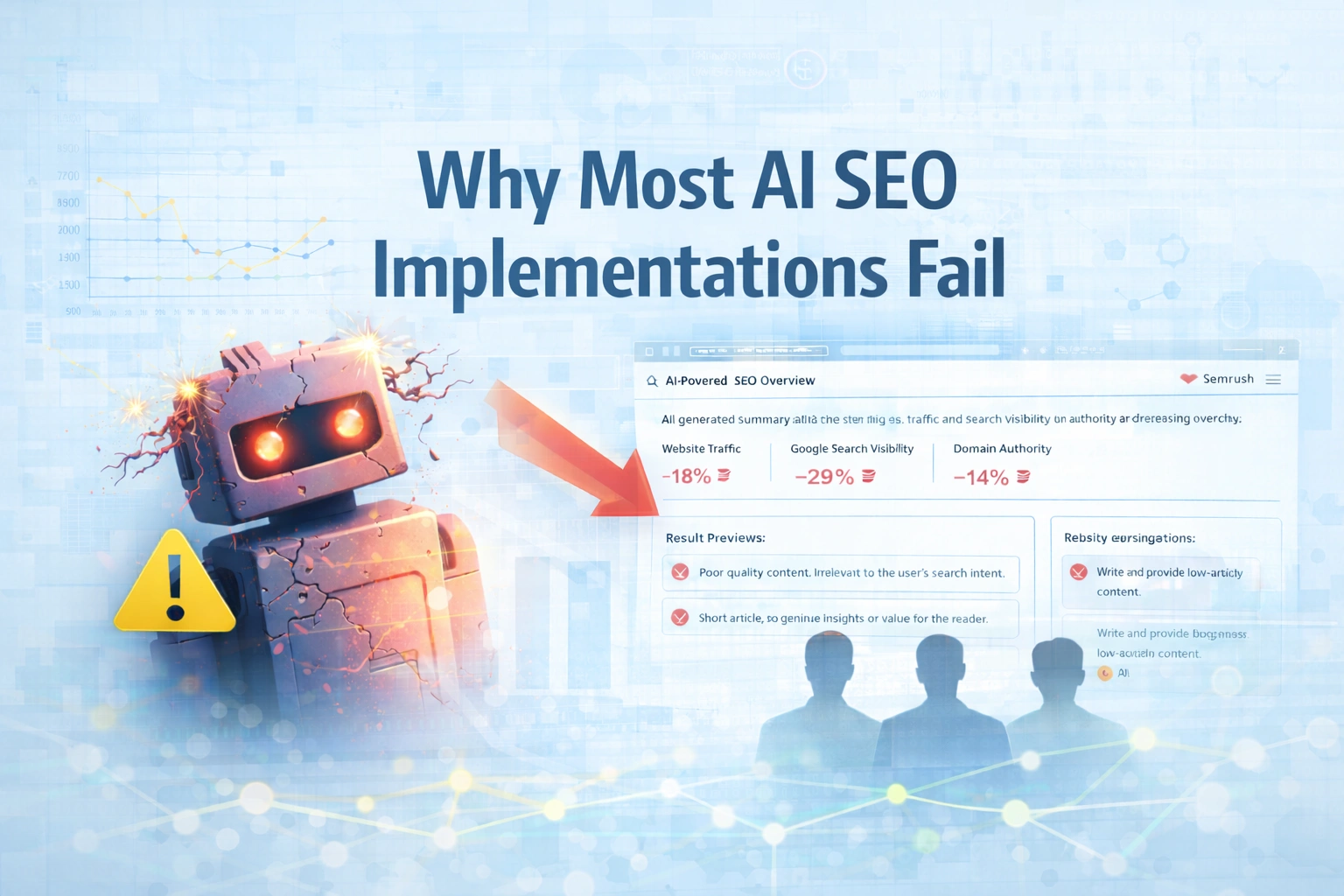
    Why Most AI SEO Implementations Fail 1024x683
    Share
    Facebook Twitter LinkedIn Pinterest Email

    Introduction

    AI did not break SEO. Poor implementation did. Over the last two years, organizations rushed to adopt AI for content creation, keyword research, technical audits, and optimization at scale. Tools were added, prompts were shared, and output volume exploded. Yet for many teams, rankings stagnated, trust eroded, and quality declined. The problem was never AI itself—it was the assumption that AI could replace systems.

    This article explains why most AI SEO implementations fail, where teams misunderstand AI’s role in search, and how mature organizations approach AI as infrastructure rather than a shortcut.

    The Core Misconception: AI as a Replacement, Not an Amplifier

    The most common failure begins with mindset.

    Many teams assume AI will:

    • Replace SEO strategy
    • Automate judgment
    • Generate rankings through volume
    • Eliminate the need for expertise

    AI does none of these reliably.

    AI amplifies what already exists. If the underlying SEO system is weak, AI accelerates failure.

    Why Speed Becomes the Enemy of Quality

    AI makes execution faster than review.

    This creates predictable outcomes

    • Content published without validation
    • Thin pages at massive scale
    • Repetitive semantic patterns
    • Reduced editorial scrutiny

    Search engines do not penalize AI usage. They penalize low-value outcomes.

    The Gap Between AI Output and Search Expectations

    AI generates plausible language—not verified expertise.

    Where AI output often fails

    • Lack of original insight
    • No lived experience
    • Generic recommendations
    • Unverifiable claims

    Search increasingly rewards usefulness, trust, and specificity—not linguistic fluency.

    AI Without Strategy Produces Noise

    Many implementations begin with tools instead of goals.

    Common patterns

    • Bulk content generation without topical mapping
    • Keyword lists expanded endlessly
    • No prioritization by business impact
    • No connection to conversion or authority

    AI produces output. Strategy produces direction.

    Why AI Exposes Weak SEO Foundations

    AI adoption surfaces existing problems.

    Weak foundations include

    • No clear topical authority structure
    • Poor internal linking
    • Unclear content ownership
    • No editorial standards

    AI scales what exists—it does not fix what is broken.

    The Missing Layer: Human Judgment

    Successful AI SEO systems preserve human decision-making.

    Human judgment is required for

    • Topic selection
    • Search intent interpretation
    • Quality evaluation
    • Risk assessment

    When judgment is removed, trust collapses.

    AI and E-E-A-T: Where Automation Hits Its Limits

    E-E-A-T is not a checklist.

    AI struggles with:

    • Demonstrating first-hand experience
    • Establishing author credibility
    • Providing accountable opinions
    • Maintaining consistency across large sites

    AI can assist E-E-A-T signals, but it cannot generate them independently.

    Why Many AI SEO Experiments Stall After Early Gains

    Initial results often look promising.

    Then performance plateaus because:

    • Content lacks differentiation
    • Pages cannibalize each other
    • Search intent is misaligned
    • Quality thresholds are crossed

    Early gains hide long-term fragility.

    The Tool Trap: Optimizing AI Instead of Outcomes

    Teams often focus on improving prompts instead of results.

    This leads to:

    • Prompt libraries without context
    • Outputs disconnected from performance
    • No feedback loop from analytics

    AI systems must be measured by impact, not output quality alone.

    What Successful AI SEO Implementations Do Differently

    Mature teams follow consistent patterns.

    They:

    • Define strategy before automation
    • Limit AI to well-defined tasks
    • Maintain human editorial control
    • Integrate analytics into AI workflows

    AI becomes infrastructure—not experimentation.

    AI as Part of a Larger SEO System

    AI works best when embedded into existing processes.

    High-value integration points

    • Content research and outlining
    • Pattern detection in large datasets
    • Technical issue prioritization
    • Search intent clustering

    AI supports decisions instead of replacing them.

    Common AI SEO Failure Patterns to Avoid

    • Publishing AI content without review
    • Scaling before proving value
    • Ignoring brand and trust signals
    • Separating AI from analytics

    These patterns lead to silent underperformance.

    Real-World Pattern: From AI Output to AI System

    Before

    • High content volume
    • Inconsistent rankings
    • Declining engagement

    Changes made

    • Restricted AI use to defined stages
    • Introduced editorial checkpoints
    • Connected AI output to performance data

    After

    • Fewer pages
    • Higher average rankings
    • Improved trust signals

    Results improved by reducing automation, not increasing it.

    Why AI SEO Discipline Matters More in 2026

    Search is becoming more selective.

    • AI-generated content volume is exploding
    • Search engines prioritize usefulness
    • LLMs surface fewer sources
    • Trust thresholds are higher

    Undisciplined AI usage increases risk.

    Final Takeaway

    Most AI SEO implementations fail because they optimize output instead of outcomes.

    High-performing teams:

    • Treat AI as infrastructure
    • Preserve human judgment
    • Design systems before scaling
    • Measure impact, not volume

    AI does not replace SEO systems. It exposes whether they exist.

    Share. Facebook Twitter Pinterest LinkedIn Tumblr Email
    yashwant160@gmail.com
    • Website

    Related Posts

    AI-Driven SEO Workflows: What to Automate and What Not To

    February 3, 2026
    Leave A Reply Cancel Reply

    Don't Miss

    Personal Branding Without the Cringe: Building Professional Credibility That Actually Works

    yashwant160@gmail.comFebruary 6, 2026

    Personal branding has a reputation problem. Too often, it’s confused with self-promotion, performative posting, or…

    Career Resilience: How to Build a Job That Survives Layoffs, AI, and Market Shifts

    February 6, 2026

    From Individual Contributor to Leader: The Career Shift Most People Get Wrong

    February 6, 2026

    The Non-Linear Career: Why the Best Careers No Longer Follow a Straight Path

    February 6, 2026
    Stay In Touch
    • Facebook
    • Twitter
    • Pinterest
    • Instagram
    • YouTube
    • Vimeo

    Subscribe to Updates

    Get the latest creative news from SmartMag about art & design.

    About Us

    Results-driven digital professional with 15+ years of experience across Web Operations, Enterprise SEO, and large-scale digital platforms. I specialize in building, scaling, and optimizing complex websites where performance, search visibility, and operational reliability must work together—not in silos. My work sits at the intersection of strategy and execution, translating business goals into systems that teams can actually run.

    Facebook X (Twitter) Pinterest YouTube
    Our Picks

    Personal Branding Without the Cringe: Building Professional Credibility That Actually Works

    February 6, 2026

    Career Resilience: How to Build a Job That Survives Layoffs, AI, and Market Shifts

    February 6, 2026

    From Individual Contributor to Leader: The Career Shift Most People Get Wrong

    February 6, 2026
    Most Popular

    Top 15 popular link building methods you should consider before it’s too late

    March 24, 20180 Views

    Quality Score Demystified: What Actually Improves SEM Performance

    January 31, 20260 Views

    How SEO, SEM, Email, and Paid Social Should Work Together

    February 2, 20260 Views
    © 2026 All rights reserved. Y. K. Thakur.
    • Home
    • Technical SEO
    • World
    • Lifestyle
    • Buy Now

    Type above and press Enter to search. Press Esc to cancel.