
Close Menu
blog.ykthakur.com

    Subscribe to Updates

    Get the latest creative news from FooBar about art, design and business.

    What's Hot

    Personal Branding Without the Cringe: Building Professional Credibility That Actually Works

    February 6, 2026

    Career Resilience: How to Build a Job That Survives Layoffs, AI, and Market Shifts

    February 6, 2026

    From Individual Contributor to Leader: The Career Shift Most People Get Wrong

    February 6, 2026
    Facebook X (Twitter) Instagram
    blog.ykthakur.com
    • Home
    • About Me
    • Case Studies
    • Services
    • Contact Us
    Facebook X (Twitter) Instagram
    Subscribe
    • Blog
    • Search & Growth
      1. SEO
      2. Technical SEO
      3. SEM
      4. Paid Advertisements
      5. View All

      Why SEO Fails Even With the Right Tools and Data

      January 31, 2026

      How to Refresh Old Content Without Losing Rankings

      January 31, 2026

      How to Build a Topic Authority Map for SEO

      January 31, 2026

      E-E-A-T Signals Explained: What Actually Influences Trust and Rankings

      January 31, 2026

      XML Sitemaps at Scale: Signaling Priority, Not Forcing Indexation

      February 3, 2026

      Robots.txt at Scale: Control, Risk, and the Limits of Crawl Directives

      February 3, 2026

      Monitoring, Alerting, and SEO Observability: Seeing Failures Before Traffic Drops

      February 3, 2026

      Migrations, Releases, and SEO Risk: How Technical Changes Break Search at Scale

      February 3, 2026

      Scaling SEM Without Burning Budget

      January 31, 2026

      SEM vs SEO: How Paid Search Should Support Organic Growth

      January 31, 2026

      Quality Score Demystified: What Actually Improves SEM Performance

      January 31, 2026

      Brand vs Non-Brand Search: Budget Allocation Reality

      January 31, 2026

      Personal Branding Without the Cringe: Building Professional Credibility That Actually Works

      February 6, 2026

      Career Resilience: How to Build a Job That Survives Layoffs, AI, and Market Shifts

      February 6, 2026

      From Individual Contributor to Leader: The Career Shift Most People Get Wrong

      February 6, 2026

      The Non-Linear Career: Why the Best Careers No Longer Follow a Straight Path

      February 6, 2026
    • Performance & Infrastructure
      1. Website Performance
      2. Core Web Vitals
      3. Hosting Architecture
      4. Web Application Infrastructure
      5. Load Balancing
      6. View All

      Performance Drift: How Sites Get Slower Without Any One Bad Change

      February 3, 2026

      Why passing scores still hide systemic performance risk

      February 3, 2026

      Performance Monitoring Beyond Core Web Vitals

      February 3, 2026

      Personal Branding Without the Cringe: Building Professional Credibility That Actually Works

      February 6, 2026

      Career Resilience: How to Build a Job That Survives Layoffs, AI, and Market Shifts

      February 6, 2026

      From Individual Contributor to Leader: The Career Shift Most People Get Wrong

      February 6, 2026

      The Non-Linear Career: Why the Best Careers No Longer Follow a Straight Path

      February 6, 2026
    • AI & Automation
      1. AI Content Systems
      2. AI in SEO & Marketing
      3. AI Search Analysis
      4. AI-Driven SEO Workflows
      5. Generative AI Strategy
      6. View All

      AI Content Systems: How to Scale Without Losing Quality or Trust

      February 3, 2026

      AI in Marketing Is a System, Not a Toolset

      February 3, 2026

      SEO in a Zero-Click World: Designing for AI Answers and Visibility

      February 3, 2026

      AI Search Analysis: How LLMs Interpret and Surface Content

      February 3, 2026

      Using AI for Technical SEO Analysis Without Breaking Trust

      February 3, 2026

      AI-Driven SEO Workflows: What to Automate and What Not To

      February 3, 2026

      SEO in a Zero-Click World: Designing for AI Answers and Visibility

      February 3, 2026

      AI Search Analysis: How LLMs Interpret and Surface Content

      February 3, 2026

      Using AI for Technical SEO Analysis Without Breaking Trust

      February 3, 2026

      AI-Driven SEO Workflows: What to Automate and What Not To

      February 3, 2026

      Why Most AI SEO Implementations Fail

      February 3, 2026

      Human-in-the-Loop SEO: Where AI Stops and Judgment Starts

      February 3, 2026

      Personal Branding Without the Cringe: Building Professional Credibility That Actually Works

      February 6, 2026

      Career Resilience: How to Build a Job That Survives Layoffs, AI, and Market Shifts

      February 6, 2026

      From Individual Contributor to Leader: The Career Shift Most People Get Wrong

      February 6, 2026

      The Non-Linear Career: Why the Best Careers No Longer Follow a Straight Path

      February 6, 2026
    • Analytics & Intelligence
      1. GA4 Architecture
      2. Adobe Analytics
      3. View All

      GA4 vs Adobe Analytics: Choosing the Right Tool for Your Organization

      February 2, 2026

      Consent, Privacy, and Measurement: What Changes After GDPR & GA4

      February 2, 2026

      GA4 Architecture Explained: Designing Events for Real Decisions

      February 2, 2026

      GA4 vs Adobe Analytics: Choosing the Right Tool for Your Organization

      February 2, 2026

      Personal Branding Without the Cringe: Building Professional Credibility That Actually Works

      February 6, 2026

      Career Resilience: How to Build a Job That Survives Layoffs, AI, and Market Shifts

      February 6, 2026

      From Individual Contributor to Leader: The Career Shift Most People Get Wrong

      February 6, 2026

      The Non-Linear Career: Why the Best Careers No Longer Follow a Straight Path

      February 6, 2026
    • WebOps & DevOps
      1. Web Operations
      2. WebOps Roles
      3. Website Migrations & Scaling
      4. Release Management
      5. Monitoring & Alerts
      6. Performance Monitoring
      7. Deployment Automation
      8. View All

      SEO and WebOps Monitoring: Aligning Health Signals Across Systems

      February 3, 2026

      Designing Alerts for WebOps: Signal, Severity, and Actionability

      February 3, 2026

      Why Most Website Monitoring Is Too Late to Be Useful

      February 3, 2026

      Release Cadence Versus Stability: Finding the Sustainable Balance

      February 3, 2026

      Website Migrations at Scale: Why Most Fail Before the First Redirect

      February 3, 2026

      Post-Migration Reality: Why SEO and Performance Losses Persist for Months

      February 3, 2026

      Scaling Websites Without Replatforming: When Migration Is the Wrong Answer

      February 3, 2026

      Release Cadence Versus Stability: Finding the Sustainable Balance

      February 3, 2026

      Why Website Releases Break SEO Even When Nothing “Major” Changes

      February 3, 2026

      Release Management for Websites: Coordinating Risk Across Teams

      February 3, 2026

      Release Pipelines and Search Risk: Why Velocity Without Guardrails Breaks Websites

      February 3, 2026

      SEO and WebOps Monitoring: Aligning Health Signals Across Systems

      February 3, 2026

      Designing Alerts for WebOps: Signal, Severity, and Actionability

      February 3, 2026

      Why Most Website Monitoring Is Too Late to Be Useful

      February 3, 2026

      Feature Flags, Experiments, and the SEO Blast Radius

      February 3, 2026

      Performance Drift: How Sites Get Slower Without Any One Bad Change

      February 3, 2026

      Performance Monitoring Beyond Core Web Vitals

      February 3, 2026

      Designing SEO-Safe Deployment Automation

      February 3, 2026

      Deployment Automation for Websites: What to Automate and What Not To

      February 3, 2026

      Personal Branding Without the Cringe: Building Professional Credibility That Actually Works

      February 6, 2026

      Career Resilience: How to Build a Job That Survives Layoffs, AI, and Market Shifts

      February 6, 2026

      From Individual Contributor to Leader: The Career Shift Most People Get Wrong

      February 6, 2026

      The Non-Linear Career: Why the Best Careers No Longer Follow a Straight Path

      February 6, 2026
    • Project Strategy

      Personal Branding Without the Cringe: Building Professional Credibility That Actually Works

      February 6, 2026

      Career Resilience: How to Build a Job That Survives Layoffs, AI, and Market Shifts

      February 6, 2026

      From Individual Contributor to Leader: The Career Shift Most People Get Wrong

      February 6, 2026

      The Non-Linear Career: Why the Best Careers No Longer Follow a Straight Path

      February 6, 2026

      How to Stay Relevant When Roles Are Changing Faster Than Job Descriptions

      February 6, 2026
    • Web Engineering
      1. Web Development
      2. Web Designing & UX
      3. CMS & Platforms
      4. Web Application Firewall
      5. View All

      Personal Branding Without the Cringe: Building Professional Credibility That Actually Works

      February 6, 2026

      Career Resilience: How to Build a Job That Survives Layoffs, AI, and Market Shifts

      February 6, 2026

      From Individual Contributor to Leader: The Career Shift Most People Get Wrong

      February 6, 2026

      The Non-Linear Career: Why the Best Careers No Longer Follow a Straight Path

      February 6, 2026
    blog.ykthakur.com
    Home»SEM»Strategy»Scaling SEM Without Burning Budget
    Strategy

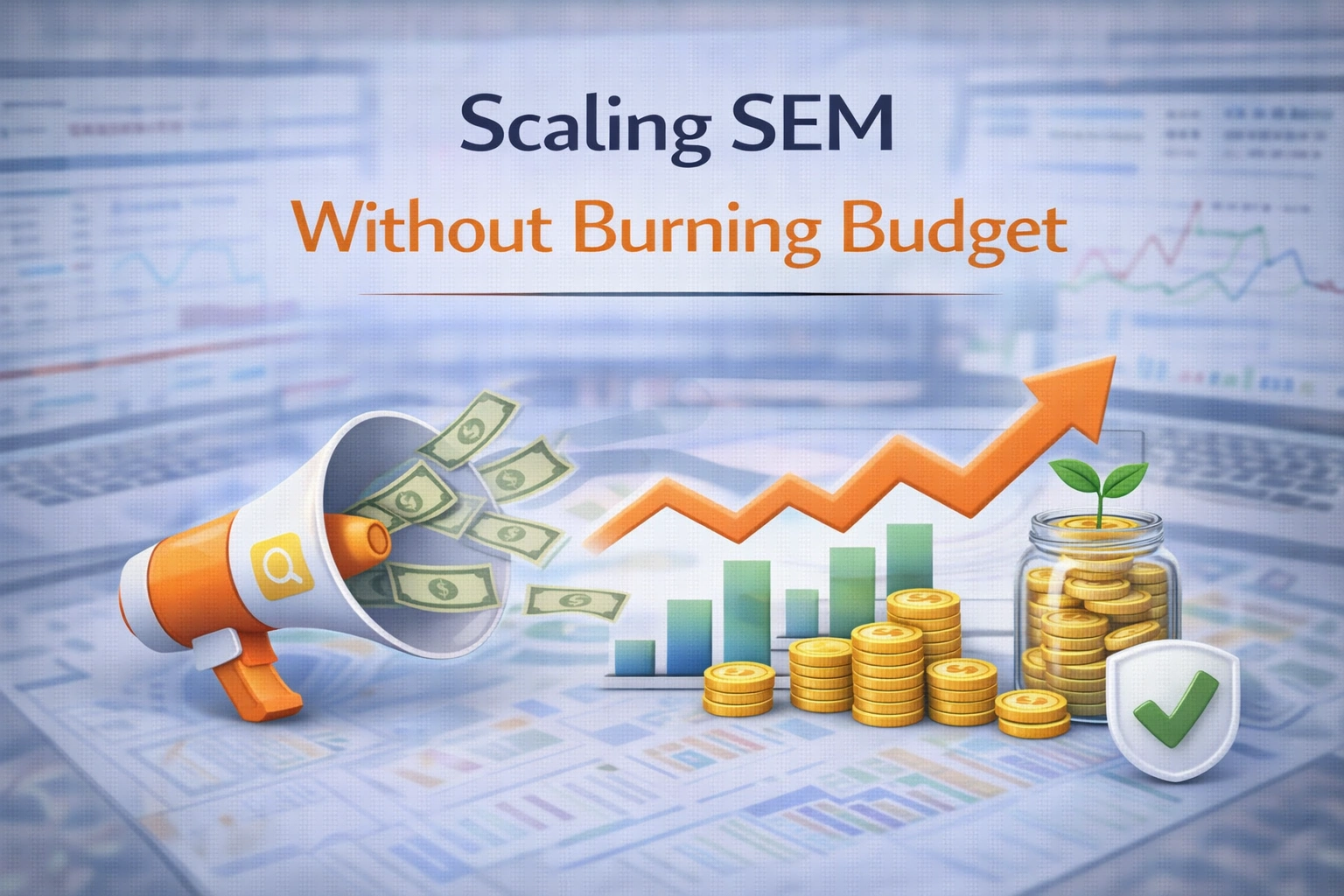
    Scaling SEM Without Burning Budget

    yashwant160@gmail.comBy yashwant160@gmail.comJanuary 31, 2026Updated:February 4, 2026No Comments5 Mins Read
    Share Facebook Twitter Pinterest LinkedIn Tumblr Email
    Follow Us
    Google News Flipboard Threads
    Budget 1024x683
    Share
    Facebook Twitter LinkedIn Pinterest Email

    Introduction

    Most SEM programs don’t fail when budgets are small—they fail when budgets grow. Performance that looks stable at $5k–$10k per month often collapses at $30k, $50k, or more. CPCs spike, conversion quality drops, and teams respond by adding more automation or increasing bids—accelerating the problem. The reality is simple: scaling SEM without burning budget requires systems, not tactics.

    This article explains how to scale SEM responsibly, why many programs break during growth phases, and how mature teams expand spend while preserving efficiency, predictability, and lead quality.

    Why SEM Breaks When You Scale

    Scaling increases exposure to every weakness in your system.

    At higher spend:

    • Intent leakage becomes expensive
    • Landing page misalignment compounds
    • Conversion tracking errors scale
    • Automation magnifies noise
    • Governance gaps create chaos

    Budget doesn’t change SEM behavior.
    It amplifies whatever already exists.

    The Core Scaling Myth: “If It Works at $10k, It’ll Work at $50k.”

    This assumption fails because:

    • Auction dynamics change at scale
    • You exhaust easy wins
    • Marginal traffic is of lower quality
    • Competition intensifies
    • Algorithms face new constraints

    Scaling requires new controls, not just more of the same.

    Step 1: Prove Stability Before Increasing Spend

    Before scaling, confirm these signals are stable for at least 30–60 days:

    • CPA within target range
    • Conversion rate consistency
    • Lead quality feedback is positive
    • No major tracking volatility
    • Search term drift is controlled

    If performance fluctuates wildly at low spend, scaling will only make it worse.

    Step 2: Scale in One Dimension at a Time

    Many teams fail by scaling:

    • Budget
    • Keywords
    • Match types
    • Automation
    • Geography

    …all at once.

    Best practice

    Scale one variable at a time:

    • Increase the budget or
    • Expand keywords or
    • Test new match types

    This preserves diagnostic clarity and prevents cascading failure.

    Step 3: Increase Budgets Gradually (Not Aggressively)

    Large budget jumps shock algorithms.

    Safe scaling guidelines

    • Increase budgets by 10–20% at a time
    • Allow 7–14 days for stabilization
    • Monitor CPA and conversion quality
    • Pause if volatility exceeds tolerance

    Gradual increases allow learning to adapt without panic bidding.

    Step 4: Expand Intent Depth Before Intent Breadth

    Scaling should move downward before outward.

    Wrong approach

    • Add broad keywords
    • Open new low-intent queries
    • Chase volume

    Correct approach

    • Maximize high-intent coverage
    • Capture variations of proven queries
    • Improve impression share where ROI exists

    Depth scales more safely than breadth.

    Step 5: Segment Budgets by Intent and Risk

    Not all spend carries equal risk.

    Intent-based scaling framework

    Segment Scaling Behavior
    Brand Controlled, capped
    High intent non-brand Primary scaling
    Mid intent Incremental
    Low intent Experimental only

    Blended budgets hide where money actually works.

    Step 6: Use Automation Selectively, Not Universally

    Automation helps scale—but only when signals are clean.

    Automation works best when:

    • Conversion tracking is accurate
    • Intent is segmented
    • Landing pages convert consistently
    • Budgets allow learning periods

    Automation fails when:

    • Low-quality conversions dominate
    • Intent is mixed
    • Tracking is noisy
    • Budgets fluctuate too often

    Scaling automation without governance burns budget quickly.

    Step 7: Protect Against Search Term Drift

    As spending increases, broad and automated systems expand their reach.

    Common scaling issue

    • High-intent keywords trigger low-intent queries
    • Spend shifts toward cheaper but weaker traffic
    • CPA rises quietly

    Controls to apply

    • Weekly search term reviews
    • Aggressive negative keyword strategy
    • Intent-based exclusions
    • Match type discipline

    Search term drift is one of the most expensive silent failures.

    Step 8: Scale Landing Pages Alongside Spend

    Scaling traffic without scaling landing pages creates bottlenecks.

    As volume grows:

    • Conversion rates flatten
    • Friction becomes more visible
    • UX weaknesses compound

    Mature scaling includes:

    • Multiple intent-specific landing pages
    • Ongoing CRO improvements
    • Performance optimization
    • Clear value hierarchy

    Landing pages are capacity constraints—not accessories.

    Step 9: Align Scaling With Conversion Quality Feedback

    Scaling without sales feedback is gambling.

    What to monitor during scale

    • Lead acceptance rate
    • Sales-qualified lead ratio
    • Time to close
    • Revenue per lead

    If volume increases but quality drops, pause scaling immediately.

    Automation must optimize toward business reality, not surface metrics.

    Step 10: Build Budget Guardrails (This Is Critical)

    Guardrails prevent emotional decisions.

    Examples

    • Max CPA thresholds
    • Spend caps per intent
    • Automated alerts
    • Pause conditions

    Guardrails ensure scaling stops before damage compounds.

    Real-World Scaling Pattern (Simplified)

    Phase 1: Foundation

    • $10k/month
    • Tight intent structure
    • Manual or conservative automation
    • Stable CPA

    Phase 2: Controlled Expansion

    • $20k–$30k/month
    • Intent depth expansion
    • Selective smart bidding
    • New landing pages

    Phase 3: Strategic Scale

    • $50k+/month
    • Hybrid automation
    • Strong governance
    • SEM supports SEO growth

    Skipping phases causes failure.

    Why SEM Scaling Often Fails Under Pressure

    Common pressure-driven mistakes:

    • Leadership demands volume
    • Budgets increase too fast
    • Automation is enabled prematurely
    • Quality signals are ignored

    SEM is sensitive to urgency.
    Scaling requires discipline under pressure.

    How AI and Automation Change Scaling Dynamics

    AI accelerates patterns:

    • Good systems scale faster
    • Bad systems fail faster

    AI doesn’t forgive:

    • Noisy data
    • Weak intent separation
    • Poor landing pages

    The better your foundation, the more automation helps.

    Metrics to Watch During Scale (Non-Negotiable)

    Track these daily or weekly:

    Metric Why
    CPA by intent Detect early inefficiency
    Conversion rate Reveal friction
    Search term quality Control drift
    Lead quality Protect ROI
    Spend velocity Prevent runaway scaling

    Ignoring these guarantees results in budget burn.

    Common Scaling Anti-Patterns

    • Doubling budgets overnight
    • Scaling low-intent traffic
    • Letting automation decide everything
    • Ignoring landing page capacity
    • Optimizing for volume over quality

    These fail silently—until budgets are gone.

    Final Takeaway

    Scaling SEM is not about spending more—it’s about earning the right to spend more.

    SEM scales safely when:

    • Intent is segmented
    • Signals are clean
    • Landing pages are aligned
    • Automation is governed
    • Quality feedback is constant

    Budget doesn’t create growth.
    Systems do.


    Share. Facebook Twitter Pinterest LinkedIn Tumblr Email
    yashwant160@gmail.com
    • Website

    Related Posts

    SEM vs SEO: How Paid Search Should Support Organic Growth

    January 31, 2026

    Why SEM Campaigns Fail Even With High Budgets

    January 31, 2026
    Leave A Reply Cancel Reply

    Don't Miss

    Personal Branding Without the Cringe: Building Professional Credibility That Actually Works

    yashwant160@gmail.comFebruary 6, 2026

    Personal branding has a reputation problem. Too often, it’s confused with self-promotion, performative posting, or…

    Career Resilience: How to Build a Job That Survives Layoffs, AI, and Market Shifts

    February 6, 2026

    From Individual Contributor to Leader: The Career Shift Most People Get Wrong

    February 6, 2026

    The Non-Linear Career: Why the Best Careers No Longer Follow a Straight Path

    February 6, 2026
    Stay In Touch
    • Facebook
    • Twitter
    • Pinterest
    • Instagram
    • YouTube
    • Vimeo

    Subscribe to Updates

    Get the latest creative news from SmartMag about art & design.

    About Us

    Results-driven digital professional with 15+ years of experience across Web Operations, Enterprise SEO, and large-scale digital platforms. I specialize in building, scaling, and optimizing complex websites where performance, search visibility, and operational reliability must work together—not in silos. My work sits at the intersection of strategy and execution, translating business goals into systems that teams can actually run.

    Facebook X (Twitter) Pinterest YouTube
    Our Picks

    Personal Branding Without the Cringe: Building Professional Credibility That Actually Works

    February 6, 2026

    Career Resilience: How to Build a Job That Survives Layoffs, AI, and Market Shifts

    February 6, 2026

    From Individual Contributor to Leader: The Career Shift Most People Get Wrong

    February 6, 2026
    Most Popular

    Top 15 popular link building methods you should consider before it’s too late

    March 24, 20180 Views

    Quality Score Demystified: What Actually Improves SEM Performance

    January 31, 20260 Views

    How SEO, SEM, Email, and Paid Social Should Work Together

    February 2, 20260 Views
    © 2026 All rights reserved. Y. K. Thakur.
    • Home
    • Technical SEO
    • World
    • Lifestyle
    • Buy Now

    Type above and press Enter to search. Press Esc to cancel.