Close Menu
blog.ykthakur.com

    Subscribe to Updates

    Get the latest creative news from FooBar about art, design and business.

    What's Hot

    Personal Branding Without the Cringe: Building Professional Credibility That Actually Works

    February 6, 2026

    Career Resilience: How to Build a Job That Survives Layoffs, AI, and Market Shifts

    February 6, 2026

    From Individual Contributor to Leader: The Career Shift Most People Get Wrong

    February 6, 2026
    Facebook X (Twitter) Instagram
    blog.ykthakur.com
    • Home
    • About Me
    • Case Studies
    • Services
    • Contact Us
    Facebook X (Twitter) Instagram
    Subscribe
    • Blog
    • Search & Growth
      1. SEO
      2. Technical SEO
      3. SEM
      4. Paid Advertisements
      5. View All

      Why SEO Fails Even With the Right Tools and Data

      January 31, 2026

      How to Refresh Old Content Without Losing Rankings

      January 31, 2026

      How to Build a Topic Authority Map for SEO

      January 31, 2026

      E-E-A-T Signals Explained: What Actually Influences Trust and Rankings

      January 31, 2026

      XML Sitemaps at Scale: Signaling Priority, Not Forcing Indexation

      February 3, 2026

      Robots.txt at Scale: Control, Risk, and the Limits of Crawl Directives

      February 3, 2026

      Monitoring, Alerting, and SEO Observability: Seeing Failures Before Traffic Drops

      February 3, 2026

      Migrations, Releases, and SEO Risk: How Technical Changes Break Search at Scale

      February 3, 2026

      Scaling SEM Without Burning Budget

      January 31, 2026

      SEM vs SEO: How Paid Search Should Support Organic Growth

      January 31, 2026

      Quality Score Demystified: What Actually Improves SEM Performance

      January 31, 2026

      Brand vs Non-Brand Search: Budget Allocation Reality

      January 31, 2026

      Personal Branding Without the Cringe: Building Professional Credibility That Actually Works

      February 6, 2026

      Career Resilience: How to Build a Job That Survives Layoffs, AI, and Market Shifts

      February 6, 2026

      From Individual Contributor to Leader: The Career Shift Most People Get Wrong

      February 6, 2026

      The Non-Linear Career: Why the Best Careers No Longer Follow a Straight Path

      February 6, 2026
    • Performance & Infrastructure
      1. Website Performance
      2. Core Web Vitals
      3. Hosting Architecture
      4. Web Application Infrastructure
      5. Load Balancing
      6. View All

      Performance Drift: How Sites Get Slower Without Any One Bad Change

      February 3, 2026

      Why passing scores still hide systemic performance risk

      February 3, 2026

      Performance Monitoring Beyond Core Web Vitals

      February 3, 2026

      Personal Branding Without the Cringe: Building Professional Credibility That Actually Works

      February 6, 2026

      Career Resilience: How to Build a Job That Survives Layoffs, AI, and Market Shifts

      February 6, 2026

      From Individual Contributor to Leader: The Career Shift Most People Get Wrong

      February 6, 2026

      The Non-Linear Career: Why the Best Careers No Longer Follow a Straight Path

      February 6, 2026
    • AI & Automation
      1. AI Content Systems
      2. AI in SEO & Marketing
      3. AI Search Analysis
      4. AI-Driven SEO Workflows
      5. Generative AI Strategy
      6. View All

      AI Content Systems: How to Scale Without Losing Quality or Trust

      February 3, 2026

      AI in Marketing Is a System, Not a Toolset

      February 3, 2026

      SEO in a Zero-Click World: Designing for AI Answers and Visibility

      February 3, 2026

      AI Search Analysis: How LLMs Interpret and Surface Content

      February 3, 2026

      Using AI for Technical SEO Analysis Without Breaking Trust

      February 3, 2026

      AI-Driven SEO Workflows: What to Automate and What Not To

      February 3, 2026

      SEO in a Zero-Click World: Designing for AI Answers and Visibility

      February 3, 2026

      AI Search Analysis: How LLMs Interpret and Surface Content

      February 3, 2026

      Using AI for Technical SEO Analysis Without Breaking Trust

      February 3, 2026

      AI-Driven SEO Workflows: What to Automate and What Not To

      February 3, 2026

      Why Most AI SEO Implementations Fail

      February 3, 2026

      Human-in-the-Loop SEO: Where AI Stops and Judgment Starts

      February 3, 2026

      Personal Branding Without the Cringe: Building Professional Credibility That Actually Works

      February 6, 2026

      Career Resilience: How to Build a Job That Survives Layoffs, AI, and Market Shifts

      February 6, 2026

      From Individual Contributor to Leader: The Career Shift Most People Get Wrong

      February 6, 2026

      The Non-Linear Career: Why the Best Careers No Longer Follow a Straight Path

      February 6, 2026
    • Analytics & Intelligence
      1. GA4 Architecture
      2. Adobe Analytics
      3. View All

      GA4 vs Adobe Analytics: Choosing the Right Tool for Your Organization

      February 2, 2026

      Consent, Privacy, and Measurement: What Changes After GDPR & GA4

      February 2, 2026

      GA4 Architecture Explained: Designing Events for Real Decisions

      February 2, 2026

      GA4 vs Adobe Analytics: Choosing the Right Tool for Your Organization

      February 2, 2026

      Personal Branding Without the Cringe: Building Professional Credibility That Actually Works

      February 6, 2026

      Career Resilience: How to Build a Job That Survives Layoffs, AI, and Market Shifts

      February 6, 2026

      From Individual Contributor to Leader: The Career Shift Most People Get Wrong

      February 6, 2026

      The Non-Linear Career: Why the Best Careers No Longer Follow a Straight Path

      February 6, 2026
    • WebOps & DevOps
      1. Web Operations
      2. WebOps Roles
      3. Website Migrations & Scaling
      4. Release Management
      5. Monitoring & Alerts
      6. Performance Monitoring
      7. Deployment Automation
      8. View All

      SEO and WebOps Monitoring: Aligning Health Signals Across Systems

      February 3, 2026

      Designing Alerts for WebOps: Signal, Severity, and Actionability

      February 3, 2026

      Why Most Website Monitoring Is Too Late to Be Useful

      February 3, 2026

      Release Cadence Versus Stability: Finding the Sustainable Balance

      February 3, 2026

      Website Migrations at Scale: Why Most Fail Before the First Redirect

      February 3, 2026

      Post-Migration Reality: Why SEO and Performance Losses Persist for Months

      February 3, 2026

      Scaling Websites Without Replatforming: When Migration Is the Wrong Answer

      February 3, 2026

      Release Cadence Versus Stability: Finding the Sustainable Balance

      February 3, 2026

      Why Website Releases Break SEO Even When Nothing “Major” Changes

      February 3, 2026

      Release Management for Websites: Coordinating Risk Across Teams

      February 3, 2026

      Release Pipelines and Search Risk: Why Velocity Without Guardrails Breaks Websites

      February 3, 2026

      SEO and WebOps Monitoring: Aligning Health Signals Across Systems

      February 3, 2026

      Designing Alerts for WebOps: Signal, Severity, and Actionability

      February 3, 2026

      Why Most Website Monitoring Is Too Late to Be Useful

      February 3, 2026

      Feature Flags, Experiments, and the SEO Blast Radius

      February 3, 2026

      Performance Drift: How Sites Get Slower Without Any One Bad Change

      February 3, 2026

      Performance Monitoring Beyond Core Web Vitals

      February 3, 2026

      Designing SEO-Safe Deployment Automation

      February 3, 2026

      Deployment Automation for Websites: What to Automate and What Not To

      February 3, 2026

      Personal Branding Without the Cringe: Building Professional Credibility That Actually Works

      February 6, 2026

      Career Resilience: How to Build a Job That Survives Layoffs, AI, and Market Shifts

      February 6, 2026

      From Individual Contributor to Leader: The Career Shift Most People Get Wrong

      February 6, 2026

      The Non-Linear Career: Why the Best Careers No Longer Follow a Straight Path

      February 6, 2026
    • Project Strategy

      Personal Branding Without the Cringe: Building Professional Credibility That Actually Works

      February 6, 2026

      Career Resilience: How to Build a Job That Survives Layoffs, AI, and Market Shifts

      February 6, 2026

      From Individual Contributor to Leader: The Career Shift Most People Get Wrong

      February 6, 2026

      The Non-Linear Career: Why the Best Careers No Longer Follow a Straight Path

      February 6, 2026

      How to Stay Relevant When Roles Are Changing Faster Than Job Descriptions

      February 6, 2026
    • Web Engineering
      1. Web Development
      2. Web Designing & UX
      3. CMS & Platforms
      4. Web Application Firewall
      5. View All

      Personal Branding Without the Cringe: Building Professional Credibility That Actually Works

      February 6, 2026

      Career Resilience: How to Build a Job That Survives Layoffs, AI, and Market Shifts

      February 6, 2026

      From Individual Contributor to Leader: The Career Shift Most People Get Wrong

      February 6, 2026

      The Non-Linear Career: Why the Best Careers No Longer Follow a Straight Path

      February 6, 2026
    blog.ykthakur.com
    Home»Website Migrations & Scaling»SEO Migrations»Scaling Websites Without Replatforming: When Migration Is the Wrong Answer
    SEO Migrations

    Scaling Websites Without Replatforming: When Migration Is the Wrong Answer

    How architectural debt is often misdiagnosed as a CMS problem
    yashwant160@gmail.comBy yashwant160@gmail.comFebruary 3, 2026Updated:February 27, 2026No Comments4 Mins Read
    Share Facebook Twitter Pinterest LinkedIn Tumblr Email
    Follow Us
    Google News Flipboard Threads
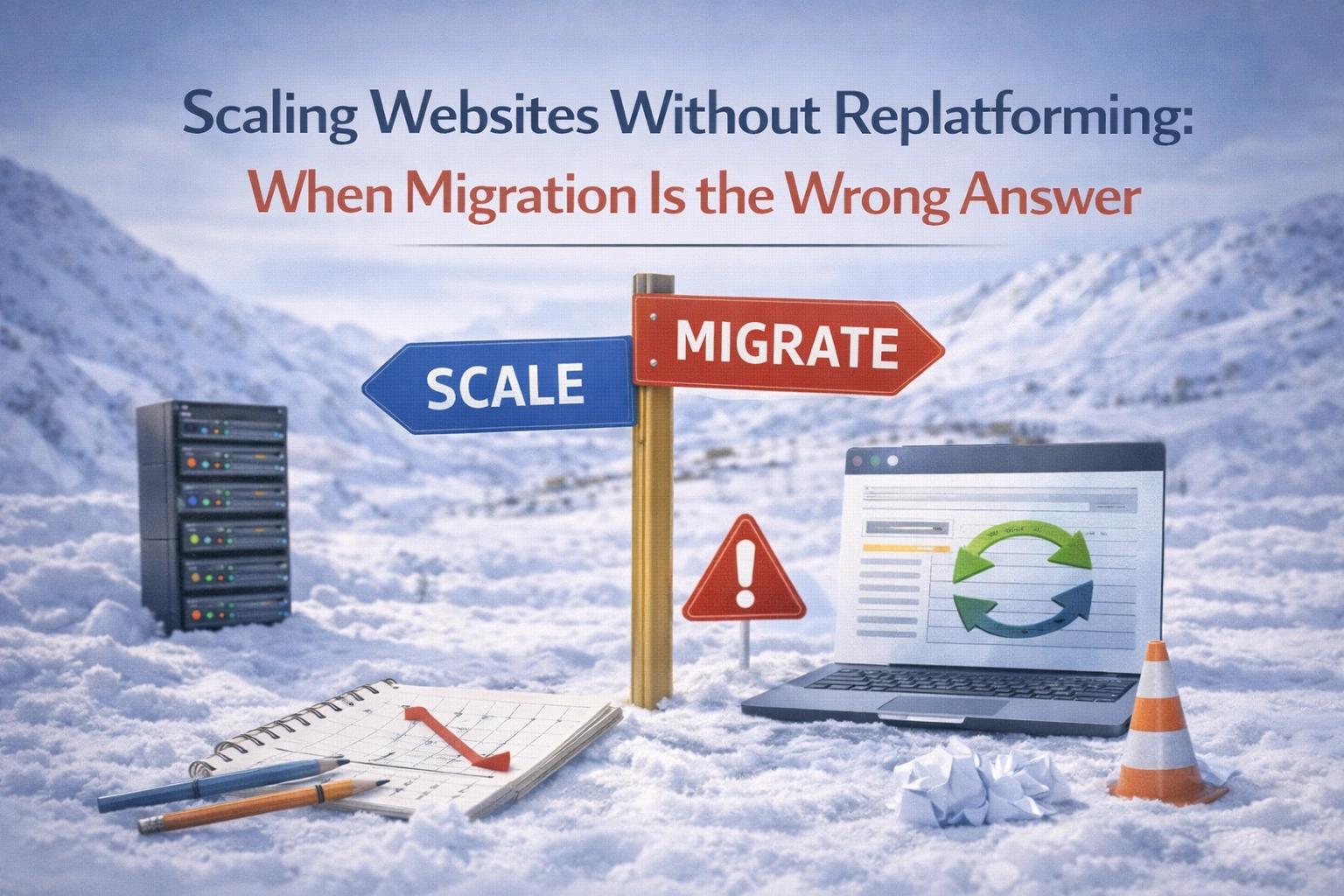
    Scaling Websites Without Replatforming When Migration Is The Wrong Answer 1024x683
    Share
    Facebook Twitter LinkedIn Pinterest Email

    Introduction

    When websites struggle to scale, migration is often presented as the default solution. Performance issues, SEO instability, slow releases, and operational friction are attributed to the current platform. A new CMS, a new framework, or a new hosting stack is positioned as the reset button.

    At enterprise scale, this assumption is frequently wrong. Many organizations migrate not because the platform is incapable, but because the operating model around it has degraded. Replatforming replaces visible pain with unfamiliar complexity while leaving structural problems unresolved.

    This article examines when migration is the wrong response to scaling challenges, why platforms are often blamed for systemic issues, and how organizations can scale reliably without changing their core technology.

    Why Migration Becomes the Default Narrative

    Migration offers a clear storyline. It promises improvement through replacement rather than repair.

    Common drivers behind migration decisions include:

    • Accumulated technical debt
    • Slow or risky release cycles
    • SEO and performance volatility
    • Frustration with legacy workflows

    While these symptoms are real, they rarely prove that the platform itself is the limiting factor.

    Platform Limitations Versus Operating Model Failures

    True platform limitations exist, but they are less common than assumed.

    More frequently, scaling issues arise from:

    • Unclear ownership and decision rights
    • Inconsistent configuration and deployment practices
    • Lack of governance across teams and regions

    Migrating without addressing these factors transfers the same problems to a new environment.

    Why Replatforming Masks Root Causes

    New platforms introduce novelty.

    In the short term:

    • Performance improves due to reduced complexity
    • SEO stabilizes because content is refreshed
    • Teams are more cautious during early releases

    These gains are often attributed to the platform rather than to temporary discipline. As old habits return, issues reappear.

    Scaling Challenges That Do Not Require Migration

    Release Friction

    Slow releases are often blamed on CMS constraints. In reality, they are usually caused by risk concentration, manual validation, and unclear approval paths.

    SEO Instability

    Crawl and indexation issues are frequently the result of inconsistent behavior, not platform incapability. Improving predictability often yields better results than rebuilding.

    Performance Degradation

    Performance regressions typically accumulate through third-party scripts, unbounded templates, and missing budgets. These issues follow teams across platforms.

    The Cost of Migrating for the Wrong Reasons

    Unnecessary migrations introduce substantial risk.

    Costs include:

    • Temporary or prolonged SEO loss
    • Operational disruption across teams
    • Delayed product and content roadmaps

    These costs are often underestimated because they are spread over time rather than concentrated.

    Scaling Through Constraint, Not Replacement

    High-performing organizations scale by tightening constraints.

    Examples include:

    • Defining non-negotiable SEO and performance standards
    • Reducing configuration surface area
    • Standardizing critical workflows

    Constraints improve predictability without requiring a platform change.

    Decoupling Capabilities From Platforms

    Many perceived platform limitations are actually coupling problems.

    Decoupling strategies include:

    • Moving SEO-critical logic out of templates
    • Centralizing edge and routing behavior
    • Standardizing shared services across sites

    This allows scaling without wholesale replacement.

    When Migration Is Actually Justified

    Migration is appropriate when:

    • The platform cannot meet regulatory or security requirements
    • Core architectural constraints block necessary capabilities
    • Operational fixes have been attempted and failed systematically

    Even then, migration should follow operating model reform, not precede it.

    Evaluating Scalability Without Platform Bias

    Before committing to migration, organizations should ask:

    • Which problems are structural versus incidental?
    • Which failures repeat across teams or sites?
    • What would change if governance improved?

    Honest answers often shift the solution away from replatforming.

    SEO as a Scalability Signal

    SEO behavior reflects system health over time.

    If SEO instability persists across releases, regions, or content types, the issue is systemic. Changing platforms without changing systems will not resolve it.

    Reducing Complexity Before Adding More

    Scaling is not about adding capability indefinitely.

    Organizations that scale sustainably:

    • Remove redundant features
    • Retire unused templates and rules
    • Simplify decision paths

    This reduces risk and improves performance on existing platforms.

    Migration as a Last Resort, Not a Strategy

    Migration should be treated as an irreversible change with long-term consequences.

    When used as a shortcut, it delays improvement. When used deliberately, it can enable growth—but only after operational maturity is addressed.

    Conclusion

    Many websites do not need a new platform to scale. They need clearer ownership, stronger governance, and tighter constraints.

    Organizations that migrate without fixing operating models carry their problems forward at a higher cost. Those that stabilize systems first gain optionality: they can scale on their current platform or migrate from a position of strength.

    At enterprise scale, migration is not a cure. It is an amplifier. What it amplifies depends entirely on the systems that surround it.

    Share. Facebook Twitter Pinterest LinkedIn Tumblr Email
    yashwant160@gmail.com
    • Website

    Leave A Reply Cancel Reply

    Don't Miss

    Personal Branding Without the Cringe: Building Professional Credibility That Actually Works

    yashwant160@gmail.comFebruary 6, 2026

    Personal branding has a reputation problem. Too often, it’s confused with self-promotion, performative posting, or…

    Career Resilience: How to Build a Job That Survives Layoffs, AI, and Market Shifts

    February 6, 2026

    From Individual Contributor to Leader: The Career Shift Most People Get Wrong

    February 6, 2026

    The Non-Linear Career: Why the Best Careers No Longer Follow a Straight Path

    February 6, 2026
    Stay In Touch
    • Facebook
    • Twitter
    • Pinterest
    • Instagram
    • YouTube
    • Vimeo

    Subscribe to Updates

    Get the latest creative news from SmartMag about art & design.

    About Us

    Results-driven digital professional with 15+ years of experience across Web Operations, Enterprise SEO, and large-scale digital platforms. I specialize in building, scaling, and optimizing complex websites where performance, search visibility, and operational reliability must work together—not in silos. My work sits at the intersection of strategy and execution, translating business goals into systems that teams can actually run.

    Facebook X (Twitter) Pinterest YouTube
    Our Picks

    Personal Branding Without the Cringe: Building Professional Credibility That Actually Works

    February 6, 2026

    Career Resilience: How to Build a Job That Survives Layoffs, AI, and Market Shifts

    February 6, 2026

    From Individual Contributor to Leader: The Career Shift Most People Get Wrong

    February 6, 2026
    Most Popular

    Top 15 popular link building methods you should consider before it’s too late

    March 24, 20180 Views

    Quality Score Demystified: What Actually Improves SEM Performance

    January 31, 20260 Views

    How SEO, SEM, Email, and Paid Social Should Work Together

    February 2, 20260 Views
    © 2026 All rights reserved. Y. K. Thakur.
    • Home
    • Technical SEO
    • World
    • Lifestyle
    • Buy Now

    Type above and press Enter to search. Press Esc to cancel.