
Close Menu
blog.ykthakur.com

    Subscribe to Updates

    Get the latest creative news from FooBar about art, design and business.

    What's Hot

    Personal Branding Without the Cringe: Building Professional Credibility That Actually Works

    February 6, 2026

    Career Resilience: How to Build a Job That Survives Layoffs, AI, and Market Shifts

    February 6, 2026

    From Individual Contributor to Leader: The Career Shift Most People Get Wrong

    February 6, 2026
    Facebook X (Twitter) Instagram
    blog.ykthakur.com
    • Home
    • About Me
    • Case Studies
    • Services
    • Contact Us
    Facebook X (Twitter) Instagram
    Subscribe
    • Blog
    • Search & Growth
      1. SEO
      2. Technical SEO
      3. SEM
      4. Paid Advertisements
      5. View All

      Why SEO Fails Even With the Right Tools and Data

      January 31, 2026

      How to Refresh Old Content Without Losing Rankings

      January 31, 2026

      How to Build a Topic Authority Map for SEO

      January 31, 2026

      E-E-A-T Signals Explained: What Actually Influences Trust and Rankings

      January 31, 2026

      XML Sitemaps at Scale: Signaling Priority, Not Forcing Indexation

      February 3, 2026

      Robots.txt at Scale: Control, Risk, and the Limits of Crawl Directives

      February 3, 2026

      Monitoring, Alerting, and SEO Observability: Seeing Failures Before Traffic Drops

      February 3, 2026

      Migrations, Releases, and SEO Risk: How Technical Changes Break Search at Scale

      February 3, 2026

      Scaling SEM Without Burning Budget

      January 31, 2026

      SEM vs SEO: How Paid Search Should Support Organic Growth

      January 31, 2026

      Quality Score Demystified: What Actually Improves SEM Performance

      January 31, 2026

      Brand vs Non-Brand Search: Budget Allocation Reality

      January 31, 2026

      Personal Branding Without the Cringe: Building Professional Credibility That Actually Works

      February 6, 2026

      Career Resilience: How to Build a Job That Survives Layoffs, AI, and Market Shifts

      February 6, 2026

      From Individual Contributor to Leader: The Career Shift Most People Get Wrong

      February 6, 2026

      The Non-Linear Career: Why the Best Careers No Longer Follow a Straight Path

      February 6, 2026
    • Performance & Infrastructure
      1. Website Performance
      2. Core Web Vitals
      3. Hosting Architecture
      4. Web Application Infrastructure
      5. Load Balancing
      6. View All

      Performance Drift: How Sites Get Slower Without Any One Bad Change

      February 3, 2026

      Why passing scores still hide systemic performance risk

      February 3, 2026

      Performance Monitoring Beyond Core Web Vitals

      February 3, 2026

      Personal Branding Without the Cringe: Building Professional Credibility That Actually Works

      February 6, 2026

      Career Resilience: How to Build a Job That Survives Layoffs, AI, and Market Shifts

      February 6, 2026

      From Individual Contributor to Leader: The Career Shift Most People Get Wrong

      February 6, 2026

      The Non-Linear Career: Why the Best Careers No Longer Follow a Straight Path

      February 6, 2026
    • AI & Automation
      1. AI Content Systems
      2. AI in SEO & Marketing
      3. AI Search Analysis
      4. AI-Driven SEO Workflows
      5. Generative AI Strategy
      6. View All

      AI Content Systems: How to Scale Without Losing Quality or Trust

      February 3, 2026

      AI in Marketing Is a System, Not a Toolset

      February 3, 2026

      SEO in a Zero-Click World: Designing for AI Answers and Visibility

      February 3, 2026

      AI Search Analysis: How LLMs Interpret and Surface Content

      February 3, 2026

      Using AI for Technical SEO Analysis Without Breaking Trust

      February 3, 2026

      AI-Driven SEO Workflows: What to Automate and What Not To

      February 3, 2026

      SEO in a Zero-Click World: Designing for AI Answers and Visibility

      February 3, 2026

      AI Search Analysis: How LLMs Interpret and Surface Content

      February 3, 2026

      Using AI for Technical SEO Analysis Without Breaking Trust

      February 3, 2026

      AI-Driven SEO Workflows: What to Automate and What Not To

      February 3, 2026

      Why Most AI SEO Implementations Fail

      February 3, 2026

      Human-in-the-Loop SEO: Where AI Stops and Judgment Starts

      February 3, 2026

      Personal Branding Without the Cringe: Building Professional Credibility That Actually Works

      February 6, 2026

      Career Resilience: How to Build a Job That Survives Layoffs, AI, and Market Shifts

      February 6, 2026

      From Individual Contributor to Leader: The Career Shift Most People Get Wrong

      February 6, 2026

      The Non-Linear Career: Why the Best Careers No Longer Follow a Straight Path

      February 6, 2026
    • Analytics & Intelligence
      1. GA4 Architecture
      2. Adobe Analytics
      3. View All

      GA4 vs Adobe Analytics: Choosing the Right Tool for Your Organization

      February 2, 2026

      Consent, Privacy, and Measurement: What Changes After GDPR & GA4

      February 2, 2026

      GA4 Architecture Explained: Designing Events for Real Decisions

      February 2, 2026

      GA4 vs Adobe Analytics: Choosing the Right Tool for Your Organization

      February 2, 2026

      Personal Branding Without the Cringe: Building Professional Credibility That Actually Works

      February 6, 2026

      Career Resilience: How to Build a Job That Survives Layoffs, AI, and Market Shifts

      February 6, 2026

      From Individual Contributor to Leader: The Career Shift Most People Get Wrong

      February 6, 2026

      The Non-Linear Career: Why the Best Careers No Longer Follow a Straight Path

      February 6, 2026
    • WebOps & DevOps
      1. Web Operations
      2. WebOps Roles
      3. Website Migrations & Scaling
      4. Release Management
      5. Monitoring & Alerts
      6. Performance Monitoring
      7. Deployment Automation
      8. View All

      SEO and WebOps Monitoring: Aligning Health Signals Across Systems

      February 3, 2026

      Designing Alerts for WebOps: Signal, Severity, and Actionability

      February 3, 2026

      Why Most Website Monitoring Is Too Late to Be Useful

      February 3, 2026

      Release Cadence Versus Stability: Finding the Sustainable Balance

      February 3, 2026

      Website Migrations at Scale: Why Most Fail Before the First Redirect

      February 3, 2026

      Post-Migration Reality: Why SEO and Performance Losses Persist for Months

      February 3, 2026

      Scaling Websites Without Replatforming: When Migration Is the Wrong Answer

      February 3, 2026

      Release Cadence Versus Stability: Finding the Sustainable Balance

      February 3, 2026

      Why Website Releases Break SEO Even When Nothing “Major” Changes

      February 3, 2026

      Release Management for Websites: Coordinating Risk Across Teams

      February 3, 2026

      Release Pipelines and Search Risk: Why Velocity Without Guardrails Breaks Websites

      February 3, 2026

      SEO and WebOps Monitoring: Aligning Health Signals Across Systems

      February 3, 2026

      Designing Alerts for WebOps: Signal, Severity, and Actionability

      February 3, 2026

      Why Most Website Monitoring Is Too Late to Be Useful

      February 3, 2026

      Feature Flags, Experiments, and the SEO Blast Radius

      February 3, 2026

      Performance Drift: How Sites Get Slower Without Any One Bad Change

      February 3, 2026

      Performance Monitoring Beyond Core Web Vitals

      February 3, 2026

      Designing SEO-Safe Deployment Automation

      February 3, 2026

      Deployment Automation for Websites: What to Automate and What Not To

      February 3, 2026

      Personal Branding Without the Cringe: Building Professional Credibility That Actually Works

      February 6, 2026

      Career Resilience: How to Build a Job That Survives Layoffs, AI, and Market Shifts

      February 6, 2026

      From Individual Contributor to Leader: The Career Shift Most People Get Wrong

      February 6, 2026

      The Non-Linear Career: Why the Best Careers No Longer Follow a Straight Path

      February 6, 2026
    • Project Strategy

      Personal Branding Without the Cringe: Building Professional Credibility That Actually Works

      February 6, 2026

      Career Resilience: How to Build a Job That Survives Layoffs, AI, and Market Shifts

      February 6, 2026

      From Individual Contributor to Leader: The Career Shift Most People Get Wrong

      February 6, 2026

      The Non-Linear Career: Why the Best Careers No Longer Follow a Straight Path

      February 6, 2026

      How to Stay Relevant When Roles Are Changing Faster Than Job Descriptions

      February 6, 2026
    • Web Engineering
      1. Web Development
      2. Web Designing & UX
      3. CMS & Platforms
      4. Web Application Firewall
      5. View All

      Personal Branding Without the Cringe: Building Professional Credibility That Actually Works

      February 6, 2026

      Career Resilience: How to Build a Job That Survives Layoffs, AI, and Market Shifts

      February 6, 2026

      From Individual Contributor to Leader: The Career Shift Most People Get Wrong

      February 6, 2026

      The Non-Linear Career: Why the Best Careers No Longer Follow a Straight Path

      February 6, 2026
    blog.ykthakur.com
    Home»Technical SEO»Robots & Directives»Robots.txt at Scale: Control, Risk, and the Limits of Crawl Directives
    Robots & Directives

    Robots.txt at Scale: Control, Risk, and the Limits of Crawl Directives

    yashwant160@gmail.comBy yashwant160@gmail.comFebruary 3, 2026Updated:February 26, 2026No Comments5 Mins Read
    Share Facebook Twitter Pinterest LinkedIn Tumblr Email
    Follow Us
    Google News Flipboard Threads
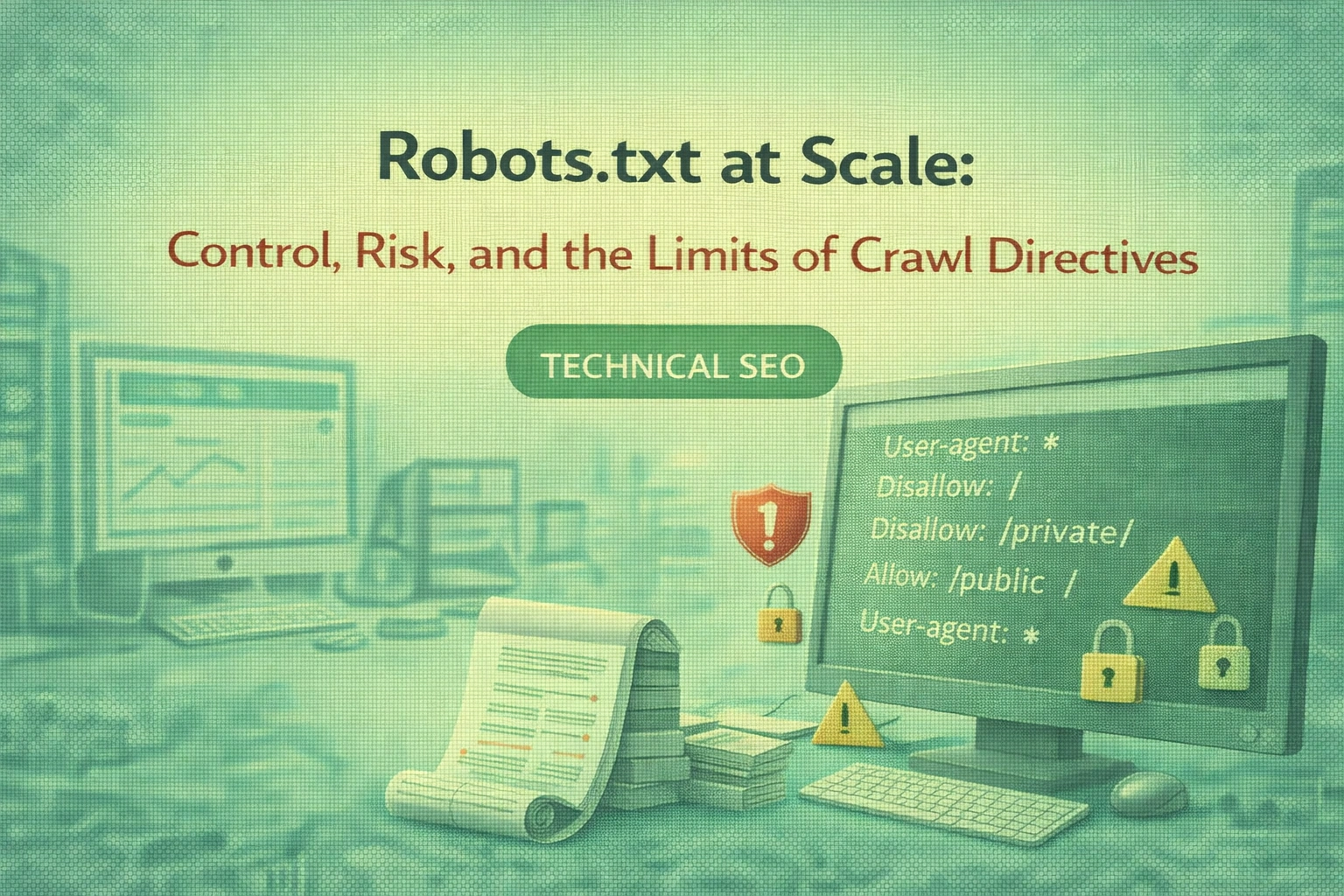
    Robots.txt At Scale Control Risk And The Limits Of Crawl Directives 1024x683
    Share
    Facebook Twitter LinkedIn Pinterest Email

    Introduction

    robots.txt is one of the simplest files in technical SEO and one of the most misunderstood. It consists of a few lines of text, is easy to edit, and is often treated as a blunt instrument for solving crawl problems. At enterprise scale, this combination makes it dangerous.

    robots.txt does not control indexation. It does not remove URLs from search results. It does not fix structural issues. What it does is influence how search engines allocate crawl resources and how they interpret access boundaries. When used without system-level understanding, it creates blind spots that are difficult to diagnose and slow to recover from.

    This article examines robots.txt as a control mechanism, not a cleanup tool, and explains how improper usage breaks crawl efficiency, index quality, and long-term search trust.

    What robots.txt Actually Does

    robots.txt is a crawl directive, not an indexing directive.

    It communicates:

    • Which URL paths are crawlers allowed to fetch
    • Which areas are off-limits for crawling
    • Optional hints about crawl delay or sitemap location

    Search engines may still index blocked URLs if they are discovered through links or external references. This distinction is the source of many enterprise SEO failures.

    Why robots.txt Becomes a Crutch at Scale

    Large sites generate complexity faster than they resolve it. robots.txt is often used to mask that complexity.

    Blocking Instead of Fixing

    Parameter explosions, faceted navigation issues, and infinite URL spaces are frequently blocked via robots.txt rather than addressed at the source. This reduces crawl load temporarily but leaves structural problems intact.

    Emergency Changes Without Review

    Robots.txt is one of the few SEO controls that can be modified instantly. This makes it attractive during incidents and risky during normal operations.

    Overconfidence in Directive Enforcement

    Teams often assume robots.txt rules are absolute. In practice, search engines interpret them probabilistically and contextually.

    Blocking Crawl Does Not Block Consequences

    Blocking URLs in robots.txt does not prevent them from affecting SEO.

    Common unintended outcomes include:

    • Blocked URLs appear as indexed without content
    • Loss of internal link signal where links point to blocked paths
    • Reduced the ability of search engines to evaluate canonical intent

    These effects are often misattributed to indexing bugs rather than crawl restrictions.

    robots.txt and Crawl Budget Misconceptions

    robots.txt is frequently used as a crawl budget optimization tool. This framing is incomplete.

    Blocking large sections does not automatically redirect crawl resources to high-value areas. Crawl allocation is influenced by:

    • Internal linking strength
    • Perceived importance of allowed URLs
    • Historical crawl and response behavior

    Blocking without reinforcing priority paths can reduce overall crawl activity rather than improve it.

    When Robots.txt Makes Sense

    Robots.txt has valid use cases when applied deliberately.

    Appropriate scenarios include:

    • Preventing crawl of non-content system endpoints
    • Blocking infinite spaces that cannot be technically constrained
    • Protecting staging or internal-only environments

    In each case, the goal is to reduce wasted crawl, not manage indexation.

    Robots.txt Versus Other Control Mechanisms

    robots.txt is one of several tools available to control crawl and index behavior. It should not be used in isolation.

    Meta Robots Directives

    Meta robots tags allow crawling but control indexation and link following. They provide more granular, page-level intent than robots.txt.

    Canonicalization

    Canonicals help consolidate signals across duplicate or similar URLs. Blocking these URLs via robots.txt prevents search engines from validating canonical intent.

    URL Parameter Handling

    Constraining URL generation at the application level is more reliable than blocking its output after the fact.

    The Risk of Blocking JavaScript and CSS

    Blocking JavaScript or CSS files is still common on legacy sites.

    This creates:

    • Rendering failures
    • Incomplete content understanding
    • Misinterpretation of layout and interaction

    Modern search engines expect access to rendering-critical resources. Blocking them undermines reliability.

    Robots.txt as a Trust Signal

    Consistent, intentional robots.txt rules signal operational discipline.

    Conversely, frequent changes, contradictory rules, or overly broad blocks indicate instability. Search engines adapt by crawling more conservatively.

    Trust is shaped not by the presence of robots.txt, but by how predictably it is used.

    Change Management and robots.txt

    Because robots.txt has a site-wide impact, it requires stronger governance than most SEO controls.

    Best practices include:

    • Version control and change logs
    • Peer review before deployment
    • Defined rollback procedures

    Ad hoc edits are a common root cause of widespread SEO incidents.

    Monitoring the Impact of robots.txt

    Changes to robots.txt should be treated as experiments with measurable outcomes.

    Monitoring should include:

    • Crawl rate changes by section
    • Index coverage shifts for affected URLs
    • Unexpected discovery of blocked paths

    Without monitoring, damage may persist unnoticed.

    Why robots.txt cannot Fix Architecture

    robots.txt operates at the perimeter. Architecture problems originate at the core.

    Blocking broken systems does not repair them. It only hides their symptoms. Over time, this increases technical debt and reduces search engine confidence.

    Designing robots.txt for Longevity

    Durable robots.txt implementations share common traits:

    • Minimal, intentional rules
    • Clear separation between crawl control and index control
    • Alignment with internal linking and sitemap strategy

    Simplicity improves predictability.

    Conclusion

    robots.txt is not a cleanup tool, a security mechanism, or an indexing switch. It is a blunt but powerful crawl control surface.

    Used carefully, it reduces waste and clarifies boundaries. Used casually, it creates blind spots that undermine crawl efficiency, index quality, and trust.

    At enterprise scale, the question is not whether to use robots.txt, but whether it is governed as a system-level control or treated as a quick fix.

    Share. Facebook Twitter Pinterest LinkedIn Tumblr Email
    yashwant160@gmail.com
    • Website

    Related Posts

    Migrations, Releases, and SEO Risk: How Technical Changes Break Search at Scale

    February 3, 2026
    Leave A Reply Cancel Reply

    Don't Miss

    Personal Branding Without the Cringe: Building Professional Credibility That Actually Works

    yashwant160@gmail.comFebruary 6, 2026

    Personal branding has a reputation problem. Too often, it’s confused with self-promotion, performative posting, or…

    Career Resilience: How to Build a Job That Survives Layoffs, AI, and Market Shifts

    February 6, 2026

    From Individual Contributor to Leader: The Career Shift Most People Get Wrong

    February 6, 2026

    The Non-Linear Career: Why the Best Careers No Longer Follow a Straight Path

    February 6, 2026
    Stay In Touch
    • Facebook
    • Twitter
    • Pinterest
    • Instagram
    • YouTube
    • Vimeo

    Subscribe to Updates

    Get the latest creative news from SmartMag about art & design.

    About Us

    Results-driven digital professional with 15+ years of experience across Web Operations, Enterprise SEO, and large-scale digital platforms. I specialize in building, scaling, and optimizing complex websites where performance, search visibility, and operational reliability must work together—not in silos. My work sits at the intersection of strategy and execution, translating business goals into systems that teams can actually run.

    Facebook X (Twitter) Pinterest YouTube
    Our Picks

    Personal Branding Without the Cringe: Building Professional Credibility That Actually Works

    February 6, 2026

    Career Resilience: How to Build a Job That Survives Layoffs, AI, and Market Shifts

    February 6, 2026

    From Individual Contributor to Leader: The Career Shift Most People Get Wrong

    February 6, 2026
    Most Popular

    Top 15 popular link building methods you should consider before it’s too late

    March 24, 20180 Views

    Quality Score Demystified: What Actually Improves SEM Performance

    January 31, 20260 Views

    How SEO, SEM, Email, and Paid Social Should Work Together

    February 2, 20260 Views
    © 2026 All rights reserved. Y. K. Thakur.
    • Home
    • Technical SEO
    • World
    • Lifestyle
    • Buy Now

    Type above and press Enter to search. Press Esc to cancel.