Close Menu
blog.ykthakur.com

    Subscribe to Updates

    Get the latest creative news from FooBar about art, design and business.

    What's Hot

    Personal Branding Without the Cringe: Building Professional Credibility That Actually Works

    February 6, 2026

    Career Resilience: How to Build a Job That Survives Layoffs, AI, and Market Shifts

    February 6, 2026

    From Individual Contributor to Leader: The Career Shift Most People Get Wrong

    February 6, 2026
    Facebook X (Twitter) Instagram
    blog.ykthakur.com
    • Home
    • About Me
    • Case Studies
    • Services
    • Contact Us
    Facebook X (Twitter) Instagram
    Subscribe
    • Blog
    • Search & Growth
      1. SEO
      2. Technical SEO
      3. SEM
      4. Paid Advertisements
      5. View All

      Why SEO Fails Even With the Right Tools and Data

      January 31, 2026

      How to Refresh Old Content Without Losing Rankings

      January 31, 2026

      How to Build a Topic Authority Map for SEO

      January 31, 2026

      E-E-A-T Signals Explained: What Actually Influences Trust and Rankings

      January 31, 2026

      XML Sitemaps at Scale: Signaling Priority, Not Forcing Indexation

      February 3, 2026

      Robots.txt at Scale: Control, Risk, and the Limits of Crawl Directives

      February 3, 2026

      Monitoring, Alerting, and SEO Observability: Seeing Failures Before Traffic Drops

      February 3, 2026

      Migrations, Releases, and SEO Risk: How Technical Changes Break Search at Scale

      February 3, 2026

      Scaling SEM Without Burning Budget

      January 31, 2026

      SEM vs SEO: How Paid Search Should Support Organic Growth

      January 31, 2026

      Quality Score Demystified: What Actually Improves SEM Performance

      January 31, 2026

      Brand vs Non-Brand Search: Budget Allocation Reality

      January 31, 2026

      Personal Branding Without the Cringe: Building Professional Credibility That Actually Works

      February 6, 2026

      Career Resilience: How to Build a Job That Survives Layoffs, AI, and Market Shifts

      February 6, 2026

      From Individual Contributor to Leader: The Career Shift Most People Get Wrong

      February 6, 2026

      The Non-Linear Career: Why the Best Careers No Longer Follow a Straight Path

      February 6, 2026
    • Performance & Infrastructure
      1. Website Performance
      2. Core Web Vitals
      3. Hosting Architecture
      4. Web Application Infrastructure
      5. Load Balancing
      6. View All

      Performance Drift: How Sites Get Slower Without Any One Bad Change

      February 3, 2026

      Why passing scores still hide systemic performance risk

      February 3, 2026

      Performance Monitoring Beyond Core Web Vitals

      February 3, 2026

      Personal Branding Without the Cringe: Building Professional Credibility That Actually Works

      February 6, 2026

      Career Resilience: How to Build a Job That Survives Layoffs, AI, and Market Shifts

      February 6, 2026

      From Individual Contributor to Leader: The Career Shift Most People Get Wrong

      February 6, 2026

      The Non-Linear Career: Why the Best Careers No Longer Follow a Straight Path

      February 6, 2026
    • AI & Automation
      1. AI Content Systems
      2. AI in SEO & Marketing
      3. AI Search Analysis
      4. AI-Driven SEO Workflows
      5. Generative AI Strategy
      6. View All

      AI Content Systems: How to Scale Without Losing Quality or Trust

      February 3, 2026

      AI in Marketing Is a System, Not a Toolset

      February 3, 2026

      SEO in a Zero-Click World: Designing for AI Answers and Visibility

      February 3, 2026

      AI Search Analysis: How LLMs Interpret and Surface Content

      February 3, 2026

      Using AI for Technical SEO Analysis Without Breaking Trust

      February 3, 2026

      AI-Driven SEO Workflows: What to Automate and What Not To

      February 3, 2026

      SEO in a Zero-Click World: Designing for AI Answers and Visibility

      February 3, 2026

      AI Search Analysis: How LLMs Interpret and Surface Content

      February 3, 2026

      Using AI for Technical SEO Analysis Without Breaking Trust

      February 3, 2026

      AI-Driven SEO Workflows: What to Automate and What Not To

      February 3, 2026

      Why Most AI SEO Implementations Fail

      February 3, 2026

      Human-in-the-Loop SEO: Where AI Stops and Judgment Starts

      February 3, 2026

      Personal Branding Without the Cringe: Building Professional Credibility That Actually Works

      February 6, 2026

      Career Resilience: How to Build a Job That Survives Layoffs, AI, and Market Shifts

      February 6, 2026

      From Individual Contributor to Leader: The Career Shift Most People Get Wrong

      February 6, 2026

      The Non-Linear Career: Why the Best Careers No Longer Follow a Straight Path

      February 6, 2026
    • Analytics & Intelligence
      1. GA4 Architecture
      2. Adobe Analytics
      3. View All

      GA4 vs Adobe Analytics: Choosing the Right Tool for Your Organization

      February 2, 2026

      Consent, Privacy, and Measurement: What Changes After GDPR & GA4

      February 2, 2026

      GA4 Architecture Explained: Designing Events for Real Decisions

      February 2, 2026

      GA4 vs Adobe Analytics: Choosing the Right Tool for Your Organization

      February 2, 2026

      Personal Branding Without the Cringe: Building Professional Credibility That Actually Works

      February 6, 2026

      Career Resilience: How to Build a Job That Survives Layoffs, AI, and Market Shifts

      February 6, 2026

      From Individual Contributor to Leader: The Career Shift Most People Get Wrong

      February 6, 2026

      The Non-Linear Career: Why the Best Careers No Longer Follow a Straight Path

      February 6, 2026
    • WebOps & DevOps
      1. Web Operations
      2. WebOps Roles
      3. Website Migrations & Scaling
      4. Release Management
      5. Monitoring & Alerts
      6. Performance Monitoring
      7. Deployment Automation
      8. View All

      SEO and WebOps Monitoring: Aligning Health Signals Across Systems

      February 3, 2026

      Designing Alerts for WebOps: Signal, Severity, and Actionability

      February 3, 2026

      Why Most Website Monitoring Is Too Late to Be Useful

      February 3, 2026

      Release Cadence Versus Stability: Finding the Sustainable Balance

      February 3, 2026

      Website Migrations at Scale: Why Most Fail Before the First Redirect

      February 3, 2026

      Post-Migration Reality: Why SEO and Performance Losses Persist for Months

      February 3, 2026

      Scaling Websites Without Replatforming: When Migration Is the Wrong Answer

      February 3, 2026

      Release Cadence Versus Stability: Finding the Sustainable Balance

      February 3, 2026

      Why Website Releases Break SEO Even When Nothing “Major” Changes

      February 3, 2026

      Release Management for Websites: Coordinating Risk Across Teams

      February 3, 2026

      Release Pipelines and Search Risk: Why Velocity Without Guardrails Breaks Websites

      February 3, 2026

      SEO and WebOps Monitoring: Aligning Health Signals Across Systems

      February 3, 2026

      Designing Alerts for WebOps: Signal, Severity, and Actionability

      February 3, 2026

      Why Most Website Monitoring Is Too Late to Be Useful

      February 3, 2026

      Feature Flags, Experiments, and the SEO Blast Radius

      February 3, 2026

      Performance Drift: How Sites Get Slower Without Any One Bad Change

      February 3, 2026

      Performance Monitoring Beyond Core Web Vitals

      February 3, 2026

      Designing SEO-Safe Deployment Automation

      February 3, 2026

      Deployment Automation for Websites: What to Automate and What Not To

      February 3, 2026

      Personal Branding Without the Cringe: Building Professional Credibility That Actually Works

      February 6, 2026

      Career Resilience: How to Build a Job That Survives Layoffs, AI, and Market Shifts

      February 6, 2026

      From Individual Contributor to Leader: The Career Shift Most People Get Wrong

      February 6, 2026

      The Non-Linear Career: Why the Best Careers No Longer Follow a Straight Path

      February 6, 2026
    • Project Strategy

      Personal Branding Without the Cringe: Building Professional Credibility That Actually Works

      February 6, 2026

      Career Resilience: How to Build a Job That Survives Layoffs, AI, and Market Shifts

      February 6, 2026

      From Individual Contributor to Leader: The Career Shift Most People Get Wrong

      February 6, 2026

      The Non-Linear Career: Why the Best Careers No Longer Follow a Straight Path

      February 6, 2026

      How to Stay Relevant When Roles Are Changing Faster Than Job Descriptions

      February 6, 2026
    • Web Engineering
      1. Web Development
      2. Web Designing & UX
      3. CMS & Platforms
      4. Web Application Firewall
      5. View All

      Personal Branding Without the Cringe: Building Professional Credibility That Actually Works

      February 6, 2026

      Career Resilience: How to Build a Job That Survives Layoffs, AI, and Market Shifts

      February 6, 2026

      From Individual Contributor to Leader: The Career Shift Most People Get Wrong

      February 6, 2026

      The Non-Linear Career: Why the Best Careers No Longer Follow a Straight Path

      February 6, 2026
    blog.ykthakur.com
    Home»AI in SEO & Marketing»AI Content Systems»AI Content Systems: How to Scale Without Losing Quality or Trust
    AI Content Systems

    AI Content Systems: How to Scale Without Losing Quality or Trust

    yashwant160@gmail.comBy yashwant160@gmail.comFebruary 3, 2026Updated:February 26, 2026No Comments5 Mins Read
    Share Facebook Twitter Pinterest LinkedIn Tumblr Email
    Follow Us
    Google News Flipboard Threads
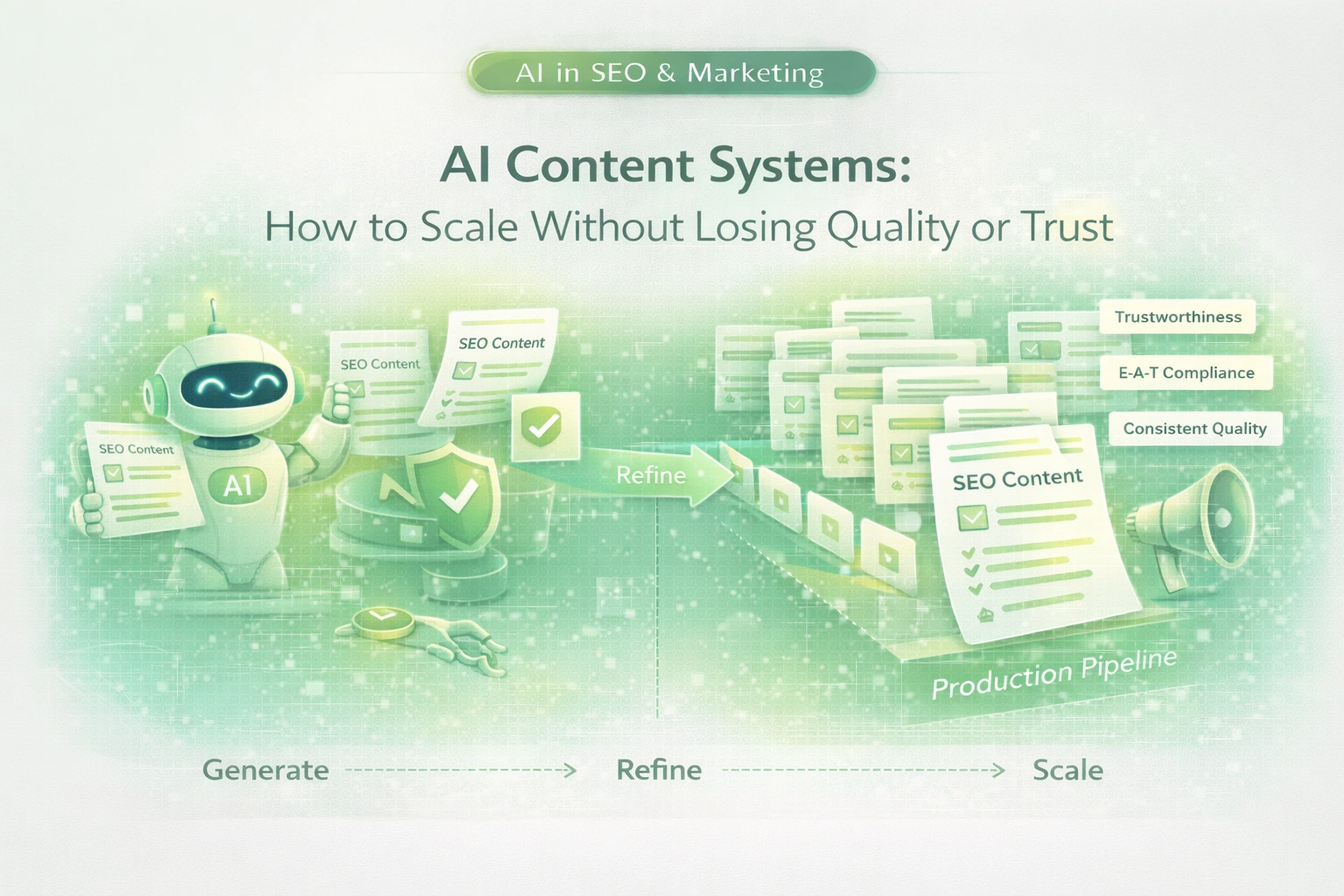
    AI Content Systems How To Scale Without Losing Quality Or Trust 1024x683
    Share
    Facebook Twitter LinkedIn Pinterest Email

    Introduction

    AI content production rarely fails because organizations move too slowly. It fails because they move too fast without structure. What begins as a controlled experiment to increase output often turns into uncontrolled scale, where quality erodes, trust weakens, and internal teams quietly disengage.

    At the enterprise level, content is not just a growth lever. It is a representation of authority, credibility, and institutional knowledge. Once trust is lost, no volume increase can compensate for it. AI content systems must therefore be designed to scale without compromising accuracy, consistency, or accountability.

    This requires treating content generation as an operational system, not a production shortcut.

    Why AI Content Scaling Commonly Fails

    Most AI content failures follow the same trajectory. Early results appear promising. Output increases. Costs drop. Then performance plateaus, editorial friction rises, and stakeholders begin questioning the reliability of what is being published.

    The underlying causes are structural, not technical.

    Output-First Thinking

    Organizations often define success by how much content AI can produce rather than by how content performs or aligns with business goals. This reverses the natural order of content strategy and introduces noise into search, messaging, and brand perception.

    Lack of Content Authority Signals

    AI-generated content that is not grounded in first-party expertise, documented processes, or validated data lacks authority. At scale, this creates a pattern that search engines and users can detect, even if individual pieces appear acceptable.

    Editorial Trust Breakdown

    When reviewers repeatedly encounter low-context or misaligned AI drafts, confidence in the system deteriorates. Editors begin bypassing AI or rewriting content entirely, eliminating efficiency gains.

    No Clear Accountability

    Without defined ownership, AI content becomes everyone’s responsibility and no one’s liability. This creates risk in regulated industries and erodes internal confidence in published assets.

    Content Scaling Is a Governance Problem

    Scaling content has never been a writing problem. It is a governance problem. AI does not change this reality; it amplifies it.

    An AI content system must answer fundamental questions before output is increased:

    • What types of content are allowed to scale?
    • What level of accuracy and sourcing is required?
    • Who validates factual claims and positioning?
    • How is consistency enforced across teams?

    If these questions are unresolved, AI accelerates inconsistency rather than value.

    Defining an AI Content System

    An AI content system is not defined by a single model or platform. It is defined by how content moves from intent to publication under controlled conditions.

    A functional system includes:

    • Clear content intent definitions
    • Documented source-of-truth inputs
    • Standardized generation constraints
    • Human validation checkpoints
    • Performance-based feedback loops

    Each component reduces uncertainty and protects trust.

    Separating Content Types Before Scaling

    One of the most common mistakes is treating all content as equally suitable for AI scale. This is operationally incorrect.

    Before scaling, content must be categorized by risk and purpose.

    Low-Risk, High-Structure Content

    Examples include glossary definitions, support documentation, and process explanations. These formats benefit most from AI assistance because the structure is predictable and validation is straightforward.

    Medium-Risk, Insight-Supported Content

    This includes SEO-driven educational content and product explainers. AI can assist, but outputs must be grounded in internal expertise, data, and review.

    High-Risk, Authority-Defining Content

    Thought leadership, strategic analysis, and policy-related content should not be scaled through AI without heavy human authorship. AI may support research synthesis, but not narrative ownership.

    Trust Is Built Through Constraints, Not Creativity

    A common misconception is that AI content systems should maximize creativity. In enterprise environments, the opposite is true.

    Trust emerges from predictability. This requires constraints such as:

    • Defined tone and positioning rules
    • Approved source types
    • Explicit assumptions and exclusions
    • Clear audience definitions

    These constraints do not limit effectiveness. They create repeatability.

    Human Review as a Structural Requirement

    Human review is often framed as a safety net. In reality, it is a design requirement.

    Effective AI content systems assign humans specific roles:

    • Subject-matter validation, not rewriting
    • Risk assessment, not stylistic correction
    • Final accountability for publication

    When human reviewers are expected to “fix” AI content, the system has already failed. Their role is to make decisions, not compensate for missing structure.

    Why Quality Degrades Without Feedback Loops

    Many AI content systems stagnate because outputs are never evaluated against outcomes. Content is produced, published, and forgotten.

    Scaling without feedback guarantees decay.

    Feedback signals should include:

    • Search performance by intent category
    • User engagement and satisfaction indicators
    • Editorial revision frequency
    • Accuracy corrections over time

    These signals must inform prompt updates, content rules, and review thresholds. Without this loop, AI content systems become static and unreliable.

    SEO Trust and AI Content

    From an SEO perspective, trust is not abstract. It manifests in crawl behavior, ranking stability, and long-term visibility.

    Search engines evaluate patterns, not individual pages. Large volumes of shallow or inconsistent AI content weaken site-wide signals, even if some pages perform well.

    A system-first approach protects SEO by:

    • Maintaining topical coherence
    • Preserving internal linking integrity
    • Ensuring factual consistency across assets

    This is not about avoiding AI detection. It is about avoiding systemic dilution.

    Scaling Output Without Scaling Risk

    The goal of AI content systems is not maximum production. It is a controlled expansion.

    Organizations that succeed scale along three dimensions:

    • Volume increases only after validation capacity exists
    • New content types are added incrementally
    • Governance tightens as output grows

    This approach feels slower in the short term. It is significantly faster in the long term.

    Designing Content Systems for Longevity

    AI models will change. Content standards should not.

    A durable AI content system is model-agnostic. It relies on documented inputs, review logic, and performance criteria that persist regardless of technology shifts.

    This allows organizations to replace tools without retraining teams or rebuilding trust from scratch.

    Conclusion

    Scaling content with AI is not a production challenge. It is a systems design challenge.

    Organizations that treat AI as an accelerator without governance lose quality and trust at scale. Those that design AI content systems deliberately preserve authority while expanding reach.

    The defining question is not how much content AI can produce, but how much trust the system can sustain as output grows.

    Share. Facebook Twitter Pinterest LinkedIn Tumblr Email
    yashwant160@gmail.com
    • Website

    Related Posts

    AI in Marketing Is a System, Not a Toolset

    February 3, 2026
    Leave A Reply Cancel Reply

    Don't Miss

    Personal Branding Without the Cringe: Building Professional Credibility That Actually Works

    yashwant160@gmail.comFebruary 6, 2026

    Personal branding has a reputation problem. Too often, it’s confused with self-promotion, performative posting, or…

    Career Resilience: How to Build a Job That Survives Layoffs, AI, and Market Shifts

    February 6, 2026

    From Individual Contributor to Leader: The Career Shift Most People Get Wrong

    February 6, 2026

    The Non-Linear Career: Why the Best Careers No Longer Follow a Straight Path

    February 6, 2026
    Stay In Touch
    • Facebook
    • Twitter
    • Pinterest
    • Instagram
    • YouTube
    • Vimeo

    Subscribe to Updates

    Get the latest creative news from SmartMag about art & design.

    About Us

    Results-driven digital professional with 15+ years of experience across Web Operations, Enterprise SEO, and large-scale digital platforms. I specialize in building, scaling, and optimizing complex websites where performance, search visibility, and operational reliability must work together—not in silos. My work sits at the intersection of strategy and execution, translating business goals into systems that teams can actually run.

    Facebook X (Twitter) Pinterest YouTube
    Our Picks

    Personal Branding Without the Cringe: Building Professional Credibility That Actually Works

    February 6, 2026

    Career Resilience: How to Build a Job That Survives Layoffs, AI, and Market Shifts

    February 6, 2026

    From Individual Contributor to Leader: The Career Shift Most People Get Wrong

    February 6, 2026
    Most Popular

    Top 15 popular link building methods you should consider before it’s too late

    March 24, 20180 Views

    Quality Score Demystified: What Actually Improves SEM Performance

    January 31, 20260 Views

    How SEO, SEM, Email, and Paid Social Should Work Together

    February 2, 20260 Views
    © 2026 All rights reserved. Y. K. Thakur.
    • Home
    • Technical SEO
    • World
    • Lifestyle
    • Buy Now

    Type above and press Enter to search. Press Esc to cancel.