

Introduction
AI-driven SEO workflows are often introduced with a single goal: automation. Teams look for tasks to eliminate, steps to accelerate, and decisions to offload. In isolation, this approach appears rational. In practice, it creates fragile systems that optimize activity while degrading outcomes.
SEO is not a linear production line. It is a decision-driven discipline operating inside a volatile search environment. Automating the wrong parts of that system does not create leverage; it creates blind spots.
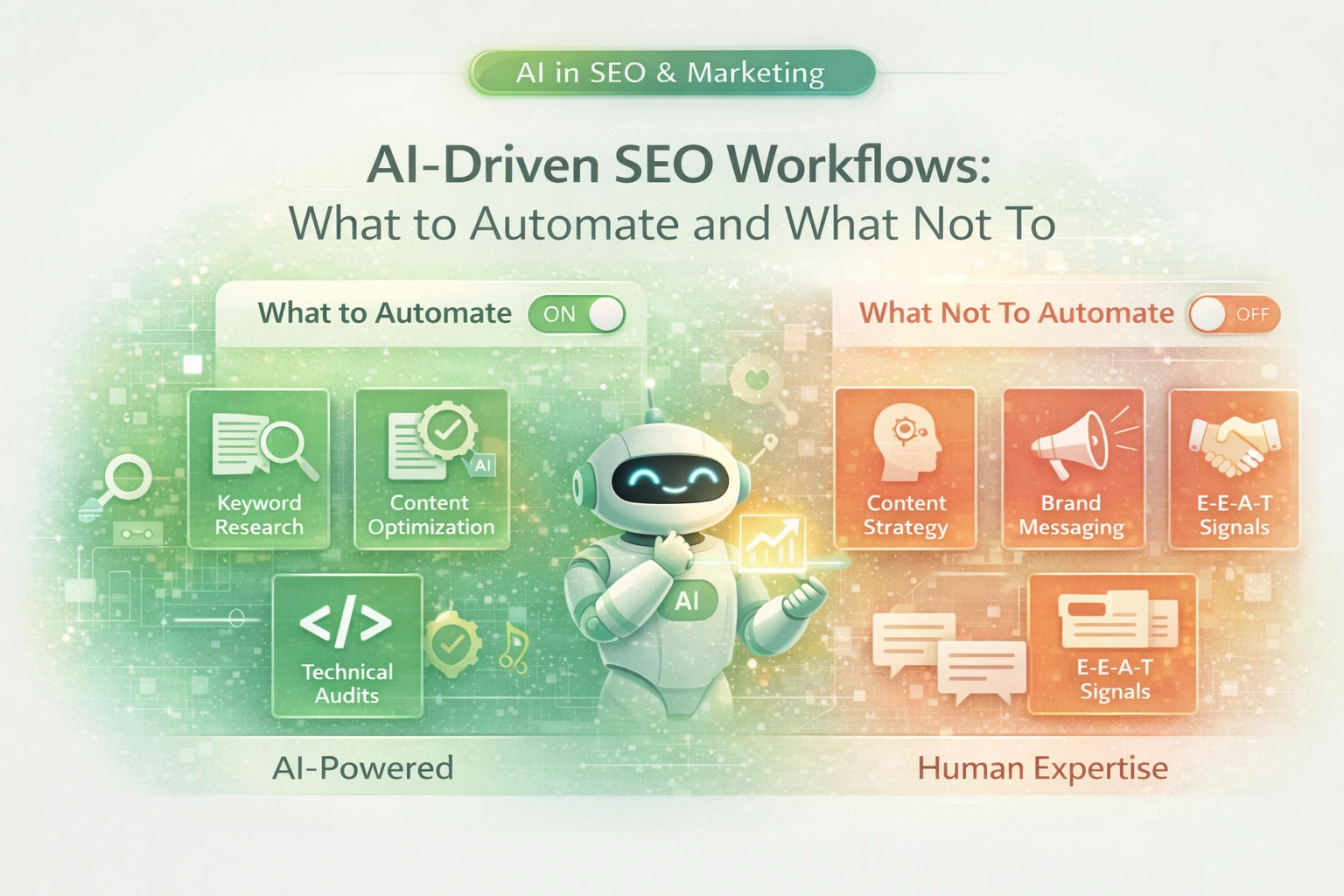
The strategic question is not how much SEO can be automated, but which parts should be automated, which must remain human-led, and how the two interact without eroding trust or control.
Why Automation-First SEO Strategies Fail
Automation-first thinking assumes SEO work is primarily executional. This assumption breaks down at scale.
Most failed AI SEO initiatives share common characteristics:
- Automation decisions are made without risk classification
- Efficiency is prioritized over signal quality
- Outputs are executed without human interpretation
The result is faster execution of poorly contextualized decisions.
Speed Amplifies Errors
AI systems do not introduce new mistakes; they scale existing ones. A flawed assumption embedded in an automated workflow propagates across thousands of pages before detection.
Search Signals Are Misread as Instructions
Ranking fluctuations, crawl anomalies, and engagement changes are often ambiguous. Automation systems that react mechanically to these signals turn noise into action.
Accountability Becomes Unclear
When AI executes changes automatically, responsibility diffuses. Teams struggle to explain why changes were made or whether they should be reversed.
SEO Workflows Are Decision Chains
Every SEO task sits somewhere on a decision chain, from data collection to execution.
Understanding this chain is essential before introducing AI.
- Signal collection and normalization
- Pattern detection and analysis
- Prioritization and trade-off evaluation
- Execution and validation
AI excels at some of these stages and performs poorly at others.
What AI Should Automate in SEO
Automation works best where tasks are repetitive, high-volume, and low-risk.
Data Aggregation and Normalization
AI systems can consolidate data from search console, analytics platforms, crawl tools, and logs into consistent formats. This reduces manual overhead and improves visibility.
Pattern and Anomaly Detection
AI can surface unusual changes in impressions, crawl behavior, indexation, or internal link distribution faster than human monitoring.
First-Pass Analysis
Generating hypotheses, summarizing technical issues, and clustering content by intent are appropriate uses of AI. These outputs accelerate diagnosis but do not replace conclusions.
Structured Recommendations
AI can propose remediation options with estimated impact and dependencies. These recommendations should be treated as inputs to planning, not execution triggers.
What Should Not Be Fully Automated
Certain SEO decisions require contextual judgment that AI cannot reliably provide.
Strategic Prioritization
Deciding which initiatives align with business goals, resource availability, and risk tolerance must remain human-led. AI lacks awareness of organizational constraints.
Content Authority Decisions
Determining whether content reinforces or undermines brand authority involves nuance AI cannot assess. Automation here risks long-term trust erosion.
Large-Scale Technical Changes
Site-wide changes such as migrations, taxonomy restructures, or indexation policy shifts should never execute without explicit human approval.
Reactive Algorithm Response
Automating responses to perceived algorithm updates encourages overfitting and instability. Human interpretation is required to separate signal from speculation.
Designing Hybrid AI SEO Workflows
High-performing organizations design workflows where AI supports humans, not replaces them.
AI as Signal Generator
AI surfaces patterns and anomalies continuously. Humans decide which signals warrant action.
Humans as Decision Owners
Every action has a named owner who approves, documents, and evaluates outcomes.
Execution With Guardrails
Automation may execute predefined actions only within strict thresholds and rollback mechanisms.
Risk Classification Enables Safe Automation
Not all SEO tasks carry equal risk. Automation decisions should follow a risk-based framework.
- Low risk: reporting, monitoring, aggregation
- Medium risk: recommendations, simulations, drafts
- High risk: execution affecting indexation or authority
Automation should concentrate on low-risk layers while supporting, not replacing, higher-risk decisions.
Feedback Loops Prevent Workflow Decay
AI-driven workflows degrade without continuous evaluation.
Effective systems incorporate feedback from:
- SEO performance changes post-action
- False positives surfaced by AI
- Human overrides and rejections
These signals refine thresholds, prompts, and automation scope over time.
Why Over-Automation Reduces SEO Maturity
Paradoxically, excessive automation often correlates with weaker SEO programs.
Teams lose interpretive skill, rely on opaque systems, and struggle to respond when automation fails. Mature SEO organizations retain deep understanding while using AI to extend capacity.
Scaling SEO Without Losing Control
As SEO operations expand across regions and properties, AI-driven workflows provide consistency without central bottlenecks.
Local teams operate within governed frameworks. AI ensures visibility and standardization. Leadership retains strategic oversight.
Conclusion
AI-driven SEO workflows succeed when automation is selective, intentional, and governed.
Automating analysis and monitoring creates leverage. Automating judgment creates risk.
The organizations that win with AI in SEO are not those that automate the most, but those that automate the right things while keeping responsibility firmly human.
