
Introduction
As organizations scale, their web footprint fragments. New brands are acquired, regions demand autonomy, and platforms proliferate. What begins as a single website becomes dozens or hundreds of sites spread across multiple CMSs, hosting stacks, and release cycles.
Centralizing control is rarely realistic. Forcing a single CMS, a single workflow, or a single deployment cadence often slows teams and creates resistance. At the same time, leaving each site to operate independently produces inconsistency, duplicated effort, and unpredictable SEO outcomes.
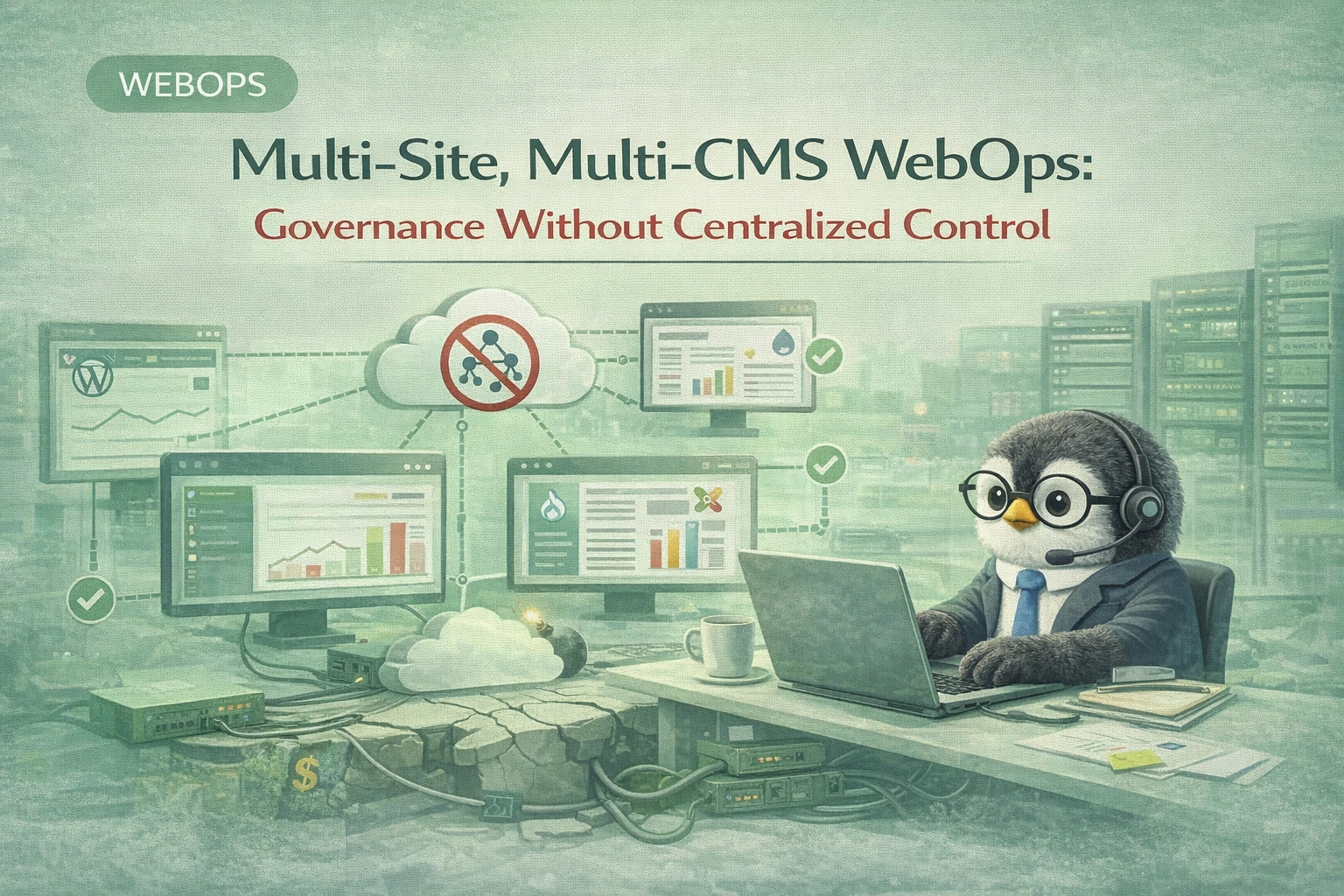
This article examines how mature organizations govern multi-site, multi-CMS ecosystems without choking local velocity, and why WebOps success in these environments depends on standards, contracts, and observability rather than command-and-control.
Why Multi-Site Complexity Is Inevitable
Multi-site environments are usually the result of rational decisions.
Common drivers include:
- Global expansion with regional requirements
- Mergers and acquisitions
- Different product lines with distinct needs
- Legacy platforms that cannot be retired quickly
The mistake is not allowing diversity. The mistake is allowing diversity without coordination.
The Failure of Centralized Web Control
Attempts to centralize everything typically fail for predictable reasons.
- Local teams lose agility
- Platform decisions become political
- Shadow systems emerge to bypass constraints
From an SEO and reliability perspective, this often makes outcomes worse, not better.
Governance Is Not Platform Standardization
Governance is frequently confused with standardization.
Standardization dictates tools. Governance defines rules of behavior.
Effective WebOps governance focuses on:
- What outcomes must be consistent
- What signals search engines should see everywhere
- What teams are free to decide locally
This distinction allows autonomy without chaos.
Defining Non-Negotiable Web Contracts
In multi-CMS environments, contracts matter more than implementations.
Non-negotiable contracts often include:
- Response code and redirect behavior
- Rendering expectations for indexable pages
- Metadata and directive consistency
- Performance and accessibility baselines
How each platform meets these contracts can vary.
SEO Consistency Without CMS Uniformity
Search engines do not care which CMS generates a page. They care about what the page communicates.
Consistency should be enforced at the signal level:
- Predictable URL structures
- Stable internal linking patterns
- Clear indexation intent
This approach scales better than enforcing a single CMS.
Shared Services as the Control Layer
Mature organizations centralize services, not sites.
Shared services may include:
- CDN and edge configuration
- Monitoring and observability
- Security and bot management
- SEO validation tooling
This creates consistency where it matters most.
Release Autonomy With Guardrails
Different sites release at different speeds.
WebOps governance supports this by:
- Defining risk tiers for changes
- Applying validation requirements by tier
- Allowing low-risk changes to move quickly
Guardrails replace bottlenecks.
Why Documentation Becomes Critical at Scale
In fragmented ecosystems, tribal knowledge does not scale.
Documentation must cover:
- SEO and WebOps standards
- Approved patterns and anti-patterns
- Escalation and incident processes
This reduces dependency on individuals and accelerates onboarding.
Observability Across Sites and Platforms
Governance without visibility is theoretical.
Multi-site observability focuses on:
- Crawl and indexation patterns by site
- Performance consistency across platforms
- Incident correlation across regions
This allows central teams to detect systemic issues early.
Managing Divergence Intentionally
Not all divergence is bad.
Organizations should explicitly decide:
- Where experimentation is allowed
- Where consistency is mandatory
- How successful patterns are shared
Unplanned divergence is a risk. Intentional divergence is learning.
Roles and Accountability in Distributed WebOps
Clear roles prevent governance from becoming advisory noise.
Effective models define:
- Local site owners are accountable for compliance
- Central WebOps teams are accountable for standards
- Clear escalation paths for conflicts
Ambiguity undermines enforcement.
Why SEO Suffers First in Fragmented Ecosystems
SEO is often the first signal of fragmentation.
Search engines detect:
- Inconsistent internal linking
- Variable performance and rendering
- Conflicting indexation intent
Without governance, these signals diverge silently.
Designing Governance That Scales With Growth
Governance must evolve as the ecosystem grows.
Scalable governance:
- Focuses on principles over prescriptions
- Automates validation where possible
- Adapts standards based on observed outcomes
Static rules do not survive dynamic organizations.
Conclusion
Multi-site, multi-CMS environments are not a failure of planning. They are a reality of growth.
Organizations that attempt to eliminate diversity through centralization create friction without reliability. Those that govern through clear contracts, shared services, and observability achieve consistency without sacrificing autonomy.
At enterprise scale, WebOps success is not about controlling every site. It is about ensuring that every site behaves predictably where it matters most.
