Close Menu
blog.ykthakur.com

    Subscribe to Updates

    Get the latest creative news from FooBar about art, design and business.

    What's Hot

    Personal Branding Without the Cringe: Building Professional Credibility That Actually Works

    February 6, 2026

    Career Resilience: How to Build a Job That Survives Layoffs, AI, and Market Shifts

    February 6, 2026

    From Individual Contributor to Leader: The Career Shift Most People Get Wrong

    February 6, 2026
    Facebook X (Twitter) Instagram
    blog.ykthakur.com
    • Home
    • About Me
    • Case Studies
    • Services
    • Contact Us
    Facebook X (Twitter) Instagram
    Subscribe
    • Blog
    • Search & Growth
      1. SEO
      2. Technical SEO
      3. SEM
      4. Paid Advertisements
      5. View All

      Why SEO Fails Even With the Right Tools and Data

      January 31, 2026

      How to Refresh Old Content Without Losing Rankings

      January 31, 2026

      How to Build a Topic Authority Map for SEO

      January 31, 2026

      E-E-A-T Signals Explained: What Actually Influences Trust and Rankings

      January 31, 2026

      XML Sitemaps at Scale: Signaling Priority, Not Forcing Indexation

      February 3, 2026

      Robots.txt at Scale: Control, Risk, and the Limits of Crawl Directives

      February 3, 2026

      Monitoring, Alerting, and SEO Observability: Seeing Failures Before Traffic Drops

      February 3, 2026

      Migrations, Releases, and SEO Risk: How Technical Changes Break Search at Scale

      February 3, 2026

      Scaling SEM Without Burning Budget

      January 31, 2026

      SEM vs SEO: How Paid Search Should Support Organic Growth

      January 31, 2026

      Quality Score Demystified: What Actually Improves SEM Performance

      January 31, 2026

      Brand vs Non-Brand Search: Budget Allocation Reality

      January 31, 2026

      Personal Branding Without the Cringe: Building Professional Credibility That Actually Works

      February 6, 2026

      Career Resilience: How to Build a Job That Survives Layoffs, AI, and Market Shifts

      February 6, 2026

      From Individual Contributor to Leader: The Career Shift Most People Get Wrong

      February 6, 2026

      The Non-Linear Career: Why the Best Careers No Longer Follow a Straight Path

      February 6, 2026
    • Performance & Infrastructure
      1. Website Performance
      2. Core Web Vitals
      3. Hosting Architecture
      4. Web Application Infrastructure
      5. Load Balancing
      6. View All

      Performance Drift: How Sites Get Slower Without Any One Bad Change

      February 3, 2026

      Why passing scores still hide systemic performance risk

      February 3, 2026

      Performance Monitoring Beyond Core Web Vitals

      February 3, 2026

      Personal Branding Without the Cringe: Building Professional Credibility That Actually Works

      February 6, 2026

      Career Resilience: How to Build a Job That Survives Layoffs, AI, and Market Shifts

      February 6, 2026

      From Individual Contributor to Leader: The Career Shift Most People Get Wrong

      February 6, 2026

      The Non-Linear Career: Why the Best Careers No Longer Follow a Straight Path

      February 6, 2026
    • AI & Automation
      1. AI Content Systems
      2. AI in SEO & Marketing
      3. AI Search Analysis
      4. AI-Driven SEO Workflows
      5. Generative AI Strategy
      6. View All

      AI Content Systems: How to Scale Without Losing Quality or Trust

      February 3, 2026

      AI in Marketing Is a System, Not a Toolset

      February 3, 2026

      SEO in a Zero-Click World: Designing for AI Answers and Visibility

      February 3, 2026

      AI Search Analysis: How LLMs Interpret and Surface Content

      February 3, 2026

      Using AI for Technical SEO Analysis Without Breaking Trust

      February 3, 2026

      AI-Driven SEO Workflows: What to Automate and What Not To

      February 3, 2026

      SEO in a Zero-Click World: Designing for AI Answers and Visibility

      February 3, 2026

      AI Search Analysis: How LLMs Interpret and Surface Content

      February 3, 2026

      Using AI for Technical SEO Analysis Without Breaking Trust

      February 3, 2026

      AI-Driven SEO Workflows: What to Automate and What Not To

      February 3, 2026

      Why Most AI SEO Implementations Fail

      February 3, 2026

      Human-in-the-Loop SEO: Where AI Stops and Judgment Starts

      February 3, 2026

      Personal Branding Without the Cringe: Building Professional Credibility That Actually Works

      February 6, 2026

      Career Resilience: How to Build a Job That Survives Layoffs, AI, and Market Shifts

      February 6, 2026

      From Individual Contributor to Leader: The Career Shift Most People Get Wrong

      February 6, 2026

      The Non-Linear Career: Why the Best Careers No Longer Follow a Straight Path

      February 6, 2026
    • Analytics & Intelligence
      1. GA4 Architecture
      2. Adobe Analytics
      3. View All

      GA4 vs Adobe Analytics: Choosing the Right Tool for Your Organization

      February 2, 2026

      Consent, Privacy, and Measurement: What Changes After GDPR & GA4

      February 2, 2026

      GA4 Architecture Explained: Designing Events for Real Decisions

      February 2, 2026

      GA4 vs Adobe Analytics: Choosing the Right Tool for Your Organization

      February 2, 2026

      Personal Branding Without the Cringe: Building Professional Credibility That Actually Works

      February 6, 2026

      Career Resilience: How to Build a Job That Survives Layoffs, AI, and Market Shifts

      February 6, 2026

      From Individual Contributor to Leader: The Career Shift Most People Get Wrong

      February 6, 2026

      The Non-Linear Career: Why the Best Careers No Longer Follow a Straight Path

      February 6, 2026
    • WebOps & DevOps
      1. Web Operations
      2. WebOps Roles
      3. Website Migrations & Scaling
      4. Release Management
      5. Monitoring & Alerts
      6. Performance Monitoring
      7. Deployment Automation
      8. View All

      SEO and WebOps Monitoring: Aligning Health Signals Across Systems

      February 3, 2026

      Designing Alerts for WebOps: Signal, Severity, and Actionability

      February 3, 2026

      Why Most Website Monitoring Is Too Late to Be Useful

      February 3, 2026

      Release Cadence Versus Stability: Finding the Sustainable Balance

      February 3, 2026

      Website Migrations at Scale: Why Most Fail Before the First Redirect

      February 3, 2026

      Post-Migration Reality: Why SEO and Performance Losses Persist for Months

      February 3, 2026

      Scaling Websites Without Replatforming: When Migration Is the Wrong Answer

      February 3, 2026

      Release Cadence Versus Stability: Finding the Sustainable Balance

      February 3, 2026

      Why Website Releases Break SEO Even When Nothing “Major” Changes

      February 3, 2026

      Release Management for Websites: Coordinating Risk Across Teams

      February 3, 2026

      Release Pipelines and Search Risk: Why Velocity Without Guardrails Breaks Websites

      February 3, 2026

      SEO and WebOps Monitoring: Aligning Health Signals Across Systems

      February 3, 2026

      Designing Alerts for WebOps: Signal, Severity, and Actionability

      February 3, 2026

      Why Most Website Monitoring Is Too Late to Be Useful

      February 3, 2026

      Feature Flags, Experiments, and the SEO Blast Radius

      February 3, 2026

      Performance Drift: How Sites Get Slower Without Any One Bad Change

      February 3, 2026

      Performance Monitoring Beyond Core Web Vitals

      February 3, 2026

      Designing SEO-Safe Deployment Automation

      February 3, 2026

      Deployment Automation for Websites: What to Automate and What Not To

      February 3, 2026

      Personal Branding Without the Cringe: Building Professional Credibility That Actually Works

      February 6, 2026

      Career Resilience: How to Build a Job That Survives Layoffs, AI, and Market Shifts

      February 6, 2026

      From Individual Contributor to Leader: The Career Shift Most People Get Wrong

      February 6, 2026

      The Non-Linear Career: Why the Best Careers No Longer Follow a Straight Path

      February 6, 2026
    • Project Strategy

      Personal Branding Without the Cringe: Building Professional Credibility That Actually Works

      February 6, 2026

      Career Resilience: How to Build a Job That Survives Layoffs, AI, and Market Shifts

      February 6, 2026

      From Individual Contributor to Leader: The Career Shift Most People Get Wrong

      February 6, 2026

      The Non-Linear Career: Why the Best Careers No Longer Follow a Straight Path

      February 6, 2026

      How to Stay Relevant When Roles Are Changing Faster Than Job Descriptions

      February 6, 2026
    • Web Engineering
      1. Web Development
      2. Web Designing & UX
      3. CMS & Platforms
      4. Web Application Firewall
      5. View All

      Personal Branding Without the Cringe: Building Professional Credibility That Actually Works

      February 6, 2026

      Career Resilience: How to Build a Job That Survives Layoffs, AI, and Market Shifts

      February 6, 2026

      From Individual Contributor to Leader: The Career Shift Most People Get Wrong

      February 6, 2026

      The Non-Linear Career: Why the Best Careers No Longer Follow a Straight Path

      February 6, 2026
    blog.ykthakur.com
    Home»Web Operations»Incident Response»Configuration Drift and Website Entropy: How Small Changes Quietly Break Large Sites
    Incident Response

    Configuration Drift and Website Entropy: How Small Changes Quietly Break Large Sites

    How small, untracked changes accumulate into fragile, un-debuggable web systems Why sites “decay” even without redesigns
    yashwant160@gmail.comBy yashwant160@gmail.comFebruary 3, 2026Updated:February 27, 2026No Comments4 Mins Read
    Share Facebook Twitter Pinterest LinkedIn Tumblr Email
    Follow Us
    Google News Flipboard Threads
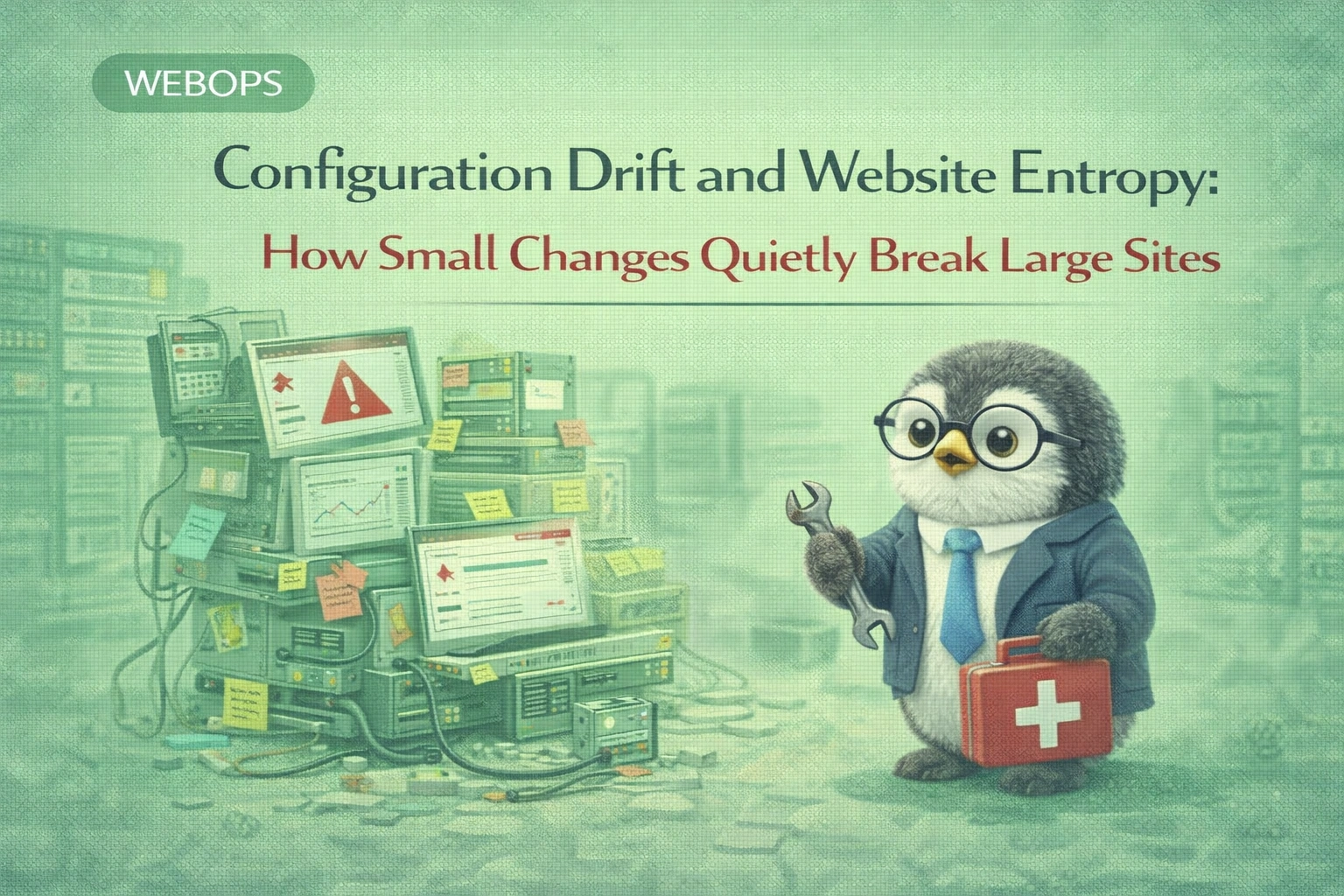
    Configuration Drift And Website Entropy How Small Changes Quietly Break Large Sites 1024x683
    Share
    Facebook Twitter LinkedIn Pinterest Email

    Introduction

    Large websites rarely fail because of a single bad decision. They fail because of accumulation. Small configuration changes, made for valid reasons at the time, compound into systems that are difficult to understand, harder to test, and fragile under change.

    This phenomenon is not unique to SEO, performance, or reliability. It is a form of entropy. As platforms evolve, configuration diverges from original intent. Defaults are overridden. Exceptions are layered. Temporary fixes become permanent. Over time, no one can confidently explain how the system behaves end to end.

    This article examines configuration drift as a WebOps and DevOps failure mode, explains why it disproportionately harms search visibility and performance, and outlines how mature organizations design controls that prevent entropy rather than reacting to it.

    What Configuration Drift Actually Is

    Configuration drift occurs when the live behavior of a system no longer matches its documented or intended state.

    In web platforms, drift commonly affects:

    • Routing and rewrite rules
    • Cache behavior and headers
    • Security and access controls
    • Rendering and feature flags

    Each change may be reasonable in isolation. Collectively, they create unpredictability.

    Why Drift Is Invisible Until It Matters

    Configuration changes rarely trigger immediate failures. They often improve a local outcome while degrading system coherence.

    Drift goes unnoticed because:

    • Changes are distributed across teams
    • No single owner sees the full impact
    • Monitoring focuses on outcomes, not causes

    By the time SEO or performance issues surface, the causal chain is long and fragmented.

    How Website Entropy Affects Search Engines

    Search engines depend on consistency.

    Configuration drift introduces:

    • Inconsistent responses for the same URLs
    • Unstable caching and render behavior
    • Conflicting signals across environments

    From a search perspective, this looks like unreliability rather than evolution.

    Common Sources of Drift in WebOps Environments

    Ad Hoc Overrides

    Emergency fixes, campaign-specific exceptions, and temporary workarounds often bypass standard processes. When not reversed, they become permanent divergence.

    Infrastructure and CDN Configuration Changes

    Edge rules, cache keys, and header policies evolve independently from application code. SEO teams often discover their impact only after crawl or indexation changes.

    Feature Flags That Never Retire

    Flags introduced for experiments or phased rollouts persist indefinitely, creating multiple execution paths that are difficult to reason about or test.

    Environment-Specific Tweaks

    Production-only changes undermine validation. When environments diverge, testing loses predictive value.

    Why Drift Hits SEO Harder Than Other Disciplines

    Many web issues can be tolerated briefly. SEO cannot.

    Search engines observe behavior over time. When configuration drift causes intermittent or uneven behavior:

    • Crawl frequency becomes conservative
    • Indexation confidence weakens
    • Recovery timelines lengthen

    SEO impact is delayed but persistent.

    Configuration as Code Is Necessary but Not Sufficient

    Infrastructure-as-code and configuration-as-code reduce accidental drift, but they do not eliminate it.

    Drift still occurs when:

    • Code is merged without system-level review
    • Temporary changes are not tracked to closure
    • Ownership of the configuration is unclear

    Tools enforce consistency only when paired with discipline.

    Baselines Are the Antidote to Entropy

    You cannot control what you cannot describe.

    Effective organizations define baselines for:

    • Response behavior by template
    • Caching and header policies
    • Rendering expectations

    Baselines turn vague “it seems slower” or “crawl feels off” into testable deviations.

    Change Tracking and Intent Documentation

    Every configuration change carries intent.

    When intent is undocumented:

    • Reversals are avoided due to uncertainty
    • New changes stack on old assumptions
    • Ownership dissolves over time

    Documenting intent is not bureaucracy. It is future-proofing.

    Why Rollback Paths Matter More Than Perfection

    Entropy is inevitable. What matters is recoverability.

    Systems that support:

    • Fast rollback of configuration changes
    • Isolation of high-risk overrides
    • Clear revert ownership

    degrade slowly rather than catastrophically.

    Auditing for Drift as a Routine Practice

    Drift should be expected and monitored.

    Routine audits focus on:

    • Differences between intended and observed behavior
    • Configuration that no longer maps to active use cases
    • Redundant or conflicting rules

    These audits prevent silent accumulation.

    Entropy Increases With Organizational Complexity

    As teams and markets scale, drift accelerates.

    Without centralized standards and local accountability:

    • Regional exceptions multiply
    • Global consistency erodes
    • SEO behavior diverges unpredictably

    Governance slows entropy without blocking autonomy.

    Designing Systems That Resist Drift

    Drift-resistant systems share common traits:

    • Minimal configuration surfaces
    • Clear ownership boundaries
    • Regular validation against baselines

    They accept change while constraining chaos.

    Conclusion

    Configuration drift is not a failure of individuals. It is a failure of systems to account for time, change, and complexity.

    In WebOps and DevOps environments, entropy is the default state. Organizations that acknowledge this and design controls to counter it maintain search visibility, performance, and reliability longer than those that rely on vigilance alone.

    At scale, stability is not preserved by freezing systems. It is preserved by managing change deliberately, before small deviations become structural failures.

    Share. Facebook Twitter Pinterest LinkedIn Tumblr Email
    yashwant160@gmail.com
    • Website

    Related Posts

    Incident Response for Websites: SEO, Performance, and Availability

    February 3, 2026
    Leave A Reply Cancel Reply

    Don't Miss

    Personal Branding Without the Cringe: Building Professional Credibility That Actually Works

    yashwant160@gmail.comFebruary 6, 2026

    Personal branding has a reputation problem. Too often, it’s confused with self-promotion, performative posting, or…

    Career Resilience: How to Build a Job That Survives Layoffs, AI, and Market Shifts

    February 6, 2026

    From Individual Contributor to Leader: The Career Shift Most People Get Wrong

    February 6, 2026

    The Non-Linear Career: Why the Best Careers No Longer Follow a Straight Path

    February 6, 2026
    Stay In Touch
    • Facebook
    • Twitter
    • Pinterest
    • Instagram
    • YouTube
    • Vimeo

    Subscribe to Updates

    Get the latest creative news from SmartMag about art & design.

    About Us

    Results-driven digital professional with 15+ years of experience across Web Operations, Enterprise SEO, and large-scale digital platforms. I specialize in building, scaling, and optimizing complex websites where performance, search visibility, and operational reliability must work together—not in silos. My work sits at the intersection of strategy and execution, translating business goals into systems that teams can actually run.

    Facebook X (Twitter) Pinterest YouTube
    Our Picks

    Personal Branding Without the Cringe: Building Professional Credibility That Actually Works

    February 6, 2026

    Career Resilience: How to Build a Job That Survives Layoffs, AI, and Market Shifts

    February 6, 2026

    From Individual Contributor to Leader: The Career Shift Most People Get Wrong

    February 6, 2026
    Most Popular

    Top 15 popular link building methods you should consider before it’s too late

    March 24, 20180 Views

    Quality Score Demystified: What Actually Improves SEM Performance

    January 31, 20260 Views

    How SEO, SEM, Email, and Paid Social Should Work Together

    February 2, 20260 Views
    © 2026 All rights reserved. Y. K. Thakur.
    • Home
    • Technical SEO
    • World
    • Lifestyle
    • Buy Now

    Type above and press Enter to search. Press Esc to cancel.