

Introduction
Most organizations believe they understand their WebOps maturity by looking at tooling. Do they have CI/CD pipelines? Monitoring dashboards? On-call rotations? These indicators are useful, but they are not decisive.
WebOps maturity is not defined by what tools exist. It is defined by how predictable outcomes are. Mature organizations experience fewer surprises, recover faster when failures occur, and can explain why systems behave the way they do. Immature organizations rely on heroics, intuition, and post-hoc explanations.
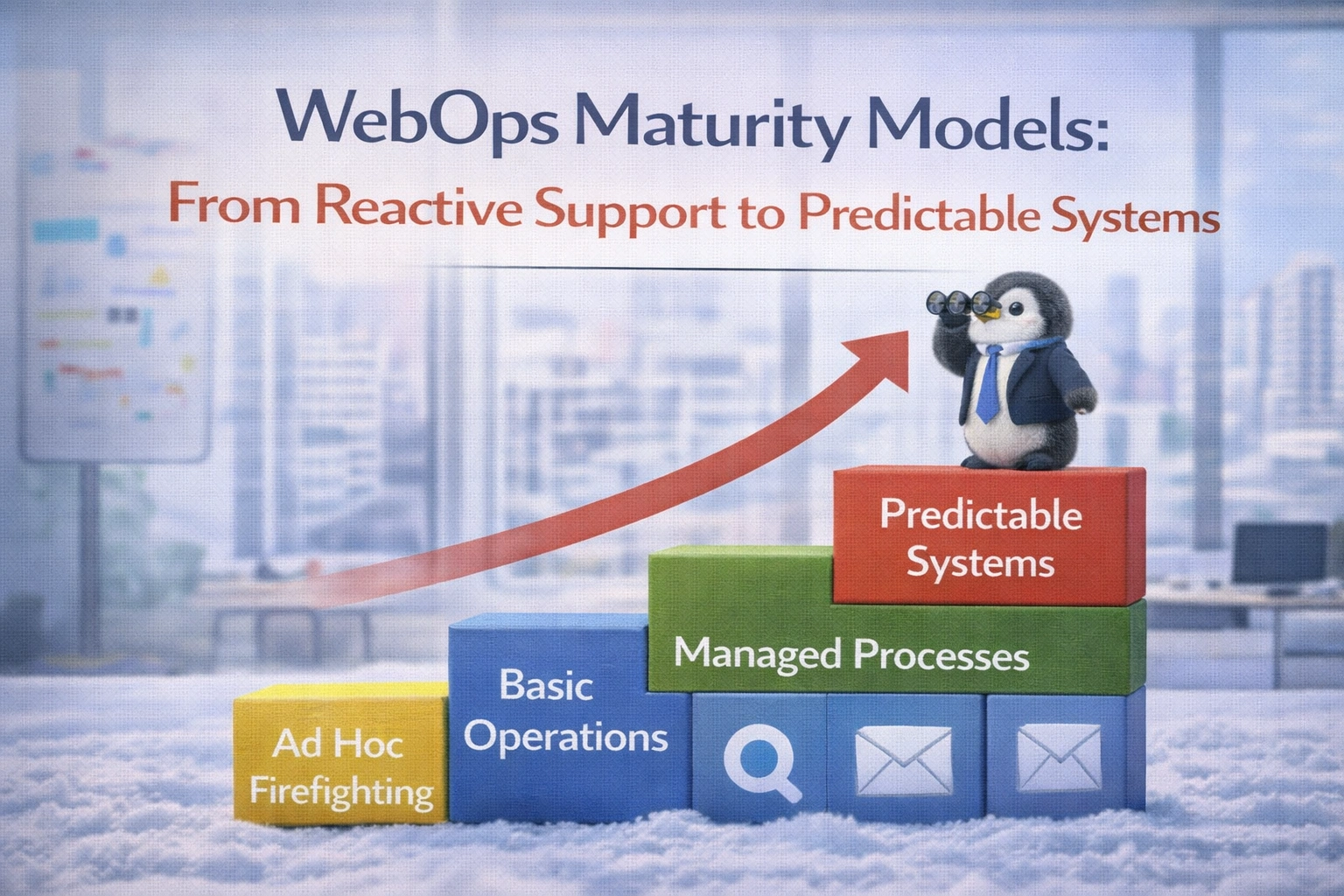
This article outlines a practical WebOps maturity model focused on outcomes rather than implementations, showing how organizations evolve from reactive support functions to predictable, system-driven operations that protect SEO, performance, and reliability at scale.
Why WebOps Maturity Is Often Misdiagnosed
Many teams equate activity with maturity. Frequent deployments, complex pipelines, and extensive dashboards create the appearance of control.
In reality, immaturity reveals itself through:
- Repeated incidents with similar root causes
- Unexplained SEO and performance volatility
- Dependence on individual experts to maintain stability
Maturity is measured by consistency, not motion.
A Systems-Based View of Maturity
A useful maturity model focuses on how systems behave under change.
Key questions include:
- Are outcomes repeatable across releases?
- Are failures detected early or late?
- Is recovery driven by process or improvisation?
These questions cut across tooling choices and organizational structure.
Level 1: Reactive Support
At this stage, WebOps functions primarily as a support queue.
- Issues are addressed when reported
- SEO and performance problems are discovered via traffic drops
- Knowledge resides with individuals rather than systems
Outcomes depend heavily on experience and availability rather than design.
Level 2: Operational Awareness
Organizations at this level begin to see patterns.
- Basic monitoring and alerting are in place
- Recurring issues are recognized but not eliminated
- SEO is consulted after problems emerge
Awareness improves response, but root causes persist.
Level 3: Defined Processes
At this stage, organizations formalize how work flows.
- Release processes are documented
- SEO requirements are known, if not enforced
- Post-incident reviews identify systemic gaps
Consistency improves, but enforcement remains uneven.
Level 4: Governed Systems
Governance becomes explicit.
- Non-negotiable standards are defined
- Validation is integrated into pipelines
- Risk is classified before changes are made
Failures still occur, but their scope and duration are constrained.
Level 5: Predictable Operations
At the highest level, outcomes are intentionally designed.
- Systems behave consistently across environments
- SEO, performance, and reliability are built-in constraints
- Incidents trigger learning rather than blame
Search engines experience the site as stable, understandable, and trustworthy.
What Changes as Maturity Increases
Maturity alters how organizations experience everyday work.
- Releases create less anxiety
- SEO teams move upstream into planning
- Fewer issues require emergency response
The shift is cultural as much as technical.
Why SEO Is a Reliable Maturity Signal
SEO outcomes reflect long-term system behavior.
In mature organizations:
- Crawl patterns are stable
- Indexation aligns with intent
- Performance regressions are rare and brief
In immature systems, SEO volatility persists regardless of effort.
The Role of Leadership in Maturity Progression
WebOps maturity cannot be delegated entirely to engineering teams.
Leadership influence is required to:
- Align incentives with stability
- Protect time for debt reduction
- Enforce standards consistently
Without leadership support, maturity plateaus.
Why Maturity Is Not Linear
Organizations may exhibit traits from multiple levels simultaneously.
Growth, acquisitions, and platform changes can temporarily reduce maturity. What matters is the ability to regain control quickly.
Assessing Your Current State
Useful assessment avoids checklists.
Better questions include:
- How often do we fix the same issue twice?
- Can we explain recent SEO volatility confidently?
- Do we trust our staging environments?
Honest answers reveal maturity gaps.
Designing a Path Forward
Advancing maturity does not require rebuilding everything.
High-leverage steps include:
- Making standards explicit
- Automating validation for known risks
- Reducing reliance on individual knowledge
Small, systemic improvements compound.
Why Predictability Beats Optimization
Organizations often chase optimization before stability.
Search engines reward predictable systems over aggressively optimized but unstable ones. Maturity creates the foundation on which optimization actually works.
Conclusion
WebOps maturity is not about sophistication. It is about control.
Organizations that progress from reactive support to predictable systems reduce SEO risk, improve performance stability, and regain confidence in change. Those that remain reactive continue to rely on heroics, regardless of investment.
At enterprise scale, maturity is not optional. It is the difference between managing growth deliberately and being managed by complexity.
