Close Menu
blog.ykthakur.com

    Subscribe to Updates

    Get the latest creative news from FooBar about art, design and business.

    What's Hot

    Personal Branding Without the Cringe: Building Professional Credibility That Actually Works

    February 6, 2026

    Career Resilience: How to Build a Job That Survives Layoffs, AI, and Market Shifts

    February 6, 2026

    From Individual Contributor to Leader: The Career Shift Most People Get Wrong

    February 6, 2026
    Facebook X (Twitter) Instagram
    blog.ykthakur.com
    • Home
    • About Me
    • Case Studies
    • Services
    • Contact Us
    Facebook X (Twitter) Instagram
    Subscribe
    • Blog
    • Search & Growth
      1. SEO
      2. Technical SEO
      3. SEM
      4. Paid Advertisements
      5. View All

      Why SEO Fails Even With the Right Tools and Data

      January 31, 2026

      How to Refresh Old Content Without Losing Rankings

      January 31, 2026

      How to Build a Topic Authority Map for SEO

      January 31, 2026

      E-E-A-T Signals Explained: What Actually Influences Trust and Rankings

      January 31, 2026

      XML Sitemaps at Scale: Signaling Priority, Not Forcing Indexation

      February 3, 2026

      Robots.txt at Scale: Control, Risk, and the Limits of Crawl Directives

      February 3, 2026

      Monitoring, Alerting, and SEO Observability: Seeing Failures Before Traffic Drops

      February 3, 2026

      Migrations, Releases, and SEO Risk: How Technical Changes Break Search at Scale

      February 3, 2026

      Scaling SEM Without Burning Budget

      January 31, 2026

      SEM vs SEO: How Paid Search Should Support Organic Growth

      January 31, 2026

      Quality Score Demystified: What Actually Improves SEM Performance

      January 31, 2026

      Brand vs Non-Brand Search: Budget Allocation Reality

      January 31, 2026

      Personal Branding Without the Cringe: Building Professional Credibility That Actually Works

      February 6, 2026

      Career Resilience: How to Build a Job That Survives Layoffs, AI, and Market Shifts

      February 6, 2026

      From Individual Contributor to Leader: The Career Shift Most People Get Wrong

      February 6, 2026

      The Non-Linear Career: Why the Best Careers No Longer Follow a Straight Path

      February 6, 2026
    • Performance & Infrastructure
      1. Website Performance
      2. Core Web Vitals
      3. Hosting Architecture
      4. Web Application Infrastructure
      5. Load Balancing
      6. View All

      Performance Drift: How Sites Get Slower Without Any One Bad Change

      February 3, 2026

      Why passing scores still hide systemic performance risk

      February 3, 2026

      Performance Monitoring Beyond Core Web Vitals

      February 3, 2026

      Personal Branding Without the Cringe: Building Professional Credibility That Actually Works

      February 6, 2026

      Career Resilience: How to Build a Job That Survives Layoffs, AI, and Market Shifts

      February 6, 2026

      From Individual Contributor to Leader: The Career Shift Most People Get Wrong

      February 6, 2026

      The Non-Linear Career: Why the Best Careers No Longer Follow a Straight Path

      February 6, 2026
    • AI & Automation
      1. AI Content Systems
      2. AI in SEO & Marketing
      3. AI Search Analysis
      4. AI-Driven SEO Workflows
      5. Generative AI Strategy
      6. View All

      AI Content Systems: How to Scale Without Losing Quality or Trust

      February 3, 2026

      AI in Marketing Is a System, Not a Toolset

      February 3, 2026

      SEO in a Zero-Click World: Designing for AI Answers and Visibility

      February 3, 2026

      AI Search Analysis: How LLMs Interpret and Surface Content

      February 3, 2026

      Using AI for Technical SEO Analysis Without Breaking Trust

      February 3, 2026

      AI-Driven SEO Workflows: What to Automate and What Not To

      February 3, 2026

      SEO in a Zero-Click World: Designing for AI Answers and Visibility

      February 3, 2026

      AI Search Analysis: How LLMs Interpret and Surface Content

      February 3, 2026

      Using AI for Technical SEO Analysis Without Breaking Trust

      February 3, 2026

      AI-Driven SEO Workflows: What to Automate and What Not To

      February 3, 2026

      Why Most AI SEO Implementations Fail

      February 3, 2026

      Human-in-the-Loop SEO: Where AI Stops and Judgment Starts

      February 3, 2026

      Personal Branding Without the Cringe: Building Professional Credibility That Actually Works

      February 6, 2026

      Career Resilience: How to Build a Job That Survives Layoffs, AI, and Market Shifts

      February 6, 2026

      From Individual Contributor to Leader: The Career Shift Most People Get Wrong

      February 6, 2026

      The Non-Linear Career: Why the Best Careers No Longer Follow a Straight Path

      February 6, 2026
    • Analytics & Intelligence
      1. GA4 Architecture
      2. Adobe Analytics
      3. View All

      GA4 vs Adobe Analytics: Choosing the Right Tool for Your Organization

      February 2, 2026

      Consent, Privacy, and Measurement: What Changes After GDPR & GA4

      February 2, 2026

      GA4 Architecture Explained: Designing Events for Real Decisions

      February 2, 2026

      GA4 vs Adobe Analytics: Choosing the Right Tool for Your Organization

      February 2, 2026

      Personal Branding Without the Cringe: Building Professional Credibility That Actually Works

      February 6, 2026

      Career Resilience: How to Build a Job That Survives Layoffs, AI, and Market Shifts

      February 6, 2026

      From Individual Contributor to Leader: The Career Shift Most People Get Wrong

      February 6, 2026

      The Non-Linear Career: Why the Best Careers No Longer Follow a Straight Path

      February 6, 2026
    • WebOps & DevOps
      1. Web Operations
      2. WebOps Roles
      3. Website Migrations & Scaling
      4. Release Management
      5. Monitoring & Alerts
      6. Performance Monitoring
      7. Deployment Automation
      8. View All

      SEO and WebOps Monitoring: Aligning Health Signals Across Systems

      February 3, 2026

      Designing Alerts for WebOps: Signal, Severity, and Actionability

      February 3, 2026

      Why Most Website Monitoring Is Too Late to Be Useful

      February 3, 2026

      Release Cadence Versus Stability: Finding the Sustainable Balance

      February 3, 2026

      Website Migrations at Scale: Why Most Fail Before the First Redirect

      February 3, 2026

      Post-Migration Reality: Why SEO and Performance Losses Persist for Months

      February 3, 2026

      Scaling Websites Without Replatforming: When Migration Is the Wrong Answer

      February 3, 2026

      Release Cadence Versus Stability: Finding the Sustainable Balance

      February 3, 2026

      Why Website Releases Break SEO Even When Nothing “Major” Changes

      February 3, 2026

      Release Management for Websites: Coordinating Risk Across Teams

      February 3, 2026

      Release Pipelines and Search Risk: Why Velocity Without Guardrails Breaks Websites

      February 3, 2026

      SEO and WebOps Monitoring: Aligning Health Signals Across Systems

      February 3, 2026

      Designing Alerts for WebOps: Signal, Severity, and Actionability

      February 3, 2026

      Why Most Website Monitoring Is Too Late to Be Useful

      February 3, 2026

      Feature Flags, Experiments, and the SEO Blast Radius

      February 3, 2026

      Performance Drift: How Sites Get Slower Without Any One Bad Change

      February 3, 2026

      Performance Monitoring Beyond Core Web Vitals

      February 3, 2026

      Designing SEO-Safe Deployment Automation

      February 3, 2026

      Deployment Automation for Websites: What to Automate and What Not To

      February 3, 2026

      Personal Branding Without the Cringe: Building Professional Credibility That Actually Works

      February 6, 2026

      Career Resilience: How to Build a Job That Survives Layoffs, AI, and Market Shifts

      February 6, 2026

      From Individual Contributor to Leader: The Career Shift Most People Get Wrong

      February 6, 2026

      The Non-Linear Career: Why the Best Careers No Longer Follow a Straight Path

      February 6, 2026
    • Project Strategy

      Personal Branding Without the Cringe: Building Professional Credibility That Actually Works

      February 6, 2026

      Career Resilience: How to Build a Job That Survives Layoffs, AI, and Market Shifts

      February 6, 2026

      From Individual Contributor to Leader: The Career Shift Most People Get Wrong

      February 6, 2026

      The Non-Linear Career: Why the Best Careers No Longer Follow a Straight Path

      February 6, 2026

      How to Stay Relevant When Roles Are Changing Faster Than Job Descriptions

      February 6, 2026
    • Web Engineering
      1. Web Development
      2. Web Designing & UX
      3. CMS & Platforms
      4. Web Application Firewall
      5. View All

      Personal Branding Without the Cringe: Building Professional Credibility That Actually Works

      February 6, 2026

      Career Resilience: How to Build a Job That Survives Layoffs, AI, and Market Shifts

      February 6, 2026

      From Individual Contributor to Leader: The Career Shift Most People Get Wrong

      February 6, 2026

      The Non-Linear Career: Why the Best Careers No Longer Follow a Straight Path

      February 6, 2026
    blog.ykthakur.com
    Home»Technical SEO»Information Architecture at Scale: How Structure Determines Search Performance
    Technical SEO

    Information Architecture at Scale: How Structure Determines Search Performance

    yashwant160@gmail.comBy yashwant160@gmail.comFebruary 3, 2026Updated:February 26, 2026No Comments4 Mins Read
    Share Facebook Twitter Pinterest LinkedIn Tumblr Email
    Follow Us
    Google News Flipboard Threads
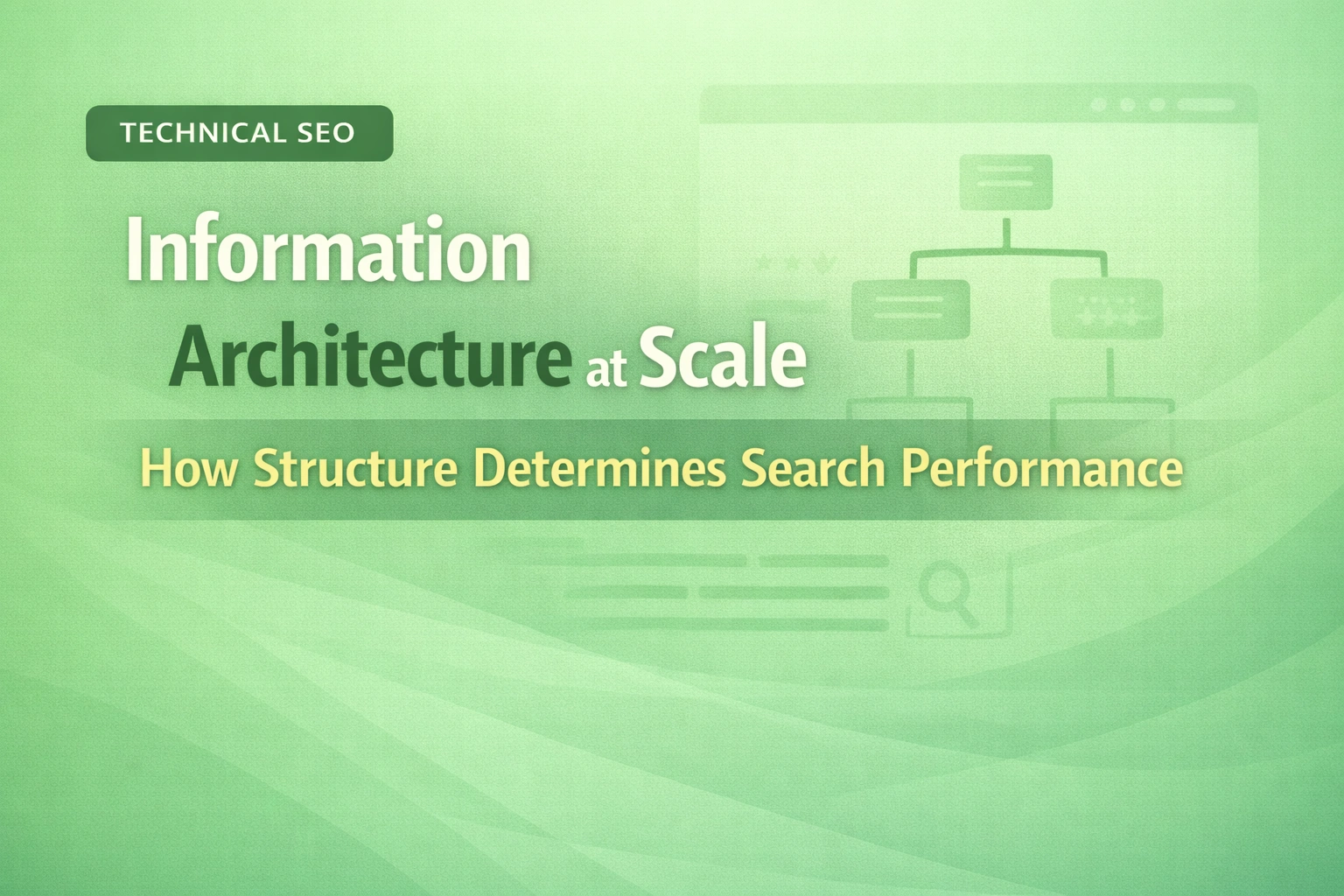
    Information Architecture At Scale How Structure Determines Search Performance 1024x683
    Share
    Facebook Twitter LinkedIn Pinterest Email

    Introduction

    Information architecture is one of the least visible yet most decisive factors in technical SEO performance. When it works, search visibility appears effortless. When it fails, teams chase symptoms across crawling, indexation, and rankings without addressing the underlying cause.

    At enterprise scale, information architecture is not a navigation problem. It is a system for expressing meaning, priority, and relationships to both users and search engines. Every structural decision compounds over time, shaping how authority flows and how content is interpreted.

    This article examines why information architecture breaks down at scale, how search engines actually interpret structure, and what it takes to design architectures that remain stable as sites grow.

    Why Information Architecture Becomes a Technical SEO Problem

    Many organizations treat information architecture as a UX or content concern, separate from technical SEO. This separation creates blind spots.

    Search engines rely heavily on structure to infer:

    • Topical focus and boundaries
    • Relative importance of pages
    • Relationships between concepts

    When architecture is unclear or inconsistent, search engines compensate by making assumptions. Those assumptions are rarely aligned with business priorities.

    How Large Sites Drift Into Structural Chaos

    Information architecture rarely breaks in a single redesign. It degrades gradually.

    Incremental Content Additions

    New sections, campaigns, and initiatives are often added without revisiting the existing structure. Over time, the original logic erodes.

    Competing Organizational Agendas

    Different teams optimize for different goals. Product launches, regional needs, and marketing campaigns introduce parallel structures that overlap but do not align.

    Legacy Constraints

    Historical URL patterns, deprecated categories, and backward compatibility requirements lock in decisions that no longer make sense but are difficult to remove.

    Search Engines Read Structure Before Content

    Before evaluating page-level quality, search engines assess how content is organized.

    They infer meaning from:

    • Directory depth and consistency
    • Internal link hierarchies
    • Navigation and breadcrumb patterns

    When these signals conflict, content quality alone cannot compensate.

    Hierarchy Communicates Priority

    Depth is not just a usability consideration. It is a prioritization signal.

    Pages closer to the root are assumed to be:

    • More authoritative
    • More stable
    • More central to the site’s purpose

    Excessive depth or inconsistent nesting dilutes these signals and increases crawl cost.

    Taxonomies Must Reflect Intent, Not Organization Charts

    Enterprise taxonomies often mirror internal structures rather than user or search intent.

    This creates categories that make sense internally but confuse external interpretation. Search engines do not understand business units; they understand topics and relationships.

    Effective taxonomies are:

    • Intent-driven
    • Mutually exclusive where possible
    • Consistently applied across templates

    Internal Linking as Structural Reinforcement

    Internal links are not merely navigational aids. They are the connective tissue of information architecture.

    At scale, internal linking must:

    • Reinforce primary hierarchies
    • Prevent authority leakage to low-value pages
    • Create predictable discovery paths

    Ad hoc internal linking weakens architecture rather than strengthening it.

    Faceted Navigation and Structural Risk

    Faceted systems introduce flexibility at the cost of structural clarity.

    Without strict controls, facets create:

    • Duplicate thematic paths
    • Competing canonical interpretations
    • Unbounded crawl spaces

    Facets must be treated as controlled extensions of architecture, not free-form exploration tools.

    Architecture and Topical Authority

    Topical authority is not built page by page. It emerges from coherent clusters.

    Well-designed architectures:

    • Group-related content predictably
    • Signal coverage depth within a topic
    • Separate core topics from peripheral ones

    This clarity makes it easier for search engines to trust and surface content.

    Why Flat Structures Fail at Scale

    In reaction to crawl and depth issues, some organizations attempt to flatten everything.

    This approach removes hierarchy entirely, forcing search engines to infer relationships from links alone. The result is ambiguity rather than efficiency.

    Structure should be intentional, not eliminated.

    Designing Architecture for Change

    Enterprise sites are not static. Architecture must anticipate growth.

    This means:

    • Leaving room for new categories
    • Defining rules for expansion
    • Documenting structural principles

    Architectures that lack rules require constant rework.

    Auditing Architecture as a System

    Effective architecture audits go beyond URL lists.

    They examine:

    • Depth distribution across sections
    • Internal link concentration
    • Consistency of taxonomy usage

    This reveals systemic weaknesses rather than isolated issues.

    Governance Prevents Structural Decay

    Without governance, even strong architectures decay.

    Governance mechanisms include:

    • Approval processes for new categories
    • SEO review of navigation changes
    • Periodic structural reviews

    These controls preserve intent over time.

    Conclusion

    Information architecture is one of the highest-leverage technical SEO investments organizations can make.

    When structure clearly communicates priority and relationships, search engines require fewer assumptions. Crawl efficiency improves, indexation stabilizes, and authority compounds naturally.

    At scale, search performance is not optimized page by page. It is designed structurally.

    Share. Facebook Twitter Pinterest LinkedIn Tumblr Email
    yashwant160@gmail.com
    • Website

    Related Posts

    XML Sitemaps at Scale: Signaling Priority, Not Forcing Indexation

    February 3, 2026

    Robots.txt at Scale: Control, Risk, and the Limits of Crawl Directives

    February 3, 2026

    Monitoring, Alerting, and SEO Observability: Seeing Failures Before Traffic Drops

    February 3, 2026
    Leave A Reply Cancel Reply

    Don't Miss

    Personal Branding Without the Cringe: Building Professional Credibility That Actually Works

    yashwant160@gmail.comFebruary 6, 2026

    Personal branding has a reputation problem. Too often, it’s confused with self-promotion, performative posting, or…

    Career Resilience: How to Build a Job That Survives Layoffs, AI, and Market Shifts

    February 6, 2026

    From Individual Contributor to Leader: The Career Shift Most People Get Wrong

    February 6, 2026

    The Non-Linear Career: Why the Best Careers No Longer Follow a Straight Path

    February 6, 2026
    Stay In Touch
    • Facebook
    • Twitter
    • Pinterest
    • Instagram
    • YouTube
    • Vimeo

    Subscribe to Updates

    Get the latest creative news from SmartMag about art & design.

    About Us

    Results-driven digital professional with 15+ years of experience across Web Operations, Enterprise SEO, and large-scale digital platforms. I specialize in building, scaling, and optimizing complex websites where performance, search visibility, and operational reliability must work together—not in silos. My work sits at the intersection of strategy and execution, translating business goals into systems that teams can actually run.

    Facebook X (Twitter) Pinterest YouTube
    Our Picks

    Personal Branding Without the Cringe: Building Professional Credibility That Actually Works

    February 6, 2026

    Career Resilience: How to Build a Job That Survives Layoffs, AI, and Market Shifts

    February 6, 2026

    From Individual Contributor to Leader: The Career Shift Most People Get Wrong

    February 6, 2026
    Most Popular

    Top 15 popular link building methods you should consider before it’s too late

    March 24, 20180 Views

    Quality Score Demystified: What Actually Improves SEM Performance

    January 31, 20260 Views

    How SEO, SEM, Email, and Paid Social Should Work Together

    February 2, 20260 Views
    © 2026 All rights reserved. Y. K. Thakur.
    • Home
    • Technical SEO
    • World
    • Lifestyle
    • Buy Now

    Type above and press Enter to search. Press Esc to cancel.