Close Menu
blog.ykthakur.com

    Subscribe to Updates

    Get the latest creative news from FooBar about art, design and business.

    What's Hot

    Personal Branding Without the Cringe: Building Professional Credibility That Actually Works

    February 6, 2026

    Career Resilience: How to Build a Job That Survives Layoffs, AI, and Market Shifts

    February 6, 2026

    From Individual Contributor to Leader: The Career Shift Most People Get Wrong

    February 6, 2026
    Facebook X (Twitter) Instagram
    blog.ykthakur.com
    • Home
    • About Me
    • Case Studies
    • Services
    • Contact Us
    Facebook X (Twitter) Instagram
    Subscribe
    • Blog
    • Search & Growth
      1. SEO
      2. Technical SEO
      3. SEM
      4. Paid Advertisements
      5. View All

      Why SEO Fails Even With the Right Tools and Data

      January 31, 2026

      How to Refresh Old Content Without Losing Rankings

      January 31, 2026

      How to Build a Topic Authority Map for SEO

      January 31, 2026

      E-E-A-T Signals Explained: What Actually Influences Trust and Rankings

      January 31, 2026

      XML Sitemaps at Scale: Signaling Priority, Not Forcing Indexation

      February 3, 2026

      Robots.txt at Scale: Control, Risk, and the Limits of Crawl Directives

      February 3, 2026

      Monitoring, Alerting, and SEO Observability: Seeing Failures Before Traffic Drops

      February 3, 2026

      Migrations, Releases, and SEO Risk: How Technical Changes Break Search at Scale

      February 3, 2026

      Scaling SEM Without Burning Budget

      January 31, 2026

      SEM vs SEO: How Paid Search Should Support Organic Growth

      January 31, 2026

      Quality Score Demystified: What Actually Improves SEM Performance

      January 31, 2026

      Brand vs Non-Brand Search: Budget Allocation Reality

      January 31, 2026

      Personal Branding Without the Cringe: Building Professional Credibility That Actually Works

      February 6, 2026

      Career Resilience: How to Build a Job That Survives Layoffs, AI, and Market Shifts

      February 6, 2026

      From Individual Contributor to Leader: The Career Shift Most People Get Wrong

      February 6, 2026

      The Non-Linear Career: Why the Best Careers No Longer Follow a Straight Path

      February 6, 2026
    • Performance & Infrastructure
      1. Website Performance
      2. Core Web Vitals
      3. Hosting Architecture
      4. Web Application Infrastructure
      5. Load Balancing
      6. View All

      Performance Drift: How Sites Get Slower Without Any One Bad Change

      February 3, 2026

      Why passing scores still hide systemic performance risk

      February 3, 2026

      Performance Monitoring Beyond Core Web Vitals

      February 3, 2026

      Personal Branding Without the Cringe: Building Professional Credibility That Actually Works

      February 6, 2026

      Career Resilience: How to Build a Job That Survives Layoffs, AI, and Market Shifts

      February 6, 2026

      From Individual Contributor to Leader: The Career Shift Most People Get Wrong

      February 6, 2026

      The Non-Linear Career: Why the Best Careers No Longer Follow a Straight Path

      February 6, 2026
    • AI & Automation
      1. AI Content Systems
      2. AI in SEO & Marketing
      3. AI Search Analysis
      4. AI-Driven SEO Workflows
      5. Generative AI Strategy
      6. View All

      AI Content Systems: How to Scale Without Losing Quality or Trust

      February 3, 2026

      AI in Marketing Is a System, Not a Toolset

      February 3, 2026

      SEO in a Zero-Click World: Designing for AI Answers and Visibility

      February 3, 2026

      AI Search Analysis: How LLMs Interpret and Surface Content

      February 3, 2026

      Using AI for Technical SEO Analysis Without Breaking Trust

      February 3, 2026

      AI-Driven SEO Workflows: What to Automate and What Not To

      February 3, 2026

      SEO in a Zero-Click World: Designing for AI Answers and Visibility

      February 3, 2026

      AI Search Analysis: How LLMs Interpret and Surface Content

      February 3, 2026

      Using AI for Technical SEO Analysis Without Breaking Trust

      February 3, 2026

      AI-Driven SEO Workflows: What to Automate and What Not To

      February 3, 2026

      Why Most AI SEO Implementations Fail

      February 3, 2026

      Human-in-the-Loop SEO: Where AI Stops and Judgment Starts

      February 3, 2026

      Personal Branding Without the Cringe: Building Professional Credibility That Actually Works

      February 6, 2026

      Career Resilience: How to Build a Job That Survives Layoffs, AI, and Market Shifts

      February 6, 2026

      From Individual Contributor to Leader: The Career Shift Most People Get Wrong

      February 6, 2026

      The Non-Linear Career: Why the Best Careers No Longer Follow a Straight Path

      February 6, 2026
    • Analytics & Intelligence
      1. GA4 Architecture
      2. Adobe Analytics
      3. View All

      GA4 vs Adobe Analytics: Choosing the Right Tool for Your Organization

      February 2, 2026

      Consent, Privacy, and Measurement: What Changes After GDPR & GA4

      February 2, 2026

      GA4 Architecture Explained: Designing Events for Real Decisions

      February 2, 2026

      GA4 vs Adobe Analytics: Choosing the Right Tool for Your Organization

      February 2, 2026

      Personal Branding Without the Cringe: Building Professional Credibility That Actually Works

      February 6, 2026

      Career Resilience: How to Build a Job That Survives Layoffs, AI, and Market Shifts

      February 6, 2026

      From Individual Contributor to Leader: The Career Shift Most People Get Wrong

      February 6, 2026

      The Non-Linear Career: Why the Best Careers No Longer Follow a Straight Path

      February 6, 2026
    • WebOps & DevOps
      1. Web Operations
      2. WebOps Roles
      3. Website Migrations & Scaling
      4. Release Management
      5. Monitoring & Alerts
      6. Performance Monitoring
      7. Deployment Automation
      8. View All

      SEO and WebOps Monitoring: Aligning Health Signals Across Systems

      February 3, 2026

      Designing Alerts for WebOps: Signal, Severity, and Actionability

      February 3, 2026

      Why Most Website Monitoring Is Too Late to Be Useful

      February 3, 2026

      Release Cadence Versus Stability: Finding the Sustainable Balance

      February 3, 2026

      Website Migrations at Scale: Why Most Fail Before the First Redirect

      February 3, 2026

      Post-Migration Reality: Why SEO and Performance Losses Persist for Months

      February 3, 2026

      Scaling Websites Without Replatforming: When Migration Is the Wrong Answer

      February 3, 2026

      Release Cadence Versus Stability: Finding the Sustainable Balance

      February 3, 2026

      Why Website Releases Break SEO Even When Nothing “Major” Changes

      February 3, 2026

      Release Management for Websites: Coordinating Risk Across Teams

      February 3, 2026

      Release Pipelines and Search Risk: Why Velocity Without Guardrails Breaks Websites

      February 3, 2026

      SEO and WebOps Monitoring: Aligning Health Signals Across Systems

      February 3, 2026

      Designing Alerts for WebOps: Signal, Severity, and Actionability

      February 3, 2026

      Why Most Website Monitoring Is Too Late to Be Useful

      February 3, 2026

      Feature Flags, Experiments, and the SEO Blast Radius

      February 3, 2026

      Performance Drift: How Sites Get Slower Without Any One Bad Change

      February 3, 2026

      Performance Monitoring Beyond Core Web Vitals

      February 3, 2026

      Designing SEO-Safe Deployment Automation

      February 3, 2026

      Deployment Automation for Websites: What to Automate and What Not To

      February 3, 2026

      Personal Branding Without the Cringe: Building Professional Credibility That Actually Works

      February 6, 2026

      Career Resilience: How to Build a Job That Survives Layoffs, AI, and Market Shifts

      February 6, 2026

      From Individual Contributor to Leader: The Career Shift Most People Get Wrong

      February 6, 2026

      The Non-Linear Career: Why the Best Careers No Longer Follow a Straight Path

      February 6, 2026
    • Project Strategy

      Personal Branding Without the Cringe: Building Professional Credibility That Actually Works

      February 6, 2026

      Career Resilience: How to Build a Job That Survives Layoffs, AI, and Market Shifts

      February 6, 2026

      From Individual Contributor to Leader: The Career Shift Most People Get Wrong

      February 6, 2026

      The Non-Linear Career: Why the Best Careers No Longer Follow a Straight Path

      February 6, 2026

      How to Stay Relevant When Roles Are Changing Faster Than Job Descriptions

      February 6, 2026
    • Web Engineering
      1. Web Development
      2. Web Designing & UX
      3. CMS & Platforms
      4. Web Application Firewall
      5. View All

      Personal Branding Without the Cringe: Building Professional Credibility That Actually Works

      February 6, 2026

      Career Resilience: How to Build a Job That Survives Layoffs, AI, and Market Shifts

      February 6, 2026

      From Individual Contributor to Leader: The Career Shift Most People Get Wrong

      February 6, 2026

      The Non-Linear Career: Why the Best Careers No Longer Follow a Straight Path

      February 6, 2026
    blog.ykthakur.com
    Home»SEM»Landing Page Alignment»Landing Page Alignment: Why Good Ads Still Don’t Convert
    Landing Page Alignment

    Landing Page Alignment: Why Good Ads Still Don’t Convert

    yashwant160@gmail.comBy yashwant160@gmail.comJanuary 31, 2026Updated:February 1, 2026No Comments5 Mins Read
    Share Facebook Twitter Pinterest LinkedIn Tumblr Email
    Follow Us
    Google News Flipboard Threads
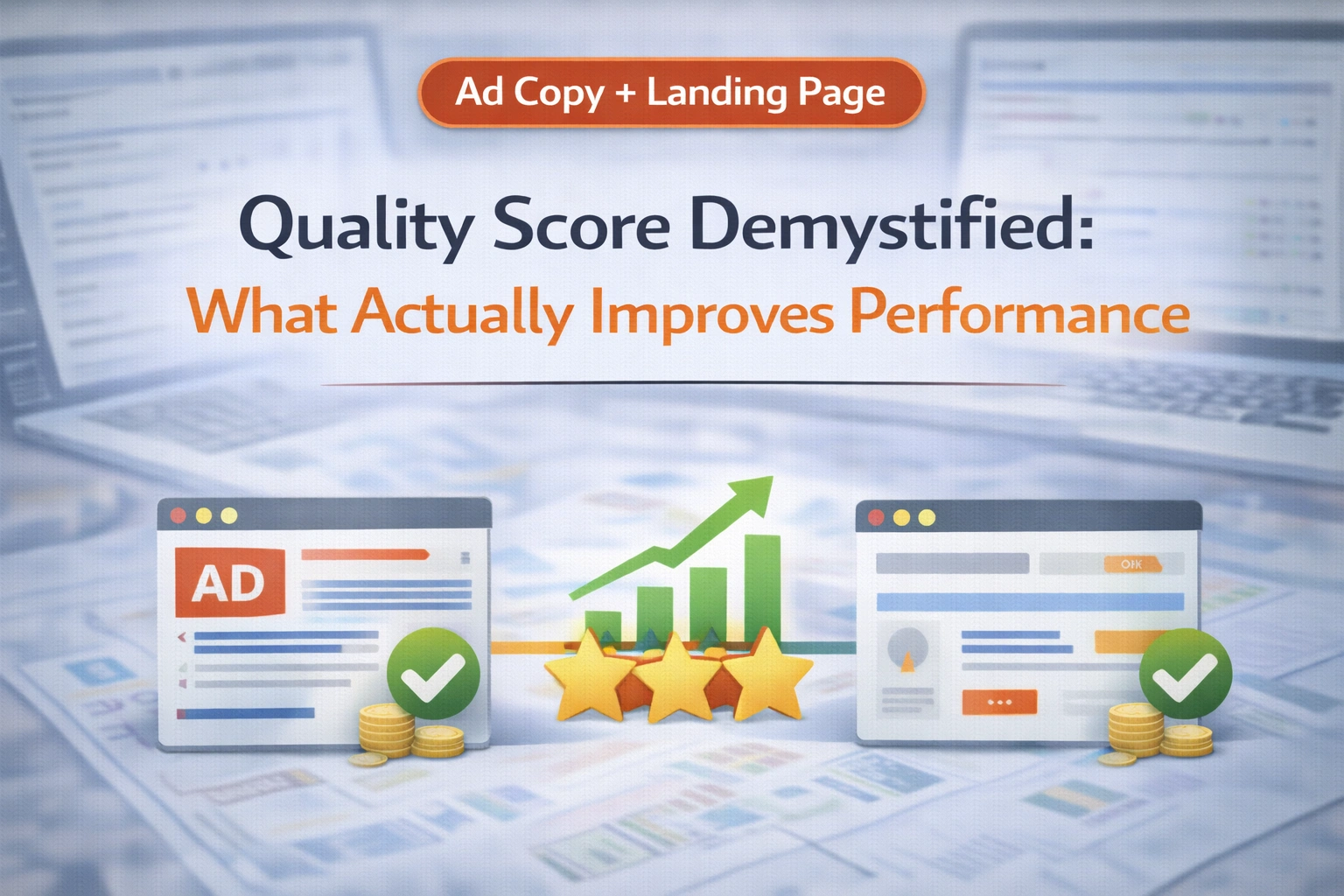
    Quality Score 1 1024x683
    Share
    Facebook Twitter LinkedIn Pinterest Email

    Introduction

    Many SEM teams do everything right on the ad side—tight keyword targeting, intent-aligned copy, smart bidding—and still see poor conversion rates. When this happens, the issue is rarely the ads. It’s the landing page experience. In modern SEM, ads create expectations, but landing pages determine outcomes. If the page doesn’t immediately confirm relevance, trust erodes, and conversions collapse—often within seconds.

    This article explains why good ads still don’t convert, how landing page misalignment quietly destroys SEM performance, and how mature teams design landing pages that complete the promise made in the ad.

    The Core Truth: Ads Don’t Convert—Landing Pages Do

    An ad’s job is to:

    • Attract the right click
    • Set a clear expectation
    • Filter out unqualified users

    A landing page’s job is to:

    • Confirm relevance instantly
    • Reduce friction
    • Guide the next action

    When these two are misaligned, SEM efficiency drops—regardless of spend.

    Why Landing Page Alignment Matters More as Budgets Grow

    With small budgets, inefficiencies are hidden.
    At large budgets, they are amplified.

    What happens at scale

    • More impressions → more mismatched clicks
    • More clicks → more wasted spend
    • More data → algorithms learn the wrong signals

    Landing page alignment is not a UX preference—it’s a budget protection mechanism.

    The Most Common Landing Page Failure: “One Page for Everything”

    Many organizations rely on:

    • Homepage
    • Generic service page
    • Catch-all solution page

    Why this fails

    Search intent is specific.
    Generic pages are not.

    When users click an ad addressing a specific problem and land on a general overview, relevance breaks instantly.

    Step 1: Match Landing Pages to Intent (Not Keywords)

    Intent determines:

    • What information users expect
    • How much persuasion is needed
    • What action feels appropriate

    Intent-based landing page mapping

    Intent Level Landing Page Focus
    High intent Conversion-first
    Mid intent Explanation + comparison
    Low intent Education + guidance

    Trying to convert low-intent users aggressively increases bounce rates and lowers Quality Score.

    Step 2: Confirm Relevance in the First 5 Seconds

    Users subconsciously ask:

    “Did I land in the right place?”

    This decision happens almost immediately.

    High-impact relevance signals

    • Headline mirrors ad promise
    • The problem statement is visible
    • Visual context supports the message
    • No distractions above the fold

    Weak opening example

    “Welcome to Our Company”

    Strong opening example

    “Fix Declining Google Ads Performance Without Increasing Spend”

    The headline should continue the ad conversation, not restart it.

    Step 3: Remove Cognitive Friction

    Cognitive friction is mental effort.

    Landing pages fail when users must:

    • Figure out what’s being offered
    • Interpret jargon
    • Navigate unrelated content
    • Guess the next step

    Common friction sources

    • Long intros
    • Buzzword-heavy copy
    • Competing CTAs
    • Excessive navigation
    • Unclear value proposition

    Reducing friction improves conversion rates faster than adding features.

    Step 4: Align Content Depth with Intent Stage

    More content is not always better.

    High-intent pages should:

    • Focus on outcomes
    • Reduce risk
    • Highlight next steps
    • Minimize distractions

    Mid-intent pages should:

    • Explain trade-offs
    • Build credibility
    • Provide clarity
    • Guide decisions

    Low-intent pages should:

    • Educate
    • Set expectations
    • Invite deeper engagement

    Mismatch here leads to either:

    • Overwhelming users
    • Under-informing them

    Step 5: Use Proof Strategically (Not Excessively)

    Trust matters—but too much proof overwhelms.

    Effective proof elements

    • Short testimonials
    • Specific outcomes
    • Relevant case summaries
    • Familiar brand signals

    Ineffective proof

    • Long logo walls
    • Generic testimonials
    • Unrelated success stories
    • Awards without context

    Proof should reduce doubt, not distract.

    Step 6: Design CTAs Around Commitment Level

    Calls to action must match readiness.

    CTA alignment examples

    Intent CTA Type
    High “Request Audit”
    Mid “See How It Works”
    Low “Learn the Framework”

    Asking for too much too soon suppresses conversions and trains algorithms incorrectly.

    Step 7: Optimize Page Speed and Technical Performance

    Landing page performance directly affects:

    • Conversion rates
    • Bounce rates
    • Quality Score
    • CPC efficiency

    Real-world impact

    • A 1-second delay can reduce conversions by 5–10%
    • Mobile performance matters more than desktop
    • Heavy scripts often negate good UX

    SEM traffic is impatient.
    Performance issues erase relevance instantly.

    Step 8: Track the Right Conversions (Not Just Any Conversion)

    Landing pages often “convert” in ways that don’t matter.

    Common mistakes

    • Tracking form submissions without qualification
    • Treating downloads as equal to leads
    • Ignoring post-conversion behavior

    Better approach

    • Track qualified leads
    • Assign a value to actions
    • Feed quality signals back into bidding

    Landing page alignment must extend past the form.

    Why Landing Pages Fail Even With Good UX

    Good UX ≠ , good alignment.

    A page can be:

    • Well-designed
    • Fast
    • Polished

    …and still fail if it:

    • Doesn’t match intent
    • Overgeneralizes
    • Misaligns expectations

    Alignment beats aesthetics every time.

    Real-World Example: Fixing Conversion Without Changing Ads

    Before

    • Strong CTR
    • Low conversion rate
    • Rising CPA

    Changes made

    • Dedicated landing page per intent
    • Headline aligned with ad copy
    • Removed navigation
    • Clarified CTA

    After (30–60 days)

    • Conversion rate doubled
    • CPA dropped significantly
    • Lead quality improved
    • Algorithm stabilized

    Ads stayed the same. Pages did the work.

    How Landing Page Alignment Improves Automation

    Automation thrives on:

    • Consistent signals
    • Predictable outcomes
    • Reduced noise

    Aligned landing pages:

    • Improve conversion consistency
    • Accelerate learning
    • Reduce volatility
    • Enable safer scaling

    Landing pages are inputs to automation, not outputs.

    Common Landing Page Anti-Patterns to Avoid

    • Sending traffic to the homepage
    • Reusing SEO content for paid traffic
    • Overloading pages with navigation
    • Asking for commitment too early
    • Ignoring mobile experience

    These issues compound as budgets increase.

    Final Takeaway

    SEM fails to convert, not because ads are weak, but because landing pages break the promise.

    When landing pages:

    • Match intent
    • Confirm relevance immediately
    • Reduce friction
    • Guide the right action

    Paid search becomes efficient, scalable, and predictable.

    Ads attract attention. Landing pages turn attention into results.

    Share. Facebook Twitter Pinterest LinkedIn Tumblr Email
    yashwant160@gmail.com
    • Website

    Leave A Reply Cancel Reply

    Don't Miss

    Personal Branding Without the Cringe: Building Professional Credibility That Actually Works

    yashwant160@gmail.comFebruary 6, 2026

    Personal branding has a reputation problem. Too often, it’s confused with self-promotion, performative posting, or…

    Career Resilience: How to Build a Job That Survives Layoffs, AI, and Market Shifts

    February 6, 2026

    From Individual Contributor to Leader: The Career Shift Most People Get Wrong

    February 6, 2026

    The Non-Linear Career: Why the Best Careers No Longer Follow a Straight Path

    February 6, 2026
    Stay In Touch
    • Facebook
    • Twitter
    • Pinterest
    • Instagram
    • YouTube
    • Vimeo

    Subscribe to Updates

    Get the latest creative news from SmartMag about art & design.

    About Us

    Results-driven digital professional with 15+ years of experience across Web Operations, Enterprise SEO, and large-scale digital platforms. I specialize in building, scaling, and optimizing complex websites where performance, search visibility, and operational reliability must work together—not in silos. My work sits at the intersection of strategy and execution, translating business goals into systems that teams can actually run.

    Facebook X (Twitter) Pinterest YouTube
    Our Picks

    Personal Branding Without the Cringe: Building Professional Credibility That Actually Works

    February 6, 2026

    Career Resilience: How to Build a Job That Survives Layoffs, AI, and Market Shifts

    February 6, 2026

    From Individual Contributor to Leader: The Career Shift Most People Get Wrong

    February 6, 2026
    Most Popular

    Top 15 popular link building methods you should consider before it’s too late

    March 24, 20180 Views

    Quality Score Demystified: What Actually Improves SEM Performance

    January 31, 20260 Views

    How SEO, SEM, Email, and Paid Social Should Work Together

    February 2, 20260 Views
    © 2026 All rights reserved. Y. K. Thakur.
    • Home
    • Technical SEO
    • World
    • Lifestyle
    • Buy Now

    Type above and press Enter to search. Press Esc to cancel.