

Introduction
CI/CD pipelines are often introduced to solve very real problems: slow releases, manual errors, and inconsistent environments. In many organizations, the presence of a pipeline becomes synonymous with maturity. Faster deployments are taken as evidence that systems are under control.
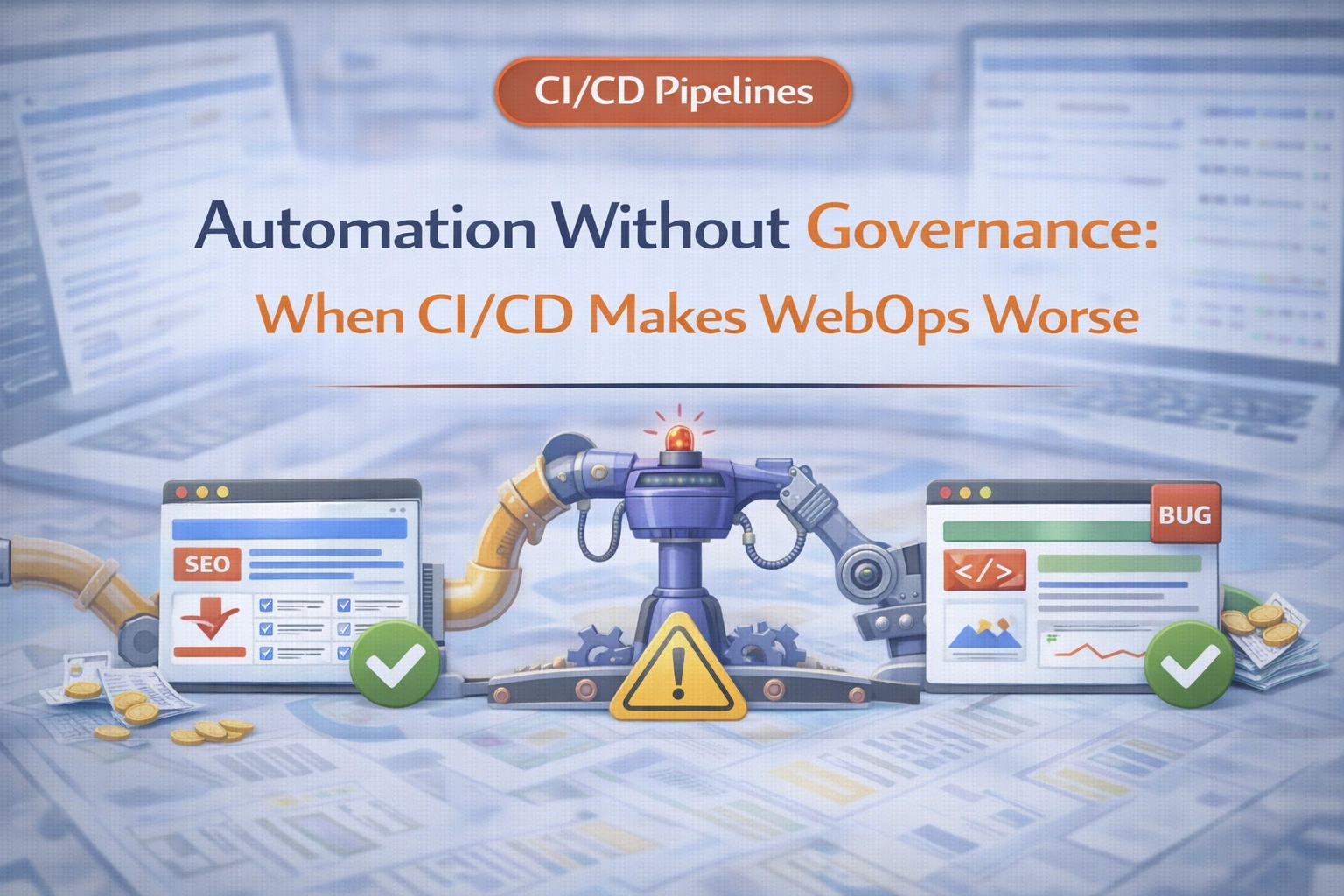
At enterprise scale, this assumption is dangerous. Automation without governance does not reduce risk. It redistributes and amplifies it. When pipelines encode speed without constraints, they accelerate drift, propagate mistakes instantly, and make failures harder to contain.
This article examines how CI/CD can actively degrade WebOps outcomes when governance is missing, why many organizations experience worse SEO and stability after automation, and what distinguishes controlled automation from automated chaos.
Why CI/CD Is Often Treated as a Maturity Shortcut
CI/CD promises tangible improvements.
Teams expect:
- Shorter release cycles
- Fewer manual steps
- Consistent deployments
These benefits are real, but they assume that what is being automated is already well understood and well governed. When that assumption is false, pipelines magnify existing weaknesses.
Automation Accelerates the System You Already Have
CI/CD does not create discipline. It accelerates it.
If an organization has:
- Unclear ownership
- Weak validation
- Ambiguous risk acceptance
Automation ensures these problems manifest faster and at larger scale.
The Illusion of Safety Created by Green Pipelines
A successful pipeline run often signals completion.
From a WebOps perspective, it only confirms that:
- Code compiled
- Tests passed
- Deployment executed
It says nothing about how the system will behave when crawled, rendered, or loaded under real conditions.
When Automation Replaces Decision-Making
One of the most damaging patterns is allowing pipelines to make implicit decisions.
Examples include:
- All changes auto-deploy regardless of risk
- No distinction between SEO-sensitive and low-impact updates
- Release timing dictated by merges rather than system state
These are decisions. Treating them as mechanics removes accountability.
Why SEO Suffers First Under Ungoverned CI/CD
SEO degradation is often the earliest visible symptom.
Ungoverned automation introduces:
- Frequent template changes without stabilization
- Incremental performance regressions
- Unreviewed changes to crawl and rendering behavior
Search engines respond conservatively to this volatility, reducing trust over time.
The Compounding Effect of Small Automated Changes
CI/CD encourages small, frequent changes.
Without constraints:
- No single change appears risky
- Cumulative impact is not assessed
- Baselines drift unnoticed
Automation removes natural pauses that once exposed emerging problems.
Why Rollback Culture Degrades Under Automation
Automation is often justified by the promise of easy rollback.
In practice:
- Multiple releases are already live
- Dependencies are unclear
- SEO impact persists after rollback
As rollback becomes harder, teams tolerate regressions longer.
CI/CD Without Risk Classification
Treating all changes equally is a governance failure.
High-risk changes include:
- Shared template modifications
- Rendering or framework upgrades
- Routing, caching, or crawl logic changes
Automating these changes without additional gates increases the blast radius dramatically.
Why Validation Gaps Grow Over Time
Early pipelines often include basic checks.
Over time:
- Validation is bypassed to meet deadlines
- Checks become outdated
- SEO and performance rules are not encoded
Pipelines still run, but confidence in their outcomes erodes quietly.
Automation and Loss of System Awareness
Manual processes force teams to slow down and observe.
Fully automated pipelines:
- Abstract away system behavior
- Reduce shared understanding of changes
- Encourage reactive monitoring instead of proactive control
When something breaks, fewer people understand why.
Why CI/CD Can Undermine WebOps Authority
When pipelines auto-deploy, WebOps often loses leverage.
They are expected to:
- Maintain stability
- Respond to incidents
- Protect SEO and performance
without the authority to slow or block risky releases. Automation becomes a power shift, not just a technical change.
Governance Is What Makes Automation Safe
Governance defines how automation is allowed to operate.
It includes:
- Explicit non-negotiable constraints
- Clear ownership for outcomes
- Defined escalation and override paths
Automation enforces governance. It cannot replace it.
Encoding Policy Into Pipelines
Safe CI/CD pipelines encode policy, not just steps.
Examples include:
- Blocking releases that exceed performance budgets
- Requiring approval for SEO-sensitive changes
- Preventing deployment during stabilization windows
Pipelines become guardrails rather than accelerators.
Progressive Delivery as a Governance Tool
Governed automation uses staged exposure.
Progressive delivery:
- Limits the blast radius
- Allows real-world validation
- Supports deliberate go/no-go decisions
Automation supports human judgment rather than bypassing it.
Why Governance Must Precede Optimization
Organizations often automate first and govern later.
This sequence is backwards.
Without governance:
- Optimization creates instability
- Speed increases recovery cost
- SEO and performance regressions compound
Governance defines what optimization is safe.
Signals of Healthy Automation
In mature WebOps environments:
- Not all changes auto-deploy
- Release speed varies by risk
- Pipelines surface decisions rather than hiding them
Automation is visible, intentional, and constrained.
Conclusion
CI/CD does not make WebOps better by default. Without governance, it often makes it worse.
Automation amplifies existing behaviors, incentives, and blind spots. Organizations that encode policy, risk awareness, and authority into their pipelines gain stability alongside speed. Those that automate without governance trade short-term velocity for long-term degradation.
At enterprise scale, the question is not whether to automate. It is whether automation is serving the system or silently destabilizing it.
