
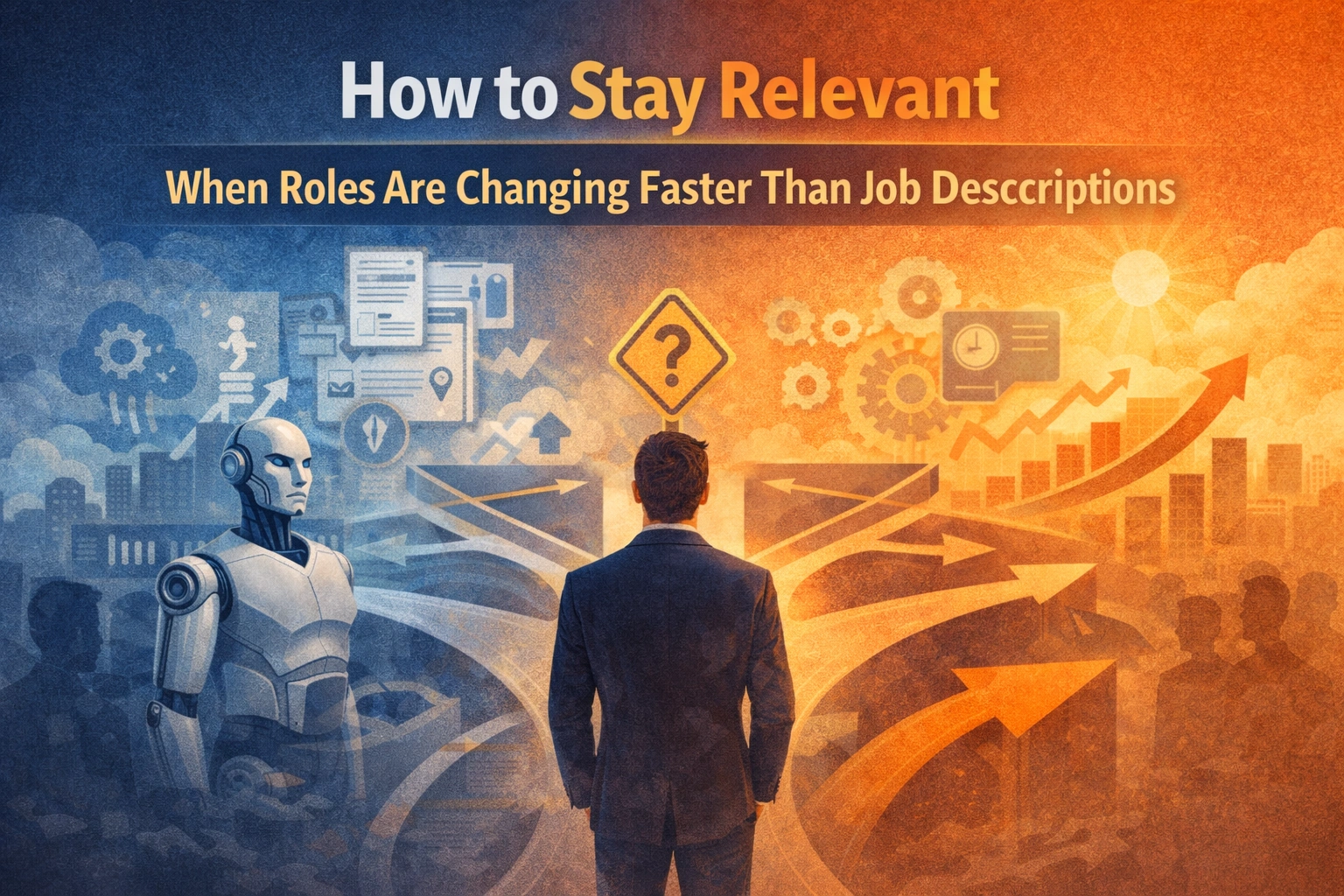
The fastest way to fall behind is to assume your job description defines your future. In an era shaped by AI, automation, remote work, and constant reorgs, relevance has become a skill—not a status.
By Content Creative Head · Updated 2026
Why Roles Are Changing So Fast
Roles are no longer stable containers of responsibility. They are temporary snapshots of business needs.
Several forces are accelerating role change:
- AI tools absorbing routine tasks
- Remote and distributed team structures
- Faster product and market cycles
- Constant organizational restructuring
As a result, the half-life of many roles is shrinking. What you were hired to do two years ago may no longer be what creates value today.
Why Job Descriptions Always Lag Reality
Job descriptions are written to describe yesterday’s needs, not tomorrow’s opportunities.
They are constrained by:
- HR templates
- Compensation bands
- Organizational politics
- Legacy role definitions
Meanwhile, real work evolves daily. Professionals who rely too heavily on job descriptions often miss where value is actually shifting.
What Career Relevance Really Means
Career relevance is the ability to consistently contribute value as conditions change.
Relevant professionals:
- Understand the business context of their work
- Adapt their skill set as tools and processes evolve
- Anticipate needs rather than react to them
Relevance is not about knowing everything—it’s about learning faster than the environment changes.
AI, Automation, and the New Skill Divide
AI does not replace entire jobs at once. It replaces specific tasks.
This creates a widening divide:
- Those who offload routine work to AI and move up the value chain
- Those whose roles are defined entirely by automatable tasks
Relevance increasingly depends on judgment, systems thinking, creativity, and the ability to work with AI—not against it.
The Risk of Static Careers
A static career feels comfortable—until it suddenly isn’t.
Warning signs of declining relevance include:
- Doing the same work year after year
- Avoiding new tools or responsibilities
- Relying on tenure instead of impact
By the time relevance is questioned, recovery becomes much harder.
Signals That Matter More Than Titles
Modern hiring and promotion decisions are driven by signals of capability.
Strong signals include:
- Problems you’ve solved end-to-end
- Systems or processes you’ve improved
- Cross-functional influence
- Clear, documented outcomes
Titles may open doors, but signals determine who is trusted.
Learning in the Flow of Work
The most effective learning does not happen in isolation—it happens inside real work.
Relevant professionals:
- Volunteer for ambiguous projects
- Shadow adjacent roles
- Learn tools as they are applied, not abstractly
Learning in context accelerates both skill acquisition and credibility.
Building Career Adjacencies
Career resilience grows at the edges.
Career adjacencies are skills and responsibilities that sit just outside your core role but increase your versatility.
Examples include:
- An engineer learning product strategy
- A marketer learning analytics and experimentation
- An operations manager learning automation
Adjacencies make career pivots smoother and less risky.
How to Future-Proof Your Career
No career is fully future-proof—but many are future-resilient.
Future-resilient professionals:
- Continuously refresh their skills
- Build transferable expertise
- Maintain visibility through impact, not noise
They treat relevance as an ongoing practice.
A Practical Relevance Framework
- Track how value is shifting in your industry
- Identify skills adjacent to your current role
- Apply new skills inside real projects
- Document outcomes and learning
- Review and adjust every 6–12 months
Staying relevant is not a one-time effort—it’s a career habit.
Final takeaway: Roles will keep changing. Careers that survive are built on adaptability, learning velocity, and the ability to deliver value beyond a job description.
