
Close Menu
blog.ykthakur.com

    Subscribe to Updates

    Get the latest creative news from FooBar about art, design and business.

    What's Hot

    Personal Branding Without the Cringe: Building Professional Credibility That Actually Works

    February 6, 2026

    Career Resilience: How to Build a Job That Survives Layoffs, AI, and Market Shifts

    February 6, 2026

    From Individual Contributor to Leader: The Career Shift Most People Get Wrong

    February 6, 2026
    Facebook X (Twitter) Instagram
    blog.ykthakur.com
    • Home
    • About Me
    • Case Studies
    • Services
    • Contact Us
    Facebook X (Twitter) Instagram
    Subscribe
    • Blog
    • Search & Growth
      1. SEO
      2. Technical SEO
      3. SEM
      4. Paid Advertisements
      5. View All

      Why SEO Fails Even With the Right Tools and Data

      January 31, 2026

      How to Refresh Old Content Without Losing Rankings

      January 31, 2026

      How to Build a Topic Authority Map for SEO

      January 31, 2026

      E-E-A-T Signals Explained: What Actually Influences Trust and Rankings

      January 31, 2026

      XML Sitemaps at Scale: Signaling Priority, Not Forcing Indexation

      February 3, 2026

      Robots.txt at Scale: Control, Risk, and the Limits of Crawl Directives

      February 3, 2026

      Monitoring, Alerting, and SEO Observability: Seeing Failures Before Traffic Drops

      February 3, 2026

      Migrations, Releases, and SEO Risk: How Technical Changes Break Search at Scale

      February 3, 2026

      Scaling SEM Without Burning Budget

      January 31, 2026

      SEM vs SEO: How Paid Search Should Support Organic Growth

      January 31, 2026

      Quality Score Demystified: What Actually Improves SEM Performance

      January 31, 2026

      Brand vs Non-Brand Search: Budget Allocation Reality

      January 31, 2026

      Personal Branding Without the Cringe: Building Professional Credibility That Actually Works

      February 6, 2026

      Career Resilience: How to Build a Job That Survives Layoffs, AI, and Market Shifts

      February 6, 2026

      From Individual Contributor to Leader: The Career Shift Most People Get Wrong

      February 6, 2026

      The Non-Linear Career: Why the Best Careers No Longer Follow a Straight Path

      February 6, 2026
    • Performance & Infrastructure
      1. Website Performance
      2. Core Web Vitals
      3. Hosting Architecture
      4. Web Application Infrastructure
      5. Load Balancing
      6. View All

      Performance Drift: How Sites Get Slower Without Any One Bad Change

      February 3, 2026

      Why passing scores still hide systemic performance risk

      February 3, 2026

      Performance Monitoring Beyond Core Web Vitals

      February 3, 2026

      Personal Branding Without the Cringe: Building Professional Credibility That Actually Works

      February 6, 2026

      Career Resilience: How to Build a Job That Survives Layoffs, AI, and Market Shifts

      February 6, 2026

      From Individual Contributor to Leader: The Career Shift Most People Get Wrong

      February 6, 2026

      The Non-Linear Career: Why the Best Careers No Longer Follow a Straight Path

      February 6, 2026
    • AI & Automation
      1. AI Content Systems
      2. AI in SEO & Marketing
      3. AI Search Analysis
      4. AI-Driven SEO Workflows
      5. Generative AI Strategy
      6. View All

      AI Content Systems: How to Scale Without Losing Quality or Trust

      February 3, 2026

      AI in Marketing Is a System, Not a Toolset

      February 3, 2026

      SEO in a Zero-Click World: Designing for AI Answers and Visibility

      February 3, 2026

      AI Search Analysis: How LLMs Interpret and Surface Content

      February 3, 2026

      Using AI for Technical SEO Analysis Without Breaking Trust

      February 3, 2026

      AI-Driven SEO Workflows: What to Automate and What Not To

      February 3, 2026

      SEO in a Zero-Click World: Designing for AI Answers and Visibility

      February 3, 2026

      AI Search Analysis: How LLMs Interpret and Surface Content

      February 3, 2026

      Using AI for Technical SEO Analysis Without Breaking Trust

      February 3, 2026

      AI-Driven SEO Workflows: What to Automate and What Not To

      February 3, 2026

      Why Most AI SEO Implementations Fail

      February 3, 2026

      Human-in-the-Loop SEO: Where AI Stops and Judgment Starts

      February 3, 2026

      Personal Branding Without the Cringe: Building Professional Credibility That Actually Works

      February 6, 2026

      Career Resilience: How to Build a Job That Survives Layoffs, AI, and Market Shifts

      February 6, 2026

      From Individual Contributor to Leader: The Career Shift Most People Get Wrong

      February 6, 2026

      The Non-Linear Career: Why the Best Careers No Longer Follow a Straight Path

      February 6, 2026
    • Analytics & Intelligence
      1. GA4 Architecture
      2. Adobe Analytics
      3. View All

      GA4 vs Adobe Analytics: Choosing the Right Tool for Your Organization

      February 2, 2026

      Consent, Privacy, and Measurement: What Changes After GDPR & GA4

      February 2, 2026

      GA4 Architecture Explained: Designing Events for Real Decisions

      February 2, 2026

      GA4 vs Adobe Analytics: Choosing the Right Tool for Your Organization

      February 2, 2026

      Personal Branding Without the Cringe: Building Professional Credibility That Actually Works

      February 6, 2026

      Career Resilience: How to Build a Job That Survives Layoffs, AI, and Market Shifts

      February 6, 2026

      From Individual Contributor to Leader: The Career Shift Most People Get Wrong

      February 6, 2026

      The Non-Linear Career: Why the Best Careers No Longer Follow a Straight Path

      February 6, 2026
    • WebOps & DevOps
      1. Web Operations
      2. WebOps Roles
      3. Website Migrations & Scaling
      4. Release Management
      5. Monitoring & Alerts
      6. Performance Monitoring
      7. Deployment Automation
      8. View All

      SEO and WebOps Monitoring: Aligning Health Signals Across Systems

      February 3, 2026

      Designing Alerts for WebOps: Signal, Severity, and Actionability

      February 3, 2026

      Why Most Website Monitoring Is Too Late to Be Useful

      February 3, 2026

      Release Cadence Versus Stability: Finding the Sustainable Balance

      February 3, 2026

      Website Migrations at Scale: Why Most Fail Before the First Redirect

      February 3, 2026

      Post-Migration Reality: Why SEO and Performance Losses Persist for Months

      February 3, 2026

      Scaling Websites Without Replatforming: When Migration Is the Wrong Answer

      February 3, 2026

      Release Cadence Versus Stability: Finding the Sustainable Balance

      February 3, 2026

      Why Website Releases Break SEO Even When Nothing “Major” Changes

      February 3, 2026

      Release Management for Websites: Coordinating Risk Across Teams

      February 3, 2026

      Release Pipelines and Search Risk: Why Velocity Without Guardrails Breaks Websites

      February 3, 2026

      SEO and WebOps Monitoring: Aligning Health Signals Across Systems

      February 3, 2026

      Designing Alerts for WebOps: Signal, Severity, and Actionability

      February 3, 2026

      Why Most Website Monitoring Is Too Late to Be Useful

      February 3, 2026

      Feature Flags, Experiments, and the SEO Blast Radius

      February 3, 2026

      Performance Drift: How Sites Get Slower Without Any One Bad Change

      February 3, 2026

      Performance Monitoring Beyond Core Web Vitals

      February 3, 2026

      Designing SEO-Safe Deployment Automation

      February 3, 2026

      Deployment Automation for Websites: What to Automate and What Not To

      February 3, 2026

      Personal Branding Without the Cringe: Building Professional Credibility That Actually Works

      February 6, 2026

      Career Resilience: How to Build a Job That Survives Layoffs, AI, and Market Shifts

      February 6, 2026

      From Individual Contributor to Leader: The Career Shift Most People Get Wrong

      February 6, 2026

      The Non-Linear Career: Why the Best Careers No Longer Follow a Straight Path

      February 6, 2026
    • Project Strategy

      Personal Branding Without the Cringe: Building Professional Credibility That Actually Works

      February 6, 2026

      Career Resilience: How to Build a Job That Survives Layoffs, AI, and Market Shifts

      February 6, 2026

      From Individual Contributor to Leader: The Career Shift Most People Get Wrong

      February 6, 2026

      The Non-Linear Career: Why the Best Careers No Longer Follow a Straight Path

      February 6, 2026

      How to Stay Relevant When Roles Are Changing Faster Than Job Descriptions

      February 6, 2026
    • Web Engineering
      1. Web Development
      2. Web Designing & UX
      3. CMS & Platforms
      4. Web Application Firewall
      5. View All

      Personal Branding Without the Cringe: Building Professional Credibility That Actually Works

      February 6, 2026

      Career Resilience: How to Build a Job That Survives Layoffs, AI, and Market Shifts

      February 6, 2026

      From Individual Contributor to Leader: The Career Shift Most People Get Wrong

      February 6, 2026

      The Non-Linear Career: Why the Best Careers No Longer Follow a Straight Path

      February 6, 2026
    blog.ykthakur.com
    Home»AI in SEO & Marketing»Prompt Engineering»Why Prompt Libraries Fail Without Context and Data
    Prompt Engineering

    Why Prompt Libraries Fail Without Context and Data

    yashwant160@gmail.comBy yashwant160@gmail.comFebruary 3, 2026Updated:February 26, 2026No Comments5 Mins Read
    Share Facebook Twitter Pinterest LinkedIn Tumblr Email
    Follow Us
    Google News Flipboard Threads
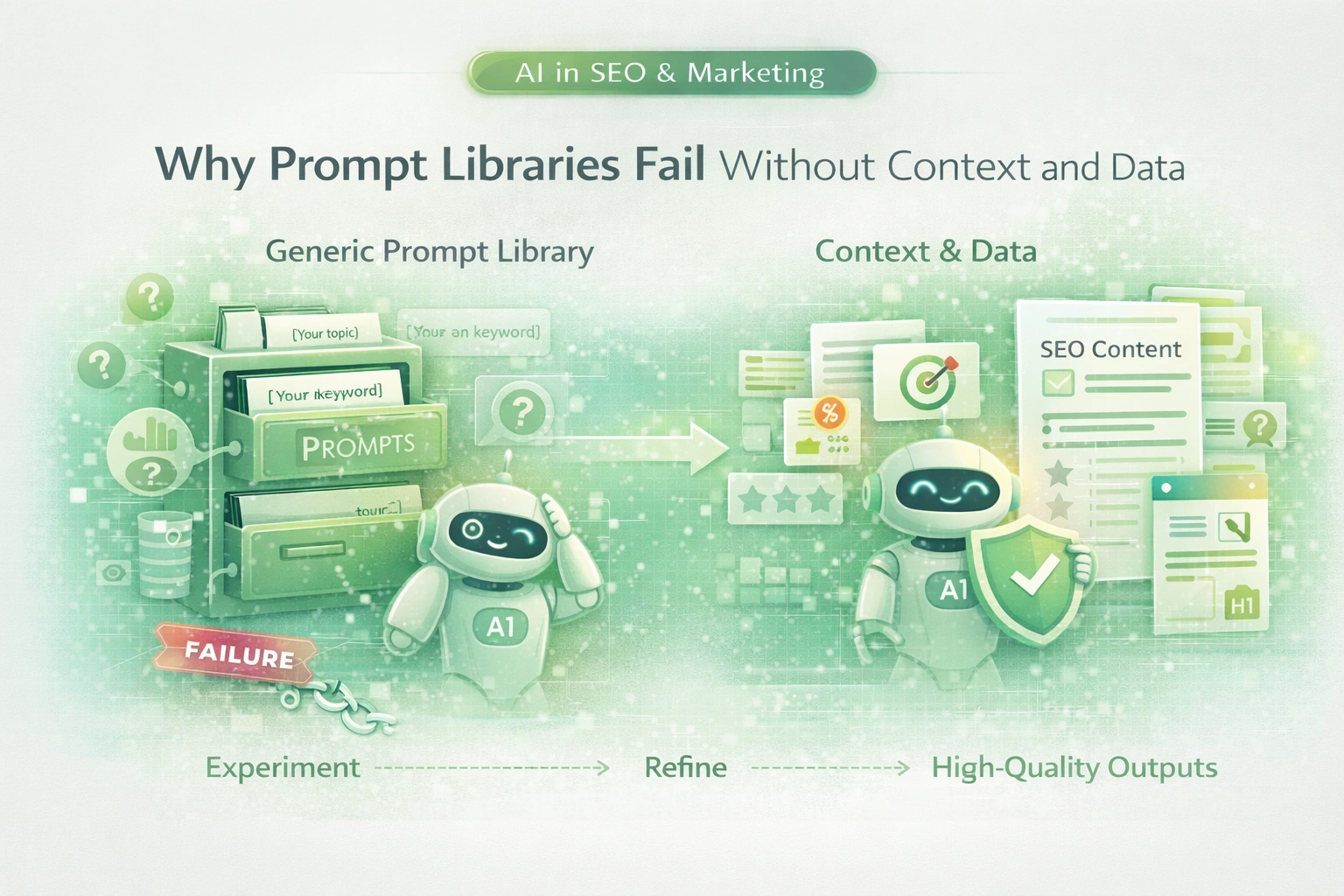
    Why Prompt Libraries Fail Without Context And Data 1024x683
    Share
    Facebook Twitter LinkedIn Pinterest Email

    Introduction

    Prompt libraries are often presented as a maturity milestone in AI adoption. Teams collect successful prompts, document them, and distribute them as reusable assets. On the surface, this looks like progress: fewer experiments, faster onboarding, and more consistent outputs.

    In practice, prompt libraries frequently fail at scale. Outputs drift, relevance declines, and teams quietly revert to modifying prompts ad hoc. The problem is not execution quality. It is a structural misunderstanding of what prompts can and cannot do in isolation.

    Prompts without context and data are static instructions applied to dynamic systems. At enterprise scale, this mismatch guarantees failure.

    Why Prompt Libraries Look Like the Right Answer

    Prompt libraries appeal to organizations because they resemble familiar knowledge-management patterns. Documentation, reuse, and standardization are proven strategies in engineering, analytics, and operations.

    Early benefits reinforce the belief:

    • Teams spend less time experimenting
    • Outputs appear more consistent initially
    • AI usage feels more controlled

    These gains are real but temporary. Without supporting systems, libraries become brittle quickly.

    The Core Flaw: Prompts Are Not Self-Sufficient

    A prompt does not contain meaning on its own. It references assumptions about audience, data freshness, business priorities, and risk tolerance. When those assumptions are not explicitly connected to live context, prompts degrade.

    Prompt libraries fail because they treat prompts as complete instructions rather than interfaces into larger systems.

    Context Decay Over Time

    Marketing and SEO contexts change continuously. Search intent evolves. Product positioning shifts. Regulatory requirements update. A static prompt does not adapt to these changes.

    When teams reuse prompts without updating contextual inputs, AI outputs slowly diverge from reality. Because the degradation is incremental, it often goes unnoticed until performance drops.

    Audience Context Is Assumed, Not Defined

    Many library prompts rely on implicit audience knowledge. As teams expand or rotate, those assumptions are lost. AI outputs remain fluent but misaligned.

    Business Priorities Are Frozen in Time

    Prompts created during one strategic phase may conflict with current objectives. Without explicit data injection, AI continues optimizing for outdated goals.

    Data Blindness in Prompt Libraries

    The most significant limitation of prompt libraries is their separation from data.

    Prompts often instruct AI to analyze, prioritize, or recommend actions without providing current performance signals. The model compensates by generalizing, which reduces relevance and increases risk.

    Without data integration, prompts cannot:

    • Differentiate high-impact pages from low-impact ones
    • Account for seasonal or market-specific variation
    • Reflect real user behavior or engagement trends

    Why “Best Prompts” Do Not Exist

    Prompt libraries are often built around the idea of best-performing prompts. This framing is misleading.

    A prompt that works well in one context may fail in another. Effectiveness depends on inputs, constraints, and evaluation criteria. Removing a prompt from its original environment strips it of the factors that made it successful.

    At scale, this leads to false standardization: prompts look consistent, but outputs are not.

    Prompt Libraries Encourage Shallow Reuse

    When teams are given a library, they tend to reuse prompts mechanically. This discourages critical thinking about intent, data relevance, and downstream impact.

    Instead of asking whether a prompt fits the current decision, teams ask which prompt to use. This shifts responsibility away from judgment and toward template selection.

    What Scales Better Than Prompt Libraries

    Mature organizations move beyond libraries toward prompt frameworks.

    A prompt framework defines:

    • Required contextual inputs
    • Approved data sources
    • Decision criteria and output formats

    Individual prompts are then instantiated dynamically based on live inputs, rather than copied from a static list.

    Integrating Context Into Prompt Systems

    Context must be explicit and refreshable.

    Effective systems inject:

    • Audience definitions from centralized documentation
    • Current business priorities from planning systems
    • SEO constraints from technical governance rules

    This reduces reliance on human memory and increases output reliability.

    Data as a First-Class Prompt Input

    Prompt systems that scale treat data as mandatory input, not optional enhancement.

    This includes:

    • Performance metrics tied to specific pages or topics
    • Search demand signals segmented by intent
    • Historical outcomes of similar decisions

    When AI reasons over real data, outputs become situational rather than generic.

    Governance Prevents Prompt Drift

    Without governance, prompt libraries fragment as teams customize locally. Over time, the library becomes a collection of loosely related instructions with no clear ownership.

    Governed systems:

    • Define who can modify prompt frameworks
    • Require rationale for changes
    • Test outputs against known benchmarks

    This preserves consistency while allowing evolution.

    Why Context and Data Restore Trust

    Trust in AI systems is not built through clever prompts. It is built through predictable behavior.

    When prompts are consistently grounded in current context and data:

    • Outputs align with business reality
    • Review effort decreases
    • Stakeholder confidence increases

    This is the difference between AI assistance and AI guesswork.

    Conclusion

    Prompt libraries fail not because prompts are ineffective, but because libraries isolate them from the systems they depend on.

    At enterprise scale, prompts must be dynamic, data-informed, and context-aware. Static collections create the illusion of control while introducing hidden instability.

    The sustainable path forward is not building better libraries, but designing prompt systems that evolve with the organization and the decisions they support.

    Share. Facebook Twitter Pinterest LinkedIn Tumblr Email
    yashwant160@gmail.com
    • Website

    Related Posts

    Prompt Engineering for SEO: From Experiments to Repeatable Systems

    February 3, 2026
    Leave A Reply Cancel Reply

    Don't Miss

    Personal Branding Without the Cringe: Building Professional Credibility That Actually Works

    yashwant160@gmail.comFebruary 6, 2026

    Personal branding has a reputation problem. Too often, it’s confused with self-promotion, performative posting, or…

    Career Resilience: How to Build a Job That Survives Layoffs, AI, and Market Shifts

    February 6, 2026

    From Individual Contributor to Leader: The Career Shift Most People Get Wrong

    February 6, 2026

    The Non-Linear Career: Why the Best Careers No Longer Follow a Straight Path

    February 6, 2026
    Stay In Touch
    • Facebook
    • Twitter
    • Pinterest
    • Instagram
    • YouTube
    • Vimeo

    Subscribe to Updates

    Get the latest creative news from SmartMag about art & design.

    About Us

    Results-driven digital professional with 15+ years of experience across Web Operations, Enterprise SEO, and large-scale digital platforms. I specialize in building, scaling, and optimizing complex websites where performance, search visibility, and operational reliability must work together—not in silos. My work sits at the intersection of strategy and execution, translating business goals into systems that teams can actually run.

    Facebook X (Twitter) Pinterest YouTube
    Our Picks

    Personal Branding Without the Cringe: Building Professional Credibility That Actually Works

    February 6, 2026

    Career Resilience: How to Build a Job That Survives Layoffs, AI, and Market Shifts

    February 6, 2026

    From Individual Contributor to Leader: The Career Shift Most People Get Wrong

    February 6, 2026
    Most Popular

    Top 15 popular link building methods you should consider before it’s too late

    March 24, 20180 Views

    Quality Score Demystified: What Actually Improves SEM Performance

    January 31, 20260 Views

    How SEO, SEM, Email, and Paid Social Should Work Together

    February 2, 20260 Views
    © 2026 All rights reserved. Y. K. Thakur.
    • Home
    • Technical SEO
    • World
    • Lifestyle
    • Buy Now

    Type above and press Enter to search. Press Esc to cancel.