

Introduction
WebOps roles have evolved quietly, often without formal acknowledgment. Many organizations still design responsibilities based on an outdated mental model of websites as collections of pages rather than as continuously operating platforms.
As websites became revenue-critical systems with complex dependencies, the scope of WebOps expanded. Yet role definitions frequently lag behind reality. Individuals are expected to manage scale, reliability, and risk using role structures designed for static sites and infrequent change.
This article traces the evolution of WebOps roles, explains why legacy role models no longer work, and outlines how modern organizations redefine ownership as websites transition from managed assets to operating platforms.
The Webmaster Era: Centralized Control Over Static Systems
Early websites were simple by design.
A single role is often handled:
- Content updates
- Basic infrastructure
- SEO and analytics
This model worked because change was infrequent, dependencies were minimal, and risk was contained. Decision-making and execution were tightly coupled.
Why the Webmaster Model Collapsed
As websites grew in complexity, the assumptions underpinning the webmaster role broke down.
Key shifts included:
- Continuous releases instead of periodic updates
- Distributed teams instead of single owners
- Integration with marketing, commerce, and data systems
No single individual could retain end-to-end control without becoming a bottleneck.
The Rise of Specialized Roles
To address scale, organizations introduced specialization.
Distinct roles emerged for:
- Engineering and infrastructure
- Content and SEO
- Operations and reliability
While specialization improved depth, it introduced new coordination problems. Ownership became fragmented.
Fragmentation as a Structural Risk
Specialization without integration creates gaps.
Common consequences include:
- SEO issues without clear remediation paths
- Operational changes made without search awareness
- Release failures are attributed to “communication issues.”
These are not cultural problems. They are role design problems.
Websites as Platforms, Not Projects
Modern websites behave like platforms.
They are:
- Always on
- Continuously changing
- Consumed by humans and machines simultaneously
This shift fundamentally changes what WebOps roles must account for.
The Emergence of the Platform Owner
In mature organizations, a platform owner role replaces the implicit webmaster.
The platform owner:
- Is accountable for system-level outcomes
- Balances speed, stability, and scalability
- Owns standards rather than implementations
This role does not execute every task. It defines how tasks fit together.
Decoupling Execution From Accountability
One of the most important evolutions in WebOps roles is decoupling execution from accountability.
In modern models:
- Engineering executes changes
- SEO defines search constraints
- WebOps governs flow and risk
Accountability sits above execution, ensuring coherence across functions.
Why Legacy Job Titles Obscure Modern Responsibilities
Many organizations retain legacy titles that understate authority.
Roles labeled as:
- Webmaster
- Site administrator
- Digital support
are often expected to manage platform-level outcomes without platform-level authority.
Role Evolution Driven by Risk, Not Growth
Role evolution is often triggered by failure rather than planning.
Major incidents, migrations, or traffic losses expose:
- Who is expected to decide
- Who actually has authority
- Where accountability was assumed but never defined
Organizations that formalize roles proactively recover faster.
From Coordination to Governance
Early WebOps roles focused on coordination.
As platforms scale, coordination is insufficient. Governance becomes necessary.
Governance-focused roles:
- Define non-negotiable constraints
- Classify and manage risk
- Ensure consistency across teams and regions
This reduces reliance on personal networks.
Why SEO Accelerates Role Evolution
SEO acts as a forcing function.
Search engines respond to long-term system behavior, not intent. When roles are unclear, SEO volatility increases, exposing governance gaps earlier than other signals.
Designing Roles for Continuous Change
Modern WebOps roles must assume constant change.
This requires:
- Clear escalation paths
- Explicit decision ownership
- Defined authority during incidents
Roles designed for stability fail under growth.
Organizational Signals of Mature Role Evolution
Organizations with evolved WebOps roles exhibit consistent traits.
- Platform health has a named owner
- Release decisions consider SEO and performance by default
- Incidents trigger systemic fixes, not role confusion
These signals indicate alignment between responsibility and authority.
Why Role Evolution Is Ongoing
There is no final state for WebOps roles.
As platforms adopt new architectures and markets expand, roles must adapt. Static role definitions eventually reintroduce the same fragmentation they were designed to solve.
Conclusion
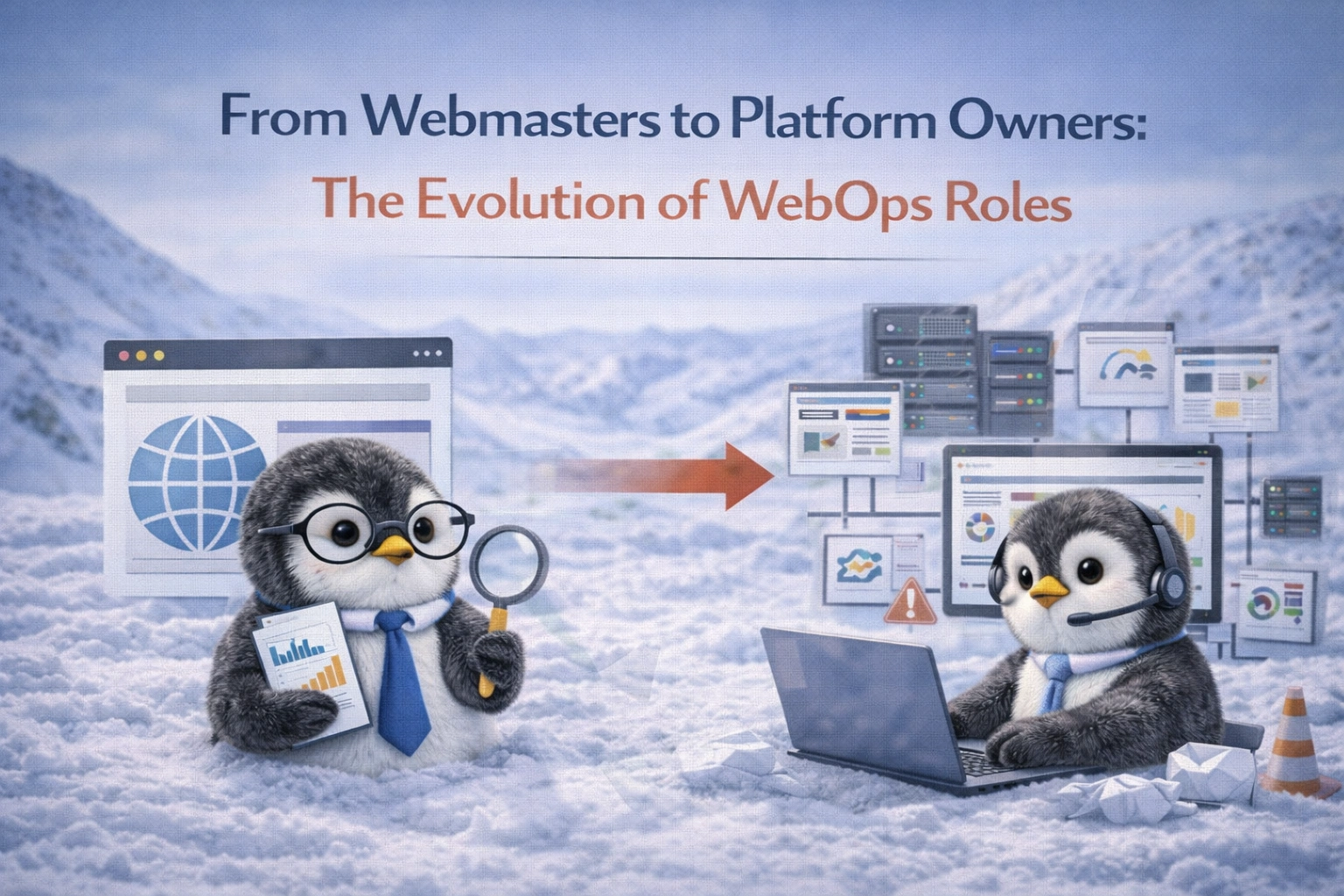
The evolution from webmaster to platform owner reflects a deeper shift: from managing pages to governing systems.
Organizations that recognize this transition and redesign roles accordingly gain predictability, resilience, and scalable SEO outcomes. Those that retain legacy role models ask individuals to solve system-level problems without system-level authority.
At enterprise scale, WebOps success depends less on who does the work and more on who owns the system.
