

Introduction
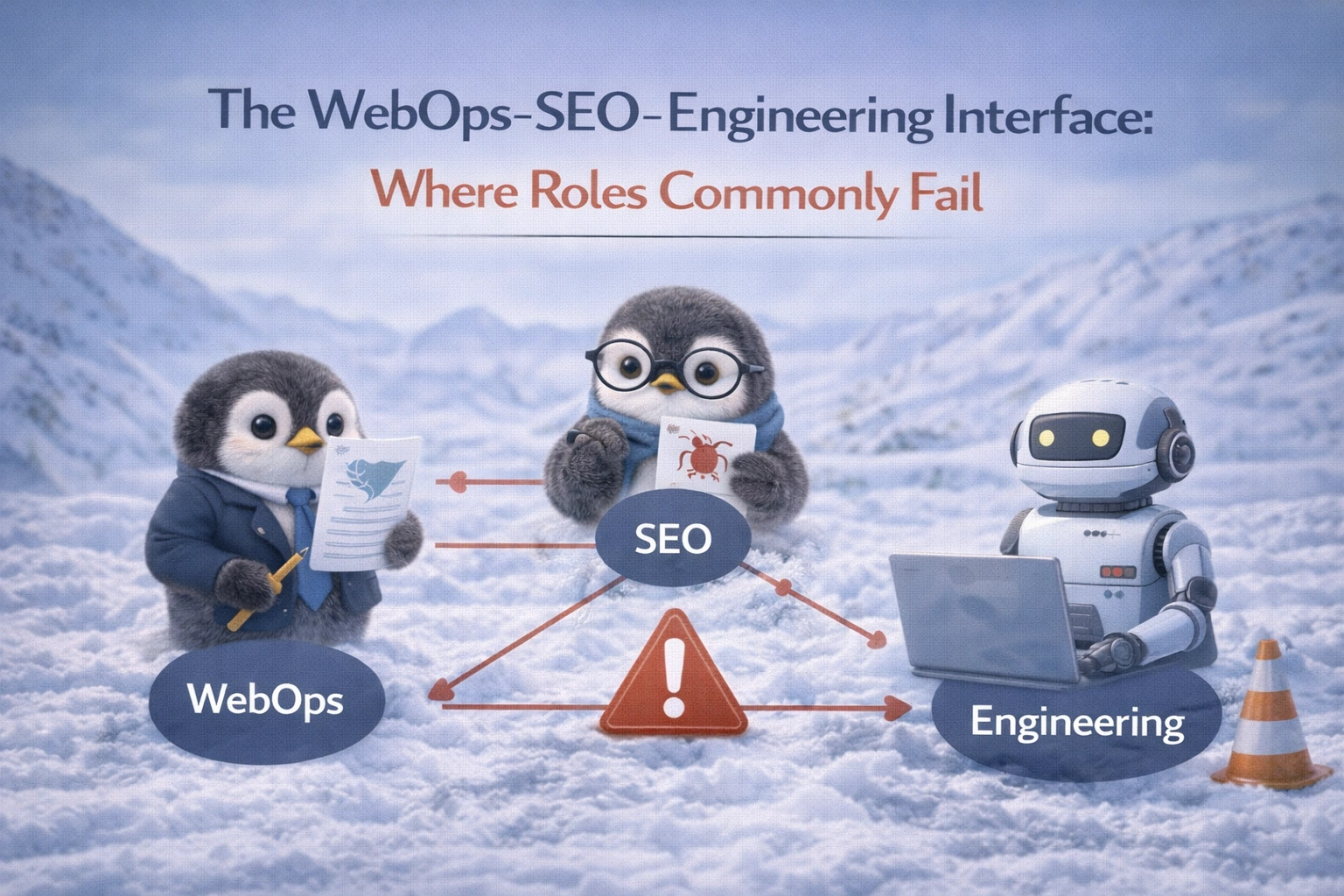
Most WebOps failures do not originate from a lack of effort or expertise. They originate at the boundaries between teams. SEO, engineering, and WebOps each operate with valid priorities, yet outcomes degrade when those priorities are not translated into shared decisions.
The interface between these functions is where assumptions accumulate. Engineering ships changes, believing they are isolated. SEO detects impact but lacks authority. WebOps absorbs the fallout without the power to correct root causes. Over time, this pattern normalizes failure.
This article examines the WebOps–SEO–engineering interface as a system boundary, explains why role misalignment persists even in mature organizations, and outlines how clear interfaces prevent recurring breakdowns.
Why Interfaces Matter More Than Individual Teams
Each function may be internally well-run while the overall system fails.
This occurs because:
- Engineering optimizes for delivery and correctness
- SEO optimizes for crawlability, indexation, and stability
- WebOps optimizes for reliability and flow
Without explicit integration points, these optimizations conflict silently.
The Assumption Gap Between Teams
Most cross-functional failures stem from unspoken assumptions.
Common examples include:
- Engineering assumes SEO issues are content-related
- SEO assumes WebOps controls release timing
- WebOps assumes changes were vetted upstream
When assumptions replace explicit agreements, accountability dissolves.
Where Role Boundaries Typically Break
During Planning
SEO and WebOps are often excluded from early planning.
By the time they are consulted:
- Architecture decisions are locked
- Timelines are fixed
- Risk tolerance is already set
Late involvement limits influence and increases downstream friction.
During Releases
Release responsibility is frequently diffused.
When something goes wrong:
- Engineering looks for code defects
- SEO looks for signal regressions
- WebOps looks for operational anomalies
Without a single release authority, resolution slows.
During Incidents
Incidents expose unclear decision rights.
Questions such as whether to roll back, wait, or mitigate externally often trigger escalation rather than action.
SEO as an Interface Function, Not a Department
In mature organizations, SEO operates as an interface layer.
This means:
- Translating search behavior into engineering constraints
- Identifying which changes carry search risk
- Participating in design and post-incident reviews
When SEO is treated as downstream validation, its impact is limited.
Why WebOps Often Becomes the Default Escalation Path
WebOps teams frequently inherit problems they did not create.
This happens because:
- They sit closest to production
- They have visibility across systems
- They are expected to “make it wor.k”
Without authority, this role becomes reactive rather than corrective.
Decision Rights at the Interface
Clear interfaces require explicit decision ownership.
Key decisions that must be assigned include:
- What constitutes an SEO-risky change
- Who can approve or block such changes
- Who decides rollback during mixed-impact incidents
When these are implicit, conflict is inevitable.
Why Documentation Alone Does Not Fix Interfaces
Many organizations respond to interface issues by writing guidelines.
Guidelines without enforcement:
- Are ignored under pressure
- Do not resolve authority conflicts
- Create a false sense of alignment
Interfaces must be operationalized, not just described.
Operationalizing the WebOps–SEO Interface
Effective integration is designed into workflows.
Examples include:
- Mandatory SEO input for high-risk changes
- Release checklists with explicit sign-off points
- Incident runbooks that include search validation
This reduces reliance on personal relationships.
How Interface Clarity Improves Outcomes
When roles and interfaces are clear:
- Decisions are faster
- Trade-offs are explicit
- Incidentare resolvedve with less friction
Search engines experience fewer surprises and greater consistency.
Why Interface Failures Persist
Interface problems are uncomfortable to address.
They require:
- Clarifying authority
- Challenging existing incentives
- Changing habitual workflows
As a result, organizations tolerate dysfunction longer than necessary.
Designing Interfaces for Scale
As organizations grow, interfaces multiply.
Scalable interface design:
- Standardizes decision points
- Defines escalation paths
- Separates consultation from approval
This allows teams to move independently without breaking the system.
Why Search Stability Depends on Interface Health
Search engines reward coherence.
When internal interfaces are broken, external signals fragment. Fixing SEO outcomes requires fixing how teams interact, not just what they deploy.
Conclusion
The WebOps–SEO–engineering interface is where most large-scale website failures are born.
Organizations that define roles but ignore interfaces remain reactive. Those who design clear decision boundaries and integrate them into workflows achieve stability without slowing down.
At enterprise scale, success is not determined by individual excellence. It is determined by how well teams connect.
