Close Menu
blog.ykthakur.com

    Subscribe to Updates

    Get the latest creative news from FooBar about art, design and business.

    What's Hot

    Personal Branding Without the Cringe: Building Professional Credibility That Actually Works

    February 6, 2026

    Career Resilience: How to Build a Job That Survives Layoffs, AI, and Market Shifts

    February 6, 2026

    From Individual Contributor to Leader: The Career Shift Most People Get Wrong

    February 6, 2026
    Facebook X (Twitter) Instagram
    blog.ykthakur.com
    • Home
    • About Me
    • Case Studies
    • Services
    • Contact Us
    Facebook X (Twitter) Instagram
    Subscribe
    • Blog
    • Search & Growth
      1. SEO
      2. Technical SEO
      3. SEM
      4. Paid Advertisements
      5. View All

      Why SEO Fails Even With the Right Tools and Data

      January 31, 2026

      How to Refresh Old Content Without Losing Rankings

      January 31, 2026

      How to Build a Topic Authority Map for SEO

      January 31, 2026

      E-E-A-T Signals Explained: What Actually Influences Trust and Rankings

      January 31, 2026

      XML Sitemaps at Scale: Signaling Priority, Not Forcing Indexation

      February 3, 2026

      Robots.txt at Scale: Control, Risk, and the Limits of Crawl Directives

      February 3, 2026

      Monitoring, Alerting, and SEO Observability: Seeing Failures Before Traffic Drops

      February 3, 2026

      Migrations, Releases, and SEO Risk: How Technical Changes Break Search at Scale

      February 3, 2026

      Scaling SEM Without Burning Budget

      January 31, 2026

      SEM vs SEO: How Paid Search Should Support Organic Growth

      January 31, 2026

      Quality Score Demystified: What Actually Improves SEM Performance

      January 31, 2026

      Brand vs Non-Brand Search: Budget Allocation Reality

      January 31, 2026

      Personal Branding Without the Cringe: Building Professional Credibility That Actually Works

      February 6, 2026

      Career Resilience: How to Build a Job That Survives Layoffs, AI, and Market Shifts

      February 6, 2026

      From Individual Contributor to Leader: The Career Shift Most People Get Wrong

      February 6, 2026

      The Non-Linear Career: Why the Best Careers No Longer Follow a Straight Path

      February 6, 2026
    • Performance & Infrastructure
      1. Website Performance
      2. Core Web Vitals
      3. Hosting Architecture
      4. Web Application Infrastructure
      5. Load Balancing
      6. View All

      Performance Drift: How Sites Get Slower Without Any One Bad Change

      February 3, 2026

      Why passing scores still hide systemic performance risk

      February 3, 2026

      Performance Monitoring Beyond Core Web Vitals

      February 3, 2026

      Personal Branding Without the Cringe: Building Professional Credibility That Actually Works

      February 6, 2026

      Career Resilience: How to Build a Job That Survives Layoffs, AI, and Market Shifts

      February 6, 2026

      From Individual Contributor to Leader: The Career Shift Most People Get Wrong

      February 6, 2026

      The Non-Linear Career: Why the Best Careers No Longer Follow a Straight Path

      February 6, 2026
    • AI & Automation
      1. AI Content Systems
      2. AI in SEO & Marketing
      3. AI Search Analysis
      4. AI-Driven SEO Workflows
      5. Generative AI Strategy
      6. View All

      AI Content Systems: How to Scale Without Losing Quality or Trust

      February 3, 2026

      AI in Marketing Is a System, Not a Toolset

      February 3, 2026

      SEO in a Zero-Click World: Designing for AI Answers and Visibility

      February 3, 2026

      AI Search Analysis: How LLMs Interpret and Surface Content

      February 3, 2026

      Using AI for Technical SEO Analysis Without Breaking Trust

      February 3, 2026

      AI-Driven SEO Workflows: What to Automate and What Not To

      February 3, 2026

      SEO in a Zero-Click World: Designing for AI Answers and Visibility

      February 3, 2026

      AI Search Analysis: How LLMs Interpret and Surface Content

      February 3, 2026

      Using AI for Technical SEO Analysis Without Breaking Trust

      February 3, 2026

      AI-Driven SEO Workflows: What to Automate and What Not To

      February 3, 2026

      Why Most AI SEO Implementations Fail

      February 3, 2026

      Human-in-the-Loop SEO: Where AI Stops and Judgment Starts

      February 3, 2026

      Personal Branding Without the Cringe: Building Professional Credibility That Actually Works

      February 6, 2026

      Career Resilience: How to Build a Job That Survives Layoffs, AI, and Market Shifts

      February 6, 2026

      From Individual Contributor to Leader: The Career Shift Most People Get Wrong

      February 6, 2026

      The Non-Linear Career: Why the Best Careers No Longer Follow a Straight Path

      February 6, 2026
    • Analytics & Intelligence
      1. GA4 Architecture
      2. Adobe Analytics
      3. View All

      GA4 vs Adobe Analytics: Choosing the Right Tool for Your Organization

      February 2, 2026

      Consent, Privacy, and Measurement: What Changes After GDPR & GA4

      February 2, 2026

      GA4 Architecture Explained: Designing Events for Real Decisions

      February 2, 2026

      GA4 vs Adobe Analytics: Choosing the Right Tool for Your Organization

      February 2, 2026

      Personal Branding Without the Cringe: Building Professional Credibility That Actually Works

      February 6, 2026

      Career Resilience: How to Build a Job That Survives Layoffs, AI, and Market Shifts

      February 6, 2026

      From Individual Contributor to Leader: The Career Shift Most People Get Wrong

      February 6, 2026

      The Non-Linear Career: Why the Best Careers No Longer Follow a Straight Path

      February 6, 2026
    • WebOps & DevOps
      1. Web Operations
      2. WebOps Roles
      3. Website Migrations & Scaling
      4. Release Management
      5. Monitoring & Alerts
      6. Performance Monitoring
      7. Deployment Automation
      8. View All

      SEO and WebOps Monitoring: Aligning Health Signals Across Systems

      February 3, 2026

      Designing Alerts for WebOps: Signal, Severity, and Actionability

      February 3, 2026

      Why Most Website Monitoring Is Too Late to Be Useful

      February 3, 2026

      Release Cadence Versus Stability: Finding the Sustainable Balance

      February 3, 2026

      Website Migrations at Scale: Why Most Fail Before the First Redirect

      February 3, 2026

      Post-Migration Reality: Why SEO and Performance Losses Persist for Months

      February 3, 2026

      Scaling Websites Without Replatforming: When Migration Is the Wrong Answer

      February 3, 2026

      Release Cadence Versus Stability: Finding the Sustainable Balance

      February 3, 2026

      Why Website Releases Break SEO Even When Nothing “Major” Changes

      February 3, 2026

      Release Management for Websites: Coordinating Risk Across Teams

      February 3, 2026

      Release Pipelines and Search Risk: Why Velocity Without Guardrails Breaks Websites

      February 3, 2026

      SEO and WebOps Monitoring: Aligning Health Signals Across Systems

      February 3, 2026

      Designing Alerts for WebOps: Signal, Severity, and Actionability

      February 3, 2026

      Why Most Website Monitoring Is Too Late to Be Useful

      February 3, 2026

      Feature Flags, Experiments, and the SEO Blast Radius

      February 3, 2026

      Performance Drift: How Sites Get Slower Without Any One Bad Change

      February 3, 2026

      Performance Monitoring Beyond Core Web Vitals

      February 3, 2026

      Designing SEO-Safe Deployment Automation

      February 3, 2026

      Deployment Automation for Websites: What to Automate and What Not To

      February 3, 2026

      Personal Branding Without the Cringe: Building Professional Credibility That Actually Works

      February 6, 2026

      Career Resilience: How to Build a Job That Survives Layoffs, AI, and Market Shifts

      February 6, 2026

      From Individual Contributor to Leader: The Career Shift Most People Get Wrong

      February 6, 2026

      The Non-Linear Career: Why the Best Careers No Longer Follow a Straight Path

      February 6, 2026
    • Project Strategy

      Personal Branding Without the Cringe: Building Professional Credibility That Actually Works

      February 6, 2026

      Career Resilience: How to Build a Job That Survives Layoffs, AI, and Market Shifts

      February 6, 2026

      From Individual Contributor to Leader: The Career Shift Most People Get Wrong

      February 6, 2026

      The Non-Linear Career: Why the Best Careers No Longer Follow a Straight Path

      February 6, 2026

      How to Stay Relevant When Roles Are Changing Faster Than Job Descriptions

      February 6, 2026
    • Web Engineering
      1. Web Development
      2. Web Designing & UX
      3. CMS & Platforms
      4. Web Application Firewall
      5. View All

      Personal Branding Without the Cringe: Building Professional Credibility That Actually Works

      February 6, 2026

      Career Resilience: How to Build a Job That Survives Layoffs, AI, and Market Shifts

      February 6, 2026

      From Individual Contributor to Leader: The Career Shift Most People Get Wrong

      February 6, 2026

      The Non-Linear Career: Why the Best Careers No Longer Follow a Straight Path

      February 6, 2026
    blog.ykthakur.com
    Home»Web Operations»Editorial Workflows»WebOps Maturity Models: From Reactive Support to Predictable Systems
    Editorial Workflows

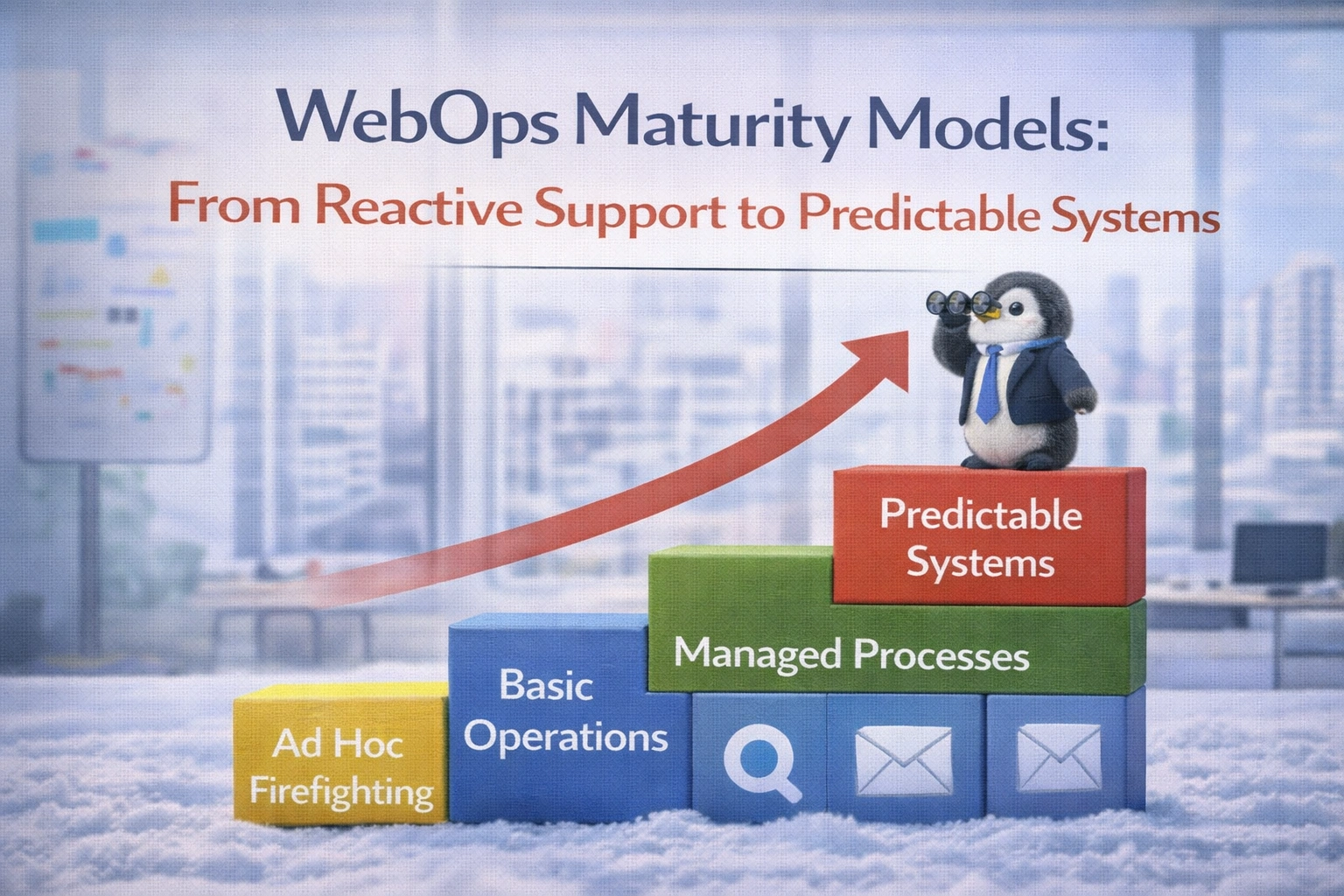
    WebOps Maturity Models: From Reactive Support to Predictable Systems

    How organizations evolve from firefighting to reliability engineering What “good” actually looks like at scale
    yashwant160@gmail.comBy yashwant160@gmail.comFebruary 3, 2026Updated:February 27, 2026No Comments4 Mins Read
    Share Facebook Twitter Pinterest LinkedIn Tumblr Email
    Follow Us
    Google News Flipboard Threads
    WebOps Maturity Models From Reactive Support To Predictable Systems 1024x683
    Share
    Facebook Twitter LinkedIn Pinterest Email

    Introduction

    Most organizations believe they understand their WebOps maturity by looking at tooling. Do they have CI/CD pipelines? Monitoring dashboards? On-call rotations? These indicators are useful, but they are not decisive.

    WebOps maturity is not defined by what tools exist. It is defined by how predictable outcomes are. Mature organizations experience fewer surprises, recover faster when failures occur, and can explain why systems behave the way they do. Immature organizations rely on heroics, intuition, and post-hoc explanations.

    This article outlines a practical WebOps maturity model focused on outcomes rather than implementations, showing how organizations evolve from reactive support functions to predictable, system-driven operations that protect SEO, performance, and reliability at scale.

    Why WebOps Maturity Is Often Misdiagnosed

    Many teams equate activity with maturity. Frequent deployments, complex pipelines, and extensive dashboards create the appearance of control.

    In reality, immaturity reveals itself through:

    • Repeated incidents with similar root causes
    • Unexplained SEO and performance volatility
    • Dependence on individual experts to maintain stability

    Maturity is measured by consistency, not motion.

    A Systems-Based View of Maturity

    A useful maturity model focuses on how systems behave under change.

    Key questions include:

    • Are outcomes repeatable across releases?
    • Are failures detected early or late?
    • Is recovery driven by process or improvisation?

    These questions cut across tooling choices and organizational structure.

    Level 1: Reactive Support

    At this stage, WebOps functions primarily as a support queue.

    • Issues are addressed when reported
    • SEO and performance problems are discovered via traffic drops
    • Knowledge resides with individuals rather than systems

    Outcomes depend heavily on experience and availability rather than design.

    Level 2: Operational Awareness

    Organizations at this level begin to see patterns.

    • Basic monitoring and alerting are in place
    • Recurring issues are recognized but not eliminated
    • SEO is consulted after problems emerge

    Awareness improves response, but root causes persist.

    Level 3: Defined Processes

    At this stage, organizations formalize how work flows.

    • Release processes are documented
    • SEO requirements are known, if not enforced
    • Post-incident reviews identify systemic gaps

    Consistency improves, but enforcement remains uneven.

    Level 4: Governed Systems

    Governance becomes explicit.

    • Non-negotiable standards are defined
    • Validation is integrated into pipelines
    • Risk is classified before changes are made

    Failures still occur, but their scope and duration are constrained.

    Level 5: Predictable Operations

    At the highest level, outcomes are intentionally designed.

    • Systems behave consistently across environments
    • SEO, performance, and reliability are built-in constraints
    • Incidents trigger learning rather than blame

    Search engines experience the site as stable, understandable, and trustworthy.

    What Changes as Maturity Increases

    Maturity alters how organizations experience everyday work.

    • Releases create less anxiety
    • SEO teams move upstream into planning
    • Fewer issues require emergency response

    The shift is cultural as much as technical.

    Why SEO Is a Reliable Maturity Signal

    SEO outcomes reflect long-term system behavior.

    In mature organizations:

    • Crawl patterns are stable
    • Indexation aligns with intent
    • Performance regressions are rare and brief

    In immature systems, SEO volatility persists regardless of effort.

    The Role of Leadership in Maturity Progression

    WebOps maturity cannot be delegated entirely to engineering teams.

    Leadership influence is required to:

    • Align incentives with stability
    • Protect time for debt reduction
    • Enforce standards consistently

    Without leadership support, maturity plateaus.

    Why Maturity Is Not Linear

    Organizations may exhibit traits from multiple levels simultaneously.

    Growth, acquisitions, and platform changes can temporarily reduce maturity. What matters is the ability to regain control quickly.

    Assessing Your Current State

    Useful assessment avoids checklists.

    Better questions include:

    • How often do we fix the same issue twice?
    • Can we explain recent SEO volatility confidently?
    • Do we trust our staging environments?

    Honest answers reveal maturity gaps.

    Designing a Path Forward

    Advancing maturity does not require rebuilding everything.

    High-leverage steps include:

    • Making standards explicit
    • Automating validation for known risks
    • Reducing reliance on individual knowledge

    Small, systemic improvements compound.

    Why Predictability Beats Optimization

    Organizations often chase optimization before stability.

    Search engines reward predictable systems over aggressively optimized but unstable ones. Maturity creates the foundation on which optimization actually works.

    Conclusion

    WebOps maturity is not about sophistication. It is about control.

    Organizations that progress from reactive support to predictable systems reduce SEO risk, improve performance stability, and regain confidence in change. Those that remain reactive continue to rely on heroics, regardless of investment.

    At enterprise scale, maturity is not optional. It is the difference between managing growth deliberately and being managed by complexity.

    Share. Facebook Twitter Pinterest LinkedIn Tumblr Email
    yashwant160@gmail.com
    • Website

    Related Posts

    Technical Debt in WebOps: How Platforms Accumulate SEO Risk

    February 3, 2026

    Environment Parity: Why Staging Rarely Matches Production and Why SEO Suffers

    February 3, 2026
    Leave A Reply Cancel Reply

    Don't Miss

    Personal Branding Without the Cringe: Building Professional Credibility That Actually Works

    yashwant160@gmail.comFebruary 6, 2026

    Personal branding has a reputation problem. Too often, it’s confused with self-promotion, performative posting, or…

    Career Resilience: How to Build a Job That Survives Layoffs, AI, and Market Shifts

    February 6, 2026

    From Individual Contributor to Leader: The Career Shift Most People Get Wrong

    February 6, 2026

    The Non-Linear Career: Why the Best Careers No Longer Follow a Straight Path

    February 6, 2026
    Stay In Touch
    • Facebook
    • Twitter
    • Pinterest
    • Instagram
    • YouTube
    • Vimeo

    Subscribe to Updates

    Get the latest creative news from SmartMag about art & design.

    About Us

    Results-driven digital professional with 15+ years of experience across Web Operations, Enterprise SEO, and large-scale digital platforms. I specialize in building, scaling, and optimizing complex websites where performance, search visibility, and operational reliability must work together—not in silos. My work sits at the intersection of strategy and execution, translating business goals into systems that teams can actually run.

    Facebook X (Twitter) Pinterest YouTube
    Our Picks

    Personal Branding Without the Cringe: Building Professional Credibility That Actually Works

    February 6, 2026

    Career Resilience: How to Build a Job That Survives Layoffs, AI, and Market Shifts

    February 6, 2026

    From Individual Contributor to Leader: The Career Shift Most People Get Wrong

    February 6, 2026
    Most Popular

    Top 15 popular link building methods you should consider before it’s too late

    March 24, 20180 Views

    Quality Score Demystified: What Actually Improves SEM Performance

    January 31, 20260 Views

    How SEO, SEM, Email, and Paid Social Should Work Together

    February 2, 20260 Views
    © 2026 All rights reserved. Y. K. Thakur.
    • Home
    • Technical SEO
    • World
    • Lifestyle
    • Buy Now

    Type above and press Enter to search. Press Esc to cancel.