Close Menu
blog.ykthakur.com

    Subscribe to Updates

    Get the latest creative news from FooBar about art, design and business.

    What's Hot

    Personal Branding Without the Cringe: Building Professional Credibility That Actually Works

    February 6, 2026

    Career Resilience: How to Build a Job That Survives Layoffs, AI, and Market Shifts

    February 6, 2026

    From Individual Contributor to Leader: The Career Shift Most People Get Wrong

    February 6, 2026
    Facebook X (Twitter) Instagram
    blog.ykthakur.com
    • Home
    • About Me
    • Case Studies
    • Services
    • Contact Us
    Facebook X (Twitter) Instagram
    Subscribe
    • Blog
    • Search & Growth
      1. SEO
      2. Technical SEO
      3. SEM
      4. Paid Advertisements
      5. View All

      Why SEO Fails Even With the Right Tools and Data

      January 31, 2026

      How to Refresh Old Content Without Losing Rankings

      January 31, 2026

      How to Build a Topic Authority Map for SEO

      January 31, 2026

      E-E-A-T Signals Explained: What Actually Influences Trust and Rankings

      January 31, 2026

      XML Sitemaps at Scale: Signaling Priority, Not Forcing Indexation

      February 3, 2026

      Robots.txt at Scale: Control, Risk, and the Limits of Crawl Directives

      February 3, 2026

      Monitoring, Alerting, and SEO Observability: Seeing Failures Before Traffic Drops

      February 3, 2026

      Migrations, Releases, and SEO Risk: How Technical Changes Break Search at Scale

      February 3, 2026

      Scaling SEM Without Burning Budget

      January 31, 2026

      SEM vs SEO: How Paid Search Should Support Organic Growth

      January 31, 2026

      Quality Score Demystified: What Actually Improves SEM Performance

      January 31, 2026

      Brand vs Non-Brand Search: Budget Allocation Reality

      January 31, 2026

      Personal Branding Without the Cringe: Building Professional Credibility That Actually Works

      February 6, 2026

      Career Resilience: How to Build a Job That Survives Layoffs, AI, and Market Shifts

      February 6, 2026

      From Individual Contributor to Leader: The Career Shift Most People Get Wrong

      February 6, 2026

      The Non-Linear Career: Why the Best Careers No Longer Follow a Straight Path

      February 6, 2026
    • Performance & Infrastructure
      1. Website Performance
      2. Core Web Vitals
      3. Hosting Architecture
      4. Web Application Infrastructure
      5. Load Balancing
      6. View All

      Performance Drift: How Sites Get Slower Without Any One Bad Change

      February 3, 2026

      Why passing scores still hide systemic performance risk

      February 3, 2026

      Performance Monitoring Beyond Core Web Vitals

      February 3, 2026

      Personal Branding Without the Cringe: Building Professional Credibility That Actually Works

      February 6, 2026

      Career Resilience: How to Build a Job That Survives Layoffs, AI, and Market Shifts

      February 6, 2026

      From Individual Contributor to Leader: The Career Shift Most People Get Wrong

      February 6, 2026

      The Non-Linear Career: Why the Best Careers No Longer Follow a Straight Path

      February 6, 2026
    • AI & Automation
      1. AI Content Systems
      2. AI in SEO & Marketing
      3. AI Search Analysis
      4. AI-Driven SEO Workflows
      5. Generative AI Strategy
      6. View All

      AI Content Systems: How to Scale Without Losing Quality or Trust

      February 3, 2026

      AI in Marketing Is a System, Not a Toolset

      February 3, 2026

      SEO in a Zero-Click World: Designing for AI Answers and Visibility

      February 3, 2026

      AI Search Analysis: How LLMs Interpret and Surface Content

      February 3, 2026

      Using AI for Technical SEO Analysis Without Breaking Trust

      February 3, 2026

      AI-Driven SEO Workflows: What to Automate and What Not To

      February 3, 2026

      SEO in a Zero-Click World: Designing for AI Answers and Visibility

      February 3, 2026

      AI Search Analysis: How LLMs Interpret and Surface Content

      February 3, 2026

      Using AI for Technical SEO Analysis Without Breaking Trust

      February 3, 2026

      AI-Driven SEO Workflows: What to Automate and What Not To

      February 3, 2026

      Why Most AI SEO Implementations Fail

      February 3, 2026

      Human-in-the-Loop SEO: Where AI Stops and Judgment Starts

      February 3, 2026

      Personal Branding Without the Cringe: Building Professional Credibility That Actually Works

      February 6, 2026

      Career Resilience: How to Build a Job That Survives Layoffs, AI, and Market Shifts

      February 6, 2026

      From Individual Contributor to Leader: The Career Shift Most People Get Wrong

      February 6, 2026

      The Non-Linear Career: Why the Best Careers No Longer Follow a Straight Path

      February 6, 2026
    • Analytics & Intelligence
      1. GA4 Architecture
      2. Adobe Analytics
      3. View All

      GA4 vs Adobe Analytics: Choosing the Right Tool for Your Organization

      February 2, 2026

      Consent, Privacy, and Measurement: What Changes After GDPR & GA4

      February 2, 2026

      GA4 Architecture Explained: Designing Events for Real Decisions

      February 2, 2026

      GA4 vs Adobe Analytics: Choosing the Right Tool for Your Organization

      February 2, 2026

      Personal Branding Without the Cringe: Building Professional Credibility That Actually Works

      February 6, 2026

      Career Resilience: How to Build a Job That Survives Layoffs, AI, and Market Shifts

      February 6, 2026

      From Individual Contributor to Leader: The Career Shift Most People Get Wrong

      February 6, 2026

      The Non-Linear Career: Why the Best Careers No Longer Follow a Straight Path

      February 6, 2026
    • WebOps & DevOps
      1. Web Operations
      2. WebOps Roles
      3. Website Migrations & Scaling
      4. Release Management
      5. Monitoring & Alerts
      6. Performance Monitoring
      7. Deployment Automation
      8. View All

      SEO and WebOps Monitoring: Aligning Health Signals Across Systems

      February 3, 2026

      Designing Alerts for WebOps: Signal, Severity, and Actionability

      February 3, 2026

      Why Most Website Monitoring Is Too Late to Be Useful

      February 3, 2026

      Release Cadence Versus Stability: Finding the Sustainable Balance

      February 3, 2026

      Website Migrations at Scale: Why Most Fail Before the First Redirect

      February 3, 2026

      Post-Migration Reality: Why SEO and Performance Losses Persist for Months

      February 3, 2026

      Scaling Websites Without Replatforming: When Migration Is the Wrong Answer

      February 3, 2026

      Release Cadence Versus Stability: Finding the Sustainable Balance

      February 3, 2026

      Why Website Releases Break SEO Even When Nothing “Major” Changes

      February 3, 2026

      Release Management for Websites: Coordinating Risk Across Teams

      February 3, 2026

      Release Pipelines and Search Risk: Why Velocity Without Guardrails Breaks Websites

      February 3, 2026

      SEO and WebOps Monitoring: Aligning Health Signals Across Systems

      February 3, 2026

      Designing Alerts for WebOps: Signal, Severity, and Actionability

      February 3, 2026

      Why Most Website Monitoring Is Too Late to Be Useful

      February 3, 2026

      Feature Flags, Experiments, and the SEO Blast Radius

      February 3, 2026

      Performance Drift: How Sites Get Slower Without Any One Bad Change

      February 3, 2026

      Performance Monitoring Beyond Core Web Vitals

      February 3, 2026

      Designing SEO-Safe Deployment Automation

      February 3, 2026

      Deployment Automation for Websites: What to Automate and What Not To

      February 3, 2026

      Personal Branding Without the Cringe: Building Professional Credibility That Actually Works

      February 6, 2026

      Career Resilience: How to Build a Job That Survives Layoffs, AI, and Market Shifts

      February 6, 2026

      From Individual Contributor to Leader: The Career Shift Most People Get Wrong

      February 6, 2026

      The Non-Linear Career: Why the Best Careers No Longer Follow a Straight Path

      February 6, 2026
    • Project Strategy

      Personal Branding Without the Cringe: Building Professional Credibility That Actually Works

      February 6, 2026

      Career Resilience: How to Build a Job That Survives Layoffs, AI, and Market Shifts

      February 6, 2026

      From Individual Contributor to Leader: The Career Shift Most People Get Wrong

      February 6, 2026

      The Non-Linear Career: Why the Best Careers No Longer Follow a Straight Path

      February 6, 2026

      How to Stay Relevant When Roles Are Changing Faster Than Job Descriptions

      February 6, 2026
    • Web Engineering
      1. Web Development
      2. Web Designing & UX
      3. CMS & Platforms
      4. Web Application Firewall
      5. View All

      Personal Branding Without the Cringe: Building Professional Credibility That Actually Works

      February 6, 2026

      Career Resilience: How to Build a Job That Survives Layoffs, AI, and Market Shifts

      February 6, 2026

      From Individual Contributor to Leader: The Career Shift Most People Get Wrong

      February 6, 2026

      The Non-Linear Career: Why the Best Careers No Longer Follow a Straight Path

      February 6, 2026
    blog.ykthakur.com
    Home»Web Operations»Multi-Site Governance»Multi-Site, Multi-CMS WebOps: Governance Without Centralized Control
    Multi-Site Governance

    Multi-Site, Multi-CMS WebOps: Governance Without Centralized Control

    How global organizations manage hundreds of sites without chaos Standards, autonomy, and enforcement
    yashwant160@gmail.comBy yashwant160@gmail.comFebruary 3, 2026Updated:February 27, 2026No Comments4 Mins Read
    Share Facebook Twitter Pinterest LinkedIn Tumblr Email
    Follow Us
    Google News Flipboard Threads
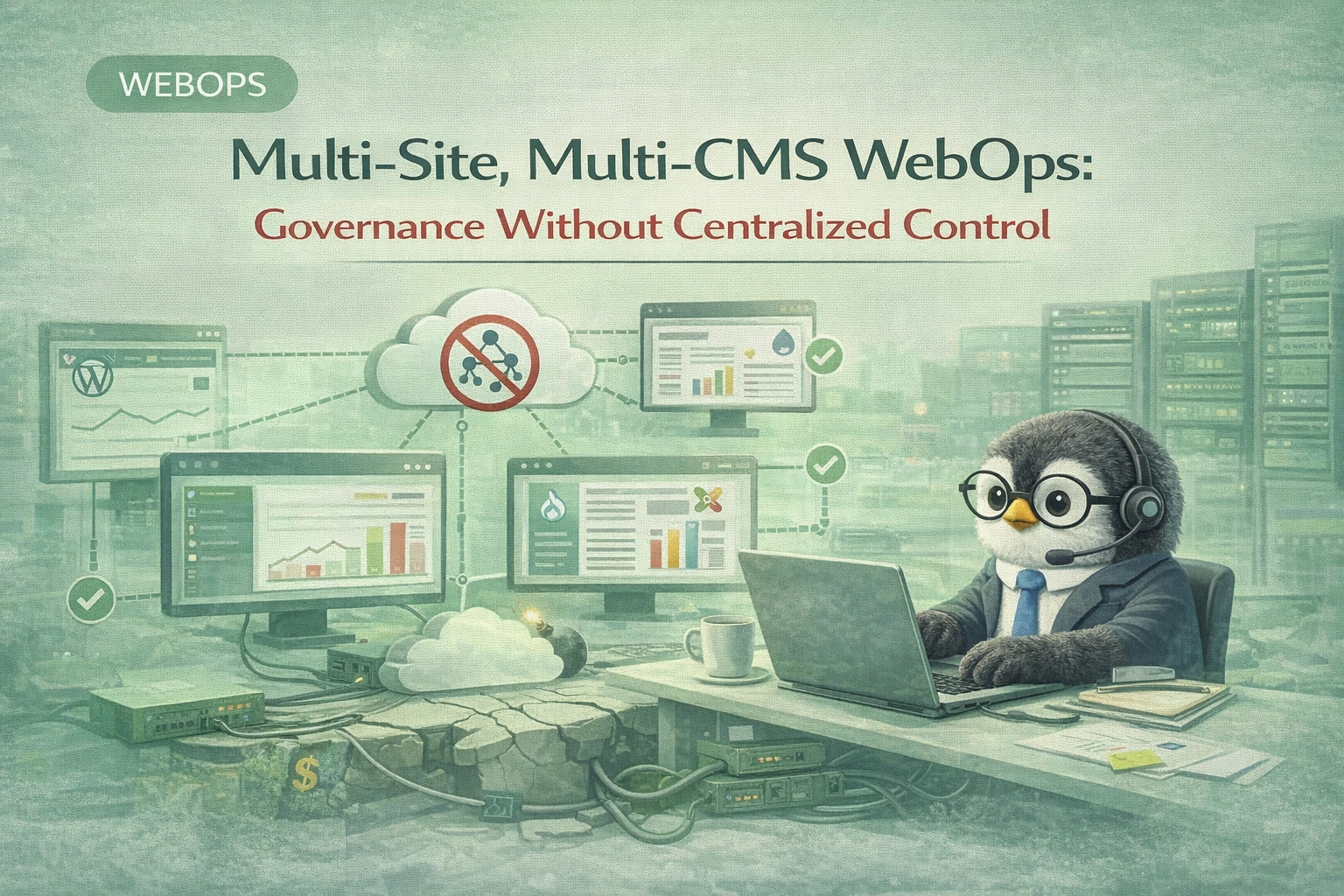
    Multi Site Multi CMS WebOps Governance Without Centralized Control 1024x683
    Share
    Facebook Twitter LinkedIn Pinterest Email

    Introduction

    As organizations scale, their web footprint fragments. New brands are acquired, regions demand autonomy, and platforms proliferate. What begins as a single website becomes dozens or hundreds of sites spread across multiple CMSs, hosting stacks, and release cycles.

    Centralizing control is rarely realistic. Forcing a single CMS, a single workflow, or a single deployment cadence often slows teams and creates resistance. At the same time, leaving each site to operate independently produces inconsistency, duplicated effort, and unpredictable SEO outcomes.

    This article examines how mature organizations govern multi-site, multi-CMS ecosystems without choking local velocity, and why WebOps success in these environments depends on standards, contracts, and observability rather than command-and-control.

    Why Multi-Site Complexity Is Inevitable

    Multi-site environments are usually the result of rational decisions.

    Common drivers include:

    • Global expansion with regional requirements
    • Mergers and acquisitions
    • Different product lines with distinct needs
    • Legacy platforms that cannot be retired quickly

    The mistake is not allowing diversity. The mistake is allowing diversity without coordination.

    The Failure of Centralized Web Control

    Attempts to centralize everything typically fail for predictable reasons.

    • Local teams lose agility
    • Platform decisions become political
    • Shadow systems emerge to bypass constraints

    From an SEO and reliability perspective, this often makes outcomes worse, not better.

    Governance Is Not Platform Standardization

    Governance is frequently confused with standardization.

    Standardization dictates tools. Governance defines rules of behavior.

    Effective WebOps governance focuses on:

    • What outcomes must be consistent
    • What signals search engines should see everywhere
    • What teams are free to decide locally

    This distinction allows autonomy without chaos.

    Defining Non-Negotiable Web Contracts

    In multi-CMS environments, contracts matter more than implementations.

    Non-negotiable contracts often include:

    • Response code and redirect behavior
    • Rendering expectations for indexable pages
    • Metadata and directive consistency
    • Performance and accessibility baselines

    How each platform meets these contracts can vary.

    SEO Consistency Without CMS Uniformity

    Search engines do not care which CMS generates a page. They care about what the page communicates.

    Consistency should be enforced at the signal level:

    • Predictable URL structures
    • Stable internal linking patterns
    • Clear indexation intent

    This approach scales better than enforcing a single CMS.

    Shared Services as the Control Layer

    Mature organizations centralize services, not sites.

    Shared services may include:

    • CDN and edge configuration
    • Monitoring and observability
    • Security and bot management
    • SEO validation tooling

    This creates consistency where it matters most.

    Release Autonomy With Guardrails

    Different sites release at different speeds.

    WebOps governance supports this by:

    • Defining risk tiers for changes
    • Applying validation requirements by tier
    • Allowing low-risk changes to move quickly

    Guardrails replace bottlenecks.

    Why Documentation Becomes Critical at Scale

    In fragmented ecosystems, tribal knowledge does not scale.

    Documentation must cover:

    • SEO and WebOps standards
    • Approved patterns and anti-patterns
    • Escalation and incident processes

    This reduces dependency on individuals and accelerates onboarding.

    Observability Across Sites and Platforms

    Governance without visibility is theoretical.

    Multi-site observability focuses on:

    • Crawl and indexation patterns by site
    • Performance consistency across platforms
    • Incident correlation across regions

    This allows central teams to detect systemic issues early.

    Managing Divergence Intentionally

    Not all divergence is bad.

    Organizations should explicitly decide:

    • Where experimentation is allowed
    • Where consistency is mandatory
    • How successful patterns are shared

    Unplanned divergence is a risk. Intentional divergence is learning.

    Roles and Accountability in Distributed WebOps

    Clear roles prevent governance from becoming advisory noise.

    Effective models define:

    • Local site owners are accountable for compliance
    • Central WebOps teams are accountable for standards
    • Clear escalation paths for conflicts

    Ambiguity undermines enforcement.

    Why SEO Suffers First in Fragmented Ecosystems

    SEO is often the first signal of fragmentation.

    Search engines detect:

    • Inconsistent internal linking
    • Variable performance and rendering
    • Conflicting indexation intent

    Without governance, these signals diverge silently.

    Designing Governance That Scales With Growth

    Governance must evolve as the ecosystem grows.

    Scalable governance:

    • Focuses on principles over prescriptions
    • Automates validation where possible
    • Adapts standards based on observed outcomes

    Static rules do not survive dynamic organizations.

    Conclusion

    Multi-site, multi-CMS environments are not a failure of planning. They are a reality of growth.

    Organizations that attempt to eliminate diversity through centralization create friction without reliability. Those that govern through clear contracts, shared services, and observability achieve consistency without sacrificing autonomy.

    At enterprise scale, WebOps success is not about controlling every site. It is about ensuring that every site behaves predictably where it matters most.

    Share. Facebook Twitter Pinterest LinkedIn Tumblr Email
    yashwant160@gmail.com
    • Website

    Leave A Reply Cancel Reply

    Don't Miss

    Personal Branding Without the Cringe: Building Professional Credibility That Actually Works

    yashwant160@gmail.comFebruary 6, 2026

    Personal branding has a reputation problem. Too often, it’s confused with self-promotion, performative posting, or…

    Career Resilience: How to Build a Job That Survives Layoffs, AI, and Market Shifts

    February 6, 2026

    From Individual Contributor to Leader: The Career Shift Most People Get Wrong

    February 6, 2026

    The Non-Linear Career: Why the Best Careers No Longer Follow a Straight Path

    February 6, 2026
    Stay In Touch
    • Facebook
    • Twitter
    • Pinterest
    • Instagram
    • YouTube
    • Vimeo

    Subscribe to Updates

    Get the latest creative news from SmartMag about art & design.

    About Us

    Results-driven digital professional with 15+ years of experience across Web Operations, Enterprise SEO, and large-scale digital platforms. I specialize in building, scaling, and optimizing complex websites where performance, search visibility, and operational reliability must work together—not in silos. My work sits at the intersection of strategy and execution, translating business goals into systems that teams can actually run.

    Facebook X (Twitter) Pinterest YouTube
    Our Picks

    Personal Branding Without the Cringe: Building Professional Credibility That Actually Works

    February 6, 2026

    Career Resilience: How to Build a Job That Survives Layoffs, AI, and Market Shifts

    February 6, 2026

    From Individual Contributor to Leader: The Career Shift Most People Get Wrong

    February 6, 2026
    Most Popular

    Top 15 popular link building methods you should consider before it’s too late

    March 24, 20180 Views

    Quality Score Demystified: What Actually Improves SEM Performance

    January 31, 20260 Views

    How SEO, SEM, Email, and Paid Social Should Work Together

    February 2, 20260 Views
    © 2026 All rights reserved. Y. K. Thakur.
    • Home
    • Technical SEO
    • World
    • Lifestyle
    • Buy Now

    Type above and press Enter to search. Press Esc to cancel.