

Introduction
Prompt engineering entered marketing organizations as an experimental activity. Individuals tested phrasing variations, shared successful prompts informally, and relied on personal intuition to get better outputs from AI models. In the early stages, this behavior was acceptable. At scale, it becomes a liability.
In SEO and enterprise marketing, prompts are not creative tricks. They are operational instructions. When prompts remain experimental, outputs remain inconsistent, ungoverned, and difficult to trust. Moving from experimentation to repeatability requires treating prompts as system components, not personal assets.
Prompt engineering for SEO is not about clever wording. It is about building instructions that reliably produce decision-ready outputs under real-world constraints.
Why Experimental Prompting Fails at Scale
Most organizations begin prompt usage informally. A few team members discover effective patterns, others copy them partially, and variations spread without documentation or validation.
This creates short-term gains and long-term instability.
Prompts Become Person-Dependent
When prompt effectiveness depends on who is writing it, the system cannot scale. Knowledge becomes siloed, and output quality fluctuates as teams change or expand.
Outputs Are Not Comparable
If prompts differ across teams, outputs cannot be evaluated consistently. Performance analysis becomes unreliable because inputs are uncontrolled.
No Auditability or Learning
Without versioned prompts, organizations cannot trace why an output changed or whether a performance improvement was causal or coincidental.
Prompts Are Interfaces, Not Messages
In a system-first model, prompts function as interfaces between organizational knowledge and AI capabilities.
An effective prompt:
- Defines the decision context
- Constrains acceptable outputs
- Specifies assumptions and exclusions
- Aligns outputs with downstream workflows
This is fundamentally different from asking AI to “write better content” or “analyze keywords.”
What Makes a Prompt Repeatable
Repeatable prompts are designed to survive scale, team changes, and model updates.
Explicit Context Boundaries
Prompts must clearly state what information the model should use and what it should ignore. This prevents hallucination and reduces variance.
Structured Output Requirements
Outputs should be formatted for immediate use or evaluation. Open-ended responses increase review time and reduce trust.
Decision Framing
Prompts should ask for analysis that supports a decision, not content that assumes one. This preserves human judgment in the workflow.
SEO-Specific Prompt Design Considerations
SEO introduces constraints that generic prompt templates fail to address.
Search Intent Alignment
Prompts must specify intent categories and audience sophistication. Without this, AI produces content that ranks poorly or misaligns with user needs.
Technical and Structural Limits
AI should be instructed to respect site architecture, indexation constraints, and internal linking logic. Ignoring these produces unusable recommendations.
Risk Sensitivity
Prompts should define acceptable levels of uncertainty, especially for YMYL, regulated, or brand-critical topics.
From Individual Prompts to Prompt Systems
Organizations that mature in AI usage move away from single prompts toward layered prompt systems.
These systems typically include:
- Base prompts defining tone, authority, and constraints
- Task-specific prompts for analysis or generation
- Validation prompts for consistency and risk checks
This structure reduces variance and makes prompt behavior predictable.
Versioning and Governance of Prompts
Once prompts influence business decisions, they require the same governance as code or analytics configurations.
Mature organizations:
- Version prompts explicitly
- Document intent and use cases
- Test changes against known benchmarks
This allows prompt evolution without destabilizing outputs.
Why Better Prompts Do Not Replace Judgment
Even the most well-designed prompt cannot resolve the ambiguity inherent in SEO.
Prompts can surface options, risks, and trade-offs. They cannot decide which trade-off aligns with the business strategy. That responsibility remains human.
Treating prompts as decision-makers creates false confidence. Treating them as decision support creates leverage.
Scaling Prompt Engineering Across Teams
Scaling prompt usage requires alignment, not creativity contests.
Successful organizations:
- Standardize core prompt patterns
- Train teams on intent, not wording tricks
- Centralize ownership of prompt evolution
This ensures consistency without blocking local adaptation.
Prompt Engineering as Infrastructure
When prompts are treated as infrastructure, they enable stability across changing tools and models.
Model upgrades become manageable. Output quality remains consistent. Teams spend less time experimenting and more time making informed decisions.
Conclusion
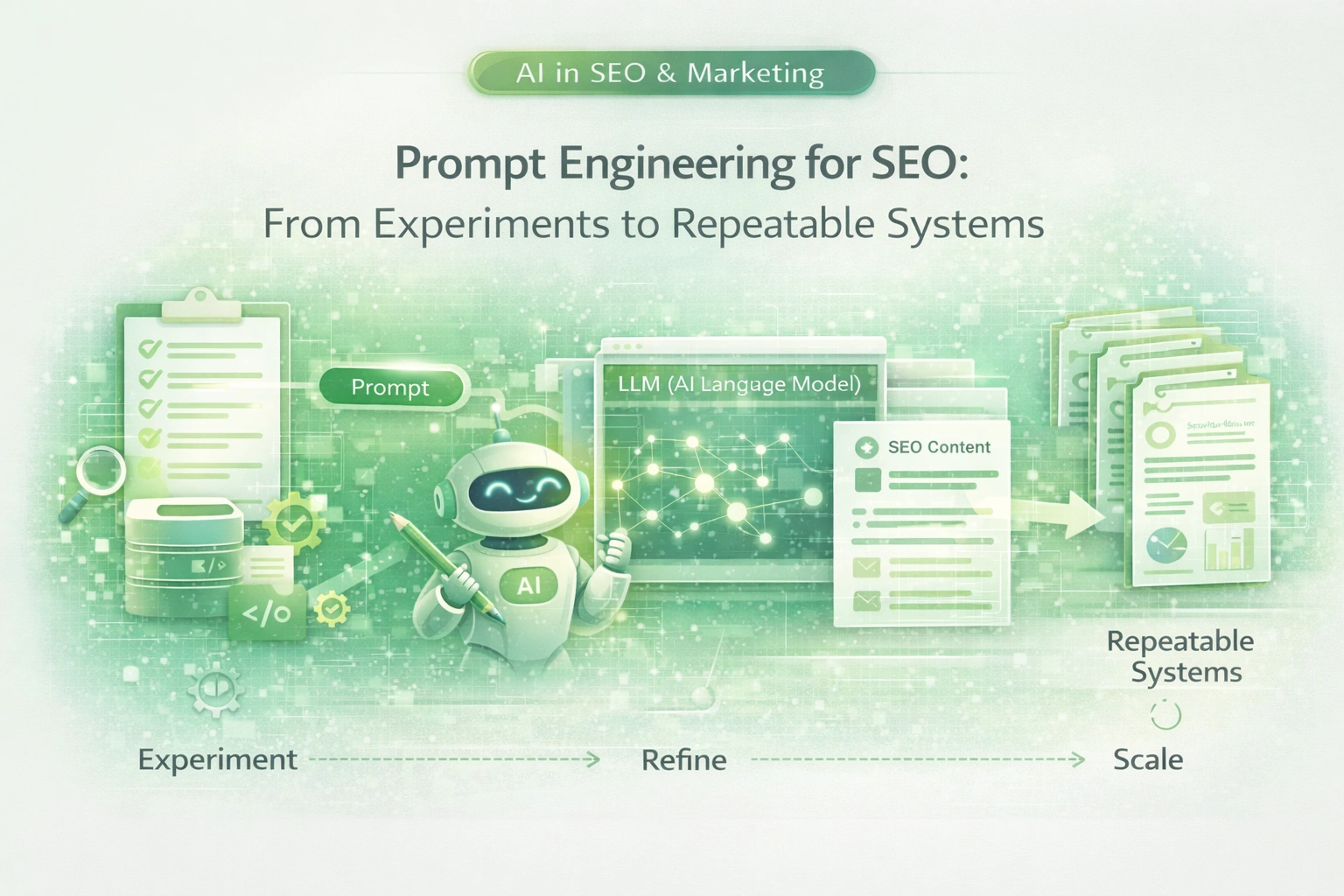
Prompt engineering for SEO must evolve from experimentation to systemization.
Organizations that rely on ad hoc prompts gain temporary efficiency and long-term inconsistency. Those who build repeatable prompt systems gain durable leverage from AI without surrendering control.
The goal is not better prompts. It is predictable, decision-ready outputs that scale with trust intact.
