

Introduction
Prompt libraries are often presented as a maturity milestone in AI adoption. Teams collect successful prompts, document them, and distribute them as reusable assets. On the surface, this looks like progress: fewer experiments, faster onboarding, and more consistent outputs.
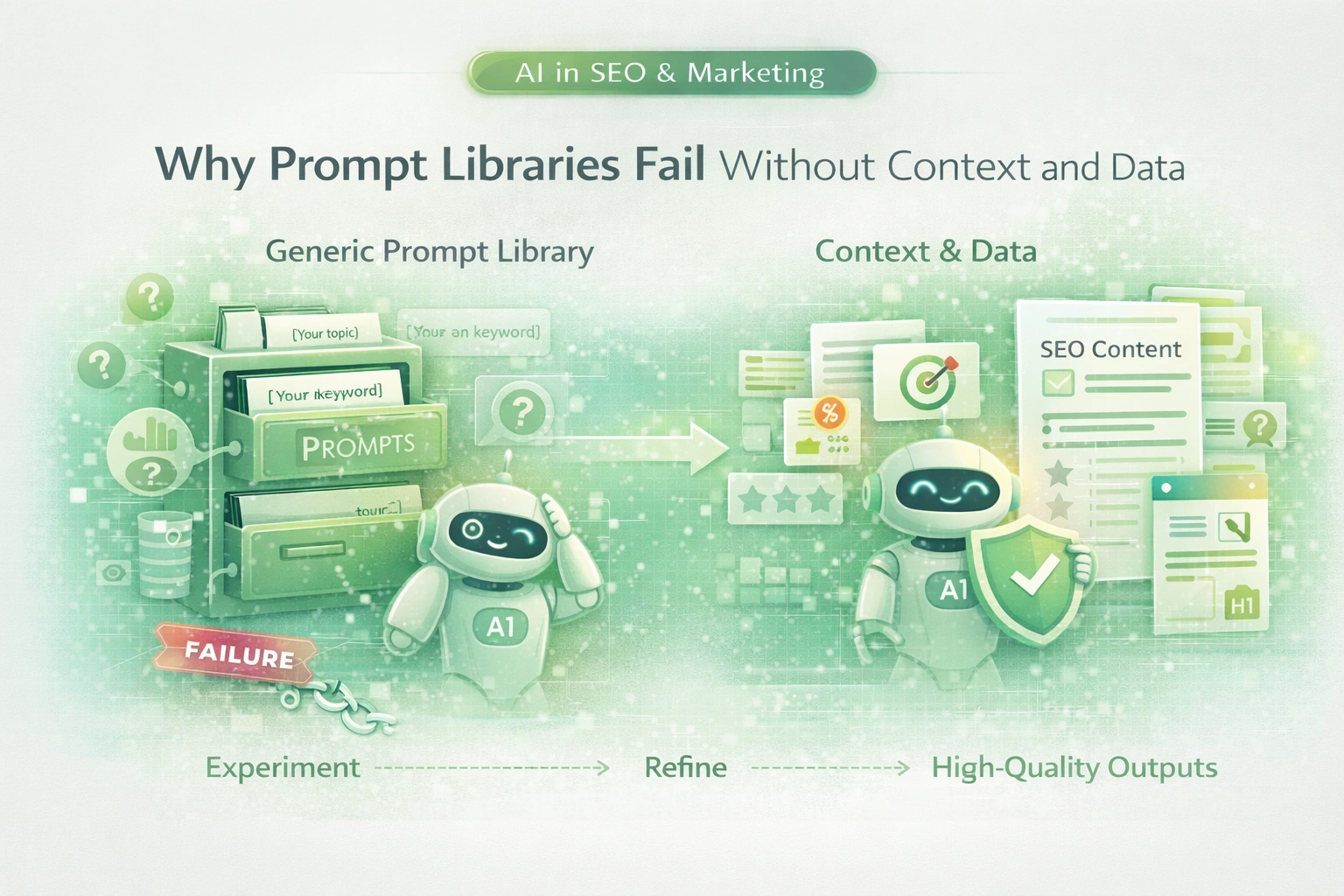
In practice, prompt libraries frequently fail at scale. Outputs drift, relevance declines, and teams quietly revert to modifying prompts ad hoc. The problem is not execution quality. It is a structural misunderstanding of what prompts can and cannot do in isolation.
Prompts without context and data are static instructions applied to dynamic systems. At enterprise scale, this mismatch guarantees failure.
Why Prompt Libraries Look Like the Right Answer
Prompt libraries appeal to organizations because they resemble familiar knowledge-management patterns. Documentation, reuse, and standardization are proven strategies in engineering, analytics, and operations.
Early benefits reinforce the belief:
- Teams spend less time experimenting
- Outputs appear more consistent initially
- AI usage feels more controlled
These gains are real but temporary. Without supporting systems, libraries become brittle quickly.
The Core Flaw: Prompts Are Not Self-Sufficient
A prompt does not contain meaning on its own. It references assumptions about audience, data freshness, business priorities, and risk tolerance. When those assumptions are not explicitly connected to live context, prompts degrade.
Prompt libraries fail because they treat prompts as complete instructions rather than interfaces into larger systems.
Context Decay Over Time
Marketing and SEO contexts change continuously. Search intent evolves. Product positioning shifts. Regulatory requirements update. A static prompt does not adapt to these changes.
When teams reuse prompts without updating contextual inputs, AI outputs slowly diverge from reality. Because the degradation is incremental, it often goes unnoticed until performance drops.
Audience Context Is Assumed, Not Defined
Many library prompts rely on implicit audience knowledge. As teams expand or rotate, those assumptions are lost. AI outputs remain fluent but misaligned.
Business Priorities Are Frozen in Time
Prompts created during one strategic phase may conflict with current objectives. Without explicit data injection, AI continues optimizing for outdated goals.
Data Blindness in Prompt Libraries
The most significant limitation of prompt libraries is their separation from data.
Prompts often instruct AI to analyze, prioritize, or recommend actions without providing current performance signals. The model compensates by generalizing, which reduces relevance and increases risk.
Without data integration, prompts cannot:
- Differentiate high-impact pages from low-impact ones
- Account for seasonal or market-specific variation
- Reflect real user behavior or engagement trends
Why “Best Prompts” Do Not Exist
Prompt libraries are often built around the idea of best-performing prompts. This framing is misleading.
A prompt that works well in one context may fail in another. Effectiveness depends on inputs, constraints, and evaluation criteria. Removing a prompt from its original environment strips it of the factors that made it successful.
At scale, this leads to false standardization: prompts look consistent, but outputs are not.
Prompt Libraries Encourage Shallow Reuse
When teams are given a library, they tend to reuse prompts mechanically. This discourages critical thinking about intent, data relevance, and downstream impact.
Instead of asking whether a prompt fits the current decision, teams ask which prompt to use. This shifts responsibility away from judgment and toward template selection.
What Scales Better Than Prompt Libraries
Mature organizations move beyond libraries toward prompt frameworks.
A prompt framework defines:
- Required contextual inputs
- Approved data sources
- Decision criteria and output formats
Individual prompts are then instantiated dynamically based on live inputs, rather than copied from a static list.
Integrating Context Into Prompt Systems
Context must be explicit and refreshable.
Effective systems inject:
- Audience definitions from centralized documentation
- Current business priorities from planning systems
- SEO constraints from technical governance rules
This reduces reliance on human memory and increases output reliability.
Data as a First-Class Prompt Input
Prompt systems that scale treat data as mandatory input, not optional enhancement.
This includes:
- Performance metrics tied to specific pages or topics
- Search demand signals segmented by intent
- Historical outcomes of similar decisions
When AI reasons over real data, outputs become situational rather than generic.
Governance Prevents Prompt Drift
Without governance, prompt libraries fragment as teams customize locally. Over time, the library becomes a collection of loosely related instructions with no clear ownership.
Governed systems:
- Define who can modify prompt frameworks
- Require rationale for changes
- Test outputs against known benchmarks
This preserves consistency while allowing evolution.
Why Context and Data Restore Trust
Trust in AI systems is not built through clever prompts. It is built through predictable behavior.
When prompts are consistently grounded in current context and data:
- Outputs align with business reality
- Review effort decreases
- Stakeholder confidence increases
This is the difference between AI assistance and AI guesswork.
Conclusion
Prompt libraries fail not because prompts are ineffective, but because libraries isolate them from the systems they depend on.
At enterprise scale, prompts must be dynamic, data-informed, and context-aware. Static collections create the illusion of control while introducing hidden instability.
The sustainable path forward is not building better libraries, but designing prompt systems that evolve with the organization and the decisions they support.
