
Close Menu
blog.ykthakur.com

    Subscribe to Updates

    Get the latest creative news from FooBar about art, design and business.

    What's Hot

    Personal Branding Without the Cringe: Building Professional Credibility That Actually Works

    February 6, 2026

    Career Resilience: How to Build a Job That Survives Layoffs, AI, and Market Shifts

    February 6, 2026

    From Individual Contributor to Leader: The Career Shift Most People Get Wrong

    February 6, 2026
    Facebook X (Twitter) Instagram
    blog.ykthakur.com
    • Home
    • About Me
    • Case Studies
    • Services
    • Contact Us
    Facebook X (Twitter) Instagram
    Subscribe
    • Blog
    • Search & Growth
      1. SEO
      2. Technical SEO
      3. SEM
      4. Paid Advertisements
      5. View All

      Why SEO Fails Even With the Right Tools and Data

      January 31, 2026

      How to Refresh Old Content Without Losing Rankings

      January 31, 2026

      How to Build a Topic Authority Map for SEO

      January 31, 2026

      E-E-A-T Signals Explained: What Actually Influences Trust and Rankings

      January 31, 2026

      XML Sitemaps at Scale: Signaling Priority, Not Forcing Indexation

      February 3, 2026

      Robots.txt at Scale: Control, Risk, and the Limits of Crawl Directives

      February 3, 2026

      Monitoring, Alerting, and SEO Observability: Seeing Failures Before Traffic Drops

      February 3, 2026

      Migrations, Releases, and SEO Risk: How Technical Changes Break Search at Scale

      February 3, 2026

      Scaling SEM Without Burning Budget

      January 31, 2026

      SEM vs SEO: How Paid Search Should Support Organic Growth

      January 31, 2026

      Quality Score Demystified: What Actually Improves SEM Performance

      January 31, 2026

      Brand vs Non-Brand Search: Budget Allocation Reality

      January 31, 2026

      Personal Branding Without the Cringe: Building Professional Credibility That Actually Works

      February 6, 2026

      Career Resilience: How to Build a Job That Survives Layoffs, AI, and Market Shifts

      February 6, 2026

      From Individual Contributor to Leader: The Career Shift Most People Get Wrong

      February 6, 2026

      The Non-Linear Career: Why the Best Careers No Longer Follow a Straight Path

      February 6, 2026
    • Performance & Infrastructure
      1. Website Performance
      2. Core Web Vitals
      3. Hosting Architecture
      4. Web Application Infrastructure
      5. Load Balancing
      6. View All

      Performance Drift: How Sites Get Slower Without Any One Bad Change

      February 3, 2026

      Why passing scores still hide systemic performance risk

      February 3, 2026

      Performance Monitoring Beyond Core Web Vitals

      February 3, 2026

      Personal Branding Without the Cringe: Building Professional Credibility That Actually Works

      February 6, 2026

      Career Resilience: How to Build a Job That Survives Layoffs, AI, and Market Shifts

      February 6, 2026

      From Individual Contributor to Leader: The Career Shift Most People Get Wrong

      February 6, 2026

      The Non-Linear Career: Why the Best Careers No Longer Follow a Straight Path

      February 6, 2026
    • AI & Automation
      1. AI Content Systems
      2. AI in SEO & Marketing
      3. AI Search Analysis
      4. AI-Driven SEO Workflows
      5. Generative AI Strategy
      6. View All

      AI Content Systems: How to Scale Without Losing Quality or Trust

      February 3, 2026

      AI in Marketing Is a System, Not a Toolset

      February 3, 2026

      SEO in a Zero-Click World: Designing for AI Answers and Visibility

      February 3, 2026

      AI Search Analysis: How LLMs Interpret and Surface Content

      February 3, 2026

      Using AI for Technical SEO Analysis Without Breaking Trust

      February 3, 2026

      AI-Driven SEO Workflows: What to Automate and What Not To

      February 3, 2026

      SEO in a Zero-Click World: Designing for AI Answers and Visibility

      February 3, 2026

      AI Search Analysis: How LLMs Interpret and Surface Content

      February 3, 2026

      Using AI for Technical SEO Analysis Without Breaking Trust

      February 3, 2026

      AI-Driven SEO Workflows: What to Automate and What Not To

      February 3, 2026

      Why Most AI SEO Implementations Fail

      February 3, 2026

      Human-in-the-Loop SEO: Where AI Stops and Judgment Starts

      February 3, 2026

      Personal Branding Without the Cringe: Building Professional Credibility That Actually Works

      February 6, 2026

      Career Resilience: How to Build a Job That Survives Layoffs, AI, and Market Shifts

      February 6, 2026

      From Individual Contributor to Leader: The Career Shift Most People Get Wrong

      February 6, 2026

      The Non-Linear Career: Why the Best Careers No Longer Follow a Straight Path

      February 6, 2026
    • Analytics & Intelligence
      1. GA4 Architecture
      2. Adobe Analytics
      3. View All

      GA4 vs Adobe Analytics: Choosing the Right Tool for Your Organization

      February 2, 2026

      Consent, Privacy, and Measurement: What Changes After GDPR & GA4

      February 2, 2026

      GA4 Architecture Explained: Designing Events for Real Decisions

      February 2, 2026

      GA4 vs Adobe Analytics: Choosing the Right Tool for Your Organization

      February 2, 2026

      Personal Branding Without the Cringe: Building Professional Credibility That Actually Works

      February 6, 2026

      Career Resilience: How to Build a Job That Survives Layoffs, AI, and Market Shifts

      February 6, 2026

      From Individual Contributor to Leader: The Career Shift Most People Get Wrong

      February 6, 2026

      The Non-Linear Career: Why the Best Careers No Longer Follow a Straight Path

      February 6, 2026
    • WebOps & DevOps
      1. Web Operations
      2. WebOps Roles
      3. Website Migrations & Scaling
      4. Release Management
      5. Monitoring & Alerts
      6. Performance Monitoring
      7. Deployment Automation
      8. View All

      SEO and WebOps Monitoring: Aligning Health Signals Across Systems

      February 3, 2026

      Designing Alerts for WebOps: Signal, Severity, and Actionability

      February 3, 2026

      Why Most Website Monitoring Is Too Late to Be Useful

      February 3, 2026

      Release Cadence Versus Stability: Finding the Sustainable Balance

      February 3, 2026

      Website Migrations at Scale: Why Most Fail Before the First Redirect

      February 3, 2026

      Post-Migration Reality: Why SEO and Performance Losses Persist for Months

      February 3, 2026

      Scaling Websites Without Replatforming: When Migration Is the Wrong Answer

      February 3, 2026

      Release Cadence Versus Stability: Finding the Sustainable Balance

      February 3, 2026

      Why Website Releases Break SEO Even When Nothing “Major” Changes

      February 3, 2026

      Release Management for Websites: Coordinating Risk Across Teams

      February 3, 2026

      Release Pipelines and Search Risk: Why Velocity Without Guardrails Breaks Websites

      February 3, 2026

      SEO and WebOps Monitoring: Aligning Health Signals Across Systems

      February 3, 2026

      Designing Alerts for WebOps: Signal, Severity, and Actionability

      February 3, 2026

      Why Most Website Monitoring Is Too Late to Be Useful

      February 3, 2026

      Feature Flags, Experiments, and the SEO Blast Radius

      February 3, 2026

      Performance Drift: How Sites Get Slower Without Any One Bad Change

      February 3, 2026

      Performance Monitoring Beyond Core Web Vitals

      February 3, 2026

      Designing SEO-Safe Deployment Automation

      February 3, 2026

      Deployment Automation for Websites: What to Automate and What Not To

      February 3, 2026

      Personal Branding Without the Cringe: Building Professional Credibility That Actually Works

      February 6, 2026

      Career Resilience: How to Build a Job That Survives Layoffs, AI, and Market Shifts

      February 6, 2026

      From Individual Contributor to Leader: The Career Shift Most People Get Wrong

      February 6, 2026

      The Non-Linear Career: Why the Best Careers No Longer Follow a Straight Path

      February 6, 2026
    • Project Strategy

      Personal Branding Without the Cringe: Building Professional Credibility That Actually Works

      February 6, 2026

      Career Resilience: How to Build a Job That Survives Layoffs, AI, and Market Shifts

      February 6, 2026

      From Individual Contributor to Leader: The Career Shift Most People Get Wrong

      February 6, 2026

      The Non-Linear Career: Why the Best Careers No Longer Follow a Straight Path

      February 6, 2026

      How to Stay Relevant When Roles Are Changing Faster Than Job Descriptions

      February 6, 2026
    • Web Engineering
      1. Web Development
      2. Web Designing & UX
      3. CMS & Platforms
      4. Web Application Firewall
      5. View All

      Personal Branding Without the Cringe: Building Professional Credibility That Actually Works

      February 6, 2026

      Career Resilience: How to Build a Job That Survives Layoffs, AI, and Market Shifts

      February 6, 2026

      From Individual Contributor to Leader: The Career Shift Most People Get Wrong

      February 6, 2026

      The Non-Linear Career: Why the Best Careers No Longer Follow a Straight Path

      February 6, 2026
    blog.ykthakur.com
    Home»SEM»Keyword Bidding Models»Keyword Bidding Models Explained: Manual, Smart, and Hybrid
    Keyword Bidding Models

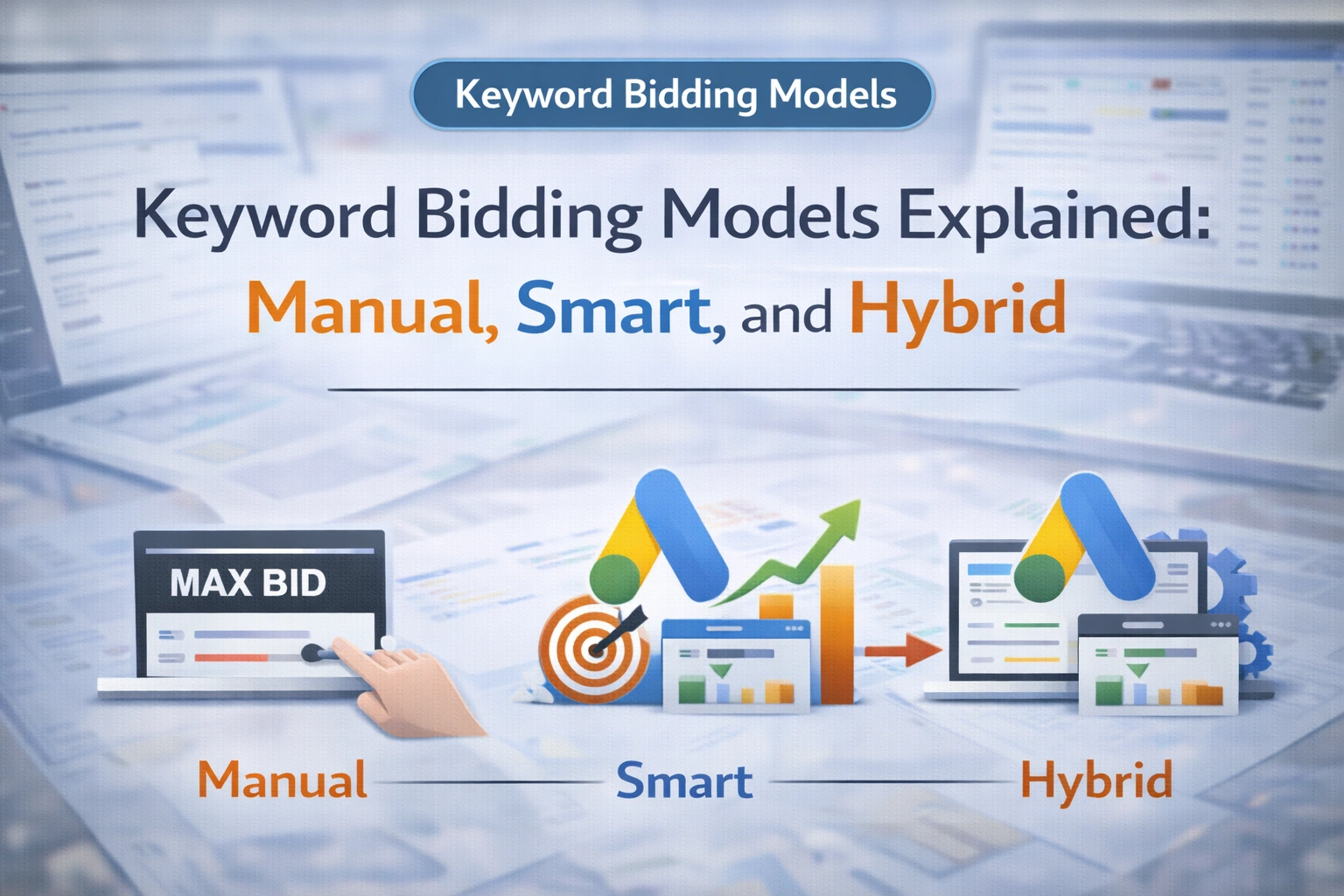
    Keyword Bidding Models Explained: Manual, Smart, and Hybrid

    yashwant160@gmail.comBy yashwant160@gmail.comJanuary 31, 2026Updated:February 1, 2026No Comments5 Mins Read
    Share Facebook Twitter Pinterest LinkedIn Tumblr Email
    Follow Us
    Google News Flipboard Threads
    Keywords Bidding 1024x683
    Share
    Facebook Twitter LinkedIn Pinterest Email

    Introduction

    Choosing the wrong bidding model is one of the fastest ways to destroy SEM performance—quietly and expensively. Many teams switch bidding strategies based on trends, platform recommendations, or pressure to “use automation,” without understanding how bidding models actually work under the hood. In reality, bidding models don’t create performance; they amplify the signals you feed them. When those signals are weak, even the most advanced automation fails.

    This article explains manual, smart, and hybrid keyword bidding models, how each one behaves in real-world SEM accounts, when to use them, and how experienced teams transition between models safely as campaigns mature.

    Why Bidding Models Matter More Than Most Teams Realize

    Bidding controls:

    • How aggressively you enter auctions
    • Which users do you prioritize
    • How the budget is distributed over time
    • How algorithms interpret success

    A mismatch between:

    • Bidding model
    • Campaign structure
    • Signal quality

    …leads to wasted spend—even with good ads and landing pages.

    Bidding is not a tactic.
    It’s a risk management decision.

    The Three Core Bidding Models (High-Level Overview)

    Model Control Level Automation Risk Profile
    Manual High None Low–Medium
    Smart Low High Medium–High
    Hybrid Medium Selective Low

    Each model solves a different problem.
    No single model is “best” in all cases.

    Manual Bidding: Maximum Control, Maximum Responsibility

    What Manual Bidding Actually Does

    Manual bidding allows you to:

    • Set keyword-level bids
    • Control CPC ceilings
    • React immediately to performance changes

    You are telling the platform:

    “Do not make assumptions. Follow my instructions.”

    When Manual Bidding Works Best

    Manual bidding is most effective when:

    • Campaigns are new
    • Conversion data is limited
    • Intent is clearly segmented
    • Budgets are controlled
    • Risk tolerance is low

    It’s especially useful in:

    • Brand campaigns
    • High-cost verticals
    • Regulated industries
    • Early testing phases

    Why Manual Bidding Still Matters in 2026

    Despite automation advances, manual bidding excels at:

    • Preventing overspend
    • Maintaining CPC discipline
    • Isolating intent performance
    • Avoiding algorithmic drift

    It forces intentional optimization, not reactive automation.

    Limitations of Manual Bidding

    Manual bidding struggles when:

    • Scale increases
    • Auction dynamics shift rapidly
    • Conversion data grows complex
    • Time constraints limit oversight

    It does not adapt in real time, and that can cap upside.

    Smart Bidding: Automation That Scales Signals

    What Smart Bidding Actually Does

    Smart bidding uses:

    • Historical conversion data
    • User signals
    • Contextual factors
    • Predictive modeling

    To dynamically adjust bids in real time.

    You are telling the platform:

    “Optimize toward this outcome using all available signals.”

    Common Smart Bidding Models (Conceptual)

    • Maximize Conversions
    • Target CPA
    • Maximize Conversion Value
    • Target ROAS

    Each relies heavily on conversion accuracy and volume.

    When Smart Bidding Works Well

    Smart bidding performs best when:

    • Conversion tracking is accurate
    • Volume is sufficient (30–50+ conversions/month)
    • Intent is cleanly segmented
    • Landing pages convert consistently
    • Budgets allow learning periods

    It shines in:

    • Mature non-brand campaigns
    • E-commerce
    • High-volume lead gen
    • Stable markets

    Why Smart Bidding Fails So Often

    Smart bidding breaks when:

    • Conversion data is noisy
    • Low-quality leads are counted equally
    • Intent is mixed within campaigns
    • Budgets fluctuate unpredictably

    In these cases, automation:

    • Optimizes the wrong outcomes
    • Scales low-quality traffic
    • Inflates CPCs
    • Hides inefficiencies

    Automation doesn’t fail randomly—it follows instructions too well.

    Hybrid Bidding: Control Where It Matters, Automation Where It Helps

    What Hybrid Bidding Means in Practice

    Hybrid bidding is not a platform setting—it’s a strategy.

    It combines:

    • Manual bidding for control-heavy campaigns
    • Smart bidding for scale-ready campaigns

    Based on:

    • Intent maturity
    • Data quality
    • Risk tolerance

    How Mature Teams Use Hybrid Models

    A common hybrid setup:

    Campaign Type Bidding Model
    Brand Manual
    High Intent Non-Brand Target CPA
    Mid Intent Maximize Conversions (capped)
    Low Intent / Learning Manual or limited automation

    This allows:

    • Protection of high-value traffic
    • Controlled experimentation
    • Scalable growth without runaway spending

    Step-by-Step: Choosing the Right Bidding Model

    Step 1: Assess Signal Quality

    Ask:

    • Are conversions meaningful?
    • Are low-quality leads filtered?
    • Is attribution reliable?

    If not → avoid full automation.

    Step 2: Evaluate Volume and Consistency

    Smart bidding needs:

    • Consistent conversion flow
    • Stable demand
    • Time to learn

    Low volume = poor predictions.

    Step 3: Match Risk to Business Reality

    High-margin businesses can tolerate:

    • Learning inefficiency
    • CPC volatility

    Low-margin businesses cannot.

    Bidding must reflect financial reality—not platform suggestions.

    Step 4: Transition Gradually (Never Flip the Switch)

    Avoid:

    • Switching entire accounts at once
    • Combining structural changes with bidding changes

    Best practice:

    • Test on one campaign
    • Monitor for 2–4 weeks
    • Compare against baseline
    • Scale only after stability

    Bidding Models and Intent Segmentation (Critical Link)

    Bidding cannot compensate for poor structure.

    Example

    If a campaign mixes:

    • “SEO services pricing.”
    • “What is SEO?”

    Smart bidding will:

    • Chase cheaper conversions
    • Overweight low-intent queries
    • Reduce lead quality

    Structure must come before bidding decisions.

    Common Bidding Mistakes That Kill Performance

    • Trusting automation too early
    • Optimizing for volume instead of quality
    • Changing bids too frequently
    • Ignoring intent differences
    • Using platform defaults blindly

    Most failures are operational, not technical.

    How Bidding Models Affect CPC, CPA, and Scale

    Outcome Manual Smart Hybrid
    CPC control High Low Medium
    CPA stability Medium High (if clean data) High
    Lead quality High Variable High
    Scalability Limited High High
    Risk exposure Low High Controlled

    Advanced Insight: Why Platforms Push Automation

    Automation benefits platforms because:

    • It increases auction competition
    • It raises average CPCs
    • It reduces advertiser friction

    That doesn’t mean automation is bad—but it must be governed.

    Smart teams decide when to automate.
    Weak teams are told to.

    Final Takeaway

    Bidding models don’t fix SEM problems—they amplify existing conditions.

    • Manual bidding protects control
    • Smart bidding scales clean signals
    • Hybrid bidding balances growth and risk

    The best SEM accounts don’t “pick a model.”
    They earn the right to automate.

    Share. Facebook Twitter Pinterest LinkedIn Tumblr Email
    yashwant160@gmail.com
    • Website

    Related Posts

    Brand vs Non-Brand Search: Budget Allocation Reality

    January 31, 2026
    Leave A Reply Cancel Reply

    Don't Miss

    Personal Branding Without the Cringe: Building Professional Credibility That Actually Works

    yashwant160@gmail.comFebruary 6, 2026

    Personal branding has a reputation problem. Too often, it’s confused with self-promotion, performative posting, or…

    Career Resilience: How to Build a Job That Survives Layoffs, AI, and Market Shifts

    February 6, 2026

    From Individual Contributor to Leader: The Career Shift Most People Get Wrong

    February 6, 2026

    The Non-Linear Career: Why the Best Careers No Longer Follow a Straight Path

    February 6, 2026
    Stay In Touch
    • Facebook
    • Twitter
    • Pinterest
    • Instagram
    • YouTube
    • Vimeo

    Subscribe to Updates

    Get the latest creative news from SmartMag about art & design.

    About Us

    Results-driven digital professional with 15+ years of experience across Web Operations, Enterprise SEO, and large-scale digital platforms. I specialize in building, scaling, and optimizing complex websites where performance, search visibility, and operational reliability must work together—not in silos. My work sits at the intersection of strategy and execution, translating business goals into systems that teams can actually run.

    Facebook X (Twitter) Pinterest YouTube
    Our Picks

    Personal Branding Without the Cringe: Building Professional Credibility That Actually Works

    February 6, 2026

    Career Resilience: How to Build a Job That Survives Layoffs, AI, and Market Shifts

    February 6, 2026

    From Individual Contributor to Leader: The Career Shift Most People Get Wrong

    February 6, 2026
    Most Popular

    Top 15 popular link building methods you should consider before it’s too late

    March 24, 20180 Views

    Quality Score Demystified: What Actually Improves SEM Performance

    January 31, 20260 Views

    How SEO, SEM, Email, and Paid Social Should Work Together

    February 2, 20260 Views
    © 2026 All rights reserved. Y. K. Thakur.
    • Home
    • Technical SEO
    • World
    • Lifestyle
    • Buy Now

    Type above and press Enter to search. Press Esc to cancel.