Close Menu
blog.ykthakur.com

    Subscribe to Updates

    Get the latest creative news from FooBar about art, design and business.

    What's Hot

    Personal Branding Without the Cringe: Building Professional Credibility That Actually Works

    February 6, 2026

    Career Resilience: How to Build a Job That Survives Layoffs, AI, and Market Shifts

    February 6, 2026

    From Individual Contributor to Leader: The Career Shift Most People Get Wrong

    February 6, 2026
    Facebook X (Twitter) Instagram
    blog.ykthakur.com
    • Home
    • About Me
    • Case Studies
    • Services
    • Contact Us
    Facebook X (Twitter) Instagram
    Subscribe
    • Blog
    • Search & Growth
      1. SEO
      2. Technical SEO
      3. SEM
      4. Paid Advertisements
      5. View All

      Why SEO Fails Even With the Right Tools and Data

      January 31, 2026

      How to Refresh Old Content Without Losing Rankings

      January 31, 2026

      How to Build a Topic Authority Map for SEO

      January 31, 2026

      E-E-A-T Signals Explained: What Actually Influences Trust and Rankings

      January 31, 2026

      XML Sitemaps at Scale: Signaling Priority, Not Forcing Indexation

      February 3, 2026

      Robots.txt at Scale: Control, Risk, and the Limits of Crawl Directives

      February 3, 2026

      Monitoring, Alerting, and SEO Observability: Seeing Failures Before Traffic Drops

      February 3, 2026

      Migrations, Releases, and SEO Risk: How Technical Changes Break Search at Scale

      February 3, 2026

      Scaling SEM Without Burning Budget

      January 31, 2026

      SEM vs SEO: How Paid Search Should Support Organic Growth

      January 31, 2026

      Quality Score Demystified: What Actually Improves SEM Performance

      January 31, 2026

      Brand vs Non-Brand Search: Budget Allocation Reality

      January 31, 2026

      Personal Branding Without the Cringe: Building Professional Credibility That Actually Works

      February 6, 2026

      Career Resilience: How to Build a Job That Survives Layoffs, AI, and Market Shifts

      February 6, 2026

      From Individual Contributor to Leader: The Career Shift Most People Get Wrong

      February 6, 2026

      The Non-Linear Career: Why the Best Careers No Longer Follow a Straight Path

      February 6, 2026
    • Performance & Infrastructure
      1. Website Performance
      2. Core Web Vitals
      3. Hosting Architecture
      4. Web Application Infrastructure
      5. Load Balancing
      6. View All

      Performance Drift: How Sites Get Slower Without Any One Bad Change

      February 3, 2026

      Why passing scores still hide systemic performance risk

      February 3, 2026

      Performance Monitoring Beyond Core Web Vitals

      February 3, 2026

      Personal Branding Without the Cringe: Building Professional Credibility That Actually Works

      February 6, 2026

      Career Resilience: How to Build a Job That Survives Layoffs, AI, and Market Shifts

      February 6, 2026

      From Individual Contributor to Leader: The Career Shift Most People Get Wrong

      February 6, 2026

      The Non-Linear Career: Why the Best Careers No Longer Follow a Straight Path

      February 6, 2026
    • AI & Automation
      1. AI Content Systems
      2. AI in SEO & Marketing
      3. AI Search Analysis
      4. AI-Driven SEO Workflows
      5. Generative AI Strategy
      6. View All

      AI Content Systems: How to Scale Without Losing Quality or Trust

      February 3, 2026

      AI in Marketing Is a System, Not a Toolset

      February 3, 2026

      SEO in a Zero-Click World: Designing for AI Answers and Visibility

      February 3, 2026

      AI Search Analysis: How LLMs Interpret and Surface Content

      February 3, 2026

      Using AI for Technical SEO Analysis Without Breaking Trust

      February 3, 2026

      AI-Driven SEO Workflows: What to Automate and What Not To

      February 3, 2026

      SEO in a Zero-Click World: Designing for AI Answers and Visibility

      February 3, 2026

      AI Search Analysis: How LLMs Interpret and Surface Content

      February 3, 2026

      Using AI for Technical SEO Analysis Without Breaking Trust

      February 3, 2026

      AI-Driven SEO Workflows: What to Automate and What Not To

      February 3, 2026

      Why Most AI SEO Implementations Fail

      February 3, 2026

      Human-in-the-Loop SEO: Where AI Stops and Judgment Starts

      February 3, 2026

      Personal Branding Without the Cringe: Building Professional Credibility That Actually Works

      February 6, 2026

      Career Resilience: How to Build a Job That Survives Layoffs, AI, and Market Shifts

      February 6, 2026

      From Individual Contributor to Leader: The Career Shift Most People Get Wrong

      February 6, 2026

      The Non-Linear Career: Why the Best Careers No Longer Follow a Straight Path

      February 6, 2026
    • Analytics & Intelligence
      1. GA4 Architecture
      2. Adobe Analytics
      3. View All

      GA4 vs Adobe Analytics: Choosing the Right Tool for Your Organization

      February 2, 2026

      Consent, Privacy, and Measurement: What Changes After GDPR & GA4

      February 2, 2026

      GA4 Architecture Explained: Designing Events for Real Decisions

      February 2, 2026

      GA4 vs Adobe Analytics: Choosing the Right Tool for Your Organization

      February 2, 2026

      Personal Branding Without the Cringe: Building Professional Credibility That Actually Works

      February 6, 2026

      Career Resilience: How to Build a Job That Survives Layoffs, AI, and Market Shifts

      February 6, 2026

      From Individual Contributor to Leader: The Career Shift Most People Get Wrong

      February 6, 2026

      The Non-Linear Career: Why the Best Careers No Longer Follow a Straight Path

      February 6, 2026
    • WebOps & DevOps
      1. Web Operations
      2. WebOps Roles
      3. Website Migrations & Scaling
      4. Release Management
      5. Monitoring & Alerts
      6. Performance Monitoring
      7. Deployment Automation
      8. View All

      SEO and WebOps Monitoring: Aligning Health Signals Across Systems

      February 3, 2026

      Designing Alerts for WebOps: Signal, Severity, and Actionability

      February 3, 2026

      Why Most Website Monitoring Is Too Late to Be Useful

      February 3, 2026

      Release Cadence Versus Stability: Finding the Sustainable Balance

      February 3, 2026

      Website Migrations at Scale: Why Most Fail Before the First Redirect

      February 3, 2026

      Post-Migration Reality: Why SEO and Performance Losses Persist for Months

      February 3, 2026

      Scaling Websites Without Replatforming: When Migration Is the Wrong Answer

      February 3, 2026

      Release Cadence Versus Stability: Finding the Sustainable Balance

      February 3, 2026

      Why Website Releases Break SEO Even When Nothing “Major” Changes

      February 3, 2026

      Release Management for Websites: Coordinating Risk Across Teams

      February 3, 2026

      Release Pipelines and Search Risk: Why Velocity Without Guardrails Breaks Websites

      February 3, 2026

      SEO and WebOps Monitoring: Aligning Health Signals Across Systems

      February 3, 2026

      Designing Alerts for WebOps: Signal, Severity, and Actionability

      February 3, 2026

      Why Most Website Monitoring Is Too Late to Be Useful

      February 3, 2026

      Feature Flags, Experiments, and the SEO Blast Radius

      February 3, 2026

      Performance Drift: How Sites Get Slower Without Any One Bad Change

      February 3, 2026

      Performance Monitoring Beyond Core Web Vitals

      February 3, 2026

      Designing SEO-Safe Deployment Automation

      February 3, 2026

      Deployment Automation for Websites: What to Automate and What Not To

      February 3, 2026

      Personal Branding Without the Cringe: Building Professional Credibility That Actually Works

      February 6, 2026

      Career Resilience: How to Build a Job That Survives Layoffs, AI, and Market Shifts

      February 6, 2026

      From Individual Contributor to Leader: The Career Shift Most People Get Wrong

      February 6, 2026

      The Non-Linear Career: Why the Best Careers No Longer Follow a Straight Path

      February 6, 2026
    • Project Strategy

      Personal Branding Without the Cringe: Building Professional Credibility That Actually Works

      February 6, 2026

      Career Resilience: How to Build a Job That Survives Layoffs, AI, and Market Shifts

      February 6, 2026

      From Individual Contributor to Leader: The Career Shift Most People Get Wrong

      February 6, 2026

      The Non-Linear Career: Why the Best Careers No Longer Follow a Straight Path

      February 6, 2026

      How to Stay Relevant When Roles Are Changing Faster Than Job Descriptions

      February 6, 2026
    • Web Engineering
      1. Web Development
      2. Web Designing & UX
      3. CMS & Platforms
      4. Web Application Firewall
      5. View All

      Personal Branding Without the Cringe: Building Professional Credibility That Actually Works

      February 6, 2026

      Career Resilience: How to Build a Job That Survives Layoffs, AI, and Market Shifts

      February 6, 2026

      From Individual Contributor to Leader: The Career Shift Most People Get Wrong

      February 6, 2026

      The Non-Linear Career: Why the Best Careers No Longer Follow a Straight Path

      February 6, 2026
    blog.ykthakur.com
    Home»Career & Leadership»How to Stay Relevant When Roles Are Changing Faster Than Job Descriptions
    Career & Leadership

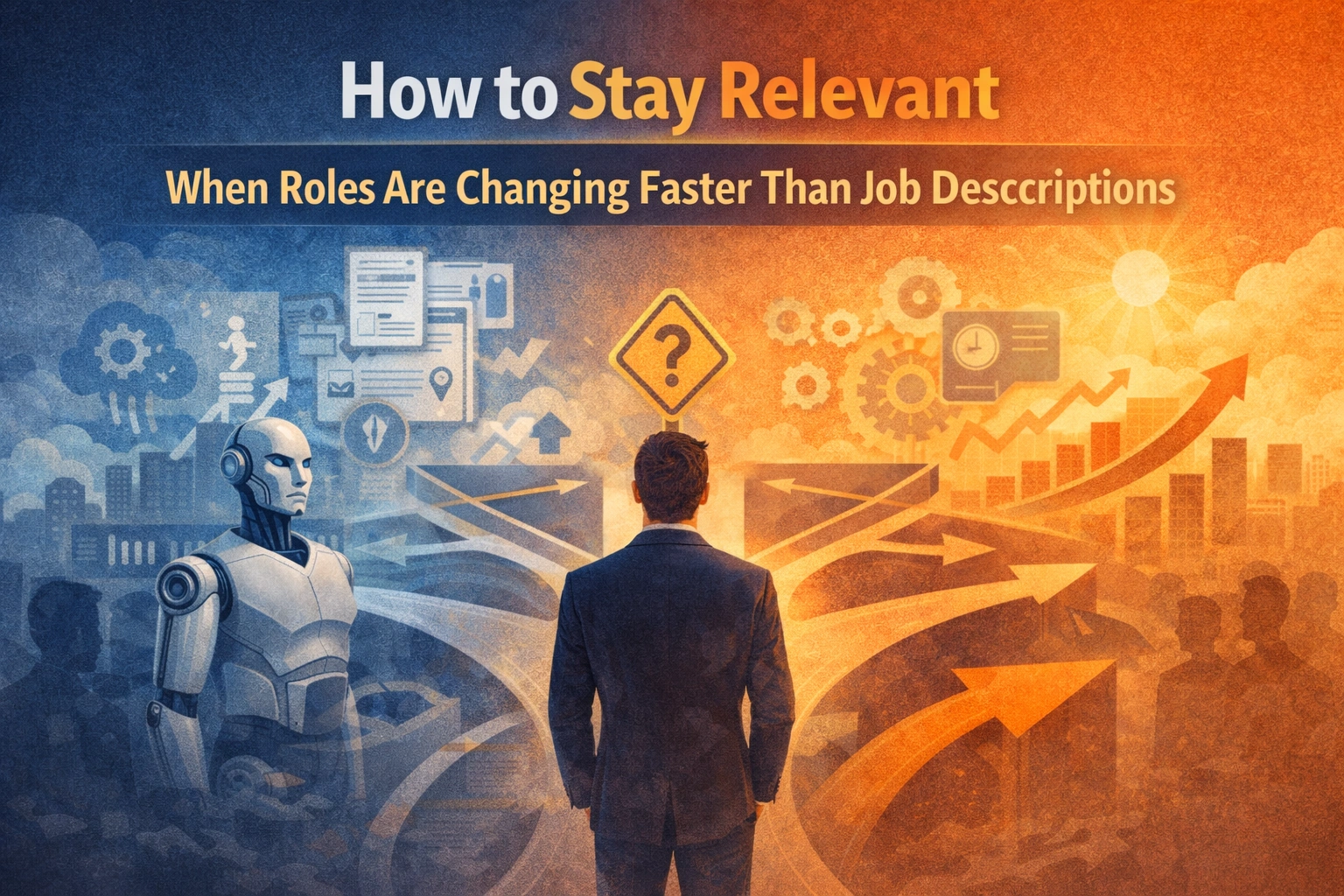
    How to Stay Relevant When Roles Are Changing Faster Than Job Descriptions

    yashwant160@gmail.comBy yashwant160@gmail.comFebruary 6, 2026Updated:February 26, 2026No Comments4 Mins Read
    Share Facebook Twitter Pinterest LinkedIn Tumblr Email
    Follow Us
    Google News Flipboard Threads
    How To Stay Relevant When Roles Are Changing Faster Than Job Descriptions 1024x683
    Share
    Facebook Twitter LinkedIn Pinterest Email

    The fastest way to fall behind is to assume your job description defines your future. In an era shaped by AI, automation, remote work, and constant reorgs, relevance has become a skill—not a status.

    By Content Creative Head · Updated 2026

    Table of Contents

    • Why Roles Are Changing So Fast
    • Why Job Descriptions Always Lag Reality
    • What Career Relevance Really Means
    • AI, Automation, and the New Skill Divide
    • The Risk of Static Careers
    • Signals That Matter More Than Titles
    • Learning in the Flow of Work
    • Building Career Adjacencies
    • How to Future-Proof Your Career
    • A Practical Relevance Framework

    Why Roles Are Changing So Fast

    Roles are no longer stable containers of responsibility. They are temporary snapshots of business needs.

    Several forces are accelerating role change:

    • AI tools absorbing routine tasks
    • Remote and distributed team structures
    • Faster product and market cycles
    • Constant organizational restructuring

    As a result, the half-life of many roles is shrinking. What you were hired to do two years ago may no longer be what creates value today.

    Why Job Descriptions Always Lag Reality

    Job descriptions are written to describe yesterday’s needs, not tomorrow’s opportunities.

    They are constrained by:

    • HR templates
    • Compensation bands
    • Organizational politics
    • Legacy role definitions

    Meanwhile, real work evolves daily. Professionals who rely too heavily on job descriptions often miss where value is actually shifting.

    What Career Relevance Really Means

    Career relevance is the ability to consistently contribute value as conditions change.

    Relevant professionals:

    • Understand the business context of their work
    • Adapt their skill set as tools and processes evolve
    • Anticipate needs rather than react to them

    Relevance is not about knowing everything—it’s about learning faster than the environment changes.

    AI, Automation, and the New Skill Divide

    AI does not replace entire jobs at once. It replaces specific tasks.

    This creates a widening divide:

    • Those who offload routine work to AI and move up the value chain
    • Those whose roles are defined entirely by automatable tasks

    Relevance increasingly depends on judgment, systems thinking, creativity, and the ability to work with AI—not against it.

    The Risk of Static Careers

    A static career feels comfortable—until it suddenly isn’t.

    Warning signs of declining relevance include:

    • Doing the same work year after year
    • Avoiding new tools or responsibilities
    • Relying on tenure instead of impact

    By the time relevance is questioned, recovery becomes much harder.

    Signals That Matter More Than Titles

    Modern hiring and promotion decisions are driven by signals of capability.

    Strong signals include:

    • Problems you’ve solved end-to-end
    • Systems or processes you’ve improved
    • Cross-functional influence
    • Clear, documented outcomes

    Titles may open doors, but signals determine who is trusted.

    Learning in the Flow of Work

    The most effective learning does not happen in isolation—it happens inside real work.

    Relevant professionals:

    • Volunteer for ambiguous projects
    • Shadow adjacent roles
    • Learn tools as they are applied, not abstractly

    Learning in context accelerates both skill acquisition and credibility.

    Building Career Adjacencies

    Career resilience grows at the edges.

    Career adjacencies are skills and responsibilities that sit just outside your core role but increase your versatility.

    Examples include:

    • An engineer learning product strategy
    • A marketer learning analytics and experimentation
    • An operations manager learning automation

    Adjacencies make career pivots smoother and less risky.

    How to Future-Proof Your Career

    No career is fully future-proof—but many are future-resilient.

    Future-resilient professionals:

    • Continuously refresh their skills
    • Build transferable expertise
    • Maintain visibility through impact, not noise

    They treat relevance as an ongoing practice.

    A Practical Relevance Framework

    1. Track how value is shifting in your industry
    2. Identify skills adjacent to your current role
    3. Apply new skills inside real projects
    4. Document outcomes and learning
    5. Review and adjust every 6–12 months

    Staying relevant is not a one-time effort—it’s a career habit.

    Final takeaway: Roles will keep changing. Careers that survive are built on adaptability, learning velocity, and the ability to deliver value beyond a job description.

    Share. Facebook Twitter Pinterest LinkedIn Tumblr Email
    yashwant160@gmail.com
    • Website

    Related Posts

    Personal Branding Without the Cringe: Building Professional Credibility That Actually Works

    February 6, 2026

    Career Resilience: How to Build a Job That Survives Layoffs, AI, and Market Shifts

    February 6, 2026

    From Individual Contributor to Leader: The Career Shift Most People Get Wrong

    February 6, 2026
    Leave A Reply Cancel Reply

    Don't Miss

    Personal Branding Without the Cringe: Building Professional Credibility That Actually Works

    yashwant160@gmail.comFebruary 6, 2026

    Personal branding has a reputation problem. Too often, it’s confused with self-promotion, performative posting, or…

    Career Resilience: How to Build a Job That Survives Layoffs, AI, and Market Shifts

    February 6, 2026

    From Individual Contributor to Leader: The Career Shift Most People Get Wrong

    February 6, 2026

    The Non-Linear Career: Why the Best Careers No Longer Follow a Straight Path

    February 6, 2026
    Stay In Touch
    • Facebook
    • Twitter
    • Pinterest
    • Instagram
    • YouTube
    • Vimeo

    Subscribe to Updates

    Get the latest creative news from SmartMag about art & design.

    About Us

    Results-driven digital professional with 15+ years of experience across Web Operations, Enterprise SEO, and large-scale digital platforms. I specialize in building, scaling, and optimizing complex websites where performance, search visibility, and operational reliability must work together—not in silos. My work sits at the intersection of strategy and execution, translating business goals into systems that teams can actually run.

    Facebook X (Twitter) Pinterest YouTube
    Our Picks

    Personal Branding Without the Cringe: Building Professional Credibility That Actually Works

    February 6, 2026

    Career Resilience: How to Build a Job That Survives Layoffs, AI, and Market Shifts

    February 6, 2026

    From Individual Contributor to Leader: The Career Shift Most People Get Wrong

    February 6, 2026
    Most Popular

    Top 15 popular link building methods you should consider before it’s too late

    March 24, 20180 Views

    Quality Score Demystified: What Actually Improves SEM Performance

    January 31, 20260 Views

    How SEO, SEM, Email, and Paid Social Should Work Together

    February 2, 20260 Views
    © 2026 All rights reserved. Y. K. Thakur.
    • Home
    • Technical SEO
    • World
    • Lifestyle
    • Buy Now

    Type above and press Enter to search. Press Esc to cancel.