
Introduction
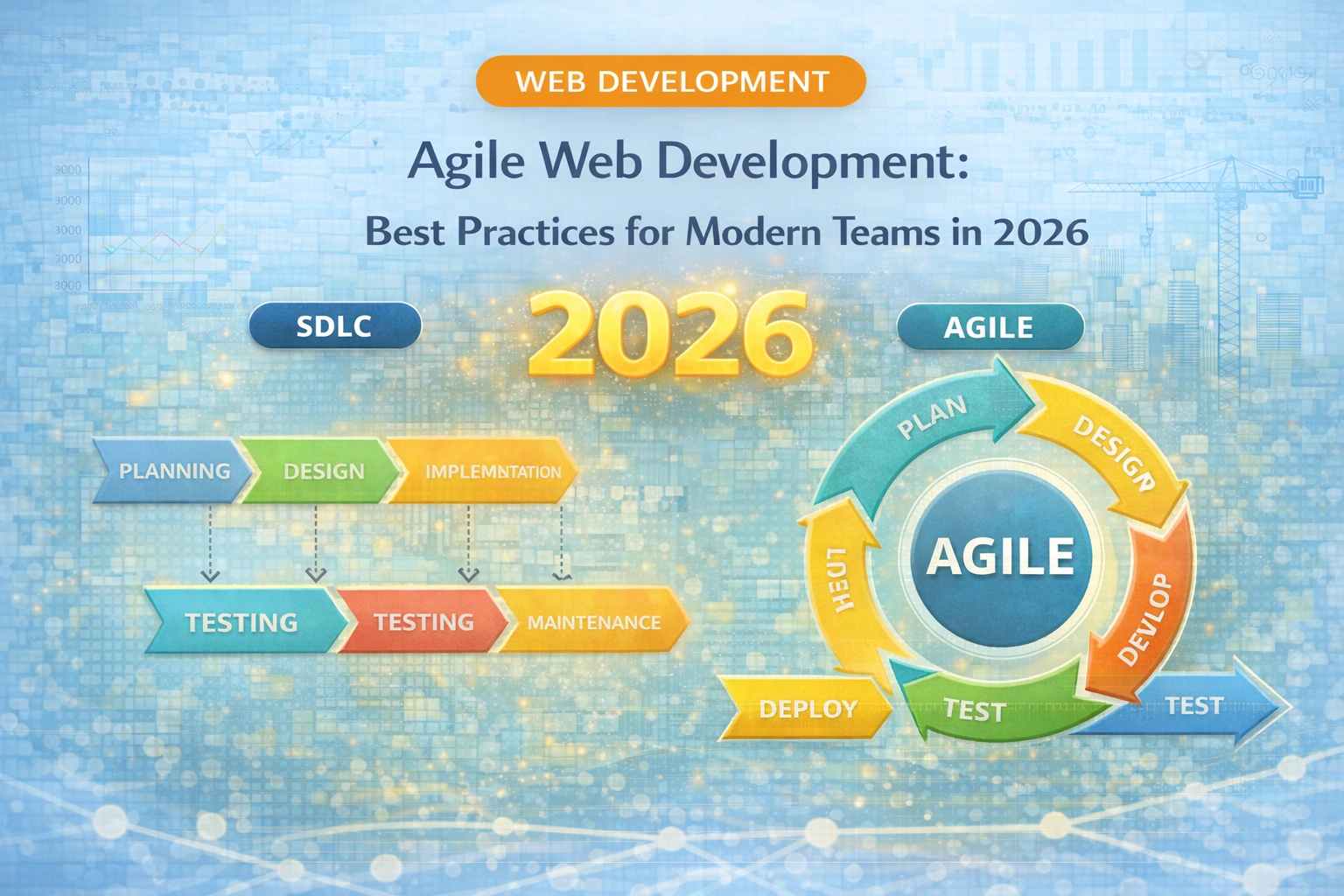
Agile is more than a methodology — it’s a mindset that enables web development teams to deliver value quickly, adapt to shifting requirements, and collaborate effectively across disciplines. Originally designed for software product development, Agile has now extended into web platforms, interactive experiences, and multi-team delivery ecosystems.
In 2026, the most successful Agile web teams combine high-velocity delivery with tight customer feedback loops, cross-team autonomy, and advanced automation — including AI-assisted planning and continuous improvement workflows. This comprehensive guide brings together the most effective practices adopted by modern teams and backed by industry trends and case evidence.
Why Agile Matters in Web Development
Traditional waterfall or phase-based planning rarely succeeds at web scale. Websites are not just collections of static pages — they are dynamic systems that must adapt to market signals, SEO changes, user behaviors, technical dependencies, and shifting stakeholder priorities.
Agile allows teams to deliver in iterative increments, learn continuously, and reduce risk while building complex web experiences. In fact, studies indicate that enterprise agile transformation services will grow at nearly 20% CAGR by the end of 2026 as organizations seek flexibility and resilience.
Web development complexity requires autonomy + alignment.
Web projects often involve designers, front-end engineers, back-end services, testers, SEO specialists, and product owners. Agile frameworks help align these roles around common outcomes rather than isolated tasks.
Core Agile Principles for Web Teams
1. Work incrementally with short iterations
Break large goals into small increments that deliver measurable value. For web teams, this could mean shipping a homepage component, a performance optimization, or a content experiment within a sprint cycle.
Short iterations reduce risk and allow teams to validate assumptions early rather than waiting for a monolithic launch. Teams that implement short cycles see higher quality and faster problem resolution.
2. Prioritize customer value
Agile is centered around delivering what users need most. Before adding features or pages, assess whether the work will create a measurable impact — whether in revenue, engagement, or SEO visibility.
3. Cross-functional collaboration
Teams should be composed of all necessary skills — design, development, testing, analytics, and SEO — so there’s no handoff bottleneck. This mirrors what research consistently shows: agile excellence depends on small, empowered teams aligned around shared outcomes. :contentReference[oaicite:4]{index=4}
4. Inspect and adapt
Agile is about learning. After each sprint or delivery, teams should hold retrospectives to identify bottlenecks, experiment with improvements, and refine processes. These regular reflection points fuel continuous improvement and keep teams responsive to change.
Scrum, Kanban & Hybrid Models
Scrum for structured delivery
Scrum is the most adopted Agile framework for web development. It breaks work into fixed iterations called sprints, typically 1–4 weeks, each ending with a review and retrospective. Scrum requires defined roles — Scrum Master, Product Owner, and the Delivery Team — and regular ceremonies to plan, execute, and reflect.
Kanban for continuous workflow
Kanban does not use fixed sprints, but instead visualizes workflow on a board and emphasizes limiting work in progress (WIP) to improve flow. Web teams use Kanban effectively for ongoing ops work, testing releases, and reactive tasks like bug fixes.
Hybrid models for real-world teams
Modern teams adapt frameworks based on needs. Hybrid Agile — combining Scrum structure with Kanban flexibility — is increasingly common. AI reports predict that hybrid workflows blending Agile with traditional planning or Lean principles will become the default approaches in 2026.
Collaboration & Communication Strategies
Define team communication norms.s
Agile workflows depend on effective communication. Establish guidelines for daily standups, async updates, cross-team handoffs, and escalation paths. For remote teams, this requires explicit documentation and communication SLAs (e.g., response expectations for chats, tickets, and email).
Shared work artifacts
Use centralized artifact repositories — shared issue boards, design systems, documentation portals — so everyone reads from the same source of truth. This reduces miscommunication and duplicate work, especially important for globally distributed teams.
Continuous Feedback and Customer Validation
Short feedback loops drive quality.
Build feedback loops into every cycle. This includes user testing, QA smoke reports, analytics checks, SEO impact assessments, and stakeholder reviews. Put simply: don’t wait until release to learn what works.
Automate feedback where possible
Leverage automated tools — performance audits, SEO crawlers, UI tests — to deliver continuous signals about system health. These automated feedback sources free human teams to focus on edge cases and strategic decisions.
AI & Automation in Agile Workflows
AI-assisted planning and risk forecasting
AI tools are rapidly evolving to support backlog prioritization, sprint forecasting, and risk insights. In 2026, predictive AI will suggest capacity adjustments and flag potential blocker signals based on historical data and work patterns.
Automated delivery pipelines
Teams use CI/CD systems integrated with automated testing and deployment scripts to ensure consistent delivery quality. Advanced automation can run security scans, accessibility validations, and build rollbacks without human intervention, speeding delivery while lowering risk.
Guardrails and human oversight
Despite automation, teams should retain human reviews for governance, legal compliance, and strategic prioritization. AI is a co-pilot, not a replacement for domain expertise.
Measuring Success: Metrics That Matter
Focus on outcomes, not just output. Effective metrics include:
- Cycle time: How long workto gos from concept to delivery
- Lead time: The total time from request intake to delivery
- Velocity and throughput: Amount of value delivered per period
- User engagement: Impact of features on adoption, conversion, retention
- Quality indicators: Defect rates, rollback frequency, automated test coverage
These metrics help teams balance speed, quality, and business impact, rather than just counting tickets closed.
Common Challenges & How to Overcome Them
Scope diffusion
Prevent scope creep by tightly defining acceptance criteria and linking backlog items to measurable business outcomes. Review scope changes collaboratively before expanding commitments.
Estimating reality
Estimates are notoriously hard. Use relative sizing, historical velocity, and risk buffers to make realistic commitments. Re-estimate as more information becomes available.
Cultural resistance
Agile values require cultural buy-in. Invest in training, cross-team mentorship, and open reflections to build trust and shared purpose.
Modern Tools and Technologies
Successful Agile teams use a balanced stack that supports planning, collaboration, delivery, and feedback. Typical tools include:
- Planning & Backlog: Jira, Asana, ClickUp
- Documentation & Knowledge Management: Confluence, Notion, GitHub Wikis
- CI/CD & Automation: GitHub Actions, GitLab CI, Jenkins
- Testing & QA: Selenium, Cypress, automated performance audits
- Communication: Slack, Microsoft Teams
- Monitoring & Analytics: Datadog, New Relic, GA4
Conclusion and Next Steps
Agile web development in 2026 blends traditional Agile values with emerging trends like AI-assisted planning, hybrid frameworks, and continuous feedback systems. The teams that thrive will be those that emphasize clear outcomes, automation without losing human judgment, and iterative improvement grounded in real user value.
By adopting the best practices outlined in this guide — from effective collaboration and metrics to hybrid frameworks and automated workflows — modern teams can build resilient, adaptable processes that deliver meaningful results.
