
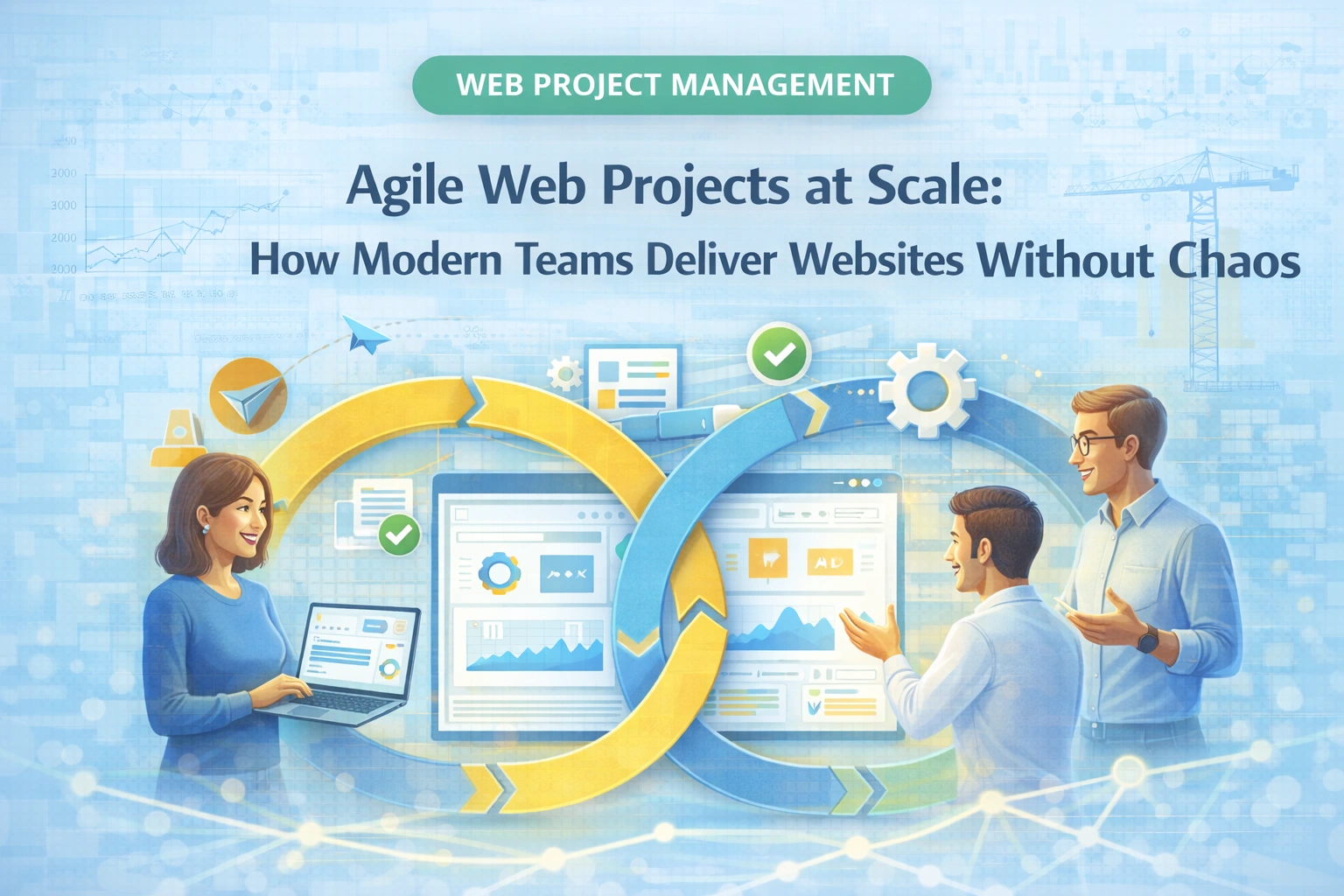
Yet despite widespread Agile adoption, web projects still fail at alarming rates. According to industry data from PMI and enterprise delivery benchmarks, nearly 40–45% of digital projects miss timelines, budgets, or strategic goals.
The issue is not Agile itself. The issue is applying software-centric Agile models to web ecosystems that include infrastructure, content, search engines, marketing funnels, and human decision-making.
This article explains how modern teams successfully run Agile web projects by:
- Choosing Scrum or Kanban based on work type
- Designing Agile workflows for remote teams
- Managing client and stakeholder expectations without friction
Agile Web Development in the Real World
Web projects are fundamentally different from product software development.
A website is not just code. It is a system that includes:
- Infrastructure and hosting environments
- CMS platforms and release pipelines
- SEO constraints and search engine behavior
- Marketing campaigns and analytics
- Multiple stakeholders with competing priorities
Agile works for web projects only when it adapts to this reality.
High-performing teams treat Agile not as a process, but as a decision-making framework that balances speed, risk, and business impact.
Scrum vs Kanban for Web Projects
When Scrum Works Best
Scrum is effective when web work is:
- Feature-driven
- Predictable within short cycles
- Dependent on cross-functional collaboration
Examples include:
- New website builds
- Major redesigns
- Platform migrations
Scrum brings discipline through:
- Time-boxed sprints
- Clear sprint goals
- Regular retrospectives
When Kanban Is the Better Choice
Kanban excels in environments where work is:
- Continuous
- Interrupt-driven
- Operational or optimization-focused
Typical Kanban-friendly web work includes:
- SEO optimizations
- Performance tuning
- Content updates
- Marketing experimentation
Many high-maturity teams run Scrum for major initiatives and Kanban for ongoing operations.
Sprint Planning & Backlog Grooming That Actually Works
The Problem with Most Web Backlogs
Most web backlogs fail because they are task lists, not outcome lists.
Examples of poor backlog items:
- “Fix page speed”
- “Improve SEO”
- “Update landing page”
Outcome-Driven Backlogs
High-performing teams write backlog items tied to impact:
- “Reduce LCP by 800ms on top 20 revenue pages”
- “Increase organic CTR for non-brand queries by 10%”
- “Improve checkout conversion rate from 2.1% to 2.5%”
This approach aligns Agile delivery with business outcomes—not activity.
Running Agile with Remote & Distributed Teams
Remote work has permanently reshaped web delivery.
According to US workforce studies, over 65% of digital teams now operate in hybrid or fully remote models.
Documentation-First Agile
Remote Agile fails without documentation.
High-performing teams document:
- Sprint goals
- Decisions and tradeoffs
- Release notes
- Post-mortems
The rule is simple:
If it isn’t written, it didn’t happen.
Async Beats Meetings
Modern Agile teams prioritize:
- Async updates
- Dashboards over status calls
- Recorded demos instead of live walkthroughs
This reduces burnout and increases accountability.
Managing Client & Stakeholder Expectations
Most web project failures are expectation failures.
Clients often expect:
- Certainty in uncertain systems
- Fixed timelines for variable work
- Immediate ROI from long-term initiatives
Expectation Alignment Framework
Successful teams align on:
- What is controllable vs uncontrollable
- Leading vs lagging indicators
- Tradeoffs between speed, cost, and risk
This conversation must happen early—and repeatedly.
Preventing Scope Creep Without Damaging Trust
Scope creep is not a client problem. It is a process problem.
Why Scope Creep Happens
- Vague requirements
- Missing change control
- Fear of saying no
Healthy Change Management
High-performing teams:
- Document change requests
- Explain impact on time and cost
- Offer tradeoffs instead of rejection
This preserves trust while protecting delivery.
Enterprise Reality: Hybrid Agile Models
Pure Agile rarely exists in enterprise environments.
Fixed budgets, legal constraints, and governance requirements demand hybrid models.
Successful organizations combine:
- Waterfall planning for funding
- Agile execution for delivery
- Continuous optimization post-launch
What High-Maturity Agile Teams Do Differently
The best web teams:
- Optimize systems, not tasks
- Measure outcomes, not activity
- Design workflows for AI assistance
Agile is no longer optional. It is a core capability.
Final Thought
Agile web projects succeed when teams respect the complexity of digital systems.
Not by working faster—but by working smarter.
