
Close Menu
blog.ykthakur.com

    Subscribe to Updates

    Get the latest creative news from FooBar about art, design and business.

    What's Hot

    Personal Branding Without the Cringe: Building Professional Credibility That Actually Works

    February 6, 2026

    Career Resilience: How to Build a Job That Survives Layoffs, AI, and Market Shifts

    February 6, 2026

    From Individual Contributor to Leader: The Career Shift Most People Get Wrong

    February 6, 2026
    Facebook X (Twitter) Instagram
    blog.ykthakur.com
    • Home
    • About Me
    • Case Studies
    • Services
    • Contact Us
    Facebook X (Twitter) Instagram
    Subscribe
    • Blog
    • Search & Growth
      1. SEO
      2. Technical SEO
      3. SEM
      4. Paid Advertisements
      5. View All

      Why SEO Fails Even With the Right Tools and Data

      January 31, 2026

      How to Refresh Old Content Without Losing Rankings

      January 31, 2026

      How to Build a Topic Authority Map for SEO

      January 31, 2026

      E-E-A-T Signals Explained: What Actually Influences Trust and Rankings

      January 31, 2026

      XML Sitemaps at Scale: Signaling Priority, Not Forcing Indexation

      February 3, 2026

      Robots.txt at Scale: Control, Risk, and the Limits of Crawl Directives

      February 3, 2026

      Monitoring, Alerting, and SEO Observability: Seeing Failures Before Traffic Drops

      February 3, 2026

      Migrations, Releases, and SEO Risk: How Technical Changes Break Search at Scale

      February 3, 2026

      Scaling SEM Without Burning Budget

      January 31, 2026

      SEM vs SEO: How Paid Search Should Support Organic Growth

      January 31, 2026

      Quality Score Demystified: What Actually Improves SEM Performance

      January 31, 2026

      Brand vs Non-Brand Search: Budget Allocation Reality

      January 31, 2026

      Personal Branding Without the Cringe: Building Professional Credibility That Actually Works

      February 6, 2026

      Career Resilience: How to Build a Job That Survives Layoffs, AI, and Market Shifts

      February 6, 2026

      From Individual Contributor to Leader: The Career Shift Most People Get Wrong

      February 6, 2026

      The Non-Linear Career: Why the Best Careers No Longer Follow a Straight Path

      February 6, 2026
    • Performance & Infrastructure
      1. Website Performance
      2. Core Web Vitals
      3. Hosting Architecture
      4. Web Application Infrastructure
      5. Load Balancing
      6. View All

      Performance Drift: How Sites Get Slower Without Any One Bad Change

      February 3, 2026

      Why passing scores still hide systemic performance risk

      February 3, 2026

      Performance Monitoring Beyond Core Web Vitals

      February 3, 2026

      Personal Branding Without the Cringe: Building Professional Credibility That Actually Works

      February 6, 2026

      Career Resilience: How to Build a Job That Survives Layoffs, AI, and Market Shifts

      February 6, 2026

      From Individual Contributor to Leader: The Career Shift Most People Get Wrong

      February 6, 2026

      The Non-Linear Career: Why the Best Careers No Longer Follow a Straight Path

      February 6, 2026
    • AI & Automation
      1. AI Content Systems
      2. AI in SEO & Marketing
      3. AI Search Analysis
      4. AI-Driven SEO Workflows
      5. Generative AI Strategy
      6. View All

      AI Content Systems: How to Scale Without Losing Quality or Trust

      February 3, 2026

      AI in Marketing Is a System, Not a Toolset

      February 3, 2026

      SEO in a Zero-Click World: Designing for AI Answers and Visibility

      February 3, 2026

      AI Search Analysis: How LLMs Interpret and Surface Content

      February 3, 2026

      Using AI for Technical SEO Analysis Without Breaking Trust

      February 3, 2026

      AI-Driven SEO Workflows: What to Automate and What Not To

      February 3, 2026

      SEO in a Zero-Click World: Designing for AI Answers and Visibility

      February 3, 2026

      AI Search Analysis: How LLMs Interpret and Surface Content

      February 3, 2026

      Using AI for Technical SEO Analysis Without Breaking Trust

      February 3, 2026

      AI-Driven SEO Workflows: What to Automate and What Not To

      February 3, 2026

      Why Most AI SEO Implementations Fail

      February 3, 2026

      Human-in-the-Loop SEO: Where AI Stops and Judgment Starts

      February 3, 2026

      Personal Branding Without the Cringe: Building Professional Credibility That Actually Works

      February 6, 2026

      Career Resilience: How to Build a Job That Survives Layoffs, AI, and Market Shifts

      February 6, 2026

      From Individual Contributor to Leader: The Career Shift Most People Get Wrong

      February 6, 2026

      The Non-Linear Career: Why the Best Careers No Longer Follow a Straight Path

      February 6, 2026
    • Analytics & Intelligence
      1. GA4 Architecture
      2. Adobe Analytics
      3. View All

      GA4 vs Adobe Analytics: Choosing the Right Tool for Your Organization

      February 2, 2026

      Consent, Privacy, and Measurement: What Changes After GDPR & GA4

      February 2, 2026

      GA4 Architecture Explained: Designing Events for Real Decisions

      February 2, 2026

      GA4 vs Adobe Analytics: Choosing the Right Tool for Your Organization

      February 2, 2026

      Personal Branding Without the Cringe: Building Professional Credibility That Actually Works

      February 6, 2026

      Career Resilience: How to Build a Job That Survives Layoffs, AI, and Market Shifts

      February 6, 2026

      From Individual Contributor to Leader: The Career Shift Most People Get Wrong

      February 6, 2026

      The Non-Linear Career: Why the Best Careers No Longer Follow a Straight Path

      February 6, 2026
    • WebOps & DevOps
      1. Web Operations
      2. WebOps Roles
      3. Website Migrations & Scaling
      4. Release Management
      5. Monitoring & Alerts
      6. Performance Monitoring
      7. Deployment Automation
      8. View All

      SEO and WebOps Monitoring: Aligning Health Signals Across Systems

      February 3, 2026

      Designing Alerts for WebOps: Signal, Severity, and Actionability

      February 3, 2026

      Why Most Website Monitoring Is Too Late to Be Useful

      February 3, 2026

      Release Cadence Versus Stability: Finding the Sustainable Balance

      February 3, 2026

      Website Migrations at Scale: Why Most Fail Before the First Redirect

      February 3, 2026

      Post-Migration Reality: Why SEO and Performance Losses Persist for Months

      February 3, 2026

      Scaling Websites Without Replatforming: When Migration Is the Wrong Answer

      February 3, 2026

      Release Cadence Versus Stability: Finding the Sustainable Balance

      February 3, 2026

      Why Website Releases Break SEO Even When Nothing “Major” Changes

      February 3, 2026

      Release Management for Websites: Coordinating Risk Across Teams

      February 3, 2026

      Release Pipelines and Search Risk: Why Velocity Without Guardrails Breaks Websites

      February 3, 2026

      SEO and WebOps Monitoring: Aligning Health Signals Across Systems

      February 3, 2026

      Designing Alerts for WebOps: Signal, Severity, and Actionability

      February 3, 2026

      Why Most Website Monitoring Is Too Late to Be Useful

      February 3, 2026

      Feature Flags, Experiments, and the SEO Blast Radius

      February 3, 2026

      Performance Drift: How Sites Get Slower Without Any One Bad Change

      February 3, 2026

      Performance Monitoring Beyond Core Web Vitals

      February 3, 2026

      Designing SEO-Safe Deployment Automation

      February 3, 2026

      Deployment Automation for Websites: What to Automate and What Not To

      February 3, 2026

      Personal Branding Without the Cringe: Building Professional Credibility That Actually Works

      February 6, 2026

      Career Resilience: How to Build a Job That Survives Layoffs, AI, and Market Shifts

      February 6, 2026

      From Individual Contributor to Leader: The Career Shift Most People Get Wrong

      February 6, 2026

      The Non-Linear Career: Why the Best Careers No Longer Follow a Straight Path

      February 6, 2026
    • Project Strategy

      Personal Branding Without the Cringe: Building Professional Credibility That Actually Works

      February 6, 2026

      Career Resilience: How to Build a Job That Survives Layoffs, AI, and Market Shifts

      February 6, 2026

      From Individual Contributor to Leader: The Career Shift Most People Get Wrong

      February 6, 2026

      The Non-Linear Career: Why the Best Careers No Longer Follow a Straight Path

      February 6, 2026

      How to Stay Relevant When Roles Are Changing Faster Than Job Descriptions

      February 6, 2026
    • Web Engineering
      1. Web Development
      2. Web Designing & UX
      3. CMS & Platforms
      4. Web Application Firewall
      5. View All

      Personal Branding Without the Cringe: Building Professional Credibility That Actually Works

      February 6, 2026

      Career Resilience: How to Build a Job That Survives Layoffs, AI, and Market Shifts

      February 6, 2026

      From Individual Contributor to Leader: The Career Shift Most People Get Wrong

      February 6, 2026

      The Non-Linear Career: Why the Best Careers No Longer Follow a Straight Path

      February 6, 2026
    blog.ykthakur.com
    Home»Project Managemant»Agile Web Projects in the Real World: How WebOps, SEO, and Digital Marketing Teams Actually Deliver at Scale
    Project Managemant

    Agile Web Projects in the Real World: How WebOps, SEO, and Digital Marketing Teams Actually Deliver at Scale

    yashwant160@gmail.comBy yashwant160@gmail.comFebruary 6, 2026Updated:February 27, 2026No Comments5 Mins Read
    Share Facebook Twitter Pinterest LinkedIn Tumblr Email
    Follow Us
    Google News Flipboard Threads
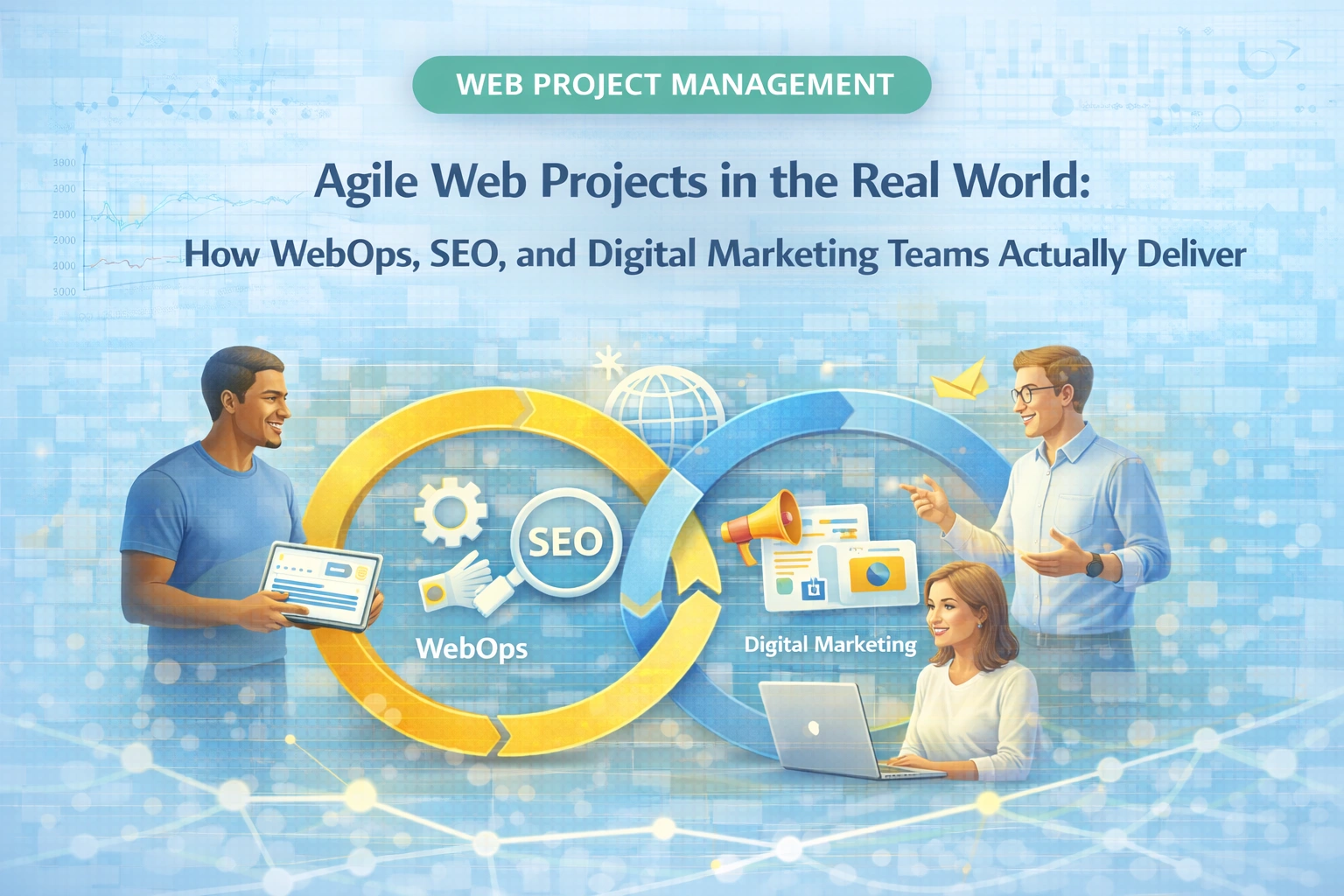
    Agile Web Projects In The Real World How WebOps SEO And Digital Marketing Teams Actually Deliver At Scale 1024x683
    Share
    Facebook Twitter LinkedIn Pinterest Email
    Agile is no longer a methodology reserved for software teams. In modern digital organizations, Agile has quietly become the operating system behind high-performing WebOps, SEO, and Digital Marketing teams.Yet despite widespread adoption, most web projects still miss deadlines, overrun scope, or fail to deliver measurable business impact. According to PMI, nearly 43% of digital projects do not meet their original goals. The problem isn’t Agile itself—it’s how Agile is applied to web ecosystems that include infrastructure, content, search, analytics, and marketing.

    This article explains how Agile actually works when applied to WebOps platforms, SEO programs, and Digital Marketing systems—especially in US-based enterprises and agencies managing distributed teams, complex stakeholders, and measurable outcomes.

    Table of Contents

    • Why Agile Web Projects Fail
    • Agile for WebOps: Stability Before Speed
    • Agile SEO: Continuous Prioritization Over Fixed Roadmaps
    • Agile Digital Marketing: Experimentation at Scale
    • Running Agile with Remote and Distributed Teams
    • Managing Client & Stakeholder Expectations
    • What Success Metrics Actually Matter
    • The Future: AI-Ready Agile Systems

    Why Agile Web Projects Fail (Even When Teams “Use Agile”)

    Most web teams claim to be Agile. Very few actually are.

    The most common failure pattern looks like this:

    • Sprints exist, but priorities change mid-sprint
    • Backlogs are task lists, not outcome-driven
    • SEO and marketing work is treated as “add-ons.”
    • WebOps work is invisible until something breaks

    Agile fails in web projects because websites are not software products—they are living systems. They combine:

    • Infrastructure and performance constraints
    • Search engine behavior and algorithm volatility
    • Human content workflows
    • Marketing experimentation and attribution

    When Agile is applied without respecting these constraints, teams move fast—but in the wrong direction.


    Agile for WebOps: Stability Before Speed

    WebOps is where Agile discipline matters the most—and where it’s most often misunderstood.

    What Agile Means in WebOps

    In WebOps, Agile is not about shipping features faster. It’s about reducing risk while enabling continuous improvement.

    Typical Agile WebOps backlog items include:

    • Core Web Vitals optimization
    • CMS upgrades and security patches
    • Release automation
    • Monitoring and alerting improvements

    Each sprint must answer one question: Does this make the platform more reliable, faster, or easier to change?

    Definition of Done in WebOps

    In high-performing teams, “done” means:

    • Monitoring is enabled
    • Rollback plan exists
    • Documentation is updated
    • SEO and analytics impact is reviewed

    Without these, Agile simply accelerates technical debt.


    Agile SEO: Continuous Prioritization Over Fixed Roadmaps

    SEO is inherently Agile—yet most SEO programs are still run like waterfall projects.

    Why Traditional SEO Roadmaps Fail

    Search demand shifts. Algorithms change. Business priorities evolve.

    Fixed 6–12 month SEO roadmaps fail because they assume certainty in an uncertain system.

    According to multiple enterprise SEO studies, fewer than 30% of planned SEO initiatives deliver their expected impact when locked into long-term plans.

    How Agile SEO Actually Works

    Agile SEO replaces static roadmaps with:

    • Rolling prioritization
    • Impact-based scoring
    • Short feedback loops

    Each sprint focuses on hypotheses such as:

    • Improving indexation efficiency
    • Reducing crawl waste
    • Aligning content with real search intent

    Success is measured in outcomes, not tasks.


    Agile Digital Marketing: Experimentation at Scale

    Digital marketing is where Agile thinking delivers the fastest visible ROI.

    Why Kanban Often Beats Scrum

    Unlike development, marketing rarely works in fixed iterations. Campaigns overlap. Channels interact.

    That’s why high-performing marketing teams favor Kanban systems that allow:

    • Continuous deployment of ideas
    • Clear ownership by channel
    • Fast kill-or-scale decisions

    Google data shows that organizations running structured experimentation frameworks outperform peers by 25–30% in conversion efficiency.

    Campaigns as Learning Systems

    In Agile marketing, campaigns are not “wins” or “failures.” They are experiments that:

    • Validate assumptions
    • Refine messaging
    • Improve funnel efficiency

    This mindset shift alone dramatically improves stakeholder trust.


    Running Agile with Remote and Distributed Teams

    Remote work is no longer an exception—it is the default.

    The Documentation-First Rule

    Remote Agile teams succeed when documentation replaces meetings.

    This includes:

    • Written sprint goals
    • Async release notes
    • Decision logs

    If work is not documented, it effectively does not exist.

    Async Over Sync

    High-performing teams limit live meetings and rely on dashboards, written updates, and recorded demos.

    This reduces burnout and increases accountability.


    Managing Client & Stakeholder Expectations Without Conflict

    Most web project failures are expectation failures, not execution failures.

    WebOps Expectations

    Clients expect stability—but rarely see the work behind it.

    Successful WebOps leaders proactively communicate:

    • Risk trade-offs
    • Maintenance value
    • Why “nothing breaking” is a success metric

    SEO Expectations

    SEO leaders must consistently reinforce one truth:

    SEO influences outcomes—it does not control them.

    By focusing on leading indicators like crawl efficiency and content velocity, trust improves dramatically.

    Marketing Expectations

    Great marketers align on:

    • Learning phases
    • Testing budgets
    • Clear kill criteria

    This removes emotion from performance discussions.


    What Success Metrics Actually Matter

    Discipline Vanity Metrics Meaningful Metrics
    WebOps Release count Uptime, performance, MTTR
    SEO Rankings Organic contribution to revenue
    Marketing Clicks Conversion efficiency, CAC

    The Future: AI-Ready Agile Systems

    As AI-driven search, automation, and analytics accelerate, Agile systems must evolve.

    The future belongs to teams that:

    • Design workflows for AI assistance
    • Maintain human oversight
    • Optimize systems, not tasks

    Agile is no longer a process—it is an organizational capability.


    Final Thought

    WebOps, SEO, and Digital Marketing succeed when treated as interconnected systems—not silos.

    Agile provides the framework, but leadership provides the discipline.

    The organizations that understand this will outpace competitors—not by working harder, but by working intelligently.

    Share. Facebook Twitter Pinterest LinkedIn Tumblr Email
    yashwant160@gmail.com
    • Website

    Related Posts

    Managing Remote Digital Teams: Best Practices for High-Performance, Async-First Organizations (2026)

    February 6, 2026

    Agile Web Development: Best Practices for Modern Teams in 2026

    February 6, 2026

    The Complete Guide to Website Project Management in 2026

    February 6, 2026
    Leave A Reply Cancel Reply

    Don't Miss

    Personal Branding Without the Cringe: Building Professional Credibility That Actually Works

    yashwant160@gmail.comFebruary 6, 2026

    Personal branding has a reputation problem. Too often, it’s confused with self-promotion, performative posting, or…

    Career Resilience: How to Build a Job That Survives Layoffs, AI, and Market Shifts

    February 6, 2026

    From Individual Contributor to Leader: The Career Shift Most People Get Wrong

    February 6, 2026

    The Non-Linear Career: Why the Best Careers No Longer Follow a Straight Path

    February 6, 2026
    Stay In Touch
    • Facebook
    • Twitter
    • Pinterest
    • Instagram
    • YouTube
    • Vimeo

    Subscribe to Updates

    Get the latest creative news from SmartMag about art & design.

    About Us

    Results-driven digital professional with 15+ years of experience across Web Operations, Enterprise SEO, and large-scale digital platforms. I specialize in building, scaling, and optimizing complex websites where performance, search visibility, and operational reliability must work together—not in silos. My work sits at the intersection of strategy and execution, translating business goals into systems that teams can actually run.

    Facebook X (Twitter) Pinterest YouTube
    Our Picks

    Personal Branding Without the Cringe: Building Professional Credibility That Actually Works

    February 6, 2026

    Career Resilience: How to Build a Job That Survives Layoffs, AI, and Market Shifts

    February 6, 2026

    From Individual Contributor to Leader: The Career Shift Most People Get Wrong

    February 6, 2026
    Most Popular

    Top 15 popular link building methods you should consider before it’s too late

    March 24, 20180 Views

    Quality Score Demystified: What Actually Improves SEM Performance

    January 31, 20260 Views

    How SEO, SEM, Email, and Paid Social Should Work Together

    February 2, 20260 Views
    © 2026 All rights reserved. Y. K. Thakur.
    • Home
    • Technical SEO
    • World
    • Lifestyle
    • Buy Now

    Type above and press Enter to search. Press Esc to cancel.