Close Menu
blog.ykthakur.com

    Subscribe to Updates

    Get the latest creative news from FooBar about art, design and business.

    What's Hot

    Personal Branding Without the Cringe: Building Professional Credibility That Actually Works

    February 6, 2026

    Career Resilience: How to Build a Job That Survives Layoffs, AI, and Market Shifts

    February 6, 2026

    From Individual Contributor to Leader: The Career Shift Most People Get Wrong

    February 6, 2026
    Facebook X (Twitter) Instagram
    blog.ykthakur.com
    • Home
    • About Me
    • Case Studies
    • Services
    • Contact Us
    Facebook X (Twitter) Instagram
    Subscribe
    • Blog
    • Search & Growth
      1. SEO
      2. Technical SEO
      3. SEM
      4. Paid Advertisements
      5. View All

      Why SEO Fails Even With the Right Tools and Data

      January 31, 2026

      How to Refresh Old Content Without Losing Rankings

      January 31, 2026

      How to Build a Topic Authority Map for SEO

      January 31, 2026

      E-E-A-T Signals Explained: What Actually Influences Trust and Rankings

      January 31, 2026

      XML Sitemaps at Scale: Signaling Priority, Not Forcing Indexation

      February 3, 2026

      Robots.txt at Scale: Control, Risk, and the Limits of Crawl Directives

      February 3, 2026

      Monitoring, Alerting, and SEO Observability: Seeing Failures Before Traffic Drops

      February 3, 2026

      Migrations, Releases, and SEO Risk: How Technical Changes Break Search at Scale

      February 3, 2026

      Scaling SEM Without Burning Budget

      January 31, 2026

      SEM vs SEO: How Paid Search Should Support Organic Growth

      January 31, 2026

      Quality Score Demystified: What Actually Improves SEM Performance

      January 31, 2026

      Brand vs Non-Brand Search: Budget Allocation Reality

      January 31, 2026

      Personal Branding Without the Cringe: Building Professional Credibility That Actually Works

      February 6, 2026

      Career Resilience: How to Build a Job That Survives Layoffs, AI, and Market Shifts

      February 6, 2026

      From Individual Contributor to Leader: The Career Shift Most People Get Wrong

      February 6, 2026

      The Non-Linear Career: Why the Best Careers No Longer Follow a Straight Path

      February 6, 2026
    • Performance & Infrastructure
      1. Website Performance
      2. Core Web Vitals
      3. Hosting Architecture
      4. Web Application Infrastructure
      5. Load Balancing
      6. View All

      Performance Drift: How Sites Get Slower Without Any One Bad Change

      February 3, 2026

      Why passing scores still hide systemic performance risk

      February 3, 2026

      Performance Monitoring Beyond Core Web Vitals

      February 3, 2026

      Personal Branding Without the Cringe: Building Professional Credibility That Actually Works

      February 6, 2026

      Career Resilience: How to Build a Job That Survives Layoffs, AI, and Market Shifts

      February 6, 2026

      From Individual Contributor to Leader: The Career Shift Most People Get Wrong

      February 6, 2026

      The Non-Linear Career: Why the Best Careers No Longer Follow a Straight Path

      February 6, 2026
    • AI & Automation
      1. AI Content Systems
      2. AI in SEO & Marketing
      3. AI Search Analysis
      4. AI-Driven SEO Workflows
      5. Generative AI Strategy
      6. View All

      AI Content Systems: How to Scale Without Losing Quality or Trust

      February 3, 2026

      AI in Marketing Is a System, Not a Toolset

      February 3, 2026

      SEO in a Zero-Click World: Designing for AI Answers and Visibility

      February 3, 2026

      AI Search Analysis: How LLMs Interpret and Surface Content

      February 3, 2026

      Using AI for Technical SEO Analysis Without Breaking Trust

      February 3, 2026

      AI-Driven SEO Workflows: What to Automate and What Not To

      February 3, 2026

      SEO in a Zero-Click World: Designing for AI Answers and Visibility

      February 3, 2026

      AI Search Analysis: How LLMs Interpret and Surface Content

      February 3, 2026

      Using AI for Technical SEO Analysis Without Breaking Trust

      February 3, 2026

      AI-Driven SEO Workflows: What to Automate and What Not To

      February 3, 2026

      Why Most AI SEO Implementations Fail

      February 3, 2026

      Human-in-the-Loop SEO: Where AI Stops and Judgment Starts

      February 3, 2026

      Personal Branding Without the Cringe: Building Professional Credibility That Actually Works

      February 6, 2026

      Career Resilience: How to Build a Job That Survives Layoffs, AI, and Market Shifts

      February 6, 2026

      From Individual Contributor to Leader: The Career Shift Most People Get Wrong

      February 6, 2026

      The Non-Linear Career: Why the Best Careers No Longer Follow a Straight Path

      February 6, 2026
    • Analytics & Intelligence
      1. GA4 Architecture
      2. Adobe Analytics
      3. View All

      GA4 vs Adobe Analytics: Choosing the Right Tool for Your Organization

      February 2, 2026

      Consent, Privacy, and Measurement: What Changes After GDPR & GA4

      February 2, 2026

      GA4 Architecture Explained: Designing Events for Real Decisions

      February 2, 2026

      GA4 vs Adobe Analytics: Choosing the Right Tool for Your Organization

      February 2, 2026

      Personal Branding Without the Cringe: Building Professional Credibility That Actually Works

      February 6, 2026

      Career Resilience: How to Build a Job That Survives Layoffs, AI, and Market Shifts

      February 6, 2026

      From Individual Contributor to Leader: The Career Shift Most People Get Wrong

      February 6, 2026

      The Non-Linear Career: Why the Best Careers No Longer Follow a Straight Path

      February 6, 2026
    • WebOps & DevOps
      1. Web Operations
      2. WebOps Roles
      3. Website Migrations & Scaling
      4. Release Management
      5. Monitoring & Alerts
      6. Performance Monitoring
      7. Deployment Automation
      8. View All

      SEO and WebOps Monitoring: Aligning Health Signals Across Systems

      February 3, 2026

      Designing Alerts for WebOps: Signal, Severity, and Actionability

      February 3, 2026

      Why Most Website Monitoring Is Too Late to Be Useful

      February 3, 2026

      Release Cadence Versus Stability: Finding the Sustainable Balance

      February 3, 2026

      Website Migrations at Scale: Why Most Fail Before the First Redirect

      February 3, 2026

      Post-Migration Reality: Why SEO and Performance Losses Persist for Months

      February 3, 2026

      Scaling Websites Without Replatforming: When Migration Is the Wrong Answer

      February 3, 2026

      Release Cadence Versus Stability: Finding the Sustainable Balance

      February 3, 2026

      Why Website Releases Break SEO Even When Nothing “Major” Changes

      February 3, 2026

      Release Management for Websites: Coordinating Risk Across Teams

      February 3, 2026

      Release Pipelines and Search Risk: Why Velocity Without Guardrails Breaks Websites

      February 3, 2026

      SEO and WebOps Monitoring: Aligning Health Signals Across Systems

      February 3, 2026

      Designing Alerts for WebOps: Signal, Severity, and Actionability

      February 3, 2026

      Why Most Website Monitoring Is Too Late to Be Useful

      February 3, 2026

      Feature Flags, Experiments, and the SEO Blast Radius

      February 3, 2026

      Performance Drift: How Sites Get Slower Without Any One Bad Change

      February 3, 2026

      Performance Monitoring Beyond Core Web Vitals

      February 3, 2026

      Designing SEO-Safe Deployment Automation

      February 3, 2026

      Deployment Automation for Websites: What to Automate and What Not To

      February 3, 2026

      Personal Branding Without the Cringe: Building Professional Credibility That Actually Works

      February 6, 2026

      Career Resilience: How to Build a Job That Survives Layoffs, AI, and Market Shifts

      February 6, 2026

      From Individual Contributor to Leader: The Career Shift Most People Get Wrong

      February 6, 2026

      The Non-Linear Career: Why the Best Careers No Longer Follow a Straight Path

      February 6, 2026
    • Project Strategy

      Personal Branding Without the Cringe: Building Professional Credibility That Actually Works

      February 6, 2026

      Career Resilience: How to Build a Job That Survives Layoffs, AI, and Market Shifts

      February 6, 2026

      From Individual Contributor to Leader: The Career Shift Most People Get Wrong

      February 6, 2026

      The Non-Linear Career: Why the Best Careers No Longer Follow a Straight Path

      February 6, 2026

      How to Stay Relevant When Roles Are Changing Faster Than Job Descriptions

      February 6, 2026
    • Web Engineering
      1. Web Development
      2. Web Designing & UX
      3. CMS & Platforms
      4. Web Application Firewall
      5. View All

      Personal Branding Without the Cringe: Building Professional Credibility That Actually Works

      February 6, 2026

      Career Resilience: How to Build a Job That Survives Layoffs, AI, and Market Shifts

      February 6, 2026

      From Individual Contributor to Leader: The Career Shift Most People Get Wrong

      February 6, 2026

      The Non-Linear Career: Why the Best Careers No Longer Follow a Straight Path

      February 6, 2026
    blog.ykthakur.com
    Home»Website Performance»Performance Monitoring»Performance Drift: How Sites Get Slower Without Any One Bad Change
    Performance Monitoring

    Performance Drift: How Sites Get Slower Without Any One Bad Change

    yashwant160@gmail.comBy yashwant160@gmail.comFebruary 3, 2026Updated:February 27, 2026No Comments5 Mins Read
    Share Facebook Twitter Pinterest LinkedIn Tumblr Email
    Follow Us
    Google News Flipboard Threads
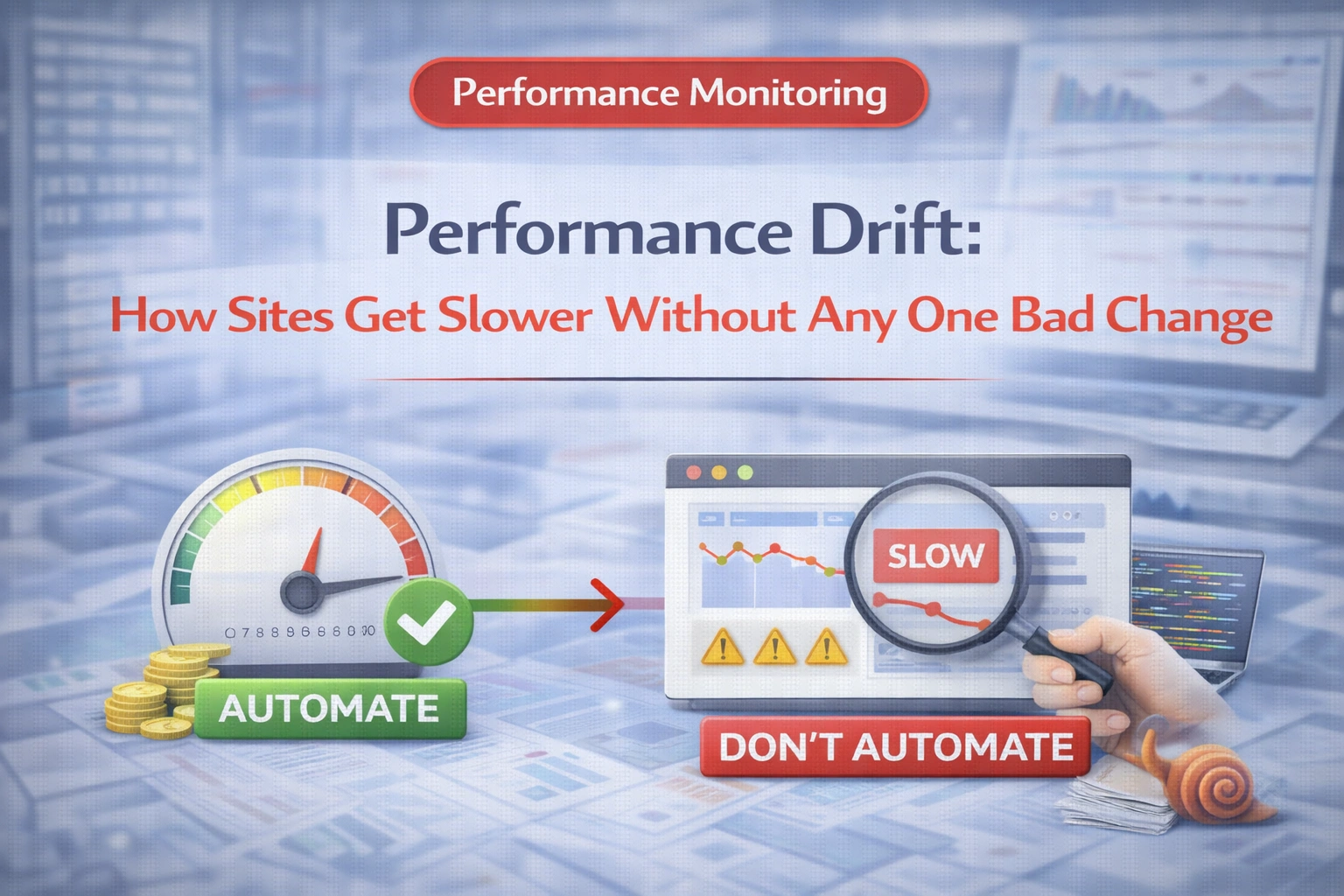
    Performance Drift How Sites Get Slower Without Any One Bad Change 1024x683
    Share
    Facebook Twitter LinkedIn Pinterest Email

    Introduction

    Most performance failures are not caused by a single bad release. They are the result of gradual drift. Sites that were once fast enough become marginal, then fragile, without any obvious inflection point. Dashboards remain mostly green. Teams struggle to identify a culprit. Over time, recovery becomes harder than prevention ever would have been.

    Performance drift is a systems problem. It emerges from repeated, individually reasonable decisions that collectively change how a site behaves under real conditions. At enterprise scale, drift is the default outcome unless it is actively controlled.

    This article explains how performance drift develops, why it is rarely detected early, and how mature organizations design monitoring and governance to prevent slow degradation from becoming structural risk.

    Why Drift Is Harder to See Than Failure

    Outright failures trigger alerts. Drift does not.

    Performance drift:

    • Occurs incrementally
    • Stays within acceptable thresholds for long periods
    • Is distributed across many releases and teams

    Because no single change appears responsible, drift is often treated as an external or inevitable phenomenon.

    The Illusion of Passing Metrics

    Passing performance thresholds creates false confidence.

    As long as metrics remain within limits:

    • Optimizations are deprioritized
    • Performance trade-offs go unchallenged
    • Buffers quietly disappear

    Once thresholds are breached, recovery requires undoing months or years of accumulated decisions.

    How Drift Actually Accumulates

    Incremental JavaScript Growth

    Small additions to client-side logic rarely justify the removal of existing code. Over time, execution cost grows, critical paths lengthen, and main-thread contention increases.

    Third-Party Expansion

    Analytics, personalization, experimentation, and marketing tools are added one at a time. Each has a measurable cost. Few are removed.

    Template Accretion

    Shared templates absorb edge cases, conditional logic, and exceptions. Complexity increases even when visual output does not change.

    Configuration Sprawl

    Caching rules, headers, and delivery settings are modified locally to solve immediate problems. Global coherence degrades.

    Why Performance Regressions Rarely Trigger Rollback

    Rollback is typically reserved for visible breakage.

    Drift-related regressions:

    • Do not break functionality
    • Do not affect all users equally
    • Are hard to attribute to a single change

    As a result, they persist across multiple release cycles.

    The Role of Release Cadence in Drift

    High release frequency accelerates drift when constraints are weak.

    Frequent, small changes:

    • Reduce the likelihood of deliberate cleanup
    • Blur before-and-after comparisons
    • Normalize gradual degradation

    Cadence amplifies drift unless paired with strong validation and stabilization practices.

    Why Drift Shows Up First in SEO and Crawling

    Search engines experience worst-case behavior more often than users.

    They:

    • Encounter cold caches
    • Traverse deep and low-priority pages
    • Revisit templates repeatedly over time

    As performance degrades, crawl rates slow, and indexation becomes more selective before user metrics shift noticeably.

    Variance Is the Early Warning Signal

    Average performance can remain stable while variance increases.

    Rising variance indicates:

    • Unpredictable rendering paths
    • Conditional logicis  behaving inconsistently
    • Uneven infrastructure behavior

    Variance growth is often the first measurable sign of drift.

    Why Teams Normalize Drift

    Drift is rarely dramatic.

    Teams adapt to:

    • Slightly slower builds
    • Marginally worse scores
    • Occasional performance complaints

    Normalization delays intervention until costs are high.

    Performance Budgets as Anti-Drift Controls

    Performance budgets are most valuable when they track consumption over time.

    Effective budgets:

    • Expose gradual erosion of headroom
    • Force explicit trade-offs
    • Prevent silent accumulation

    Budgets without enforcement do not prevent drift.

    Template-Level Monitoring Reveals Drift Patterns

    Drift rarely affects all templates equally.

    Template-level views reveal:

    • Which shared components are growing heavier
    • Where the execution cost is increasing fastest
    • Which page types are approaching instability

    This allows targeted remediation instead of broad optimization efforts.

    Why Cleanup Is Harder Than Addition

    Removing code and dependencies carries perceived risk.

    Teams hesitate because:

    • Usage is unclear
    • Ownership is diffused
    • Short-term benefit is limited

    Without explicit time allocated for cleanup, drift continues unchecked.

    Governance Failures Enable Drift

    Drift is rarely a technical failure alone.

    It reflects governance gaps such as:

    • No clear performance owner
    • No enforcement of budgets or standards
    • No expectation of periodic reduction

    Where governance is weak, drift is inevitable.

    Designing Systems That Resist Drift

    Mature organizations design against drift explicitly.

    Common practices include:

    • Regular performance debt reviews
    • Protected time for removal and simplification
    • Stabilization periods after major changes

    These practices slow the accumulation before thresholds are crossed.

    Why Optimization Campaigns Often Fail

    Periodic optimization efforts provide temporary relief.

    Without structural controls:

    • Gains are quickly eroded
    • Teams revert to previous behaviors
    • Performance returns to its prior trajectory

    Sustained improvement requires continuous governance.

    Performance Drift as an Enterprise Risk

    At scale, drift increases:

    • SEO volatility
    • Cost of change
    • Time to recover from incidents

    It is a long-term liability, not a cosmetic issue.

    Conclusion

    Performance drift does not announce itself. It accumulates quietly through reasonable decisions made without long-term constraint.

    Organizations that monitor only for failure discover drift too late. Those who track variance, budget consumption, and template-level behavior detect degradation early and intervene deliberately.

    At enterprise scale, performance is not lost in one bad release. It is lost through many small ones unless systems are designed to resist it.

    Share. Facebook Twitter Pinterest LinkedIn Tumblr Email
    yashwant160@gmail.com
    • Website

    Related Posts

    Performance Monitoring Beyond Core Web Vitals

    February 3, 2026
    Leave A Reply Cancel Reply

    Don't Miss

    Personal Branding Without the Cringe: Building Professional Credibility That Actually Works

    yashwant160@gmail.comFebruary 6, 2026

    Personal branding has a reputation problem. Too often, it’s confused with self-promotion, performative posting, or…

    Career Resilience: How to Build a Job That Survives Layoffs, AI, and Market Shifts

    February 6, 2026

    From Individual Contributor to Leader: The Career Shift Most People Get Wrong

    February 6, 2026

    The Non-Linear Career: Why the Best Careers No Longer Follow a Straight Path

    February 6, 2026
    Stay In Touch
    • Facebook
    • Twitter
    • Pinterest
    • Instagram
    • YouTube
    • Vimeo

    Subscribe to Updates

    Get the latest creative news from SmartMag about art & design.

    About Us

    Results-driven digital professional with 15+ years of experience across Web Operations, Enterprise SEO, and large-scale digital platforms. I specialize in building, scaling, and optimizing complex websites where performance, search visibility, and operational reliability must work together—not in silos. My work sits at the intersection of strategy and execution, translating business goals into systems that teams can actually run.

    Facebook X (Twitter) Pinterest YouTube
    Our Picks

    Personal Branding Without the Cringe: Building Professional Credibility That Actually Works

    February 6, 2026

    Career Resilience: How to Build a Job That Survives Layoffs, AI, and Market Shifts

    February 6, 2026

    From Individual Contributor to Leader: The Career Shift Most People Get Wrong

    February 6, 2026
    Most Popular

    Top 15 popular link building methods you should consider before it’s too late

    March 24, 20180 Views

    Quality Score Demystified: What Actually Improves SEM Performance

    January 31, 20260 Views

    How SEO, SEM, Email, and Paid Social Should Work Together

    February 2, 20260 Views
    © 2026 All rights reserved. Y. K. Thakur.
    • Home
    • Technical SEO
    • World
    • Lifestyle
    • Buy Now

    Type above and press Enter to search. Press Esc to cancel.