

Introduction
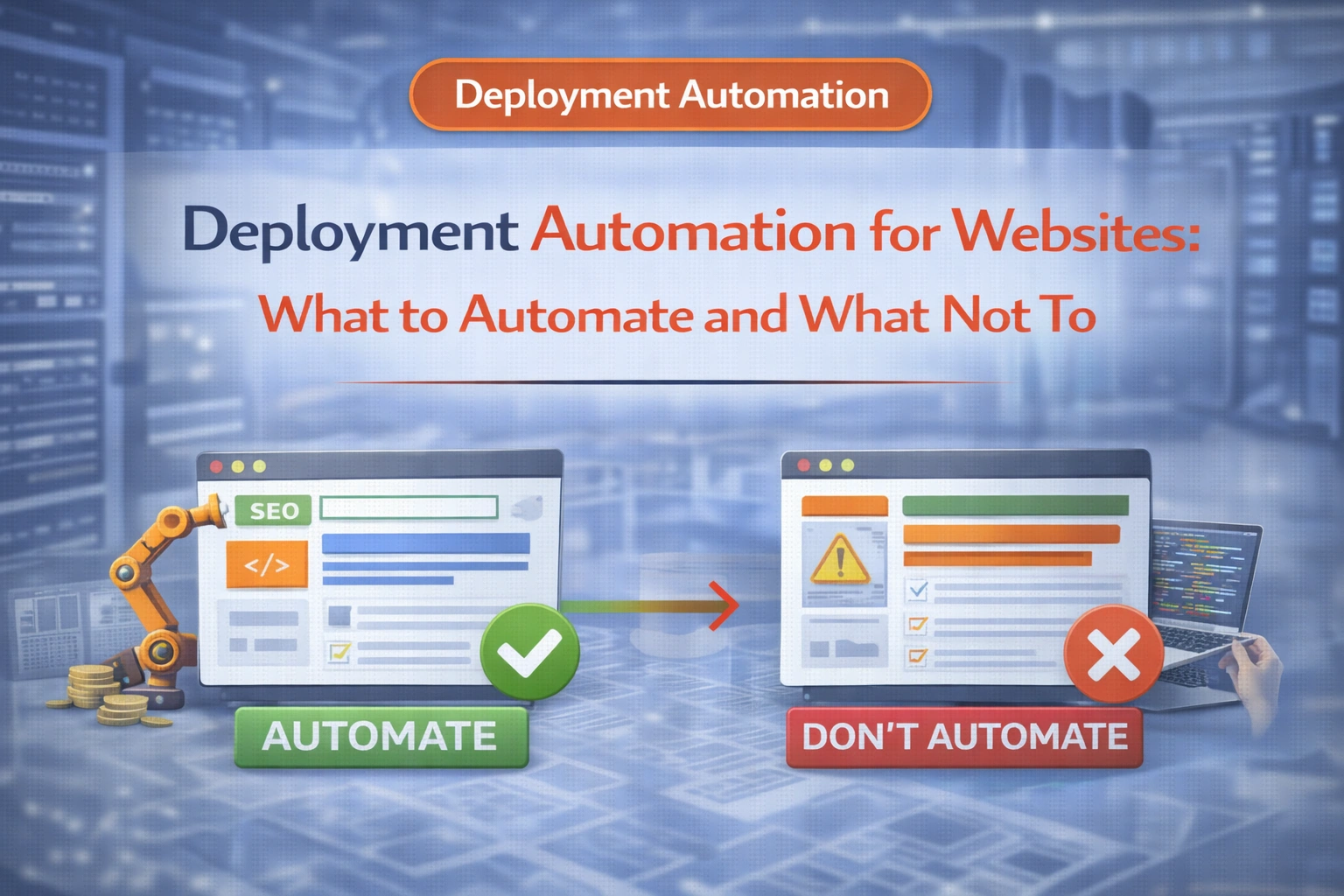
Deployment automation is often treated as an unqualified good. Faster releases, fewer manual steps, and consistent execution are assumed to reduce risk by default. For application backends, this assumption frequently holds. For websites, especially those at enterprise scale, it is incomplete.
Websites are not closed systems. They are continuously interpreted by search engines, consumed across geographies, and affected by long-lived signals such as crawl behavior and performance consistency. Automating the wrong decisions, or automating without governance, can amplify risk rather than reduce it.
This article examines deployment automation through a WebOps and SEO lens, explains what types of work benefit from automation, what must remain human-controlled, and how mature organizations design automation as a safety mechanism rather than a speed multiplier.
Why Website Automation Is Different From Application Automation
Application automation focuses on correctness and uptime.
Website automation must account for:
- Search engine interpretation over time
- Partial and delayed failure modes
- Behavioral consistency across large URL sets
A deployment can be technically successful and still degrade SEO, performance, or crawl stability. Automation that does not account for these outcomes creates false confidence.
The Common Misconception: Automate Everything
Many organizations approach automation with a single goal: remove humans from the loop.
This mindset leads to:
- Fully automated releases without risk classification
- SEO-impacting changes shipped without review
- Rollback paths assumed but never exercised
Automation removes friction, but friction is sometimes the control mechanism preventing bad decisions.
What Automation Is Good At
Automation excels at consistency and repetition.
For websites, this includes:
- Build and packaging processes
- Environment provisioning
- Infrastructure configuration enforcement
These areas benefit from reduced variance and predictable execution.
Automating Validation, Not Judgment
One of the highest-value uses of automation is validation.
Automated checks can reliably verify:
- Response codes and headers
- Presence of critical SEO directives
- Baseline performance thresholds
These checks confirm whether constraints are met. They do not decide whether a change is acceptable.
Why Judgment Should Not Be Fully Automated
Judgment requires context.
Decisions such as:
- Is this the right time to release?
- Is this risk acceptable given current stability?
- Should multiple changes be batched or separated?
depend on factors that are difficult to encode fully. Automating these decisions hides trade-offs rather than resolving them.
High-Risk Changes Require Human Gates
Not all changes are equal.
High-risk changes often include:
- Template and navigation modifications
- Rendering and framework updates
- Crawl, indexation, or routing logic changes
Automating the deployment of these changes without review increases the blast radius of mistakes.
The Danger of Automated Rollout at Scale
Automation enables rapid, global rollout.
Without safeguards, this means:
- Errors propagate instantly across regions
- SEO regressions affect entire site sections
- Rollback becomes politically and operationally harder
Speed amplifies impact. Automation must therefore include containment strategies.
Progressive Deployment as a Control Mechanism
Mature organizations combine automation with staged exposure.
Progressive deployment allows teams to:
- Observe behavior on a limited scope first
- Validate the crawler and performance response
- Decide whether to expand or halt rollout
Automation supports progression, not blind rollout.
Why Automated Rollback Is Rarely Enough
Rollback is often cited as the safety net for automation.
In practice:
- Rollback criteria are unclear
- Multiple changes are already live
- Search engine impact persists after rollback
Rollback reduces damage, but it does not erase consequences. Preventing bad releases is still essential.
SEO-Specific Constraints in Automated Pipelines
SEO constraints are often underrepresented in pipelines.
Examples of pipeline-level enforcement include:
- Blocking deployments that alter crawl directives without approval
- Failing builds when template-level performance budgets are exceeded
- Requiring validation for internal linking changes
Automation enforces rules that humans might overlook under pressure.
Automation Without Governance Creates Drift
Automation accelerates whatever behavior exists.
Without governance:
- Performance debt accumulates faster
- SEO regressions propagate silently
- Teams lose awareness of the system state
Automation magnifies discipline or lack thereof.
Ownership Is More Important Than Tooling
Automated pipelines do not own outcomes.
Clear ownership is required for:
- Defining non-negotiable constraints
- Responding to post-release signals
- Adjusting automation rules over time
Without ownership, automation becomes a black box.
Designing Automation Around Risk, Not Convenience
Effective automation is risk-aware.
This means:
- Low-risk changes flow quickly
- High-risk changes slow down intentionally
- Decision points are explicit, not implicit
Speed becomes selective rather than universal.
Automation as an Extension of WebOps Policy
Automation should encode policy.
Pipelines are most valuable when they:
- Reflect organizational standards
- Enforce agreed constraints consistently
- Make violations visible immediately
This turns automation into a governance tool rather than just a delivery mechanism.
Why Manual Steps Still Matter
Some steps are intentionally manual.
Human review introduces:
- Contextual judgment
- Cross-functional awareness
- Deliberate risk acceptance
Removing these steps entirely shifts risk; it does not eliminate it.
Automation and Long-Term SEO Stability
Search engines reward predictable behavior.
Automation that enforces consistency and prevents accidental drift supports long-term SEO stability. Automation that prioritizes speed over control undermines it.
Conclusion
Deployment automation is a powerful force multiplier. Used well, it reduces variance, enforces standards, and improves reliability. Used indiscriminately, it accelerates drift and amplifies mistakes.
For websites, the goal of automation is not maximum speed. It is a controlled change. Organizations that automate validation and execution while retaining human judgment for risk achieve both velocity and stability.
At enterprise scale, the most effective automation does not replace decision-making. It makes good decisions easier and bad decisions harder.
