
Close Menu
blog.ykthakur.com

    Subscribe to Updates

    Get the latest creative news from FooBar about art, design and business.

    What's Hot

    Personal Branding Without the Cringe: Building Professional Credibility That Actually Works

    February 6, 2026

    Career Resilience: How to Build a Job That Survives Layoffs, AI, and Market Shifts

    February 6, 2026

    From Individual Contributor to Leader: The Career Shift Most People Get Wrong

    February 6, 2026
    Facebook X (Twitter) Instagram
    blog.ykthakur.com
    • Home
    • About Me
    • Case Studies
    • Services
    • Contact Us
    Facebook X (Twitter) Instagram
    Subscribe
    • Blog
    • Search & Growth
      1. SEO
      2. Technical SEO
      3. SEM
      4. Paid Advertisements
      5. View All

      Why SEO Fails Even With the Right Tools and Data

      January 31, 2026

      How to Refresh Old Content Without Losing Rankings

      January 31, 2026

      How to Build a Topic Authority Map for SEO

      January 31, 2026

      E-E-A-T Signals Explained: What Actually Influences Trust and Rankings

      January 31, 2026

      XML Sitemaps at Scale: Signaling Priority, Not Forcing Indexation

      February 3, 2026

      Robots.txt at Scale: Control, Risk, and the Limits of Crawl Directives

      February 3, 2026

      Monitoring, Alerting, and SEO Observability: Seeing Failures Before Traffic Drops

      February 3, 2026

      Migrations, Releases, and SEO Risk: How Technical Changes Break Search at Scale

      February 3, 2026

      Scaling SEM Without Burning Budget

      January 31, 2026

      SEM vs SEO: How Paid Search Should Support Organic Growth

      January 31, 2026

      Quality Score Demystified: What Actually Improves SEM Performance

      January 31, 2026

      Brand vs Non-Brand Search: Budget Allocation Reality

      January 31, 2026

      Personal Branding Without the Cringe: Building Professional Credibility That Actually Works

      February 6, 2026

      Career Resilience: How to Build a Job That Survives Layoffs, AI, and Market Shifts

      February 6, 2026

      From Individual Contributor to Leader: The Career Shift Most People Get Wrong

      February 6, 2026

      The Non-Linear Career: Why the Best Careers No Longer Follow a Straight Path

      February 6, 2026
    • Performance & Infrastructure
      1. Website Performance
      2. Core Web Vitals
      3. Hosting Architecture
      4. Web Application Infrastructure
      5. Load Balancing
      6. View All

      Performance Drift: How Sites Get Slower Without Any One Bad Change

      February 3, 2026

      Why passing scores still hide systemic performance risk

      February 3, 2026

      Performance Monitoring Beyond Core Web Vitals

      February 3, 2026

      Personal Branding Without the Cringe: Building Professional Credibility That Actually Works

      February 6, 2026

      Career Resilience: How to Build a Job That Survives Layoffs, AI, and Market Shifts

      February 6, 2026

      From Individual Contributor to Leader: The Career Shift Most People Get Wrong

      February 6, 2026

      The Non-Linear Career: Why the Best Careers No Longer Follow a Straight Path

      February 6, 2026
    • AI & Automation
      1. AI Content Systems
      2. AI in SEO & Marketing
      3. AI Search Analysis
      4. AI-Driven SEO Workflows
      5. Generative AI Strategy
      6. View All

      AI Content Systems: How to Scale Without Losing Quality or Trust

      February 3, 2026

      AI in Marketing Is a System, Not a Toolset

      February 3, 2026

      SEO in a Zero-Click World: Designing for AI Answers and Visibility

      February 3, 2026

      AI Search Analysis: How LLMs Interpret and Surface Content

      February 3, 2026

      Using AI for Technical SEO Analysis Without Breaking Trust

      February 3, 2026

      AI-Driven SEO Workflows: What to Automate and What Not To

      February 3, 2026

      SEO in a Zero-Click World: Designing for AI Answers and Visibility

      February 3, 2026

      AI Search Analysis: How LLMs Interpret and Surface Content

      February 3, 2026

      Using AI for Technical SEO Analysis Without Breaking Trust

      February 3, 2026

      AI-Driven SEO Workflows: What to Automate and What Not To

      February 3, 2026

      Why Most AI SEO Implementations Fail

      February 3, 2026

      Human-in-the-Loop SEO: Where AI Stops and Judgment Starts

      February 3, 2026

      Personal Branding Without the Cringe: Building Professional Credibility That Actually Works

      February 6, 2026

      Career Resilience: How to Build a Job That Survives Layoffs, AI, and Market Shifts

      February 6, 2026

      From Individual Contributor to Leader: The Career Shift Most People Get Wrong

      February 6, 2026

      The Non-Linear Career: Why the Best Careers No Longer Follow a Straight Path

      February 6, 2026
    • Analytics & Intelligence
      1. GA4 Architecture
      2. Adobe Analytics
      3. View All

      GA4 vs Adobe Analytics: Choosing the Right Tool for Your Organization

      February 2, 2026

      Consent, Privacy, and Measurement: What Changes After GDPR & GA4

      February 2, 2026

      GA4 Architecture Explained: Designing Events for Real Decisions

      February 2, 2026

      GA4 vs Adobe Analytics: Choosing the Right Tool for Your Organization

      February 2, 2026

      Personal Branding Without the Cringe: Building Professional Credibility That Actually Works

      February 6, 2026

      Career Resilience: How to Build a Job That Survives Layoffs, AI, and Market Shifts

      February 6, 2026

      From Individual Contributor to Leader: The Career Shift Most People Get Wrong

      February 6, 2026

      The Non-Linear Career: Why the Best Careers No Longer Follow a Straight Path

      February 6, 2026
    • WebOps & DevOps
      1. Web Operations
      2. WebOps Roles
      3. Website Migrations & Scaling
      4. Release Management
      5. Monitoring & Alerts
      6. Performance Monitoring
      7. Deployment Automation
      8. View All

      SEO and WebOps Monitoring: Aligning Health Signals Across Systems

      February 3, 2026

      Designing Alerts for WebOps: Signal, Severity, and Actionability

      February 3, 2026

      Why Most Website Monitoring Is Too Late to Be Useful

      February 3, 2026

      Release Cadence Versus Stability: Finding the Sustainable Balance

      February 3, 2026

      Website Migrations at Scale: Why Most Fail Before the First Redirect

      February 3, 2026

      Post-Migration Reality: Why SEO and Performance Losses Persist for Months

      February 3, 2026

      Scaling Websites Without Replatforming: When Migration Is the Wrong Answer

      February 3, 2026

      Release Cadence Versus Stability: Finding the Sustainable Balance

      February 3, 2026

      Why Website Releases Break SEO Even When Nothing “Major” Changes

      February 3, 2026

      Release Management for Websites: Coordinating Risk Across Teams

      February 3, 2026

      Release Pipelines and Search Risk: Why Velocity Without Guardrails Breaks Websites

      February 3, 2026

      SEO and WebOps Monitoring: Aligning Health Signals Across Systems

      February 3, 2026

      Designing Alerts for WebOps: Signal, Severity, and Actionability

      February 3, 2026

      Why Most Website Monitoring Is Too Late to Be Useful

      February 3, 2026

      Feature Flags, Experiments, and the SEO Blast Radius

      February 3, 2026

      Performance Drift: How Sites Get Slower Without Any One Bad Change

      February 3, 2026

      Performance Monitoring Beyond Core Web Vitals

      February 3, 2026

      Designing SEO-Safe Deployment Automation

      February 3, 2026

      Deployment Automation for Websites: What to Automate and What Not To

      February 3, 2026

      Personal Branding Without the Cringe: Building Professional Credibility That Actually Works

      February 6, 2026

      Career Resilience: How to Build a Job That Survives Layoffs, AI, and Market Shifts

      February 6, 2026

      From Individual Contributor to Leader: The Career Shift Most People Get Wrong

      February 6, 2026

      The Non-Linear Career: Why the Best Careers No Longer Follow a Straight Path

      February 6, 2026
    • Project Strategy

      Personal Branding Without the Cringe: Building Professional Credibility That Actually Works

      February 6, 2026

      Career Resilience: How to Build a Job That Survives Layoffs, AI, and Market Shifts

      February 6, 2026

      From Individual Contributor to Leader: The Career Shift Most People Get Wrong

      February 6, 2026

      The Non-Linear Career: Why the Best Careers No Longer Follow a Straight Path

      February 6, 2026

      How to Stay Relevant When Roles Are Changing Faster Than Job Descriptions

      February 6, 2026
    • Web Engineering
      1. Web Development
      2. Web Designing & UX
      3. CMS & Platforms
      4. Web Application Firewall
      5. View All

      Personal Branding Without the Cringe: Building Professional Credibility That Actually Works

      February 6, 2026

      Career Resilience: How to Build a Job That Survives Layoffs, AI, and Market Shifts

      February 6, 2026

      From Individual Contributor to Leader: The Career Shift Most People Get Wrong

      February 6, 2026

      The Non-Linear Career: Why the Best Careers No Longer Follow a Straight Path

      February 6, 2026
    blog.ykthakur.com
    Home»Web Operations»Monitoring & Alerts»Why Most Website Monitoring Is Too Late to Be Useful
    Monitoring & Alerts

    Why Most Website Monitoring Is Too Late to Be Useful

    Lagging indicators, alert fatigue, and false confidence
    yashwant160@gmail.comBy yashwant160@gmail.comFebruary 3, 2026Updated:February 27, 2026No Comments5 Mins Read
    Share Facebook Twitter Pinterest LinkedIn Tumblr Email
    Follow Us
    Google News Flipboard Threads
    Why Most Website Monitoring Is Too Late To Be Useful 1024x683
    Share
    Facebook Twitter LinkedIn Pinterest Email

    Introduction

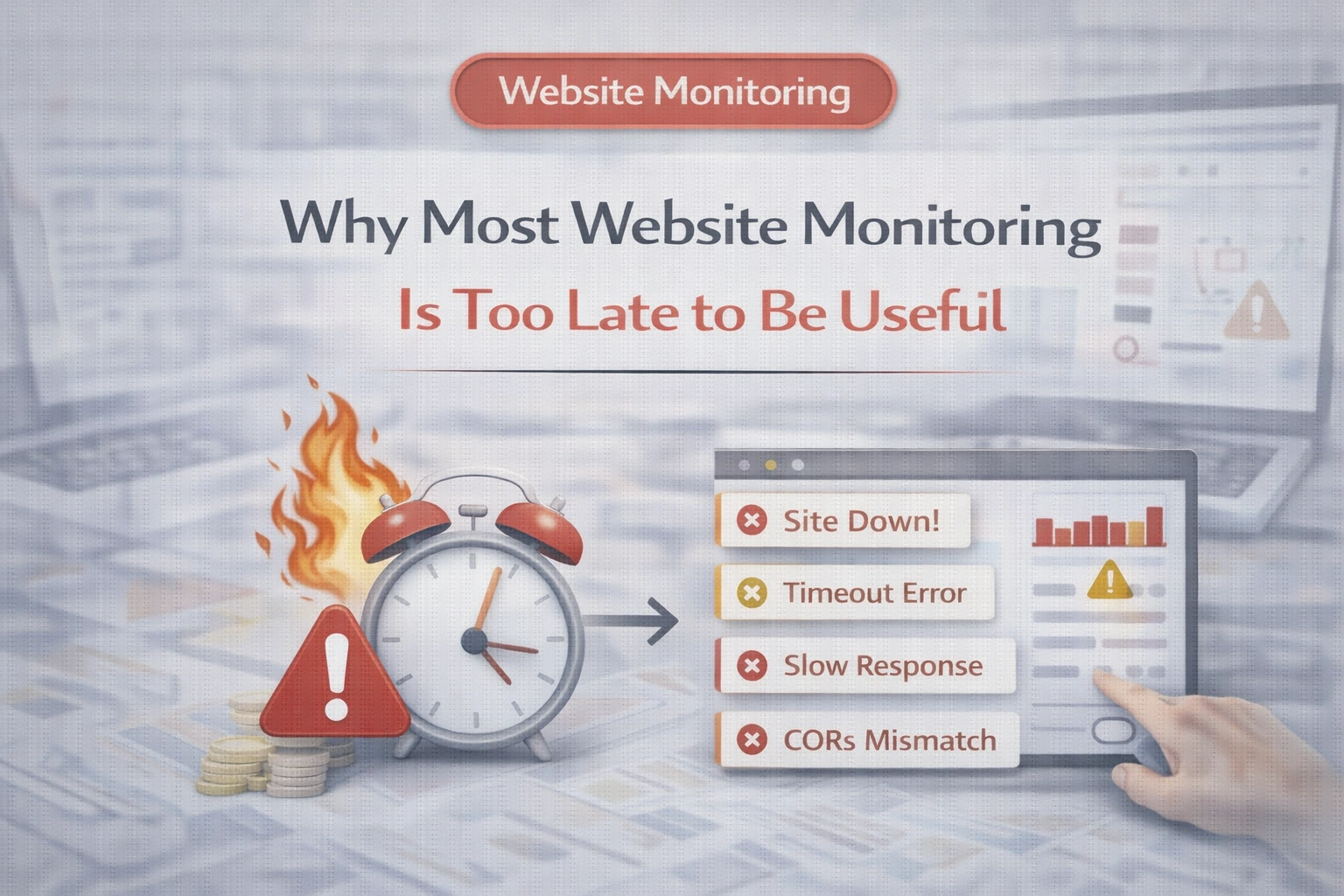
    Most organizations believe they are monitoring their websites effectively. Dashboards are populated, alerts are configured, and reports are reviewed regularly. Yet critical issues still surface first as traffic drops, SEO volatility, or customer complaints rather than as early warnings.

    The problem is not a lack of monitoring. It is the kind of monitoring being done. Most programs are built around lagging indicators that confirm failure after damage has already occurred. By the time alerts fire, search engines have already adapted to degraded behavior.

    This article explains why traditional website monitoring is structurally late, how lagging indicators create false confidence, and what it means to design monitoring systems that surface problems while they are still small and recoverable.

    Monitoring Is Often Confused With Reporting

    Many monitoring setups are repurposed reporting systems.

    They focus on:

    • Traffic and conversion trends
    • Aggregate performance metrics
    • Availability and uptime percentages

    These metrics describe outcomes, not system health. They explain what happened, not what is about to happen.

    Why Lagging Indicators Dominate

    Leading indicators are attractive because they are easy to understand and easy to justify.

    Traffic loss, ranking drops, and error spikes are unambiguous. The problem is timing. These indicators move only after:

    • Search engines have reduced trust
    • Users have already encountered issues
    • Recovery timelines have lengthened

    At that point, monitoring has failed its primary purpose.

    Search Engines Experience Failure Before Users Do

    Search engines encounter websites continuously and systematically.

    They detect:

    • Inconsistent responses
    • Rendering instability
    • Performance variance under load

    These signals accumulate long before user-facing metrics degrade. Monitoring that ignores crawler experience misses the earliest warnings.

    Why Uptime Monitoring Is Insufficient

    Uptime monitoring answers a narrow question: Is the site reachable?

    SEO and performance failures often occur while uptime remains near 100 percent. Pages return 200 responses, but:

    • Render incompletely
    • Load too slowly for reliable crawling
    • Behave inconsistently across regions

    From a monitoring perspective, everything looks healthy.

    The False Confidence of Averages

    Most dashboards report averages.

    Averages hide:

    • Template-specific regressions
    • Outliers that affect crawlers disproportionately
    • Localized failures that spread gradually

    Search engines do not experience averages. They experience individual pages over time.

    Why Alerts Often Fire Too Late

    Alert thresholds are typically based on absolute failure.

    Examples include:

    • Error rates exceeding a fixed percentage
    • Response times breaching a set limit
    • Traffic dropping below a defined baseline

    These thresholds are crossed only after significant degradation has already occurred.

    Early Failure Looks Like Anomaly, Not Error

    Early-stage issues rarely manifest as outright failures.

    They appear as:

    • Subtle shifts in crawl distribution
    • Small increases in render time variance
    • Gradual changes in indexation ratios

    Traditional monitoring systems are not designed to detect deviation from normal behavior.

    Why SEO Teams Discover Problems First

    SEO teams often notice issues before engineering alerts fire.

    This happens because SEO:

    • Observes long-term patterns
    • Tracks search-specific behavior
    • Notices inconsistencies across large URL sets

    By the time SEO raises concerns, the system has already drifted.

    Monitoring Without Context Creates Noise

    Adding more alerts does not improve detection.

    Without context:

    • Alerts trigger too frequently
    • Teams begin to ignore warnings
    • Real issues are dismissed as false positives

    Alert fatigue is often a symptom of poorly designed monitoring, not inattentive teams.

    Leading Indicators Versus Lagging Indicators

    Effective monitoring prioritizes leading indicators.

    For websites, leading indicators include:

    • Crawl behavior changes by template or section
    • Indexation volatility without content changes
    • Performance variance rather than absolute scores

    These indicators shift before traffic does.

    Why Monitoring Must Be System-Aware

    Websites are composed of shared components.

    Monitoring that does not understandthe system structure cannot localize issues. A problem in a shared template may affect thousands of pages, yet appear as a minor aggregate change.

    Detection Versus Diagnosis

    Monitoring should support diagnosis, not just detection.

    This requires:

    • Segmentation by page type
    • Historical baselines
    • Correlation with releases and configuration changes

    Without these, alerts trigger an investigation without direction.

    Why Late Detection Extends Recovery

    When issues are detected late:

    • Search engines have already adapted
    • Root cause analysis is more complex
    • Rollback windows have closed

    Recovery becomes slower and less predictable.

    Monitoring as a Control System

    In mature WebOps models, monitoring is designed as a control system.

    Its purpose is to:

    • Detect deviation early
    • Trigger an investigation before damage compounds
    • Inform decisions about release and rollback

    This shifts monitoring from observation to intervention.

    Why Most Organizations Accept Late Detection

    Late detection is often normalized.

    Teams accept traffic loss as the first signal because:

    • Earlier signals are harder to interpret
    • Ownership for proactive monitoring is unclear
    • Dashboards are built for reporting, not control

    This acceptance perpetuates reactive operations.

    Conclusion

    Most website monitoring programs fail not because they lack data, but because they focus on confirmation rather than prevention.

    Lagging indicators provide clarity only after trust has been lost. Organizations that redesign monitoring around leading indicators, deviation detection, and system behavior see issues earlier and recover faster.

    At enterprise scale, monitoring is not about knowing what went wrong. It is about knowing when something starts to go wrong, while there is still time to act.

    Share. Facebook Twitter Pinterest LinkedIn Tumblr Email
    yashwant160@gmail.com
    • Website

    Related Posts

    SEO and WebOps Monitoring: Aligning Health Signals Across Systems

    February 3, 2026

    Designing Alerts for WebOps: Signal, Severity, and Actionability

    February 3, 2026

    Feature Flags, Experiments, and the SEO Blast Radius

    February 3, 2026
    Leave A Reply Cancel Reply

    Don't Miss

    Personal Branding Without the Cringe: Building Professional Credibility That Actually Works

    yashwant160@gmail.comFebruary 6, 2026

    Personal branding has a reputation problem. Too often, it’s confused with self-promotion, performative posting, or…

    Career Resilience: How to Build a Job That Survives Layoffs, AI, and Market Shifts

    February 6, 2026

    From Individual Contributor to Leader: The Career Shift Most People Get Wrong

    February 6, 2026

    The Non-Linear Career: Why the Best Careers No Longer Follow a Straight Path

    February 6, 2026
    Stay In Touch
    • Facebook
    • Twitter
    • Pinterest
    • Instagram
    • YouTube
    • Vimeo

    Subscribe to Updates

    Get the latest creative news from SmartMag about art & design.

    About Us

    Results-driven digital professional with 15+ years of experience across Web Operations, Enterprise SEO, and large-scale digital platforms. I specialize in building, scaling, and optimizing complex websites where performance, search visibility, and operational reliability must work together—not in silos. My work sits at the intersection of strategy and execution, translating business goals into systems that teams can actually run.

    Facebook X (Twitter) Pinterest YouTube
    Our Picks

    Personal Branding Without the Cringe: Building Professional Credibility That Actually Works

    February 6, 2026

    Career Resilience: How to Build a Job That Survives Layoffs, AI, and Market Shifts

    February 6, 2026

    From Individual Contributor to Leader: The Career Shift Most People Get Wrong

    February 6, 2026
    Most Popular

    Top 15 popular link building methods you should consider before it’s too late

    March 24, 20180 Views

    Quality Score Demystified: What Actually Improves SEM Performance

    January 31, 20260 Views

    How SEO, SEM, Email, and Paid Social Should Work Together

    February 2, 20260 Views
    © 2026 All rights reserved. Y. K. Thakur.
    • Home
    • Technical SEO
    • World
    • Lifestyle
    • Buy Now

    Type above and press Enter to search. Press Esc to cancel.