Close Menu
blog.ykthakur.com

    Subscribe to Updates

    Get the latest creative news from FooBar about art, design and business.

    What's Hot

    Personal Branding Without the Cringe: Building Professional Credibility That Actually Works

    February 6, 2026

    Career Resilience: How to Build a Job That Survives Layoffs, AI, and Market Shifts

    February 6, 2026

    From Individual Contributor to Leader: The Career Shift Most People Get Wrong

    February 6, 2026
    Facebook X (Twitter) Instagram
    blog.ykthakur.com
    • Home
    • About Me
    • Case Studies
    • Services
    • Contact Us
    Facebook X (Twitter) Instagram
    Subscribe
    • Blog
    • Search & Growth
      1. SEO
      2. Technical SEO
      3. SEM
      4. Paid Advertisements
      5. View All

      Why SEO Fails Even With the Right Tools and Data

      January 31, 2026

      How to Refresh Old Content Without Losing Rankings

      January 31, 2026

      How to Build a Topic Authority Map for SEO

      January 31, 2026

      E-E-A-T Signals Explained: What Actually Influences Trust and Rankings

      January 31, 2026

      XML Sitemaps at Scale: Signaling Priority, Not Forcing Indexation

      February 3, 2026

      Robots.txt at Scale: Control, Risk, and the Limits of Crawl Directives

      February 3, 2026

      Monitoring, Alerting, and SEO Observability: Seeing Failures Before Traffic Drops

      February 3, 2026

      Migrations, Releases, and SEO Risk: How Technical Changes Break Search at Scale

      February 3, 2026

      Scaling SEM Without Burning Budget

      January 31, 2026

      SEM vs SEO: How Paid Search Should Support Organic Growth

      January 31, 2026

      Quality Score Demystified: What Actually Improves SEM Performance

      January 31, 2026

      Brand vs Non-Brand Search: Budget Allocation Reality

      January 31, 2026

      Personal Branding Without the Cringe: Building Professional Credibility That Actually Works

      February 6, 2026

      Career Resilience: How to Build a Job That Survives Layoffs, AI, and Market Shifts

      February 6, 2026

      From Individual Contributor to Leader: The Career Shift Most People Get Wrong

      February 6, 2026

      The Non-Linear Career: Why the Best Careers No Longer Follow a Straight Path

      February 6, 2026
    • Performance & Infrastructure
      1. Website Performance
      2. Core Web Vitals
      3. Hosting Architecture
      4. Web Application Infrastructure
      5. Load Balancing
      6. View All

      Performance Drift: How Sites Get Slower Without Any One Bad Change

      February 3, 2026

      Why passing scores still hide systemic performance risk

      February 3, 2026

      Performance Monitoring Beyond Core Web Vitals

      February 3, 2026

      Personal Branding Without the Cringe: Building Professional Credibility That Actually Works

      February 6, 2026

      Career Resilience: How to Build a Job That Survives Layoffs, AI, and Market Shifts

      February 6, 2026

      From Individual Contributor to Leader: The Career Shift Most People Get Wrong

      February 6, 2026

      The Non-Linear Career: Why the Best Careers No Longer Follow a Straight Path

      February 6, 2026
    • AI & Automation
      1. AI Content Systems
      2. AI in SEO & Marketing
      3. AI Search Analysis
      4. AI-Driven SEO Workflows
      5. Generative AI Strategy
      6. View All

      AI Content Systems: How to Scale Without Losing Quality or Trust

      February 3, 2026

      AI in Marketing Is a System, Not a Toolset

      February 3, 2026

      SEO in a Zero-Click World: Designing for AI Answers and Visibility

      February 3, 2026

      AI Search Analysis: How LLMs Interpret and Surface Content

      February 3, 2026

      Using AI for Technical SEO Analysis Without Breaking Trust

      February 3, 2026

      AI-Driven SEO Workflows: What to Automate and What Not To

      February 3, 2026

      SEO in a Zero-Click World: Designing for AI Answers and Visibility

      February 3, 2026

      AI Search Analysis: How LLMs Interpret and Surface Content

      February 3, 2026

      Using AI for Technical SEO Analysis Without Breaking Trust

      February 3, 2026

      AI-Driven SEO Workflows: What to Automate and What Not To

      February 3, 2026

      Why Most AI SEO Implementations Fail

      February 3, 2026

      Human-in-the-Loop SEO: Where AI Stops and Judgment Starts

      February 3, 2026

      Personal Branding Without the Cringe: Building Professional Credibility That Actually Works

      February 6, 2026

      Career Resilience: How to Build a Job That Survives Layoffs, AI, and Market Shifts

      February 6, 2026

      From Individual Contributor to Leader: The Career Shift Most People Get Wrong

      February 6, 2026

      The Non-Linear Career: Why the Best Careers No Longer Follow a Straight Path

      February 6, 2026
    • Analytics & Intelligence
      1. GA4 Architecture
      2. Adobe Analytics
      3. View All

      GA4 vs Adobe Analytics: Choosing the Right Tool for Your Organization

      February 2, 2026

      Consent, Privacy, and Measurement: What Changes After GDPR & GA4

      February 2, 2026

      GA4 Architecture Explained: Designing Events for Real Decisions

      February 2, 2026

      GA4 vs Adobe Analytics: Choosing the Right Tool for Your Organization

      February 2, 2026

      Personal Branding Without the Cringe: Building Professional Credibility That Actually Works

      February 6, 2026

      Career Resilience: How to Build a Job That Survives Layoffs, AI, and Market Shifts

      February 6, 2026

      From Individual Contributor to Leader: The Career Shift Most People Get Wrong

      February 6, 2026

      The Non-Linear Career: Why the Best Careers No Longer Follow a Straight Path

      February 6, 2026
    • WebOps & DevOps
      1. Web Operations
      2. WebOps Roles
      3. Website Migrations & Scaling
      4. Release Management
      5. Monitoring & Alerts
      6. Performance Monitoring
      7. Deployment Automation
      8. View All

      SEO and WebOps Monitoring: Aligning Health Signals Across Systems

      February 3, 2026

      Designing Alerts for WebOps: Signal, Severity, and Actionability

      February 3, 2026

      Why Most Website Monitoring Is Too Late to Be Useful

      February 3, 2026

      Release Cadence Versus Stability: Finding the Sustainable Balance

      February 3, 2026

      Website Migrations at Scale: Why Most Fail Before the First Redirect

      February 3, 2026

      Post-Migration Reality: Why SEO and Performance Losses Persist for Months

      February 3, 2026

      Scaling Websites Without Replatforming: When Migration Is the Wrong Answer

      February 3, 2026

      Release Cadence Versus Stability: Finding the Sustainable Balance

      February 3, 2026

      Why Website Releases Break SEO Even When Nothing “Major” Changes

      February 3, 2026

      Release Management for Websites: Coordinating Risk Across Teams

      February 3, 2026

      Release Pipelines and Search Risk: Why Velocity Without Guardrails Breaks Websites

      February 3, 2026

      SEO and WebOps Monitoring: Aligning Health Signals Across Systems

      February 3, 2026

      Designing Alerts for WebOps: Signal, Severity, and Actionability

      February 3, 2026

      Why Most Website Monitoring Is Too Late to Be Useful

      February 3, 2026

      Feature Flags, Experiments, and the SEO Blast Radius

      February 3, 2026

      Performance Drift: How Sites Get Slower Without Any One Bad Change

      February 3, 2026

      Performance Monitoring Beyond Core Web Vitals

      February 3, 2026

      Designing SEO-Safe Deployment Automation

      February 3, 2026

      Deployment Automation for Websites: What to Automate and What Not To

      February 3, 2026

      Personal Branding Without the Cringe: Building Professional Credibility That Actually Works

      February 6, 2026

      Career Resilience: How to Build a Job That Survives Layoffs, AI, and Market Shifts

      February 6, 2026

      From Individual Contributor to Leader: The Career Shift Most People Get Wrong

      February 6, 2026

      The Non-Linear Career: Why the Best Careers No Longer Follow a Straight Path

      February 6, 2026
    • Project Strategy

      Personal Branding Without the Cringe: Building Professional Credibility That Actually Works

      February 6, 2026

      Career Resilience: How to Build a Job That Survives Layoffs, AI, and Market Shifts

      February 6, 2026

      From Individual Contributor to Leader: The Career Shift Most People Get Wrong

      February 6, 2026

      The Non-Linear Career: Why the Best Careers No Longer Follow a Straight Path

      February 6, 2026

      How to Stay Relevant When Roles Are Changing Faster Than Job Descriptions

      February 6, 2026
    • Web Engineering
      1. Web Development
      2. Web Designing & UX
      3. CMS & Platforms
      4. Web Application Firewall
      5. View All

      Personal Branding Without the Cringe: Building Professional Credibility That Actually Works

      February 6, 2026

      Career Resilience: How to Build a Job That Survives Layoffs, AI, and Market Shifts

      February 6, 2026

      From Individual Contributor to Leader: The Career Shift Most People Get Wrong

      February 6, 2026

      The Non-Linear Career: Why the Best Careers No Longer Follow a Straight Path

      February 6, 2026
    blog.ykthakur.com
    Home»Web Operations»Release Management»Release Cadence Versus Stability: Finding the Sustainable Balance
    Release Management

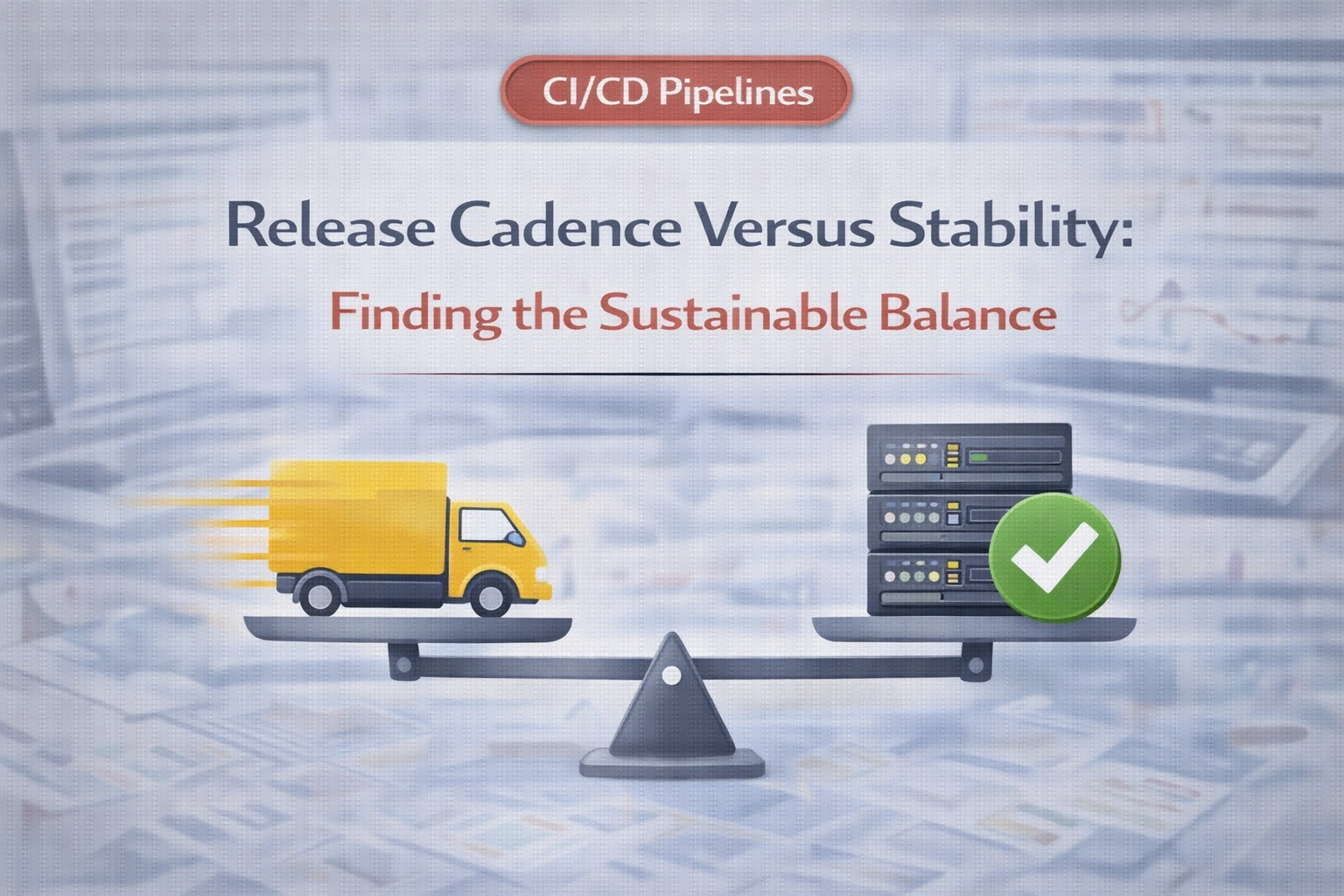
    Release Cadence Versus Stability: Finding the Sustainable Balance

    How mature teams align velocity with predictability
    yashwant160@gmail.comBy yashwant160@gmail.comFebruary 3, 2026Updated:February 27, 2026No Comments4 Mins Read
    Share Facebook Twitter Pinterest LinkedIn Tumblr Email
    Follow Us
    Google News Flipboard Threads
    Release Cadence Versus Stability Finding The Sustainable Balance 1024x683
    Share
    Facebook Twitter LinkedIn Pinterest Email

    Introduction

    Release cadence is often treated as a proxy for organizational maturity. Faster releases imply better tooling, stronger teams, and improved outcomes. In practice, velocity without stability creates fragile systems that are difficult to reason about and slow to recover when something goes wrong.

    For websites, the cost of instability is not evenly distributed. Search engines observe behavior over time, not intent. Frequent, unbounded change increases variability in crawl patterns, indexation confidence, and performance signals. The result is gradual erosion rather than dramatic failure.

    This article examines the tension between release cadence and stability, explains why more frequent releases do not automatically produce better outcomes, and outlines how mature organizations design cadence as a control mechanism rather than a throughput goal.

    Why Faster Releases Became the Default Goal

    Modern engineering practices emphasize continuous delivery.

    The benefits are real:

    • Smaller change sets
    • Faster feedback loops
    • Reduced deployment risk per change

    However, these benefits assume that change is well-scoped, observable, and reversible. When those assumptions do not hold, frequency amplifies risk.

    Stability Is an External Perception, Not an Internal Feeling

    Internally, teams may feel stable because releases are completed successfully.

    Externally, stability is defined by:

    • Consistent responses to crawlers and users
    • Predictable rendering and performance
    • Minimal variance in site behavior over time

    Search engines judge stability based on observed patterns, not deployment success.

    The Hidden Cost of High-Frequency Change

    High release frequency introduces subtle costs.

    Common consequences include:

    • Unclear behavioral baselines
    • Difficulty attributing cause and effect
    • Reduced willingness to roll back

    When everything is always changing, nothing is clearly responsible.

    Why SEO Is Sensitive to Cadence

    SEO performance depends on long-term consistency.

    Frequent changes can:

    • Shift crawl allocation unpredictably
    • Create indexation hesitation
    • Delay recovery from minor regressions

    Even positive changes require time to be evaluated and trusted.

    Release Cadence Is a Risk Multiplier

    Cadence does not create risk by itself. It multiplies existing risk.

    In environments with:

    • Weak validation
    • Limited observability
    • Unclear ownership

    higher frequency accelerates degradation rather than improvement.

    Why Fewer, Better Releases Often Perform Better

    Organizations with lower release frequency often appear slower but behave more predictably.

    Benefits include:

    • Clearer baselines between releases
    • Stronger pre-release validation
    • More decisive rollback decisions

    Predictability compounds trust with search engines.

    Stabilization Windows Are Not Optional

    After meaningful changes, systems need time to settle.

    Stabilization windows allow:

    • Search engines to re-crawl and reassess
    • Teams to observe real-world behavior
    • Regression signals should surface clearly

    Without stabilization, new changes obscure the impact of previous ones.

    Cadence Should Vary by Risk

    Uniform cadence across all changes is inefficient.

    Mature organizations differentiate cadence based on:

    • SEO and performance sensitivity
    • Blast radius of the change
    • Reversibility

    Low-risk changes can ship frequently. High-risk changes require slower, more deliberate cycles.

    The Role of Validation in Supporting Frequency

    Higher cadence is sustainable only with stronger validation.

    This includes:

    • Automated checks for SEO-critical behavior
    • Performance budgets enforced pre-release
    • Post-release monitoring tied to expectations

    Without these, cadence outpaces control.

    Why Rollback Culture Matters

    Fast cadence without rollback discipline creates paralysis.

    Teams hesitate to roll back because:

    • Multiple releases are already live
    • Dependencies are unclear
    • Ownership is diffused

    A healthy rollback culture restores confidence in change.

    Cadence and Team Cognitive Load

    Frequent releases increase cognitive load.

    Teams struggle to:

    • Track what changed
    • Understand system behavior
    • Learn from outcomes

    Sustainable cadence preserves the ability to reason about the system.

    Why “Always Shipping” Is Not a Strategy

    Shipping continuously without intent leads to drift.

    Effective cadence aligns with:

    • Business priorities
    • Search engine adaptation timelines
    • Operational capacity to observe and respond

    Cadence is a lever, not a virtue.

    Designing Cadence as a Control System

    In mature WebOps models, cadence is designed explicitly.

    This includes:

    • Defined release rhythms for different change types
    • Protected stabilization periods
    • Clear criteria for accelerating or slowing down

    Control replaces habit.

    SEO Stability as a Cadence Signal

    SEO performance reflects whether cadence is sustainable.

    Persistent volatility indicates:

    • Too much change
    • Too little validation
    • Too little time between shifts

    Ignoring this signal compounds risk.

    Conclusion

    Release cadence and stability are not opposing goals. They are variables that must be balanced deliberately.

    Organizations that chase speed without control create fragile systems that degrade quietly. Those who design cadence around risk, validation, and stabilization achieve both velocity and predictability.

    At enterprise scale, the right cadence is not the fastest possible. It is the one that allows the system to change while remaining understandable to both humans and search engines.

    Share. Facebook Twitter Pinterest LinkedIn Tumblr Email
    yashwant160@gmail.com
    • Website

    Related Posts

    Why Website Releases Break SEO Even When Nothing “Major” Changes

    February 3, 2026

    Release Management for Websites: Coordinating Risk Across Teams

    February 3, 2026

    Release Pipelines and Search Risk: Why Velocity Without Guardrails Breaks Websites

    February 3, 2026
    Leave A Reply Cancel Reply

    Don't Miss

    Personal Branding Without the Cringe: Building Professional Credibility That Actually Works

    yashwant160@gmail.comFebruary 6, 2026

    Personal branding has a reputation problem. Too often, it’s confused with self-promotion, performative posting, or…

    Career Resilience: How to Build a Job That Survives Layoffs, AI, and Market Shifts

    February 6, 2026

    From Individual Contributor to Leader: The Career Shift Most People Get Wrong

    February 6, 2026

    The Non-Linear Career: Why the Best Careers No Longer Follow a Straight Path

    February 6, 2026
    Stay In Touch
    • Facebook
    • Twitter
    • Pinterest
    • Instagram
    • YouTube
    • Vimeo

    Subscribe to Updates

    Get the latest creative news from SmartMag about art & design.

    About Us

    Results-driven digital professional with 15+ years of experience across Web Operations, Enterprise SEO, and large-scale digital platforms. I specialize in building, scaling, and optimizing complex websites where performance, search visibility, and operational reliability must work together—not in silos. My work sits at the intersection of strategy and execution, translating business goals into systems that teams can actually run.

    Facebook X (Twitter) Pinterest YouTube
    Our Picks

    Personal Branding Without the Cringe: Building Professional Credibility That Actually Works

    February 6, 2026

    Career Resilience: How to Build a Job That Survives Layoffs, AI, and Market Shifts

    February 6, 2026

    From Individual Contributor to Leader: The Career Shift Most People Get Wrong

    February 6, 2026
    Most Popular

    Top 15 popular link building methods you should consider before it’s too late

    March 24, 20180 Views

    Quality Score Demystified: What Actually Improves SEM Performance

    January 31, 20260 Views

    How SEO, SEM, Email, and Paid Social Should Work Together

    February 2, 20260 Views
    © 2026 All rights reserved. Y. K. Thakur.
    • Home
    • Technical SEO
    • World
    • Lifestyle
    • Buy Now

    Type above and press Enter to search. Press Esc to cancel.