Close Menu
blog.ykthakur.com

    Subscribe to Updates

    Get the latest creative news from FooBar about art, design and business.

    What's Hot

    Personal Branding Without the Cringe: Building Professional Credibility That Actually Works

    February 6, 2026

    Career Resilience: How to Build a Job That Survives Layoffs, AI, and Market Shifts

    February 6, 2026

    From Individual Contributor to Leader: The Career Shift Most People Get Wrong

    February 6, 2026
    Facebook X (Twitter) Instagram
    blog.ykthakur.com
    • Home
    • About Me
    • Case Studies
    • Services
    • Contact Us
    Facebook X (Twitter) Instagram
    Subscribe
    • Blog
    • Search & Growth
      1. SEO
      2. Technical SEO
      3. SEM
      4. Paid Advertisements
      5. View All

      Why SEO Fails Even With the Right Tools and Data

      January 31, 2026

      How to Refresh Old Content Without Losing Rankings

      January 31, 2026

      How to Build a Topic Authority Map for SEO

      January 31, 2026

      E-E-A-T Signals Explained: What Actually Influences Trust and Rankings

      January 31, 2026

      XML Sitemaps at Scale: Signaling Priority, Not Forcing Indexation

      February 3, 2026

      Robots.txt at Scale: Control, Risk, and the Limits of Crawl Directives

      February 3, 2026

      Monitoring, Alerting, and SEO Observability: Seeing Failures Before Traffic Drops

      February 3, 2026

      Migrations, Releases, and SEO Risk: How Technical Changes Break Search at Scale

      February 3, 2026

      Scaling SEM Without Burning Budget

      January 31, 2026

      SEM vs SEO: How Paid Search Should Support Organic Growth

      January 31, 2026

      Quality Score Demystified: What Actually Improves SEM Performance

      January 31, 2026

      Brand vs Non-Brand Search: Budget Allocation Reality

      January 31, 2026

      Personal Branding Without the Cringe: Building Professional Credibility That Actually Works

      February 6, 2026

      Career Resilience: How to Build a Job That Survives Layoffs, AI, and Market Shifts

      February 6, 2026

      From Individual Contributor to Leader: The Career Shift Most People Get Wrong

      February 6, 2026

      The Non-Linear Career: Why the Best Careers No Longer Follow a Straight Path

      February 6, 2026
    • Performance & Infrastructure
      1. Website Performance
      2. Core Web Vitals
      3. Hosting Architecture
      4. Web Application Infrastructure
      5. Load Balancing
      6. View All

      Performance Drift: How Sites Get Slower Without Any One Bad Change

      February 3, 2026

      Why passing scores still hide systemic performance risk

      February 3, 2026

      Performance Monitoring Beyond Core Web Vitals

      February 3, 2026

      Personal Branding Without the Cringe: Building Professional Credibility That Actually Works

      February 6, 2026

      Career Resilience: How to Build a Job That Survives Layoffs, AI, and Market Shifts

      February 6, 2026

      From Individual Contributor to Leader: The Career Shift Most People Get Wrong

      February 6, 2026

      The Non-Linear Career: Why the Best Careers No Longer Follow a Straight Path

      February 6, 2026
    • AI & Automation
      1. AI Content Systems
      2. AI in SEO & Marketing
      3. AI Search Analysis
      4. AI-Driven SEO Workflows
      5. Generative AI Strategy
      6. View All

      AI Content Systems: How to Scale Without Losing Quality or Trust

      February 3, 2026

      AI in Marketing Is a System, Not a Toolset

      February 3, 2026

      SEO in a Zero-Click World: Designing for AI Answers and Visibility

      February 3, 2026

      AI Search Analysis: How LLMs Interpret and Surface Content

      February 3, 2026

      Using AI for Technical SEO Analysis Without Breaking Trust

      February 3, 2026

      AI-Driven SEO Workflows: What to Automate and What Not To

      February 3, 2026

      SEO in a Zero-Click World: Designing for AI Answers and Visibility

      February 3, 2026

      AI Search Analysis: How LLMs Interpret and Surface Content

      February 3, 2026

      Using AI for Technical SEO Analysis Without Breaking Trust

      February 3, 2026

      AI-Driven SEO Workflows: What to Automate and What Not To

      February 3, 2026

      Why Most AI SEO Implementations Fail

      February 3, 2026

      Human-in-the-Loop SEO: Where AI Stops and Judgment Starts

      February 3, 2026

      Personal Branding Without the Cringe: Building Professional Credibility That Actually Works

      February 6, 2026

      Career Resilience: How to Build a Job That Survives Layoffs, AI, and Market Shifts

      February 6, 2026

      From Individual Contributor to Leader: The Career Shift Most People Get Wrong

      February 6, 2026

      The Non-Linear Career: Why the Best Careers No Longer Follow a Straight Path

      February 6, 2026
    • Analytics & Intelligence
      1. GA4 Architecture
      2. Adobe Analytics
      3. View All

      GA4 vs Adobe Analytics: Choosing the Right Tool for Your Organization

      February 2, 2026

      Consent, Privacy, and Measurement: What Changes After GDPR & GA4

      February 2, 2026

      GA4 Architecture Explained: Designing Events for Real Decisions

      February 2, 2026

      GA4 vs Adobe Analytics: Choosing the Right Tool for Your Organization

      February 2, 2026

      Personal Branding Without the Cringe: Building Professional Credibility That Actually Works

      February 6, 2026

      Career Resilience: How to Build a Job That Survives Layoffs, AI, and Market Shifts

      February 6, 2026

      From Individual Contributor to Leader: The Career Shift Most People Get Wrong

      February 6, 2026

      The Non-Linear Career: Why the Best Careers No Longer Follow a Straight Path

      February 6, 2026
    • WebOps & DevOps
      1. Web Operations
      2. WebOps Roles
      3. Website Migrations & Scaling
      4. Release Management
      5. Monitoring & Alerts
      6. Performance Monitoring
      7. Deployment Automation
      8. View All

      SEO and WebOps Monitoring: Aligning Health Signals Across Systems

      February 3, 2026

      Designing Alerts for WebOps: Signal, Severity, and Actionability

      February 3, 2026

      Why Most Website Monitoring Is Too Late to Be Useful

      February 3, 2026

      Release Cadence Versus Stability: Finding the Sustainable Balance

      February 3, 2026

      Website Migrations at Scale: Why Most Fail Before the First Redirect

      February 3, 2026

      Post-Migration Reality: Why SEO and Performance Losses Persist for Months

      February 3, 2026

      Scaling Websites Without Replatforming: When Migration Is the Wrong Answer

      February 3, 2026

      Release Cadence Versus Stability: Finding the Sustainable Balance

      February 3, 2026

      Why Website Releases Break SEO Even When Nothing “Major” Changes

      February 3, 2026

      Release Management for Websites: Coordinating Risk Across Teams

      February 3, 2026

      Release Pipelines and Search Risk: Why Velocity Without Guardrails Breaks Websites

      February 3, 2026

      SEO and WebOps Monitoring: Aligning Health Signals Across Systems

      February 3, 2026

      Designing Alerts for WebOps: Signal, Severity, and Actionability

      February 3, 2026

      Why Most Website Monitoring Is Too Late to Be Useful

      February 3, 2026

      Feature Flags, Experiments, and the SEO Blast Radius

      February 3, 2026

      Performance Drift: How Sites Get Slower Without Any One Bad Change

      February 3, 2026

      Performance Monitoring Beyond Core Web Vitals

      February 3, 2026

      Designing SEO-Safe Deployment Automation

      February 3, 2026

      Deployment Automation for Websites: What to Automate and What Not To

      February 3, 2026

      Personal Branding Without the Cringe: Building Professional Credibility That Actually Works

      February 6, 2026

      Career Resilience: How to Build a Job That Survives Layoffs, AI, and Market Shifts

      February 6, 2026

      From Individual Contributor to Leader: The Career Shift Most People Get Wrong

      February 6, 2026

      The Non-Linear Career: Why the Best Careers No Longer Follow a Straight Path

      February 6, 2026
    • Project Strategy

      Personal Branding Without the Cringe: Building Professional Credibility That Actually Works

      February 6, 2026

      Career Resilience: How to Build a Job That Survives Layoffs, AI, and Market Shifts

      February 6, 2026

      From Individual Contributor to Leader: The Career Shift Most People Get Wrong

      February 6, 2026

      The Non-Linear Career: Why the Best Careers No Longer Follow a Straight Path

      February 6, 2026

      How to Stay Relevant When Roles Are Changing Faster Than Job Descriptions

      February 6, 2026
    • Web Engineering
      1. Web Development
      2. Web Designing & UX
      3. CMS & Platforms
      4. Web Application Firewall
      5. View All

      Personal Branding Without the Cringe: Building Professional Credibility That Actually Works

      February 6, 2026

      Career Resilience: How to Build a Job That Survives Layoffs, AI, and Market Shifts

      February 6, 2026

      From Individual Contributor to Leader: The Career Shift Most People Get Wrong

      February 6, 2026

      The Non-Linear Career: Why the Best Careers No Longer Follow a Straight Path

      February 6, 2026
    blog.ykthakur.com
    Home»Web Operations»Release Management»Why Website Releases Break SEO Even When Nothing “Major” Changes
    Release Management

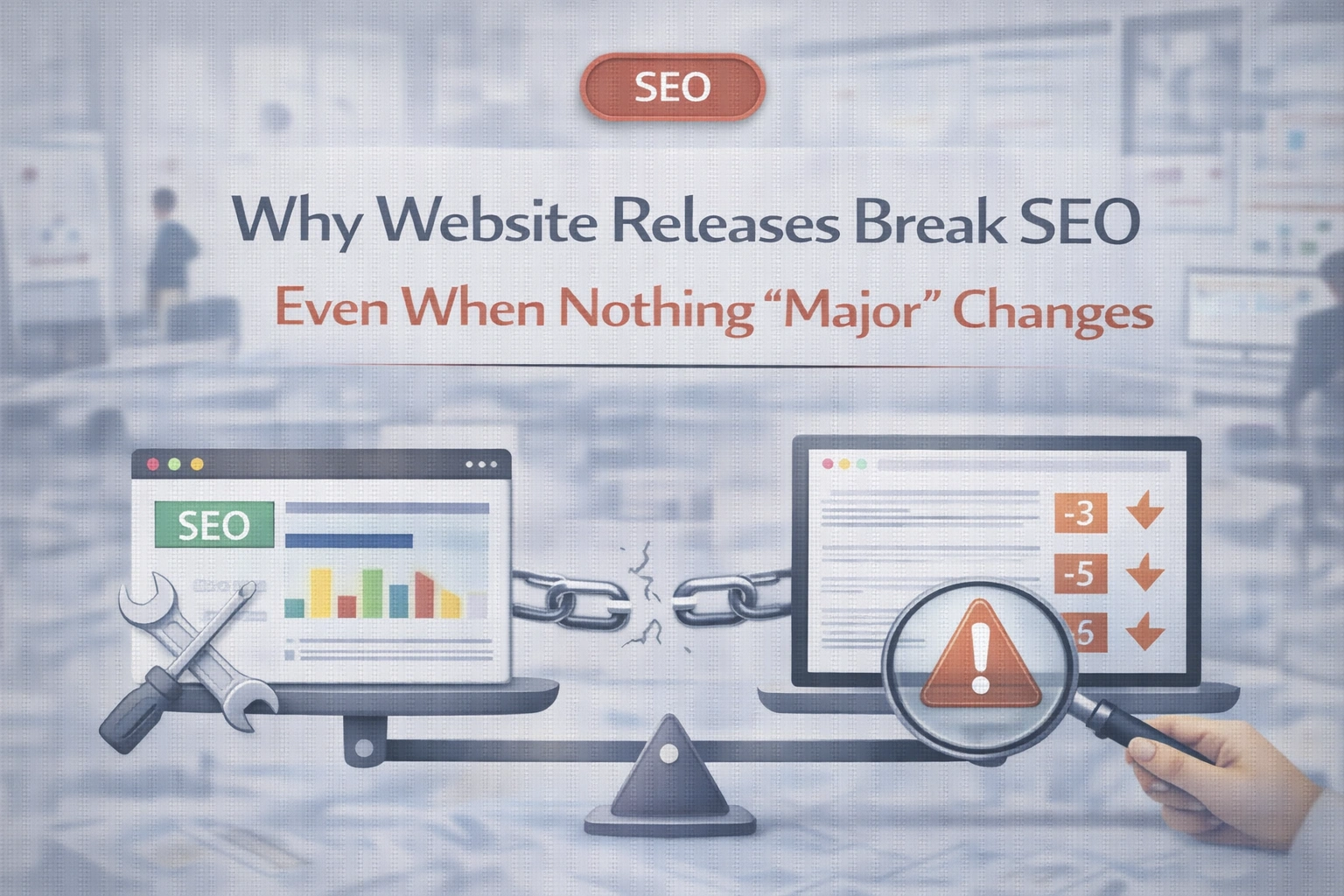
    Why Website Releases Break SEO Even When Nothing “Major” Changes

    Death by small changes and invisible regressions
    yashwant160@gmail.comBy yashwant160@gmail.comFebruary 3, 2026Updated:February 27, 2026No Comments4 Mins Read
    Share Facebook Twitter Pinterest LinkedIn Tumblr Email
    Follow Us
    Google News Flipboard Threads
    Why Website Releases Break SEO Even When Nothing Major Changes 1024x683
    Share
    Facebook Twitter LinkedIn Pinterest Email

    Introduction

    When SEO performance drops after a release, the first question is usually, “What changed?” In many cases, the answer appears to be “nothing important.” No URL changes. No content rewrites. No obvious technical defects. Yet crawl patterns shift, indexation becomes uneven, and rankings erode over time.

    At enterprise scale, SEO rarely breaks because of a single dramatic change. It breaks because of cumulative, low-visibility modifications that alter how search engines experience the system. These changes are often invisible to release notes, dashboards, and even post-release reviews.

    This article explains why “minor” releases routinely cause SEO degradation, how small changes compound into systemic risk, and why mature organizations focus on behavioral impact rather than surface-level change logs.

    The Myth of the “Safe” Release

    Organizations frequently classify releases as safe based on what did not change.

    Common assumptions include:

    • No URLs were added or removed
    • No templates were redesigned
    • No SEO tickets were opened

    These assumptions ignore how search engines interpret behavior rather than intent.

    Search Engines Detect Behavioral Drift, Not Intent

    Search systems observe patterns over time.

    They respond to:

    • Response consistency
    • Rendering reliability
    • Internal link stability

    Small changes that slightly alter these patterns may not trigger alarms internally, but they accumulate externally.

    How Minor Changes Accumulate Into SEO Impact

    Template-Level Drift

    Small template adjustments add scripts, markup variations, or conditional logic. Over multiple releases, shared templates diverge from their original performance and crawl behavior.

    Internal Linking Variance

    Navigation tweaks, related content modules, and conditional links change how authority flows internally. Each change is minor. Together, they reshape priority signals.

    Metadata Inconsistencies

    Minor differences in titles, headings, or structured data across releases introduce ambiguity for search engines evaluating similar pages.

    Performance Micro-Regressions

    Additional JavaScript, delayed resource loading, or new third-party calls may not breach performance thresholds individually. Over time, they degrade rendering and user experience signals.

    Why These Changes Are Hard to Detect

    Most release validation focuses on functional correctness.

    SEO-impacting changes often:

    • Do not cause errors
    • Do not affect all pages
    • Do not appear immediately

    By the time patterns are visible, multiple releases have already contributed.

    The Problem With Release Notes

    Release notes describe what teams believe they changed.

    They rarely capture:

    • Side effects of shared components
    • Behavioral changes under crawl load
    • Interactions between concurrent releases

    SEO impact emerges from these interactions, not from isolated changes.

    Why SEO Impact Is Often Delayed

    Search engines reassess sites gradually.

    After a minor release:

    • Crawl behavior may shift slightly
    • Indexation decisions may become conservative
    • Ranking adjustments may lag weeks or months

    Teams often attribute delayed impact to external factors rather than internal change.

    The Role of Release Frequency

    Frequent releases amplify cumulative risk.

    When small changes ship continuously:

    • Baselines are unclear
    • Cause-and-effect is difficult to isolate
    • Rollback becomes impractical

    SEO degradation becomes a slow-moving trend rather than a discrete incident.

    Why “SEO Didn’t Flag It” Is a Flawed Defense

    SEO teams cannot flag what they cannot see.

    When releases:

    • Bundle multiple small changes
    • Lack of SEO-relevant diffing
    • Ship without search-focused validation

    SEO issues surface only after search engines react.

    Behavioral Baselines Matter More Than Change Lists

    Understanding SEO impact requires knowing how the system normally behaves.

    Baselines should include:

    • Crawl distribution by template
    • Indexation ratios by section
    • Performance profiles for key page types

    Minor releases are risky when they shift behavior away from these baselines.

    Why Rollback Is Rarely Used for “Small” Issues

    Rollback is typically reserved for obvious failures.

    SEO regressions caused by minor changes:

    • Are difficult to attribute to a single release
    • Do not justify immediate rollback politically
    • Persist long enough to cause a lasting impact

    By the time rollback is considered, multiple releases have intervened.

    Designing Releases to Minimize Cumulative SEO Risk

    Mature organizations design releases with accumulation in mind.

    Practices include:

    • Limiting the scope of changes per release
    • Tracking behavioral deltas, not just features
    • Scheduling stabilization windows intentionally

    These practices reduce slow erosion.

    Why SEO Suffers First

    SEO is sensitive to consistency over time.

    While users may tolerate gradual change, search engines adjust cautiously. SEO degradation often signals systemic issues before other metrics do.

    Reframing “Minor” Changes as System Changes

    At scale, there are no truly minor changes.

    Every release alters the system’s observable behavior. The question is whether that change is intentional, measurable, and reversible.

    Conclusion

    Website releases break SEO not because teams make obvious mistakes, but because they underestimate cumulative impact.

    Small changes compound, baselines drift, and search engines respond conservatively. Organizations that focus only on major releases miss the slow degradation happening between them.

    At enterprise scale, protecting SEO is less about preventing big failures and more about controlling the quiet accumulation of small ones.

    Share. Facebook Twitter Pinterest LinkedIn Tumblr Email
    yashwant160@gmail.com
    • Website

    Related Posts

    Release Cadence Versus Stability: Finding the Sustainable Balance

    February 3, 2026

    Release Management for Websites: Coordinating Risk Across Teams

    February 3, 2026

    Release Pipelines and Search Risk: Why Velocity Without Guardrails Breaks Websites

    February 3, 2026
    Leave A Reply Cancel Reply

    Don't Miss

    Personal Branding Without the Cringe: Building Professional Credibility That Actually Works

    yashwant160@gmail.comFebruary 6, 2026

    Personal branding has a reputation problem. Too often, it’s confused with self-promotion, performative posting, or…

    Career Resilience: How to Build a Job That Survives Layoffs, AI, and Market Shifts

    February 6, 2026

    From Individual Contributor to Leader: The Career Shift Most People Get Wrong

    February 6, 2026

    The Non-Linear Career: Why the Best Careers No Longer Follow a Straight Path

    February 6, 2026
    Stay In Touch
    • Facebook
    • Twitter
    • Pinterest
    • Instagram
    • YouTube
    • Vimeo

    Subscribe to Updates

    Get the latest creative news from SmartMag about art & design.

    About Us

    Results-driven digital professional with 15+ years of experience across Web Operations, Enterprise SEO, and large-scale digital platforms. I specialize in building, scaling, and optimizing complex websites where performance, search visibility, and operational reliability must work together—not in silos. My work sits at the intersection of strategy and execution, translating business goals into systems that teams can actually run.

    Facebook X (Twitter) Pinterest YouTube
    Our Picks

    Personal Branding Without the Cringe: Building Professional Credibility That Actually Works

    February 6, 2026

    Career Resilience: How to Build a Job That Survives Layoffs, AI, and Market Shifts

    February 6, 2026

    From Individual Contributor to Leader: The Career Shift Most People Get Wrong

    February 6, 2026
    Most Popular

    Top 15 popular link building methods you should consider before it’s too late

    March 24, 20180 Views

    Quality Score Demystified: What Actually Improves SEM Performance

    January 31, 20260 Views

    How SEO, SEM, Email, and Paid Social Should Work Together

    February 2, 20260 Views
    © 2026 All rights reserved. Y. K. Thakur.
    • Home
    • Technical SEO
    • World
    • Lifestyle
    • Buy Now

    Type above and press Enter to search. Press Esc to cancel.