
Close Menu
blog.ykthakur.com

    Subscribe to Updates

    Get the latest creative news from FooBar about art, design and business.

    What's Hot

    Personal Branding Without the Cringe: Building Professional Credibility That Actually Works

    February 6, 2026

    Career Resilience: How to Build a Job That Survives Layoffs, AI, and Market Shifts

    February 6, 2026

    From Individual Contributor to Leader: The Career Shift Most People Get Wrong

    February 6, 2026
    Facebook X (Twitter) Instagram
    blog.ykthakur.com
    • Home
    • About Me
    • Case Studies
    • Services
    • Contact Us
    Facebook X (Twitter) Instagram
    Subscribe
    • Blog
    • Search & Growth
      1. SEO
      2. Technical SEO
      3. SEM
      4. Paid Advertisements
      5. View All

      Why SEO Fails Even With the Right Tools and Data

      January 31, 2026

      How to Refresh Old Content Without Losing Rankings

      January 31, 2026

      How to Build a Topic Authority Map for SEO

      January 31, 2026

      E-E-A-T Signals Explained: What Actually Influences Trust and Rankings

      January 31, 2026

      XML Sitemaps at Scale: Signaling Priority, Not Forcing Indexation

      February 3, 2026

      Robots.txt at Scale: Control, Risk, and the Limits of Crawl Directives

      February 3, 2026

      Monitoring, Alerting, and SEO Observability: Seeing Failures Before Traffic Drops

      February 3, 2026

      Migrations, Releases, and SEO Risk: How Technical Changes Break Search at Scale

      February 3, 2026

      Scaling SEM Without Burning Budget

      January 31, 2026

      SEM vs SEO: How Paid Search Should Support Organic Growth

      January 31, 2026

      Quality Score Demystified: What Actually Improves SEM Performance

      January 31, 2026

      Brand vs Non-Brand Search: Budget Allocation Reality

      January 31, 2026

      Personal Branding Without the Cringe: Building Professional Credibility That Actually Works

      February 6, 2026

      Career Resilience: How to Build a Job That Survives Layoffs, AI, and Market Shifts

      February 6, 2026

      From Individual Contributor to Leader: The Career Shift Most People Get Wrong

      February 6, 2026

      The Non-Linear Career: Why the Best Careers No Longer Follow a Straight Path

      February 6, 2026
    • Performance & Infrastructure
      1. Website Performance
      2. Core Web Vitals
      3. Hosting Architecture
      4. Web Application Infrastructure
      5. Load Balancing
      6. View All

      Performance Drift: How Sites Get Slower Without Any One Bad Change

      February 3, 2026

      Why passing scores still hide systemic performance risk

      February 3, 2026

      Performance Monitoring Beyond Core Web Vitals

      February 3, 2026

      Personal Branding Without the Cringe: Building Professional Credibility That Actually Works

      February 6, 2026

      Career Resilience: How to Build a Job That Survives Layoffs, AI, and Market Shifts

      February 6, 2026

      From Individual Contributor to Leader: The Career Shift Most People Get Wrong

      February 6, 2026

      The Non-Linear Career: Why the Best Careers No Longer Follow a Straight Path

      February 6, 2026
    • AI & Automation
      1. AI Content Systems
      2. AI in SEO & Marketing
      3. AI Search Analysis
      4. AI-Driven SEO Workflows
      5. Generative AI Strategy
      6. View All

      AI Content Systems: How to Scale Without Losing Quality or Trust

      February 3, 2026

      AI in Marketing Is a System, Not a Toolset

      February 3, 2026

      SEO in a Zero-Click World: Designing for AI Answers and Visibility

      February 3, 2026

      AI Search Analysis: How LLMs Interpret and Surface Content

      February 3, 2026

      Using AI for Technical SEO Analysis Without Breaking Trust

      February 3, 2026

      AI-Driven SEO Workflows: What to Automate and What Not To

      February 3, 2026

      SEO in a Zero-Click World: Designing for AI Answers and Visibility

      February 3, 2026

      AI Search Analysis: How LLMs Interpret and Surface Content

      February 3, 2026

      Using AI for Technical SEO Analysis Without Breaking Trust

      February 3, 2026

      AI-Driven SEO Workflows: What to Automate and What Not To

      February 3, 2026

      Why Most AI SEO Implementations Fail

      February 3, 2026

      Human-in-the-Loop SEO: Where AI Stops and Judgment Starts

      February 3, 2026

      Personal Branding Without the Cringe: Building Professional Credibility That Actually Works

      February 6, 2026

      Career Resilience: How to Build a Job That Survives Layoffs, AI, and Market Shifts

      February 6, 2026

      From Individual Contributor to Leader: The Career Shift Most People Get Wrong

      February 6, 2026

      The Non-Linear Career: Why the Best Careers No Longer Follow a Straight Path

      February 6, 2026
    • Analytics & Intelligence
      1. GA4 Architecture
      2. Adobe Analytics
      3. View All

      GA4 vs Adobe Analytics: Choosing the Right Tool for Your Organization

      February 2, 2026

      Consent, Privacy, and Measurement: What Changes After GDPR & GA4

      February 2, 2026

      GA4 Architecture Explained: Designing Events for Real Decisions

      February 2, 2026

      GA4 vs Adobe Analytics: Choosing the Right Tool for Your Organization

      February 2, 2026

      Personal Branding Without the Cringe: Building Professional Credibility That Actually Works

      February 6, 2026

      Career Resilience: How to Build a Job That Survives Layoffs, AI, and Market Shifts

      February 6, 2026

      From Individual Contributor to Leader: The Career Shift Most People Get Wrong

      February 6, 2026

      The Non-Linear Career: Why the Best Careers No Longer Follow a Straight Path

      February 6, 2026
    • WebOps & DevOps
      1. Web Operations
      2. WebOps Roles
      3. Website Migrations & Scaling
      4. Release Management
      5. Monitoring & Alerts
      6. Performance Monitoring
      7. Deployment Automation
      8. View All

      SEO and WebOps Monitoring: Aligning Health Signals Across Systems

      February 3, 2026

      Designing Alerts for WebOps: Signal, Severity, and Actionability

      February 3, 2026

      Why Most Website Monitoring Is Too Late to Be Useful

      February 3, 2026

      Release Cadence Versus Stability: Finding the Sustainable Balance

      February 3, 2026

      Website Migrations at Scale: Why Most Fail Before the First Redirect

      February 3, 2026

      Post-Migration Reality: Why SEO and Performance Losses Persist for Months

      February 3, 2026

      Scaling Websites Without Replatforming: When Migration Is the Wrong Answer

      February 3, 2026

      Release Cadence Versus Stability: Finding the Sustainable Balance

      February 3, 2026

      Why Website Releases Break SEO Even When Nothing “Major” Changes

      February 3, 2026

      Release Management for Websites: Coordinating Risk Across Teams

      February 3, 2026

      Release Pipelines and Search Risk: Why Velocity Without Guardrails Breaks Websites

      February 3, 2026

      SEO and WebOps Monitoring: Aligning Health Signals Across Systems

      February 3, 2026

      Designing Alerts for WebOps: Signal, Severity, and Actionability

      February 3, 2026

      Why Most Website Monitoring Is Too Late to Be Useful

      February 3, 2026

      Feature Flags, Experiments, and the SEO Blast Radius

      February 3, 2026

      Performance Drift: How Sites Get Slower Without Any One Bad Change

      February 3, 2026

      Performance Monitoring Beyond Core Web Vitals

      February 3, 2026

      Designing SEO-Safe Deployment Automation

      February 3, 2026

      Deployment Automation for Websites: What to Automate and What Not To

      February 3, 2026

      Personal Branding Without the Cringe: Building Professional Credibility That Actually Works

      February 6, 2026

      Career Resilience: How to Build a Job That Survives Layoffs, AI, and Market Shifts

      February 6, 2026

      From Individual Contributor to Leader: The Career Shift Most People Get Wrong

      February 6, 2026

      The Non-Linear Career: Why the Best Careers No Longer Follow a Straight Path

      February 6, 2026
    • Project Strategy

      Personal Branding Without the Cringe: Building Professional Credibility That Actually Works

      February 6, 2026

      Career Resilience: How to Build a Job That Survives Layoffs, AI, and Market Shifts

      February 6, 2026

      From Individual Contributor to Leader: The Career Shift Most People Get Wrong

      February 6, 2026

      The Non-Linear Career: Why the Best Careers No Longer Follow a Straight Path

      February 6, 2026

      How to Stay Relevant When Roles Are Changing Faster Than Job Descriptions

      February 6, 2026
    • Web Engineering
      1. Web Development
      2. Web Designing & UX
      3. CMS & Platforms
      4. Web Application Firewall
      5. View All

      Personal Branding Without the Cringe: Building Professional Credibility That Actually Works

      February 6, 2026

      Career Resilience: How to Build a Job That Survives Layoffs, AI, and Market Shifts

      February 6, 2026

      From Individual Contributor to Leader: The Career Shift Most People Get Wrong

      February 6, 2026

      The Non-Linear Career: Why the Best Careers No Longer Follow a Straight Path

      February 6, 2026
    blog.ykthakur.com
    Home»Web Operations»WebOps Is an Operating Model, Not a Support Function
    Web Operations

    WebOps Is an Operating Model, Not a Support Function

    Why high-performing web teams treat WebOps as infrastructure, not ticket resolution Foundations: ownership, SLAs, cross-team alignment
    yashwant160@gmail.comBy yashwant160@gmail.comFebruary 3, 2026Updated:February 5, 2026No Comments4 Mins Read
    Share Facebook Twitter Pinterest LinkedIn Tumblr Email
    Follow Us
    Google News Flipboard Threads
    WebOps Is An Operating Model Not A Support Function 1024x683
    Share
    Facebook Twitter LinkedIn Pinterest Email

    Introduction

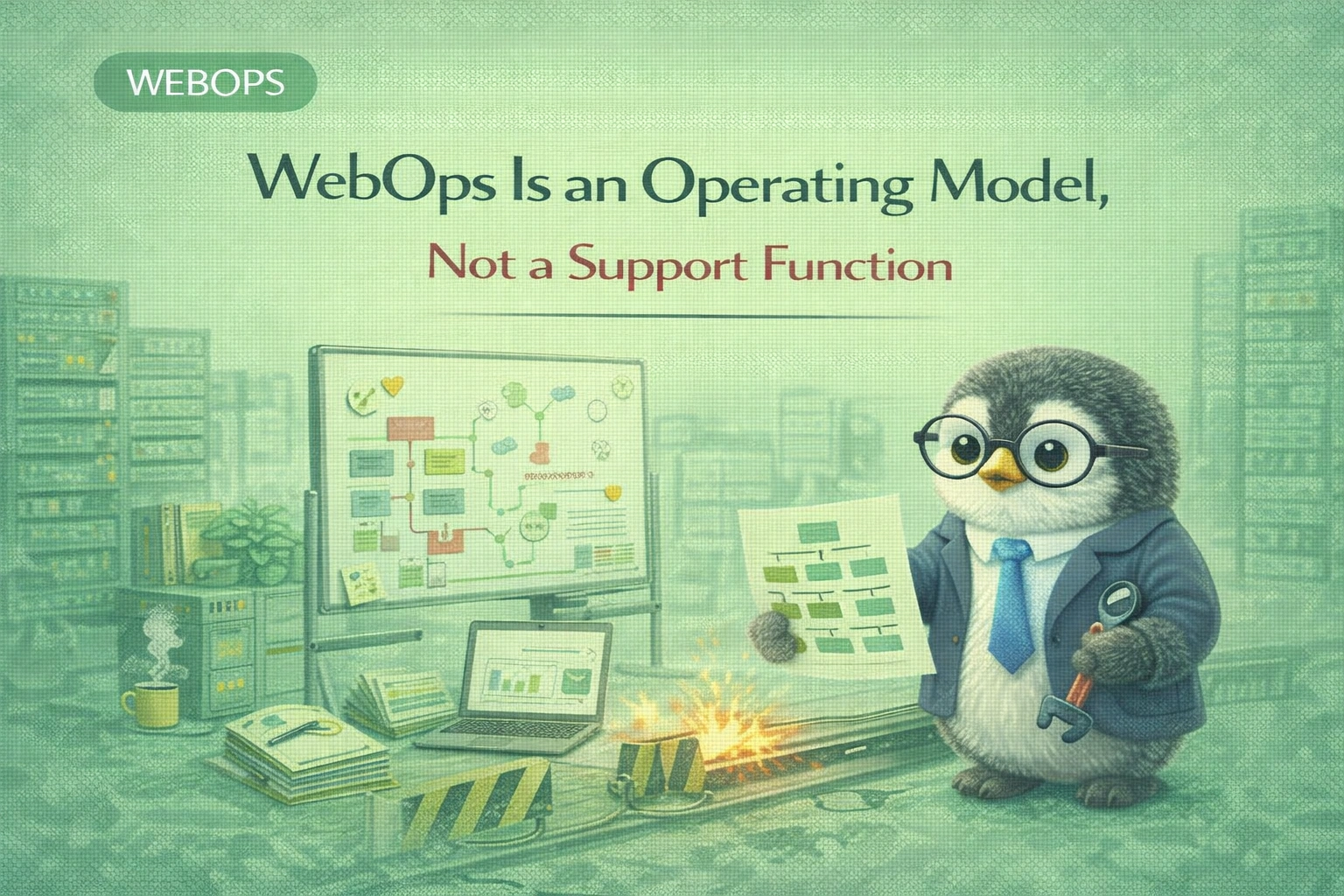
    In many organizations, WebOps is treated as a reactive service layer. Tickets arrive, changes are deployed, incidents are resolved, and the cycle repeats. This framing positions WebOps as a cost center rather than as infrastructure.

    At enterprise scale, this model breaks down. Websites are no longer static assets or marketing channels. They are production systems that support revenue, brand trust, customer experience, and search visibility simultaneously. When WebOps is reduced to support, reliability becomes accidental.

    High-performing organizations treat WebOps as an operating model. It defines how changes flow, how risk is managed, and how accountability is enforced across engineering, marketing, and product teams.

    Why the Support Model Fails at Scale

    The support model assumes that problems are discrete and solvable through intervention. This assumption does not hold for large, continuously evolving web platforms.

    Common symptoms of the support mindset include:

    • Prioritization driven by ticket volume rather than business impact
    • Reactive fixes without root-cause analysis
    • WebOps teams acting as intermediaries instead of owners

    As sites grow more complex, this approach increases operational noise while reducing predictability.

    WebOps as a System of Constraints

    An operating model does not optimize for speed alone. It optimizes for controlled change.

    In a mature WebOps model, constraints are intentional:

    • Defined deployment paths
    • Clear ownership boundaries
    • Explicit risk classification for changes

    These constraints reduce the probability of failure and make outcomes repeatable.

    The Cost of Undefined Ownership

    Web platforms sit at the intersection of multiple teams. Engineering the ship’s code. Marketing owns content. Product defines experience. When ownership is unclear, WebOps becomes the default escalation point.

    This leads to:

    • Delayed decisions
    • Unclear accountability during incidents
    • Inconsistent standards across teams

    An operating model defines who decides, who executes, and who is accountable at every stage.

    WebOps Is About Flow, Not Tasks

    Support-oriented teams focus on tasks. Operating models focus on flow.

    Flow includes:

    • How changes are proposed
    • How they are reviewed and validated
    • How they are released and monitored

    When flow is broken, even small changes create outsized risk.

    Why Speed Without Structure Creates Instability

    Organizations often equate DevOps maturity with deployment velocity. This is a partial view.

    Without structure:

    • Fast releases mask regressions
    • Rollback becomes difficult or is avoided
    • Search, performance, and accessibility issues surface late

    WebOps operating models emphasize safe speed, not raw speed.

    WebOps as Risk Management

    Every website change introduces risk. The difference between mature and immature organizations is not risk tolerance, but risk awareness.

    A system-oriented WebOps model:

    • Classifies changes by blast radius
    • Applies different validation standards by risk level
    • Plans rollback paths before deployment

    This shifts WebOps from firefighting to prevention.

    Why SEO and Performance Depend on WebOps

    Search engines and users experience the output of WebOps decisions, not intentions.

    Crawl reliability, indexation stability, and performance consistency are all consequences of:

    • Deployment discipline
    • Configuration management
    • Change governance

    When WebOps is weak, SEO and performance teams compensate reactively, often without lasting success.

    SLAs Are Not an Operating Model

    Service-level agreements are often used to formalize WebOps expectations. They define response times, not outcomes.

    An operating model goes further by defining:

    • Acceptable failure modes
    • Decision authority during incidents
    • Criteria for change readiness

    SLAs without systems create accountability theater.

    What Mature WebOps Organizations Do Differently

    Organizations with strong WebOps operating models share consistent patterns.

    • WebOps participates early in planning, not just execution
    • Standards are documented and enforced automatically
    • Post-incident reviews focus on systems, not individuals

    This maturity reduces dependency on heroics and tribal knowledge.

    WebOps as an Enabler, Not a Gatekeeper

    A common fear is that stronger WebOps governance slows teams down.

    In practice, the opposite is true. Predictable systems reduce friction by:

    • Eliminating ambiguity
    • Reducing rework
    • Increasing confidence in releases

    WebOps enables teams to move faster by making outcomes predictable.

    Designing WebOps for Change, Not Stability Illusions

    Enterprise websites are never stable. They are continuously changing systems.

    Operating models that assume stability collapse under growth. Those who assume change and design for it scale more effectively.

    Conclusion

    WebOps is not a support queue or a delivery function. It is the operating model that determines whether websites are resilient or fragile.

    Organizations that treat WebOps as infrastructure gain control over change, reduce risk, and align engineering execution with business outcomes. Those twhotreat it as support remain reactive, regardless of team size or tooling.

    At scale, the question is not whether you have a WebOps team. It is whether you have a WebOps operating model.

    Share. Facebook Twitter Pinterest LinkedIn Tumblr Email
    yashwant160@gmail.com
    • Website

    Related Posts

    SEO and WebOps Monitoring: Aligning Health Signals Across Systems

    February 3, 2026

    Designing Alerts for WebOps: Signal, Severity, and Actionability

    February 3, 2026

    Why Most Website Monitoring Is Too Late to Be Useful

    February 3, 2026
    Leave A Reply Cancel Reply

    Don't Miss

    Personal Branding Without the Cringe: Building Professional Credibility That Actually Works

    yashwant160@gmail.comFebruary 6, 2026

    Personal branding has a reputation problem. Too often, it’s confused with self-promotion, performative posting, or…

    Career Resilience: How to Build a Job That Survives Layoffs, AI, and Market Shifts

    February 6, 2026

    From Individual Contributor to Leader: The Career Shift Most People Get Wrong

    February 6, 2026

    The Non-Linear Career: Why the Best Careers No Longer Follow a Straight Path

    February 6, 2026
    Stay In Touch
    • Facebook
    • Twitter
    • Pinterest
    • Instagram
    • YouTube
    • Vimeo

    Subscribe to Updates

    Get the latest creative news from SmartMag about art & design.

    About Us

    Results-driven digital professional with 15+ years of experience across Web Operations, Enterprise SEO, and large-scale digital platforms. I specialize in building, scaling, and optimizing complex websites where performance, search visibility, and operational reliability must work together—not in silos. My work sits at the intersection of strategy and execution, translating business goals into systems that teams can actually run.

    Facebook X (Twitter) Pinterest YouTube
    Our Picks

    Personal Branding Without the Cringe: Building Professional Credibility That Actually Works

    February 6, 2026

    Career Resilience: How to Build a Job That Survives Layoffs, AI, and Market Shifts

    February 6, 2026

    From Individual Contributor to Leader: The Career Shift Most People Get Wrong

    February 6, 2026
    Most Popular

    Top 15 popular link building methods you should consider before it’s too late

    March 24, 20180 Views

    Quality Score Demystified: What Actually Improves SEM Performance

    January 31, 20260 Views

    How SEO, SEM, Email, and Paid Social Should Work Together

    February 2, 20260 Views
    © 2026 All rights reserved. Y. K. Thakur.
    • Home
    • Technical SEO
    • World
    • Lifestyle
    • Buy Now

    Type above and press Enter to search. Press Esc to cancel.