

Introduction
As AI becomes embedded across SEO workflows, the conversation often drifts toward automation limits rather than decision responsibility. Teams ask what AI can do, how much can be automated, and how far efficiency can be pushed. These are incomplete questions.
In enterprise SEO, the real risk is not underusing AI. It is delegating judgment to systems that are not designed to carry accountability. Rankings, traffic, and visibility are outcomes of decisions, not outputs of tools. When AI is allowed to make those decisions implicitly, trust erodes internally and externally.
Human-in-the-loop SEO is not a temporary safeguard. It is the operating model that allows AI to scale without compromising strategic intent, brand authority, or search trust.
Why Fully Automated SEO Breaks at Scale
Automation works best in stable, well-defined environments. SEO is neither. Search ecosystems change continuously, intent shifts without notice, and algorithmic signals are often ambiguous even in hindsight.
Fully automated SEO systems fail because they assume clarity where none exists.
Ambiguous Signals Are Treated as Facts
AI systems excel at pattern recognition, but SEO signals are probabilistic. Ranking changes, crawl behavior, and engagement metrics require interpretation. When AI treats correlation as instruction, organizations react to noise instead of strategy.
Context Is Flattened
SEO decisions are rarely isolated. A technical change can affect paid media, analytics integrity, or brand perception. AI systems operating in silos cannot evaluate second-order effects.
Risk Is Invisible Until It Compounds
Automated systems tend to fail quietly. Content quality degrades incrementally. Internal linking becomes mechanically correct but strategically weak. By the time performance drops, the causal chain is difficult to reconstruct.
What Human-in-the-Loop Actually Means
Human-in-the-loop SEO is often misunderstood as manual approval layered on top of automation. This interpretation misses the point.
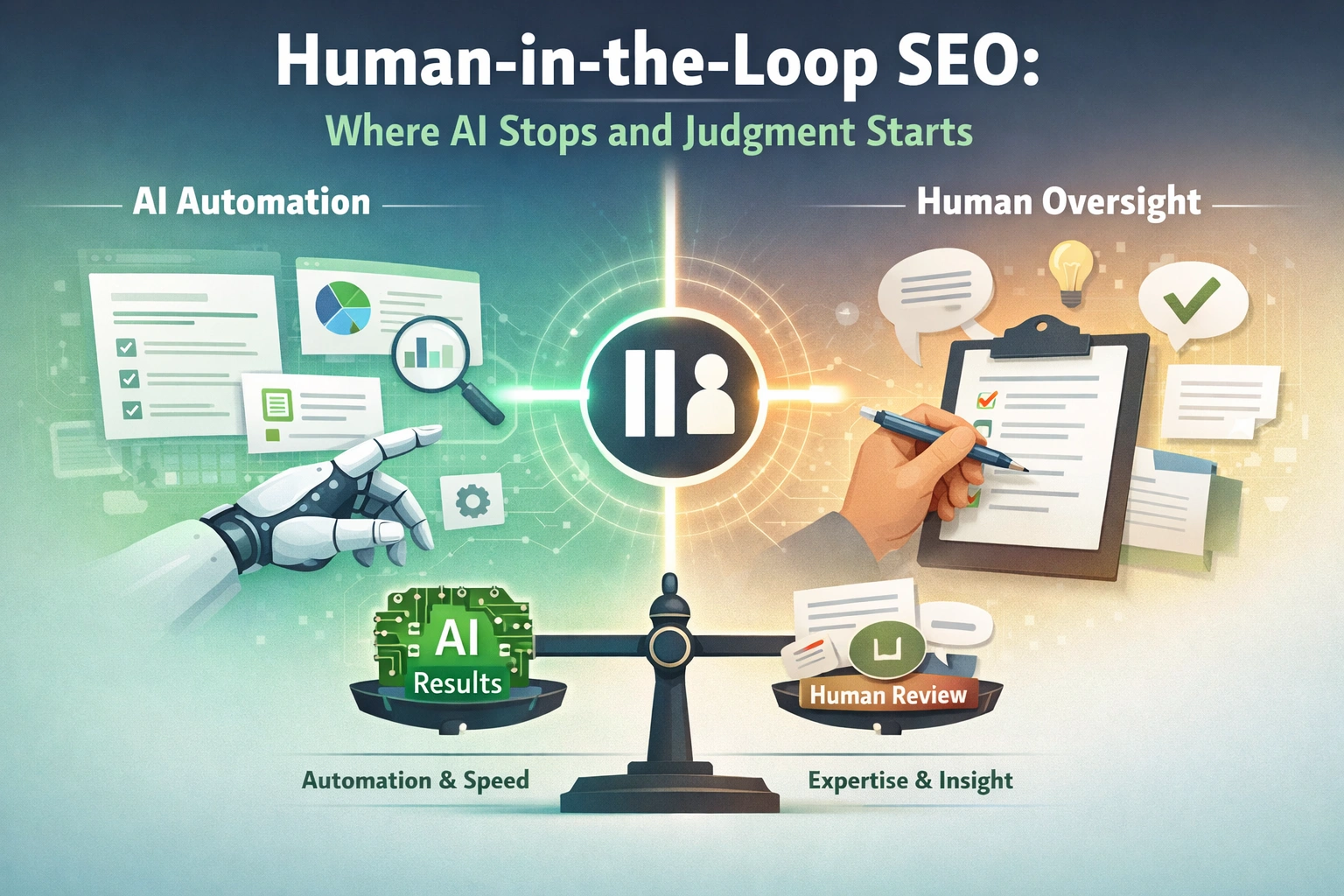
In a mature system, humans are not validators of AI output. They are decision-makers who use AI-generated analysis as structured input.
This distinction matters. Validation implies fixing mistakes. Decision-making implies ownership.
Where AI Adds Leverage in SEO
AI is most effective when it reduces cognitive load without assuming authority. In SEO, this typically occurs upstream of decisions.
Pattern Detection at Scale
AI can surface anomalies in crawl data, internal linking structures, log files, and content performance that humans would not identify manually. These signals accelerate diagnosis but do not replace judgment.
Synthesis of Disparate Inputs
SEO decisions require combining technical data, content performance, user behavior, and business priorities. AI can summarize and structure these inputs, making trade-offs visible.
Scenario Exploration
AI can model potential outcomes of changes, such as site migrations or taxonomy adjustments. These scenarios inform planning but must be evaluated against real constraints.
Where Human Judgment Must Remain Central
There are specific SEO domains where removing humans from the loop introduces unacceptable risk.
Strategic Prioritization
AI can rank opportunities by estimated impact, but it cannot account for organizational readiness, political constraints, or long-term brand goals. Humans must decide what not to pursue.
Content Authority and Positioning
Search visibility is increasingly tied to perceived expertise and trust. Determining whether content aligns with institutional authority is a human responsibility.
Risk Acceptance
Every SEO change carries risk. Deciding how much risk is acceptable, and when, is a business decision, not a technical one.
Designing Human-in-the-Loop SEO Workflows
Effective human-in-the-loop systems are intentional. They do not rely on individuals catching errors. They define where decisions occur.
Clear Decision Boundaries
Workflows should explicitly state which actions AI may recommend, which it may execute, and which require human approval. Ambiguity leads to accidental automation.
Structured Review Criteria
Human reviewers should evaluate outputs against defined criteria such as intent alignment, risk exposure, and system-wide impact. Open-ended reviews waste time and erode confidence.
Documented Rationale
When humans override or approve AI recommendations, the rationale should be recorded. This creates institutional memory and improves future system performance.
Why Human Oversight Improves AI Performance
Human-in-the-loop systems are often framed as a limitation on AI. In practice, they are what allow AI to improve.
Feedback from human decisions refines prompts, rules, and thresholds. Over time, AI outputs align more closely with organizational expectations, reducing friction rather than increasing it.
SEO Trust Depends on Accountability
Search engines reward consistency, accuracy, and authority over time. These qualities emerge from accountable systems.
When humans retain ownership of SEO decisions:
- Content reflects real expertise
- Technical changes are intentional, not reactive
- Performance gains are sustainable
AI supports these outcomes only when it operates within clearly defined limits.
Scaling SEO Without Losing Control
As organizations scale SEO across markets, languages, and properties, centralized control becomes impractical. Human-in-the-loop systems allow decentralization without chaos.
Local teams can act autonomously within governed frameworks, using AI for efficiency while leadership retains strategic oversight.
Conclusion
Human-in-the-loop SEO is not a compromise between automation and control. It is the model that aligns AI capability with business responsibility.
Organizations that remove humans from decision paths gain short-term speed and long-term instability. Those who design AI systems around human judgment build SEO programs that are resilient, trustworthy, and scalable.
The future of SEO is not human versus AI. It is human decisions, informed by AI, executed through systems designed for accountability.
