

Introduction
AI content production rarely fails because organizations move too slowly. It fails because they move too fast without structure. What begins as a controlled experiment to increase output often turns into uncontrolled scale, where quality erodes, trust weakens, and internal teams quietly disengage.
At the enterprise level, content is not just a growth lever. It is a representation of authority, credibility, and institutional knowledge. Once trust is lost, no volume increase can compensate for it. AI content systems must therefore be designed to scale without compromising accuracy, consistency, or accountability.
This requires treating content generation as an operational system, not a production shortcut.
Why AI Content Scaling Commonly Fails
Most AI content failures follow the same trajectory. Early results appear promising. Output increases. Costs drop. Then performance plateaus, editorial friction rises, and stakeholders begin questioning the reliability of what is being published.
The underlying causes are structural, not technical.
Output-First Thinking
Organizations often define success by how much content AI can produce rather than by how content performs or aligns with business goals. This reverses the natural order of content strategy and introduces noise into search, messaging, and brand perception.
Lack of Content Authority Signals
AI-generated content that is not grounded in first-party expertise, documented processes, or validated data lacks authority. At scale, this creates a pattern that search engines and users can detect, even if individual pieces appear acceptable.
Editorial Trust Breakdown
When reviewers repeatedly encounter low-context or misaligned AI drafts, confidence in the system deteriorates. Editors begin bypassing AI or rewriting content entirely, eliminating efficiency gains.
No Clear Accountability
Without defined ownership, AI content becomes everyone’s responsibility and no one’s liability. This creates risk in regulated industries and erodes internal confidence in published assets.
Content Scaling Is a Governance Problem
Scaling content has never been a writing problem. It is a governance problem. AI does not change this reality; it amplifies it.
An AI content system must answer fundamental questions before output is increased:
- What types of content are allowed to scale?
- What level of accuracy and sourcing is required?
- Who validates factual claims and positioning?
- How is consistency enforced across teams?
If these questions are unresolved, AI accelerates inconsistency rather than value.
Defining an AI Content System
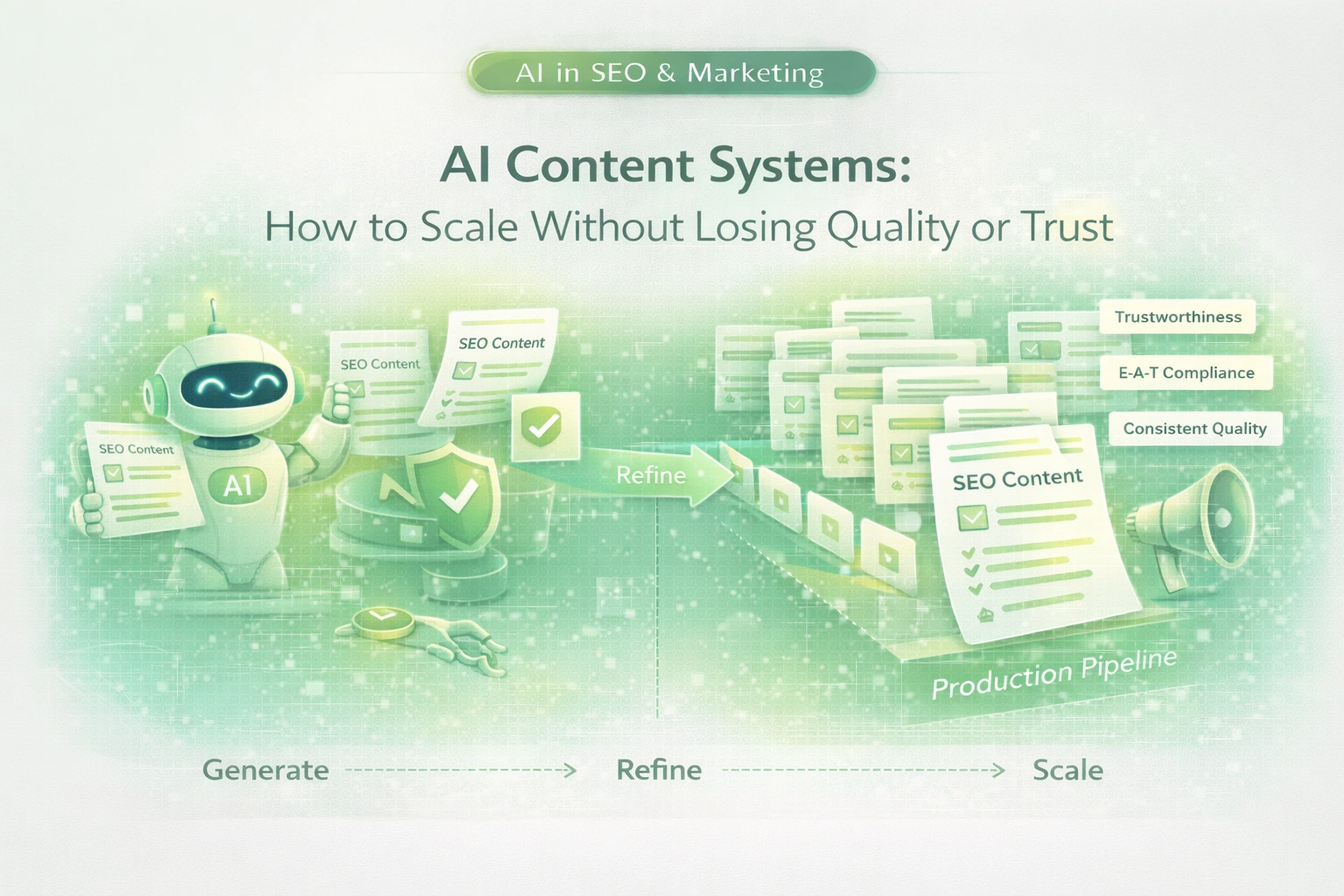
An AI content system is not defined by a single model or platform. It is defined by how content moves from intent to publication under controlled conditions.
A functional system includes:
- Clear content intent definitions
- Documented source-of-truth inputs
- Standardized generation constraints
- Human validation checkpoints
- Performance-based feedback loops
Each component reduces uncertainty and protects trust.
Separating Content Types Before Scaling
One of the most common mistakes is treating all content as equally suitable for AI scale. This is operationally incorrect.
Before scaling, content must be categorized by risk and purpose.
Low-Risk, High-Structure Content
Examples include glossary definitions, support documentation, and process explanations. These formats benefit most from AI assistance because the structure is predictable and validation is straightforward.
Medium-Risk, Insight-Supported Content
This includes SEO-driven educational content and product explainers. AI can assist, but outputs must be grounded in internal expertise, data, and review.
High-Risk, Authority-Defining Content
Thought leadership, strategic analysis, and policy-related content should not be scaled through AI without heavy human authorship. AI may support research synthesis, but not narrative ownership.
Trust Is Built Through Constraints, Not Creativity
A common misconception is that AI content systems should maximize creativity. In enterprise environments, the opposite is true.
Trust emerges from predictability. This requires constraints such as:
- Defined tone and positioning rules
- Approved source types
- Explicit assumptions and exclusions
- Clear audience definitions
These constraints do not limit effectiveness. They create repeatability.
Human Review as a Structural Requirement
Human review is often framed as a safety net. In reality, it is a design requirement.
Effective AI content systems assign humans specific roles:
- Subject-matter validation, not rewriting
- Risk assessment, not stylistic correction
- Final accountability for publication
When human reviewers are expected to “fix” AI content, the system has already failed. Their role is to make decisions, not compensate for missing structure.
Why Quality Degrades Without Feedback Loops
Many AI content systems stagnate because outputs are never evaluated against outcomes. Content is produced, published, and forgotten.
Scaling without feedback guarantees decay.
Feedback signals should include:
- Search performance by intent category
- User engagement and satisfaction indicators
- Editorial revision frequency
- Accuracy corrections over time
These signals must inform prompt updates, content rules, and review thresholds. Without this loop, AI content systems become static and unreliable.
SEO Trust and AI Content
From an SEO perspective, trust is not abstract. It manifests in crawl behavior, ranking stability, and long-term visibility.
Search engines evaluate patterns, not individual pages. Large volumes of shallow or inconsistent AI content weaken site-wide signals, even if some pages perform well.
A system-first approach protects SEO by:
- Maintaining topical coherence
- Preserving internal linking integrity
- Ensuring factual consistency across assets
This is not about avoiding AI detection. It is about avoiding systemic dilution.
Scaling Output Without Scaling Risk
The goal of AI content systems is not maximum production. It is a controlled expansion.
Organizations that succeed scale along three dimensions:
- Volume increases only after validation capacity exists
- New content types are added incrementally
- Governance tightens as output grows
This approach feels slower in the short term. It is significantly faster in the long term.
Designing Content Systems for Longevity
AI models will change. Content standards should not.
A durable AI content system is model-agnostic. It relies on documented inputs, review logic, and performance criteria that persist regardless of technology shifts.
This allows organizations to replace tools without retraining teams or rebuilding trust from scratch.
Conclusion
Scaling content with AI is not a production challenge. It is a systems design challenge.
Organizations that treat AI as an accelerator without governance lose quality and trust at scale. Those that design AI content systems deliberately preserve authority while expanding reach.
The defining question is not how much content AI can produce, but how much trust the system can sustain as output grows.
