
Close Menu
blog.ykthakur.com

    Subscribe to Updates

    Get the latest creative news from FooBar about art, design and business.

    What's Hot

    Personal Branding Without the Cringe: Building Professional Credibility That Actually Works

    February 6, 2026

    Career Resilience: How to Build a Job That Survives Layoffs, AI, and Market Shifts

    February 6, 2026

    From Individual Contributor to Leader: The Career Shift Most People Get Wrong

    February 6, 2026
    Facebook X (Twitter) Instagram
    blog.ykthakur.com
    • Home
    • About Me
    • Case Studies
    • Services
    • Contact Us
    Facebook X (Twitter) Instagram
    Subscribe
    • Blog
    • Search & Growth
      1. SEO
      2. Technical SEO
      3. SEM
      4. Paid Advertisements
      5. View All

      Why SEO Fails Even With the Right Tools and Data

      January 31, 2026

      How to Refresh Old Content Without Losing Rankings

      January 31, 2026

      How to Build a Topic Authority Map for SEO

      January 31, 2026

      E-E-A-T Signals Explained: What Actually Influences Trust and Rankings

      January 31, 2026

      XML Sitemaps at Scale: Signaling Priority, Not Forcing Indexation

      February 3, 2026

      Robots.txt at Scale: Control, Risk, and the Limits of Crawl Directives

      February 3, 2026

      Monitoring, Alerting, and SEO Observability: Seeing Failures Before Traffic Drops

      February 3, 2026

      Migrations, Releases, and SEO Risk: How Technical Changes Break Search at Scale

      February 3, 2026

      Scaling SEM Without Burning Budget

      January 31, 2026

      SEM vs SEO: How Paid Search Should Support Organic Growth

      January 31, 2026

      Quality Score Demystified: What Actually Improves SEM Performance

      January 31, 2026

      Brand vs Non-Brand Search: Budget Allocation Reality

      January 31, 2026

      Personal Branding Without the Cringe: Building Professional Credibility That Actually Works

      February 6, 2026

      Career Resilience: How to Build a Job That Survives Layoffs, AI, and Market Shifts

      February 6, 2026

      From Individual Contributor to Leader: The Career Shift Most People Get Wrong

      February 6, 2026

      The Non-Linear Career: Why the Best Careers No Longer Follow a Straight Path

      February 6, 2026
    • Performance & Infrastructure
      1. Website Performance
      2. Core Web Vitals
      3. Hosting Architecture
      4. Web Application Infrastructure
      5. Load Balancing
      6. View All

      Performance Drift: How Sites Get Slower Without Any One Bad Change

      February 3, 2026

      Why passing scores still hide systemic performance risk

      February 3, 2026

      Performance Monitoring Beyond Core Web Vitals

      February 3, 2026

      Personal Branding Without the Cringe: Building Professional Credibility That Actually Works

      February 6, 2026

      Career Resilience: How to Build a Job That Survives Layoffs, AI, and Market Shifts

      February 6, 2026

      From Individual Contributor to Leader: The Career Shift Most People Get Wrong

      February 6, 2026

      The Non-Linear Career: Why the Best Careers No Longer Follow a Straight Path

      February 6, 2026
    • AI & Automation
      1. AI Content Systems
      2. AI in SEO & Marketing
      3. AI Search Analysis
      4. AI-Driven SEO Workflows
      5. Generative AI Strategy
      6. View All

      AI Content Systems: How to Scale Without Losing Quality or Trust

      February 3, 2026

      AI in Marketing Is a System, Not a Toolset

      February 3, 2026

      SEO in a Zero-Click World: Designing for AI Answers and Visibility

      February 3, 2026

      AI Search Analysis: How LLMs Interpret and Surface Content

      February 3, 2026

      Using AI for Technical SEO Analysis Without Breaking Trust

      February 3, 2026

      AI-Driven SEO Workflows: What to Automate and What Not To

      February 3, 2026

      SEO in a Zero-Click World: Designing for AI Answers and Visibility

      February 3, 2026

      AI Search Analysis: How LLMs Interpret and Surface Content

      February 3, 2026

      Using AI for Technical SEO Analysis Without Breaking Trust

      February 3, 2026

      AI-Driven SEO Workflows: What to Automate and What Not To

      February 3, 2026

      Why Most AI SEO Implementations Fail

      February 3, 2026

      Human-in-the-Loop SEO: Where AI Stops and Judgment Starts

      February 3, 2026

      Personal Branding Without the Cringe: Building Professional Credibility That Actually Works

      February 6, 2026

      Career Resilience: How to Build a Job That Survives Layoffs, AI, and Market Shifts

      February 6, 2026

      From Individual Contributor to Leader: The Career Shift Most People Get Wrong

      February 6, 2026

      The Non-Linear Career: Why the Best Careers No Longer Follow a Straight Path

      February 6, 2026
    • Analytics & Intelligence
      1. GA4 Architecture
      2. Adobe Analytics
      3. View All

      GA4 vs Adobe Analytics: Choosing the Right Tool for Your Organization

      February 2, 2026

      Consent, Privacy, and Measurement: What Changes After GDPR & GA4

      February 2, 2026

      GA4 Architecture Explained: Designing Events for Real Decisions

      February 2, 2026

      GA4 vs Adobe Analytics: Choosing the Right Tool for Your Organization

      February 2, 2026

      Personal Branding Without the Cringe: Building Professional Credibility That Actually Works

      February 6, 2026

      Career Resilience: How to Build a Job That Survives Layoffs, AI, and Market Shifts

      February 6, 2026

      From Individual Contributor to Leader: The Career Shift Most People Get Wrong

      February 6, 2026

      The Non-Linear Career: Why the Best Careers No Longer Follow a Straight Path

      February 6, 2026
    • WebOps & DevOps
      1. Web Operations
      2. WebOps Roles
      3. Website Migrations & Scaling
      4. Release Management
      5. Monitoring & Alerts
      6. Performance Monitoring
      7. Deployment Automation
      8. View All

      SEO and WebOps Monitoring: Aligning Health Signals Across Systems

      February 3, 2026

      Designing Alerts for WebOps: Signal, Severity, and Actionability

      February 3, 2026

      Why Most Website Monitoring Is Too Late to Be Useful

      February 3, 2026

      Release Cadence Versus Stability: Finding the Sustainable Balance

      February 3, 2026

      Website Migrations at Scale: Why Most Fail Before the First Redirect

      February 3, 2026

      Post-Migration Reality: Why SEO and Performance Losses Persist for Months

      February 3, 2026

      Scaling Websites Without Replatforming: When Migration Is the Wrong Answer

      February 3, 2026

      Release Cadence Versus Stability: Finding the Sustainable Balance

      February 3, 2026

      Why Website Releases Break SEO Even When Nothing “Major” Changes

      February 3, 2026

      Release Management for Websites: Coordinating Risk Across Teams

      February 3, 2026

      Release Pipelines and Search Risk: Why Velocity Without Guardrails Breaks Websites

      February 3, 2026

      SEO and WebOps Monitoring: Aligning Health Signals Across Systems

      February 3, 2026

      Designing Alerts for WebOps: Signal, Severity, and Actionability

      February 3, 2026

      Why Most Website Monitoring Is Too Late to Be Useful

      February 3, 2026

      Feature Flags, Experiments, and the SEO Blast Radius

      February 3, 2026

      Performance Drift: How Sites Get Slower Without Any One Bad Change

      February 3, 2026

      Performance Monitoring Beyond Core Web Vitals

      February 3, 2026

      Designing SEO-Safe Deployment Automation

      February 3, 2026

      Deployment Automation for Websites: What to Automate and What Not To

      February 3, 2026

      Personal Branding Without the Cringe: Building Professional Credibility That Actually Works

      February 6, 2026

      Career Resilience: How to Build a Job That Survives Layoffs, AI, and Market Shifts

      February 6, 2026

      From Individual Contributor to Leader: The Career Shift Most People Get Wrong

      February 6, 2026

      The Non-Linear Career: Why the Best Careers No Longer Follow a Straight Path

      February 6, 2026
    • Project Strategy

      Personal Branding Without the Cringe: Building Professional Credibility That Actually Works

      February 6, 2026

      Career Resilience: How to Build a Job That Survives Layoffs, AI, and Market Shifts

      February 6, 2026

      From Individual Contributor to Leader: The Career Shift Most People Get Wrong

      February 6, 2026

      The Non-Linear Career: Why the Best Careers No Longer Follow a Straight Path

      February 6, 2026

      How to Stay Relevant When Roles Are Changing Faster Than Job Descriptions

      February 6, 2026
    • Web Engineering
      1. Web Development
      2. Web Designing & UX
      3. CMS & Platforms
      4. Web Application Firewall
      5. View All

      Personal Branding Without the Cringe: Building Professional Credibility That Actually Works

      February 6, 2026

      Career Resilience: How to Build a Job That Survives Layoffs, AI, and Market Shifts

      February 6, 2026

      From Individual Contributor to Leader: The Career Shift Most People Get Wrong

      February 6, 2026

      The Non-Linear Career: Why the Best Careers No Longer Follow a Straight Path

      February 6, 2026
    blog.ykthakur.com
    Home»AI in SEO & Marketing»AI Content Systems»AI in Marketing Is a System, Not a Toolset
    AI Content Systems

    AI in Marketing Is a System, Not a Toolset

    yashwant160@gmail.comBy yashwant160@gmail.comFebruary 3, 2026Updated:February 26, 2026No Comments6 Mins Read
    Share Facebook Twitter Pinterest LinkedIn Tumblr Email
    Follow Us
    Google News Flipboard Threads
    AI In Marketing Is A System Not A Toolset 1024x683
    Share
    Facebook Twitter LinkedIn Pinterest Email

    Introduction

    Across enterprise marketing organizations, AI adoption has followed a familiar pattern. A team licenses a set of AI tools, experiments with content generation or analysis, sees short-term efficiency gains, and then gradually encounters quality drift, governance issues, and internal mistrust. What initially looked like acceleration turns into fragmentation.

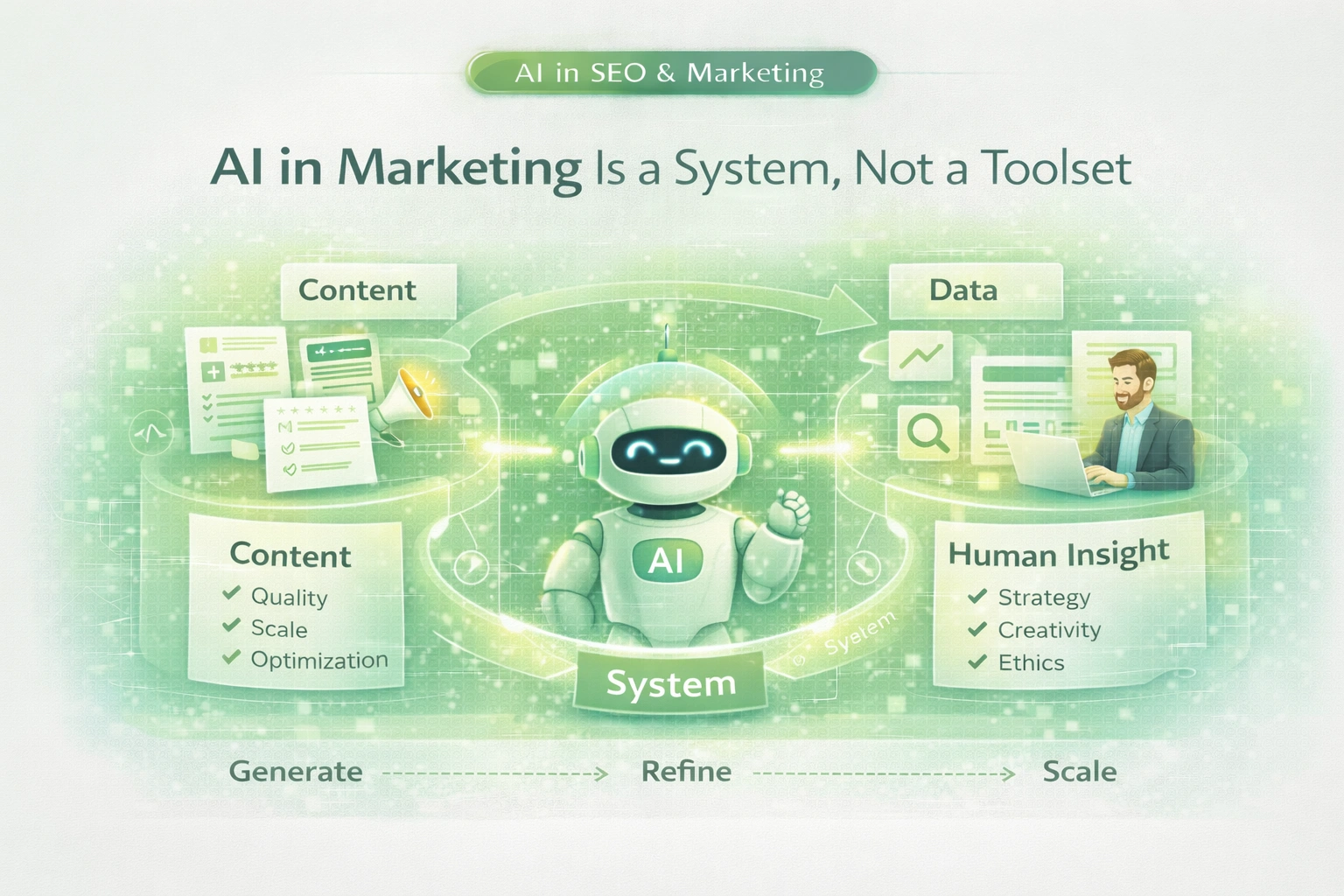
    This failure pattern is not driven by weak technology. It is driven by a structural misunderstanding. AI in marketing is not a collection of tools to be bolted onto existing workflows. It is a system that must be designed, governed, and operated with the same rigor as analytics platforms, CMS architectures, or data pipelines.

    Organizations that treat AI as a system see compounding value over time. Those who treat it as a toolset accumulate hidden risk. This distinction determines whether AI strengthens marketing operations or quietly undermines them.

    The Toolset Mentality: Why It Persists

    The toolset mindset is understandable. Marketing teams are accustomed to solving problems by adding software. Need better keyword research? Add a platform. Need faster content production? Add a generator. Need reporting insights? Add a dashboard.

    AI vendors reinforce this behavior by positioning their products as standalone solutions: write faster, analyze better, optimize smarter. The promise is speed without structural change.

    At a small scale, this works. At enterprise scale, it fails.

    The core issue is that AI does not behave like traditional marketing software. Its outputs are probabilistic, context-sensitive, and highly dependent on inputs, constraints, and feedback loops. When AI tools operate independently, they create inconsistent outputs that cannot be reconciled across teams or channels.

    What Breaks When AI Is Treated as a Tool

    Most AI marketing failures are not dramatic. They are subtle, cumulative, and difficult to trace back to a single decision. Over time, however, they produce measurable damage.

    Inconsistent Brand and Messaging

    Without a centralized system of constraints, different teams prompt AI models differently. The result is fragmented tone, inconsistent positioning, and content that no longer reflects a unified brand voice. Editorial teams notice it first. Customers notice it later.

    Unverifiable Outputs

    When AI outputs are treated as final deliverables rather than system-generated drafts, organizations lose the ability to trace how decisions were made. This becomes a risk in regulated industries, public communications, and SEO claims tied to performance.

    Data Leakage and Context Loss

    Ad hoc AI usage often involves copying internal data, strategies, or performance insights into external tools without clear controls. Even when security risks are minimal, context fragmentation is guaranteed. Each tool operates with partial information and no shared memory.

    Operational Bottlenecks

    Ironically, unstructured AI adoption increases human overhead. Teams spend more time reviewing, correcting, and aligning outputs than they would have spent executing a well-designed system.

    Defining AI as a Marketing System

    A system is not defined by the tools it contains, but by how inputs are transformed into outputs through governed processes. In marketing, this means AI must operate within a clearly defined architecture.

    An AI marketing system includes:

    • Clear objectives tied to business outcomes
    • Defined inputs and data sources
    • Standardized prompts and constraints
    • Human decision checkpoints
    • Feedback loops for continuous improvement

    When these elements are absent, AI produces activity, not progress.

    The Difference Between Tools and Systems

    Understanding the distinction requires reframing how AI is positioned inside the organization.

    Toolset Approach System Approach
    AI used independently by teams AI embedded into governed workflows
    Outputs treated as final Outputs treated as decision inputs
    Success is measured by speed Success is measured by consistency and outcomes
    Little visibility into prompt logic Prompts documented and versioned
    Minimal feedback loops Continuous learning and refinement

    The system approach does not slow teams down. It removes friction by eliminating ambiguity.

    AI Inputs Matter More Than AI Models

    One of the most persistent misconceptions in AI marketing is that model choice is the primary driver of success. In practice, inputs dominate outcomes.

    Inputs include:

    • Audience definitions
    • Brand guidelines
    • Historical performance data
    • SEO constraints and technical limitations
    • Regulatory and legal requirements

    When these inputs are informal or undocumented, AI outputs will reflect that ambiguity. A system-first approach forces organizations to formalize knowledge that previously lived in individuals’ heads.

    Governance Is Not Optional

    Governance is often perceived as bureaucracy. In AI systems, it is operational safety.

    Effective AI governance in marketing answers questions such as:

    • Who is accountable for AI-generated content?
    • What data sources are approved for use?
    • How are prompts reviewed and updated?
    • Where does human approval occur?

    Without governance, AI adoption scales risk faster than value. With governance, AI becomes predictable and auditable.

    Human Judgment as a System Component

    A system-first view does not remove humans from the loop. It defines their role precisely.

    AI excels at pattern recognition, synthesis, and draft generation. It does not understand business nuance, reputational risk, or long-term strategy. Human judgment is not a fallback mechanism; it is a core component of the system.

    High-performing organizations design workflows where humans:

    • Define objectives and constraints
    • Evaluate AI outputs against real-world context
    • Make final prioritization and publication decisions

    This structure preserves trust internally and externally.

    Feedback Loops Create Compounding Value

    The most overlooked aspect of AI systems is feedback. Without it, performance plateaus.

    In marketing, feedback can come from:

    • SEO performance metrics
    • User engagement data
    • Editorial review notes
    • Sales and customer success insights

    When these signals are systematically fed back into prompts, guidelines, and workflows, AI outputs improve over time. This is where AI shifts from cost reduction to strategic advantage.

    Why Systems Scale and Tools Do Not

    Enterprises do not fail at AI because they lack ambition. They fail because unstructured AI cannot survive scale.

    As organizations grow:

    • Teams multiply
    • Channels diversify
    • Risk exposure increases

    Only systems can absorb this complexity. Tools amplify it.

    A well-designed AI marketing system enables:

    • Consistent execution across teams
    • Clear accountability
    • Measurable improvement over time

    Designing for Longevity, Not Novelty

    AI capabilities will continue to evolve. Models will improve. Interfaces will change. Vendors will come and go.

    Organizations that anchor their strategy to tools will repeatedly rebuild. Organizations that anchor to systems will adapt.

    The strategic decision is not which AI tool to adopt, but what role AI plays in the marketing operating model. When that decision is made deliberately, technology becomes an enabler rather than a liability.

    Conclusion

    AI in marketing delivers value only when treated as a system. Tools are replaceable. Systems are durable.

    Enterprises that recognize this distinction early avoid the hidden costs of rework, mistrust, and inconsistency. They build marketing operations that are scalable, governable, and resilient in an AI-driven landscape.

    The question is no longer whether to use AI in marketing. It is whether to design it as infrastructure or experiment with it as a shortcut.

    Share. Facebook Twitter Pinterest LinkedIn Tumblr Email
    yashwant160@gmail.com
    • Website

    Related Posts

    AI Content Systems: How to Scale Without Losing Quality or Trust

    February 3, 2026
    Leave A Reply Cancel Reply

    Don't Miss

    Personal Branding Without the Cringe: Building Professional Credibility That Actually Works

    yashwant160@gmail.comFebruary 6, 2026

    Personal branding has a reputation problem. Too often, it’s confused with self-promotion, performative posting, or…

    Career Resilience: How to Build a Job That Survives Layoffs, AI, and Market Shifts

    February 6, 2026

    From Individual Contributor to Leader: The Career Shift Most People Get Wrong

    February 6, 2026

    The Non-Linear Career: Why the Best Careers No Longer Follow a Straight Path

    February 6, 2026
    Stay In Touch
    • Facebook
    • Twitter
    • Pinterest
    • Instagram
    • YouTube
    • Vimeo

    Subscribe to Updates

    Get the latest creative news from SmartMag about art & design.

    About Us

    Results-driven digital professional with 15+ years of experience across Web Operations, Enterprise SEO, and large-scale digital platforms. I specialize in building, scaling, and optimizing complex websites where performance, search visibility, and operational reliability must work together—not in silos. My work sits at the intersection of strategy and execution, translating business goals into systems that teams can actually run.

    Facebook X (Twitter) Pinterest YouTube
    Our Picks

    Personal Branding Without the Cringe: Building Professional Credibility That Actually Works

    February 6, 2026

    Career Resilience: How to Build a Job That Survives Layoffs, AI, and Market Shifts

    February 6, 2026

    From Individual Contributor to Leader: The Career Shift Most People Get Wrong

    February 6, 2026
    Most Popular

    Top 15 popular link building methods you should consider before it’s too late

    March 24, 20180 Views

    Quality Score Demystified: What Actually Improves SEM Performance

    January 31, 20260 Views

    How SEO, SEM, Email, and Paid Social Should Work Together

    February 2, 20260 Views
    © 2026 All rights reserved. Y. K. Thakur.
    • Home
    • Technical SEO
    • World
    • Lifestyle
    • Buy Now

    Type above and press Enter to search. Press Esc to cancel.