Close Menu
blog.ykthakur.com

    Subscribe to Updates

    Get the latest creative news from FooBar about art, design and business.

    What's Hot

    Personal Branding Without the Cringe: Building Professional Credibility That Actually Works

    February 6, 2026

    Career Resilience: How to Build a Job That Survives Layoffs, AI, and Market Shifts

    February 6, 2026

    From Individual Contributor to Leader: The Career Shift Most People Get Wrong

    February 6, 2026
    Facebook X (Twitter) Instagram
    blog.ykthakur.com
    • Home
    • About Me
    • Case Studies
    • Services
    • Contact Us
    Facebook X (Twitter) Instagram
    Subscribe
    • Blog
    • Search & Growth
      1. SEO
      2. Technical SEO
      3. SEM
      4. Paid Advertisements
      5. View All

      Why SEO Fails Even With the Right Tools and Data

      January 31, 2026

      How to Refresh Old Content Without Losing Rankings

      January 31, 2026

      How to Build a Topic Authority Map for SEO

      January 31, 2026

      E-E-A-T Signals Explained: What Actually Influences Trust and Rankings

      January 31, 2026

      XML Sitemaps at Scale: Signaling Priority, Not Forcing Indexation

      February 3, 2026

      Robots.txt at Scale: Control, Risk, and the Limits of Crawl Directives

      February 3, 2026

      Monitoring, Alerting, and SEO Observability: Seeing Failures Before Traffic Drops

      February 3, 2026

      Migrations, Releases, and SEO Risk: How Technical Changes Break Search at Scale

      February 3, 2026

      Scaling SEM Without Burning Budget

      January 31, 2026

      SEM vs SEO: How Paid Search Should Support Organic Growth

      January 31, 2026

      Quality Score Demystified: What Actually Improves SEM Performance

      January 31, 2026

      Brand vs Non-Brand Search: Budget Allocation Reality

      January 31, 2026

      Personal Branding Without the Cringe: Building Professional Credibility That Actually Works

      February 6, 2026

      Career Resilience: How to Build a Job That Survives Layoffs, AI, and Market Shifts

      February 6, 2026

      From Individual Contributor to Leader: The Career Shift Most People Get Wrong

      February 6, 2026

      The Non-Linear Career: Why the Best Careers No Longer Follow a Straight Path

      February 6, 2026
    • Performance & Infrastructure
      1. Website Performance
      2. Core Web Vitals
      3. Hosting Architecture
      4. Web Application Infrastructure
      5. Load Balancing
      6. View All

      Performance Drift: How Sites Get Slower Without Any One Bad Change

      February 3, 2026

      Why passing scores still hide systemic performance risk

      February 3, 2026

      Performance Monitoring Beyond Core Web Vitals

      February 3, 2026

      Personal Branding Without the Cringe: Building Professional Credibility That Actually Works

      February 6, 2026

      Career Resilience: How to Build a Job That Survives Layoffs, AI, and Market Shifts

      February 6, 2026

      From Individual Contributor to Leader: The Career Shift Most People Get Wrong

      February 6, 2026

      The Non-Linear Career: Why the Best Careers No Longer Follow a Straight Path

      February 6, 2026
    • AI & Automation
      1. AI Content Systems
      2. AI in SEO & Marketing
      3. AI Search Analysis
      4. AI-Driven SEO Workflows
      5. Generative AI Strategy
      6. View All

      AI Content Systems: How to Scale Without Losing Quality or Trust

      February 3, 2026

      AI in Marketing Is a System, Not a Toolset

      February 3, 2026

      SEO in a Zero-Click World: Designing for AI Answers and Visibility

      February 3, 2026

      AI Search Analysis: How LLMs Interpret and Surface Content

      February 3, 2026

      Using AI for Technical SEO Analysis Without Breaking Trust

      February 3, 2026

      AI-Driven SEO Workflows: What to Automate and What Not To

      February 3, 2026

      SEO in a Zero-Click World: Designing for AI Answers and Visibility

      February 3, 2026

      AI Search Analysis: How LLMs Interpret and Surface Content

      February 3, 2026

      Using AI for Technical SEO Analysis Without Breaking Trust

      February 3, 2026

      AI-Driven SEO Workflows: What to Automate and What Not To

      February 3, 2026

      Why Most AI SEO Implementations Fail

      February 3, 2026

      Human-in-the-Loop SEO: Where AI Stops and Judgment Starts

      February 3, 2026

      Personal Branding Without the Cringe: Building Professional Credibility That Actually Works

      February 6, 2026

      Career Resilience: How to Build a Job That Survives Layoffs, AI, and Market Shifts

      February 6, 2026

      From Individual Contributor to Leader: The Career Shift Most People Get Wrong

      February 6, 2026

      The Non-Linear Career: Why the Best Careers No Longer Follow a Straight Path

      February 6, 2026
    • Analytics & Intelligence
      1. GA4 Architecture
      2. Adobe Analytics
      3. View All

      GA4 vs Adobe Analytics: Choosing the Right Tool for Your Organization

      February 2, 2026

      Consent, Privacy, and Measurement: What Changes After GDPR & GA4

      February 2, 2026

      GA4 Architecture Explained: Designing Events for Real Decisions

      February 2, 2026

      GA4 vs Adobe Analytics: Choosing the Right Tool for Your Organization

      February 2, 2026

      Personal Branding Without the Cringe: Building Professional Credibility That Actually Works

      February 6, 2026

      Career Resilience: How to Build a Job That Survives Layoffs, AI, and Market Shifts

      February 6, 2026

      From Individual Contributor to Leader: The Career Shift Most People Get Wrong

      February 6, 2026

      The Non-Linear Career: Why the Best Careers No Longer Follow a Straight Path

      February 6, 2026
    • WebOps & DevOps
      1. Web Operations
      2. WebOps Roles
      3. Website Migrations & Scaling
      4. Release Management
      5. Monitoring & Alerts
      6. Performance Monitoring
      7. Deployment Automation
      8. View All

      SEO and WebOps Monitoring: Aligning Health Signals Across Systems

      February 3, 2026

      Designing Alerts for WebOps: Signal, Severity, and Actionability

      February 3, 2026

      Why Most Website Monitoring Is Too Late to Be Useful

      February 3, 2026

      Release Cadence Versus Stability: Finding the Sustainable Balance

      February 3, 2026

      Website Migrations at Scale: Why Most Fail Before the First Redirect

      February 3, 2026

      Post-Migration Reality: Why SEO and Performance Losses Persist for Months

      February 3, 2026

      Scaling Websites Without Replatforming: When Migration Is the Wrong Answer

      February 3, 2026

      Release Cadence Versus Stability: Finding the Sustainable Balance

      February 3, 2026

      Why Website Releases Break SEO Even When Nothing “Major” Changes

      February 3, 2026

      Release Management for Websites: Coordinating Risk Across Teams

      February 3, 2026

      Release Pipelines and Search Risk: Why Velocity Without Guardrails Breaks Websites

      February 3, 2026

      SEO and WebOps Monitoring: Aligning Health Signals Across Systems

      February 3, 2026

      Designing Alerts for WebOps: Signal, Severity, and Actionability

      February 3, 2026

      Why Most Website Monitoring Is Too Late to Be Useful

      February 3, 2026

      Feature Flags, Experiments, and the SEO Blast Radius

      February 3, 2026

      Performance Drift: How Sites Get Slower Without Any One Bad Change

      February 3, 2026

      Performance Monitoring Beyond Core Web Vitals

      February 3, 2026

      Designing SEO-Safe Deployment Automation

      February 3, 2026

      Deployment Automation for Websites: What to Automate and What Not To

      February 3, 2026

      Personal Branding Without the Cringe: Building Professional Credibility That Actually Works

      February 6, 2026

      Career Resilience: How to Build a Job That Survives Layoffs, AI, and Market Shifts

      February 6, 2026

      From Individual Contributor to Leader: The Career Shift Most People Get Wrong

      February 6, 2026

      The Non-Linear Career: Why the Best Careers No Longer Follow a Straight Path

      February 6, 2026
    • Project Strategy

      Personal Branding Without the Cringe: Building Professional Credibility That Actually Works

      February 6, 2026

      Career Resilience: How to Build a Job That Survives Layoffs, AI, and Market Shifts

      February 6, 2026

      From Individual Contributor to Leader: The Career Shift Most People Get Wrong

      February 6, 2026

      The Non-Linear Career: Why the Best Careers No Longer Follow a Straight Path

      February 6, 2026

      How to Stay Relevant When Roles Are Changing Faster Than Job Descriptions

      February 6, 2026
    • Web Engineering
      1. Web Development
      2. Web Designing & UX
      3. CMS & Platforms
      4. Web Application Firewall
      5. View All

      Personal Branding Without the Cringe: Building Professional Credibility That Actually Works

      February 6, 2026

      Career Resilience: How to Build a Job That Survives Layoffs, AI, and Market Shifts

      February 6, 2026

      From Individual Contributor to Leader: The Career Shift Most People Get Wrong

      February 6, 2026

      The Non-Linear Career: Why the Best Careers No Longer Follow a Straight Path

      February 6, 2026
    blog.ykthakur.com
    Home»Analytics & Data»Why Analytics Fails Without Governance and Ownership
    Analytics & Data

    Why Analytics Fails Without Governance and Ownership

    yashwant160@gmail.comBy yashwant160@gmail.comFebruary 2, 2026Updated:February 5, 2026No Comments4 Mins Read
    Share Facebook Twitter Pinterest LinkedIn Tumblr Email
    Follow Us
    Google News Flipboard Threads
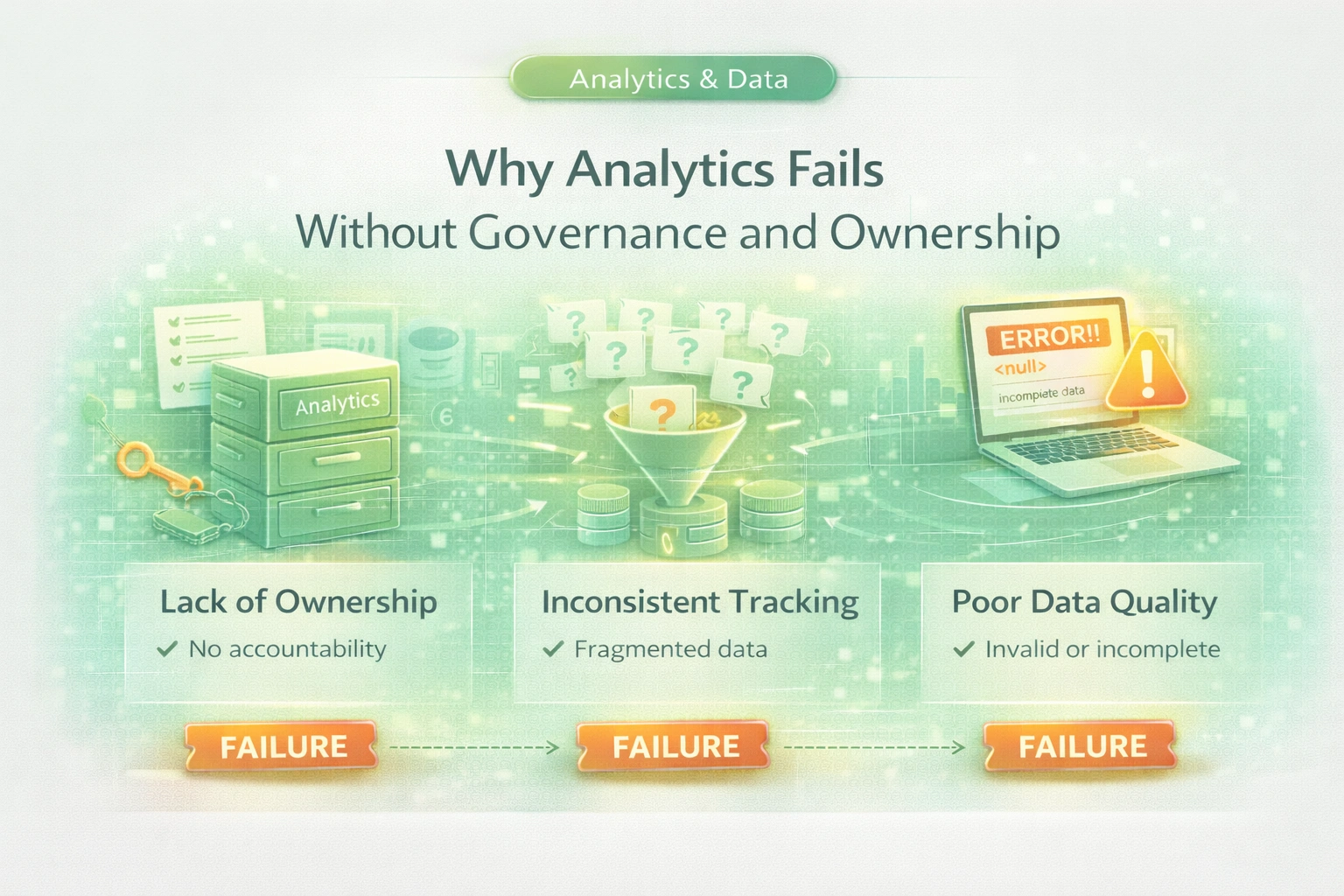
    Why Analytics Fails Without Governance And Ownership 1024x683
    Share
    Facebook Twitter LinkedIn Pinterest Email

    Introduction

    Most analytics failures are not technical. Tags fire, events flow, dashboards update—but confidence is missing. When numbers are questioned, teams argue, and decisions stall. The root cause is almost always the same: analytics exists without governance and ownership. Without clear accountability, measurement systems drift, degrade, and eventually lose trust.

    This article explains why analytics fails without governance and ownership, how unclear responsibility undermines data quality, and how mature organizations design governance models that keep analytics reliable as teams, tools, and complexity grow.

    The Hidden Assumption That Breaks Analytics

    Many organizations assume analytics will “run itself.”

    This assumption shows up as:

    • No single owner of measurement strategy
    • Multiple teams modifying tracking independently
    • Unclear definitions of success
    • No accountability for data accuracy

    Analytics without ownership becomes a shared liability instead of a shared asset.

    What Governance Actually Means in Analytics

    Governance is not bureaucracy.

    In analytics, governance defines:

    • Who decides what gets tracked
    • Who approves changes
    • Who validates data quality
    • Who resolves conflicts

    Governance creates stability as systems scale.

    Why Analytics Breaks Without Ownership

    Without ownership, analytics degrades predictably.

    Common failure patterns

    • Event sprawl with no documentation
    • Inconsistent naming conventions
    • Broken tracking unnoticed for weeks
    • Conflicting dashboards across teams

    No one is accountable—so everyone assumes someone else is.

    The Difference Between Tool Ownership and Data Ownership

    Tool access does not equal ownership.

    Common confusion

    • Marketing owns GA4 access
    • Engineering manages GTM
    • Product defines events

    But no one owns the measurement system end to end.

    True ownership spans strategy, implementation, and validation.

    The Cost of Weak Analytics Governance

    Governance gaps introduce hidden costs.

    Business impacts

    • Delayed or reversed decisions
    • Misallocated budgets
    • Loss of leadership confidence
    • Increased rework and audits

    These costs compound quietly over time.

    What Good Analytics Governance Looks Like

    High-performing organizations design governance intentionally.

    Key characteristics

    • Clear ownership roles
    • Documented standards
    • Controlled change processes
    • Regular audits and reviews

    Governance reduces friction instead of creating it.

    Define Clear Analytics Ownership Roles

    Role Primary Responsibility
    Analytics Owner Measurement strategy and standards
    Engineering Data layer and technical implementation
    Marketing Use cases and optimization feedback
    Legal / Privacy Compliance and consent requirements

    Ownership is about decision rights, not hierarchy.

    Establish a Change Management Process

    Analytics changes are inevitable.

    Governed change includes:

    • Clear request intake
    • Impact assessment
    • Approval before deployment
    • Documentation after release

    Uncontrolled change is the fastest way to lose trust.

    Documentation Is Part of Governance

    Undocumented analytics is ungoverned analytics.

    Essential documentation

    • Measurement plan
    • Event and parameter definitions
    • Data quality rules
    • Known limitations

    Documentation aligns teams around the same reality.

    Audits Prevent Drift

    Even well-governed systems drift over time.

    Regular audits should review:

    • Event relevance
    • Unused or deprecated tracking
    • Consent behavior
    • Data consistency across tools

    Audits reset alignment before problems escalate.

    Governance and Speed Are Not Opposites

    Governance is often blamed for slowing teams down.

    In reality:

    • Clear ownership reduces debate
    • Standards speed implementation
    • Trust accelerates decision-making

    Chaos is slower than structure.

    Common Governance Anti-Patterns

    • Everyone can edit everything
    • No review or rollback process
    • Analytics owned by “whoever has access”
    • Fixing issues only after complaints

    These patterns guarantee instability.

    Real-World Pattern: From Analytics Drift to Stability

    Before

    • Conflicting dashboards
    • Low trust in numbers
    • Decision paralysis

    Changes made

    • Assigned an analytics owner
    • Documented measurement standards
    • Introduced change governance

    After

    • Consistent reporting
    • Faster decisions
    • Restored confidence in data

    Stability came from ownership, not tooling.

    Why Governance Matters More in 2026

    Modern analytics environments increase governance pressure.

    • Server-side tracking adds complexity
    • Privacy regulations tighten
    • AI systems depend on clean data
    • Automation magnifies errors

    Without governance, complexity becomes risk.

    Final Takeaway

    Analytics does not fail because of tools.

    It fails because no one owns it.

    High-performing organizations:

    • Assign clear analytics ownership
    • Design governance intentionally
    • Document and audit regularly
    • Treat analytics as infrastructure

    When analytics has ownership, trust follows—and decisions improve.

    Share. Facebook Twitter Pinterest LinkedIn Tumblr Email
    yashwant160@gmail.com
    • Website

    Related Posts

    Attribution Models Explained: Why Last-Click Still Dominates and Fails

    February 2, 2026

    Data Quality Frameworks: How to Detect Broken Tracking Before It Costs You

    February 2, 2026

    GA4 vs Adobe Analytics: Choosing the Right Tool for Your Organization

    February 2, 2026
    Leave A Reply Cancel Reply

    Don't Miss

    Personal Branding Without the Cringe: Building Professional Credibility That Actually Works

    yashwant160@gmail.comFebruary 6, 2026

    Personal branding has a reputation problem. Too often, it’s confused with self-promotion, performative posting, or…

    Career Resilience: How to Build a Job That Survives Layoffs, AI, and Market Shifts

    February 6, 2026

    From Individual Contributor to Leader: The Career Shift Most People Get Wrong

    February 6, 2026

    The Non-Linear Career: Why the Best Careers No Longer Follow a Straight Path

    February 6, 2026
    Stay In Touch
    • Facebook
    • Twitter
    • Pinterest
    • Instagram
    • YouTube
    • Vimeo

    Subscribe to Updates

    Get the latest creative news from SmartMag about art & design.

    About Us

    Results-driven digital professional with 15+ years of experience across Web Operations, Enterprise SEO, and large-scale digital platforms. I specialize in building, scaling, and optimizing complex websites where performance, search visibility, and operational reliability must work together—not in silos. My work sits at the intersection of strategy and execution, translating business goals into systems that teams can actually run.

    Facebook X (Twitter) Pinterest YouTube
    Our Picks

    Personal Branding Without the Cringe: Building Professional Credibility That Actually Works

    February 6, 2026

    Career Resilience: How to Build a Job That Survives Layoffs, AI, and Market Shifts

    February 6, 2026

    From Individual Contributor to Leader: The Career Shift Most People Get Wrong

    February 6, 2026
    Most Popular

    Top 15 popular link building methods you should consider before it’s too late

    March 24, 20180 Views

    Quality Score Demystified: What Actually Improves SEM Performance

    January 31, 20260 Views

    How SEO, SEM, Email, and Paid Social Should Work Together

    February 2, 20260 Views
    © 2026 All rights reserved. Y. K. Thakur.
    • Home
    • Technical SEO
    • World
    • Lifestyle
    • Buy Now

    Type above and press Enter to search. Press Esc to cancel.