

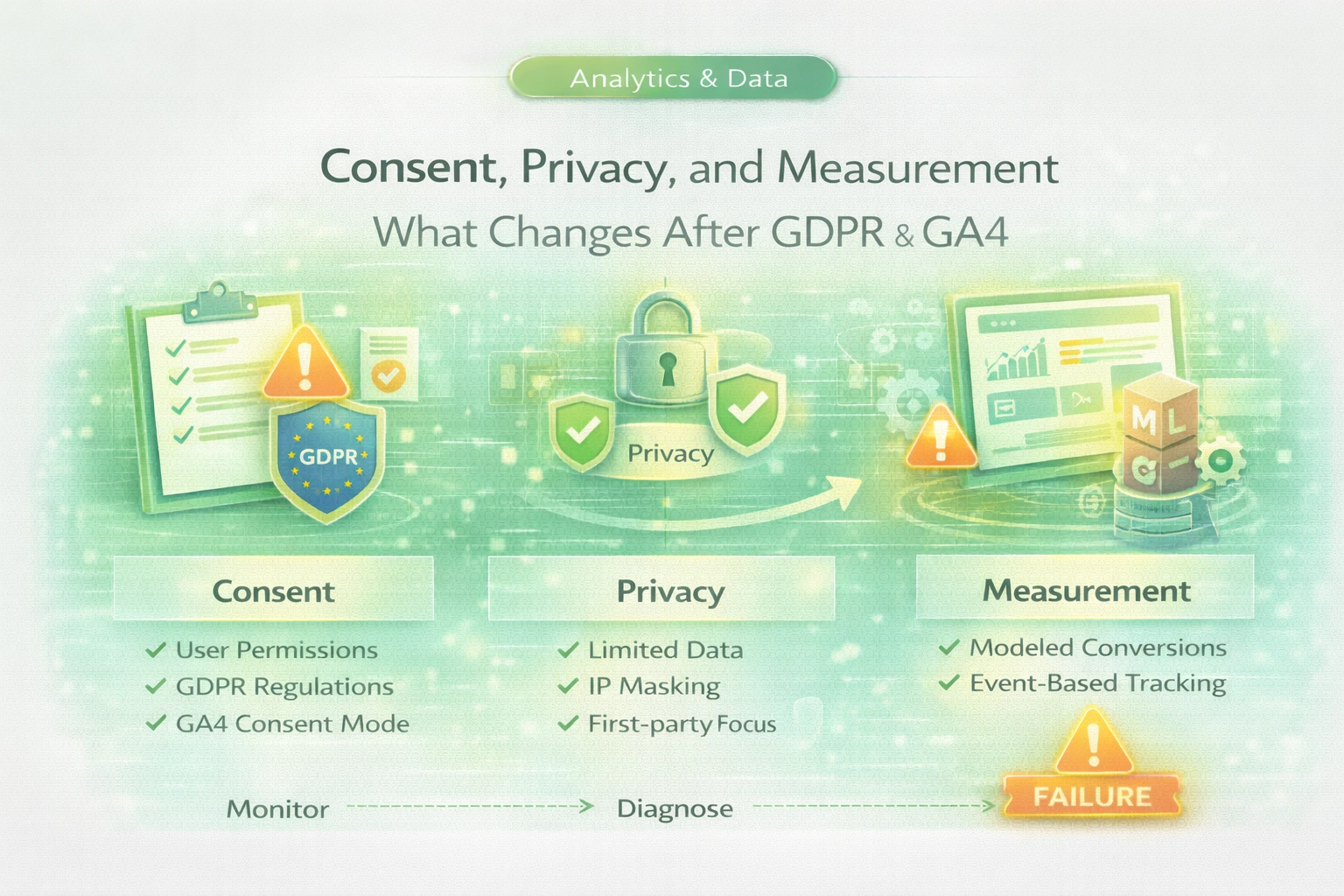
Consent, Privacy, and Measurement: What Changes After GDPR & GA4
Introduction
Privacy did not break analytics—weak measurement design did. Regulations like GDPR, along with browser-level privacy enforcement and GA4’s event-first model, exposed how fragile most analytics setups already were. Consent is now a first-class constraint, not an edge case. Teams that treat it as a legal hurdle rather than a system requirement continue to lose signal, trust, and decision clarity.
This article explains how consent and privacy change measurement after GDPR and GA4, why many analytics implementations silently fail under consent frameworks, and how mature organizations design measurement systems that remain reliable, compliant, and decision-ready.
The Shift: Privacy Is Now Part of Measurement Architecture
Before GDPR, privacy was often handled downstream.
Today, privacy affects:
- What data can be collected
- When it can be collected
- Where it can be sent
- How long can it be stored
Measurement systems that ignore this reality decay quickly.
Why Consent Breaks Traditional Analytics Setups
Most analytics tools were designed for unconditional data flow.
Consent introduces disruption by:
- Blocking scripts before execution
- Delaying tag firing
- Suppressing identifiers
- Creating partial session visibility
If consent logic is bolted on instead of designed in, data becomes fragmented.
What GDPR Actually Changes for Measurement
GDPR does not prohibit analytics.
It requires:
- Purpose limitation
- Data minimization
- User transparency
- Enforceable consent logic
Measurement must justify every data point it collects.
GA4 and Privacy: A Structural Alignment
GA4 was built with privacy constraints in mind.
Key privacy-aligned features
- Event-based data model
- Consent mode integration
- Reduced reliance on cookies
- Modeling instead of raw completeness
GA4 does not solve privacy—but it accommodates it.
The Core Mistake: Treating Consent as a Banner Problem
Consent is often reduced to UI.
Common failures
- Consent banners disconnected from tracking logic
- Tags firing before consent evaluation
- Inconsistent behavior across pages
- No validation of consent states
Consent must control data flow—not just messaging.
Consent States and Their Measurement Impact
| Consent State | Measurement Impact |
|---|---|
| No consent | No identifiers, limited or no events |
| Partial consent | Modeled or anonymized data |
| Full consent | Standard event collection |
Analytics must be interpretable across all states.
Design Measurement for Partial Visibility
Perfect data is no longer realistic.
Modern measurement systems assume:
- Incomplete sessions
- Delayed signals
- Modeled conversions
The goal is directional accuracy, not raw completeness.
Consent Mode: What It Solves and What It Doesn’t
Consent Mode allows tags to adapt behavior based on consent.
It helps by:
- Respecting user choices
- Preserving modeled insights
- Reducing legal risk
It does not:
- Fix poor event design
- Guarantee attribution accuracy
- Replace governance
Consent Mode is infrastructure, not strategy.
Privacy-First Measurement Principles
High-performing teams design for privacy from the start.
Core principles
- Collect only what is needed
- Explain why data is collected
- Enforce consent technically
- Audit regularly
Privacy discipline improves data quality.
Validation Under Consent Constraints
Validation becomes more complex under consent.
Required practices
- Test all consent states
- Verify tag suppression
- Monitor data drops
- Compare modeled vs observed trends
Consent-aware validation preserves trust.
Common Mistakes Teams Make
- Assuming consent tools handle analytics automatically
- Ignoring partial data effects
- Comparing pre- and post-GDPR numbers directly
- Overreacting to short-term drops
Misinterpretation causes more damage than data loss.
Real-World Pattern: From Broken Dashboards to Compliant Clarity
Before
- Inconsistent conversion counts
- Legal and analytics misalignment
- Low confidence in reports
Changes made
- Integrated consent into architecture
- Redefined success metrics
- Trained teams on interpretation
After
- Stable trend analysis
- Lower compliance risk
- Restored trust in data
Clarity came from alignment, not more tracking.
Why Privacy-Aware Measurement Matters More in 2026
Privacy pressure will not reverse.
- Regulation expands globally
- Browsers reduce passive tracking
- Users expect transparency
- AI systems depend on clean inputs
Measurement systems must adapt structurally.
Final Takeaway
Consent is not an obstacle to analytics.
It is a design constraint that forces clarity.
Strong analytics teams:
- Embed privacy into architecture
- Design for partial visibility
- Interpret trends, not absolutes
- Align legal, analytics, and marketing
When privacy is respected by design, measurement becomes
