
Close Menu
blog.ykthakur.com

    Subscribe to Updates

    Get the latest creative news from FooBar about art, design and business.

    What's Hot

    Personal Branding Without the Cringe: Building Professional Credibility That Actually Works

    February 6, 2026

    Career Resilience: How to Build a Job That Survives Layoffs, AI, and Market Shifts

    February 6, 2026

    From Individual Contributor to Leader: The Career Shift Most People Get Wrong

    February 6, 2026
    Facebook X (Twitter) Instagram
    blog.ykthakur.com
    • Home
    • About Me
    • Case Studies
    • Services
    • Contact Us
    Facebook X (Twitter) Instagram
    Subscribe
    • Blog
    • Search & Growth
      1. SEO
      2. Technical SEO
      3. SEM
      4. Paid Advertisements
      5. View All

      Why SEO Fails Even With the Right Tools and Data

      January 31, 2026

      How to Refresh Old Content Without Losing Rankings

      January 31, 2026

      How to Build a Topic Authority Map for SEO

      January 31, 2026

      E-E-A-T Signals Explained: What Actually Influences Trust and Rankings

      January 31, 2026

      XML Sitemaps at Scale: Signaling Priority, Not Forcing Indexation

      February 3, 2026

      Robots.txt at Scale: Control, Risk, and the Limits of Crawl Directives

      February 3, 2026

      Monitoring, Alerting, and SEO Observability: Seeing Failures Before Traffic Drops

      February 3, 2026

      Migrations, Releases, and SEO Risk: How Technical Changes Break Search at Scale

      February 3, 2026

      Scaling SEM Without Burning Budget

      January 31, 2026

      SEM vs SEO: How Paid Search Should Support Organic Growth

      January 31, 2026

      Quality Score Demystified: What Actually Improves SEM Performance

      January 31, 2026

      Brand vs Non-Brand Search: Budget Allocation Reality

      January 31, 2026

      Personal Branding Without the Cringe: Building Professional Credibility That Actually Works

      February 6, 2026

      Career Resilience: How to Build a Job That Survives Layoffs, AI, and Market Shifts

      February 6, 2026

      From Individual Contributor to Leader: The Career Shift Most People Get Wrong

      February 6, 2026

      The Non-Linear Career: Why the Best Careers No Longer Follow a Straight Path

      February 6, 2026
    • Performance & Infrastructure
      1. Website Performance
      2. Core Web Vitals
      3. Hosting Architecture
      4. Web Application Infrastructure
      5. Load Balancing
      6. View All

      Performance Drift: How Sites Get Slower Without Any One Bad Change

      February 3, 2026

      Why passing scores still hide systemic performance risk

      February 3, 2026

      Performance Monitoring Beyond Core Web Vitals

      February 3, 2026

      Personal Branding Without the Cringe: Building Professional Credibility That Actually Works

      February 6, 2026

      Career Resilience: How to Build a Job That Survives Layoffs, AI, and Market Shifts

      February 6, 2026

      From Individual Contributor to Leader: The Career Shift Most People Get Wrong

      February 6, 2026

      The Non-Linear Career: Why the Best Careers No Longer Follow a Straight Path

      February 6, 2026
    • AI & Automation
      1. AI Content Systems
      2. AI in SEO & Marketing
      3. AI Search Analysis
      4. AI-Driven SEO Workflows
      5. Generative AI Strategy
      6. View All

      AI Content Systems: How to Scale Without Losing Quality or Trust

      February 3, 2026

      AI in Marketing Is a System, Not a Toolset

      February 3, 2026

      SEO in a Zero-Click World: Designing for AI Answers and Visibility

      February 3, 2026

      AI Search Analysis: How LLMs Interpret and Surface Content

      February 3, 2026

      Using AI for Technical SEO Analysis Without Breaking Trust

      February 3, 2026

      AI-Driven SEO Workflows: What to Automate and What Not To

      February 3, 2026

      SEO in a Zero-Click World: Designing for AI Answers and Visibility

      February 3, 2026

      AI Search Analysis: How LLMs Interpret and Surface Content

      February 3, 2026

      Using AI for Technical SEO Analysis Without Breaking Trust

      February 3, 2026

      AI-Driven SEO Workflows: What to Automate and What Not To

      February 3, 2026

      Why Most AI SEO Implementations Fail

      February 3, 2026

      Human-in-the-Loop SEO: Where AI Stops and Judgment Starts

      February 3, 2026

      Personal Branding Without the Cringe: Building Professional Credibility That Actually Works

      February 6, 2026

      Career Resilience: How to Build a Job That Survives Layoffs, AI, and Market Shifts

      February 6, 2026

      From Individual Contributor to Leader: The Career Shift Most People Get Wrong

      February 6, 2026

      The Non-Linear Career: Why the Best Careers No Longer Follow a Straight Path

      February 6, 2026
    • Analytics & Intelligence
      1. GA4 Architecture
      2. Adobe Analytics
      3. View All

      GA4 vs Adobe Analytics: Choosing the Right Tool for Your Organization

      February 2, 2026

      Consent, Privacy, and Measurement: What Changes After GDPR & GA4

      February 2, 2026

      GA4 Architecture Explained: Designing Events for Real Decisions

      February 2, 2026

      GA4 vs Adobe Analytics: Choosing the Right Tool for Your Organization

      February 2, 2026

      Personal Branding Without the Cringe: Building Professional Credibility That Actually Works

      February 6, 2026

      Career Resilience: How to Build a Job That Survives Layoffs, AI, and Market Shifts

      February 6, 2026

      From Individual Contributor to Leader: The Career Shift Most People Get Wrong

      February 6, 2026

      The Non-Linear Career: Why the Best Careers No Longer Follow a Straight Path

      February 6, 2026
    • WebOps & DevOps
      1. Web Operations
      2. WebOps Roles
      3. Website Migrations & Scaling
      4. Release Management
      5. Monitoring & Alerts
      6. Performance Monitoring
      7. Deployment Automation
      8. View All

      SEO and WebOps Monitoring: Aligning Health Signals Across Systems

      February 3, 2026

      Designing Alerts for WebOps: Signal, Severity, and Actionability

      February 3, 2026

      Why Most Website Monitoring Is Too Late to Be Useful

      February 3, 2026

      Release Cadence Versus Stability: Finding the Sustainable Balance

      February 3, 2026

      Website Migrations at Scale: Why Most Fail Before the First Redirect

      February 3, 2026

      Post-Migration Reality: Why SEO and Performance Losses Persist for Months

      February 3, 2026

      Scaling Websites Without Replatforming: When Migration Is the Wrong Answer

      February 3, 2026

      Release Cadence Versus Stability: Finding the Sustainable Balance

      February 3, 2026

      Why Website Releases Break SEO Even When Nothing “Major” Changes

      February 3, 2026

      Release Management for Websites: Coordinating Risk Across Teams

      February 3, 2026

      Release Pipelines and Search Risk: Why Velocity Without Guardrails Breaks Websites

      February 3, 2026

      SEO and WebOps Monitoring: Aligning Health Signals Across Systems

      February 3, 2026

      Designing Alerts for WebOps: Signal, Severity, and Actionability

      February 3, 2026

      Why Most Website Monitoring Is Too Late to Be Useful

      February 3, 2026

      Feature Flags, Experiments, and the SEO Blast Radius

      February 3, 2026

      Performance Drift: How Sites Get Slower Without Any One Bad Change

      February 3, 2026

      Performance Monitoring Beyond Core Web Vitals

      February 3, 2026

      Designing SEO-Safe Deployment Automation

      February 3, 2026

      Deployment Automation for Websites: What to Automate and What Not To

      February 3, 2026

      Personal Branding Without the Cringe: Building Professional Credibility That Actually Works

      February 6, 2026

      Career Resilience: How to Build a Job That Survives Layoffs, AI, and Market Shifts

      February 6, 2026

      From Individual Contributor to Leader: The Career Shift Most People Get Wrong

      February 6, 2026

      The Non-Linear Career: Why the Best Careers No Longer Follow a Straight Path

      February 6, 2026
    • Project Strategy

      Personal Branding Without the Cringe: Building Professional Credibility That Actually Works

      February 6, 2026

      Career Resilience: How to Build a Job That Survives Layoffs, AI, and Market Shifts

      February 6, 2026

      From Individual Contributor to Leader: The Career Shift Most People Get Wrong

      February 6, 2026

      The Non-Linear Career: Why the Best Careers No Longer Follow a Straight Path

      February 6, 2026

      How to Stay Relevant When Roles Are Changing Faster Than Job Descriptions

      February 6, 2026
    • Web Engineering
      1. Web Development
      2. Web Designing & UX
      3. CMS & Platforms
      4. Web Application Firewall
      5. View All

      Personal Branding Without the Cringe: Building Professional Credibility That Actually Works

      February 6, 2026

      Career Resilience: How to Build a Job That Survives Layoffs, AI, and Market Shifts

      February 6, 2026

      From Individual Contributor to Leader: The Career Shift Most People Get Wrong

      February 6, 2026

      The Non-Linear Career: Why the Best Careers No Longer Follow a Straight Path

      February 6, 2026
    blog.ykthakur.com
    Home»Analytics & Data»Server-Side Tracking»Server-Side Tracking Explained: When Client-Side Data Breaks
    Server-Side Tracking

    Server-Side Tracking Explained: When Client-Side Data Breaks

    yashwant160@gmail.comBy yashwant160@gmail.comFebruary 2, 2026Updated:February 5, 2026No Comments4 Mins Read
    Share Facebook Twitter Pinterest LinkedIn Tumblr Email
    Follow Us
    Google News Flipboard Threads
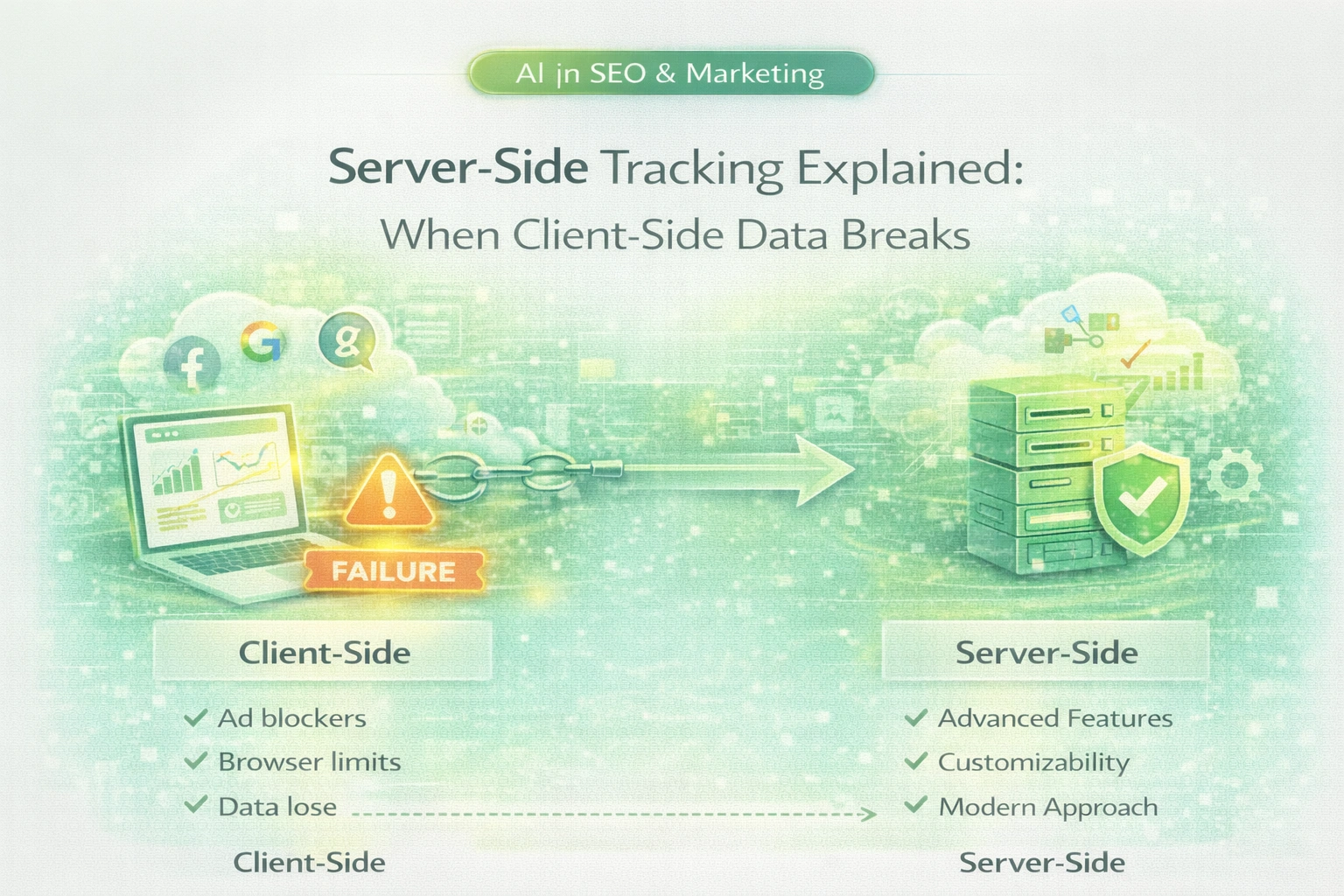
    Server Side Tracking Explained When Client Side Data Breaks 1024x683
    Share
    Facebook Twitter LinkedIn Pinterest Email

    Introduction

    Client-side analytics was never designed for today’s web. Browser restrictions, ad blockers, consent frameworks, and cross-device behavior have quietly eroded the reliability of traditional tracking. While dashboards still populate, the data underneath is increasingly incomplete, delayed, or distorted. Server-side tracking emerged not as a trend, but as a response to this breakdown.

    This article explains what server-side tracking actually is, when client-side data can no longer be trusted, and how organizations should think about server-side measurement as part of a broader analytics architecture—not a silver bullet.

    The Core Problem: Client-Side Tracking Is Losing Signal

    Client-side tracking depends on the browser behaving cooperatively.

    That assumption no longer holds because of:

    • Browser privacy protections
    • Ad and script blockers
    • ITP and ETP limitations
    • Consent-based suppression
    • Network latency and failures

    When data loss happens silently, trust erodes without obvious errors.

    What Server-Side Tracking Actually Means

    Server-side tracking moves part of the data collection process away from the browser.

    Instead of sending data directly from the user’s device to analytics and ad platforms, events are:

    • Collected by a server endpoint you control
    • Validated and enriched centrally
    • Forwarded selectively to third-party tools

    This changes who owns the data flow.

    What Server-Side Tracking Is Not

    Server-side tracking is often misunderstood.

    It is not:

    • A way to bypass consent requirements
    • A guarantee of perfect data
    • A replacement for client-side tracking
    • A plug-and-play improvement

    It is an architectural shift, not a shortcut.

    When Client-Side Tracking Breaks Down

    Client-side tracking struggles most in specific scenarios.

    High-risk conditions

    • Paid media attribution under privacy restrictions
    • Cross-domain or multi-platform journeys
    • High ad blocker usage audiences
    • Complex consent logic

    In these cases, server-side tracking stabilizes signal—not perfection.

    What Server-Side Tracking Solves Well

    Server-side tracking excels at control and consistency.

    Key advantages

    • Reduced data loss
    • Improved data accuracy
    • Centralized governance
    • Better alignment with privacy frameworks

    It shifts power from the browser to your infrastructure.

    What Server-Side Tracking Does Not Solve

    Some problems remain regardless of architecture.

    Limitations

    • It cannot invent missing user intent
    • It does not fix poor event design
    • It cannot override consent laws
    • It increases operational complexity

    Bad measurement decisions scale faster with server-side setups.

    Common Server-Side Architectures

    Architecture Description Best For
    Server-side GTM Tag forwarding via Google infrastructure Marketing-heavy teams
    Custom server endpoint Fully controlled data pipeline Enterprise & compliance-heavy orgs
    Hybrid model Client + server combined Most mature teams

    Architecture choice should reflect governance maturity.

    How Server-Side Tracking Fits Into GA4

    GA4 supports server-side data collection but does not enforce discipline.

    Key considerations

    • Event schema consistency
    • Parameter validation
    • Deduplication logic
    • Attribution alignment

    Server-side GA4 setups amplify architectural decisions.

    Privacy, Consent, and Server-Side Tracking

    Server-side tracking does not remove compliance obligations.

    In fact, it increases responsibility:

    • Consent enforcement must be explicit
    • Data minimization becomes critical
    • Retention policies must be enforced centrally

    Ownership requires accountability.

    When Server-Side Tracking Makes Sense

    Server-side tracking is justified when:

    • Client-side data loss impacts decisions
    • Paid media attribution is unreliable
    • Governance and validation processes exist
    • Engineering support is available

    It is a maturity decision, not a default.

    Common Mistakes Teams Make

    • Implementing server-side tracking without a measurement plan
    • Mirroring broken client-side events
    • Ignoring validation and monitoring
    • Assuming privacy compliance is automatic

    These mistakes reduce trust instead of improving it.

    Real-World Pattern: From Data Loss to Controlled Signal

    Before

    • Inconsistent conversion counts
    • Attribution disputes
    • Unreliable paid media ROI

    Changes made

    • Introduced hybrid tracking
    • Centralized data validation
    • Aligned consent enforcement

    After

    • More stable reporting
    • Higher confidence in decisions
    • Clearer ownership of data flow

    Stability came from architecture, not tooling.

    Why Server-Side Tracking Matters More in 2026

    Signal loss is accelerating.

    • Browser restrictions continue to expand
    • Privacy regulation tightens
    • AI systems depend on clean inputs
    • Paid media costs increase

    Server-side tracking provides resilience—not immunity.

    Final Takeaway

    Server-side tracking is not about collecting more data.

    It is about regaining control over the data you are allowed to collect.

    High-performing analytics teams:

    • Adopt server-side tracking intentionally
    • Preserve clean event architecture
    • Respect privacy constraints
    • Design for long-term trust

    When client-side tracking breaks, server-side architecture decides what survives.

    Share. Facebook Twitter Pinterest LinkedIn Tumblr Email
    yashwant160@gmail.com
    • Website

    Leave A Reply Cancel Reply

    Don't Miss

    Personal Branding Without the Cringe: Building Professional Credibility That Actually Works

    yashwant160@gmail.comFebruary 6, 2026

    Personal branding has a reputation problem. Too often, it’s confused with self-promotion, performative posting, or…

    Career Resilience: How to Build a Job That Survives Layoffs, AI, and Market Shifts

    February 6, 2026

    From Individual Contributor to Leader: The Career Shift Most People Get Wrong

    February 6, 2026

    The Non-Linear Career: Why the Best Careers No Longer Follow a Straight Path

    February 6, 2026
    Stay In Touch
    • Facebook
    • Twitter
    • Pinterest
    • Instagram
    • YouTube
    • Vimeo

    Subscribe to Updates

    Get the latest creative news from SmartMag about art & design.

    About Us

    Results-driven digital professional with 15+ years of experience across Web Operations, Enterprise SEO, and large-scale digital platforms. I specialize in building, scaling, and optimizing complex websites where performance, search visibility, and operational reliability must work together—not in silos. My work sits at the intersection of strategy and execution, translating business goals into systems that teams can actually run.

    Facebook X (Twitter) Pinterest YouTube
    Our Picks

    Personal Branding Without the Cringe: Building Professional Credibility That Actually Works

    February 6, 2026

    Career Resilience: How to Build a Job That Survives Layoffs, AI, and Market Shifts

    February 6, 2026

    From Individual Contributor to Leader: The Career Shift Most People Get Wrong

    February 6, 2026
    Most Popular

    Top 15 popular link building methods you should consider before it’s too late

    March 24, 20180 Views

    Quality Score Demystified: What Actually Improves SEM Performance

    January 31, 20260 Views

    How SEO, SEM, Email, and Paid Social Should Work Together

    February 2, 20260 Views
    © 2026 All rights reserved. Y. K. Thakur.
    • Home
    • Technical SEO
    • World
    • Lifestyle
    • Buy Now

    Type above and press Enter to search. Press Esc to cancel.