Close Menu
blog.ykthakur.com

    Subscribe to Updates

    Get the latest creative news from FooBar about art, design and business.

    What's Hot

    Personal Branding Without the Cringe: Building Professional Credibility That Actually Works

    February 6, 2026

    Career Resilience: How to Build a Job That Survives Layoffs, AI, and Market Shifts

    February 6, 2026

    From Individual Contributor to Leader: The Career Shift Most People Get Wrong

    February 6, 2026
    Facebook X (Twitter) Instagram
    blog.ykthakur.com
    • Home
    • About Me
    • Case Studies
    • Services
    • Contact Us
    Facebook X (Twitter) Instagram
    Subscribe
    • Blog
    • Search & Growth
      1. SEO
      2. Technical SEO
      3. SEM
      4. Paid Advertisements
      5. View All

      Why SEO Fails Even With the Right Tools and Data

      January 31, 2026

      How to Refresh Old Content Without Losing Rankings

      January 31, 2026

      How to Build a Topic Authority Map for SEO

      January 31, 2026

      E-E-A-T Signals Explained: What Actually Influences Trust and Rankings

      January 31, 2026

      XML Sitemaps at Scale: Signaling Priority, Not Forcing Indexation

      February 3, 2026

      Robots.txt at Scale: Control, Risk, and the Limits of Crawl Directives

      February 3, 2026

      Monitoring, Alerting, and SEO Observability: Seeing Failures Before Traffic Drops

      February 3, 2026

      Migrations, Releases, and SEO Risk: How Technical Changes Break Search at Scale

      February 3, 2026

      Scaling SEM Without Burning Budget

      January 31, 2026

      SEM vs SEO: How Paid Search Should Support Organic Growth

      January 31, 2026

      Quality Score Demystified: What Actually Improves SEM Performance

      January 31, 2026

      Brand vs Non-Brand Search: Budget Allocation Reality

      January 31, 2026

      Personal Branding Without the Cringe: Building Professional Credibility That Actually Works

      February 6, 2026

      Career Resilience: How to Build a Job That Survives Layoffs, AI, and Market Shifts

      February 6, 2026

      From Individual Contributor to Leader: The Career Shift Most People Get Wrong

      February 6, 2026

      The Non-Linear Career: Why the Best Careers No Longer Follow a Straight Path

      February 6, 2026
    • Performance & Infrastructure
      1. Website Performance
      2. Core Web Vitals
      3. Hosting Architecture
      4. Web Application Infrastructure
      5. Load Balancing
      6. View All

      Performance Drift: How Sites Get Slower Without Any One Bad Change

      February 3, 2026

      Why passing scores still hide systemic performance risk

      February 3, 2026

      Performance Monitoring Beyond Core Web Vitals

      February 3, 2026

      Personal Branding Without the Cringe: Building Professional Credibility That Actually Works

      February 6, 2026

      Career Resilience: How to Build a Job That Survives Layoffs, AI, and Market Shifts

      February 6, 2026

      From Individual Contributor to Leader: The Career Shift Most People Get Wrong

      February 6, 2026

      The Non-Linear Career: Why the Best Careers No Longer Follow a Straight Path

      February 6, 2026
    • AI & Automation
      1. AI Content Systems
      2. AI in SEO & Marketing
      3. AI Search Analysis
      4. AI-Driven SEO Workflows
      5. Generative AI Strategy
      6. View All

      AI Content Systems: How to Scale Without Losing Quality or Trust

      February 3, 2026

      AI in Marketing Is a System, Not a Toolset

      February 3, 2026

      SEO in a Zero-Click World: Designing for AI Answers and Visibility

      February 3, 2026

      AI Search Analysis: How LLMs Interpret and Surface Content

      February 3, 2026

      Using AI for Technical SEO Analysis Without Breaking Trust

      February 3, 2026

      AI-Driven SEO Workflows: What to Automate and What Not To

      February 3, 2026

      SEO in a Zero-Click World: Designing for AI Answers and Visibility

      February 3, 2026

      AI Search Analysis: How LLMs Interpret and Surface Content

      February 3, 2026

      Using AI for Technical SEO Analysis Without Breaking Trust

      February 3, 2026

      AI-Driven SEO Workflows: What to Automate and What Not To

      February 3, 2026

      Why Most AI SEO Implementations Fail

      February 3, 2026

      Human-in-the-Loop SEO: Where AI Stops and Judgment Starts

      February 3, 2026

      Personal Branding Without the Cringe: Building Professional Credibility That Actually Works

      February 6, 2026

      Career Resilience: How to Build a Job That Survives Layoffs, AI, and Market Shifts

      February 6, 2026

      From Individual Contributor to Leader: The Career Shift Most People Get Wrong

      February 6, 2026

      The Non-Linear Career: Why the Best Careers No Longer Follow a Straight Path

      February 6, 2026
    • Analytics & Intelligence
      1. GA4 Architecture
      2. Adobe Analytics
      3. View All

      GA4 vs Adobe Analytics: Choosing the Right Tool for Your Organization

      February 2, 2026

      Consent, Privacy, and Measurement: What Changes After GDPR & GA4

      February 2, 2026

      GA4 Architecture Explained: Designing Events for Real Decisions

      February 2, 2026

      GA4 vs Adobe Analytics: Choosing the Right Tool for Your Organization

      February 2, 2026

      Personal Branding Without the Cringe: Building Professional Credibility That Actually Works

      February 6, 2026

      Career Resilience: How to Build a Job That Survives Layoffs, AI, and Market Shifts

      February 6, 2026

      From Individual Contributor to Leader: The Career Shift Most People Get Wrong

      February 6, 2026

      The Non-Linear Career: Why the Best Careers No Longer Follow a Straight Path

      February 6, 2026
    • WebOps & DevOps
      1. Web Operations
      2. WebOps Roles
      3. Website Migrations & Scaling
      4. Release Management
      5. Monitoring & Alerts
      6. Performance Monitoring
      7. Deployment Automation
      8. View All

      SEO and WebOps Monitoring: Aligning Health Signals Across Systems

      February 3, 2026

      Designing Alerts for WebOps: Signal, Severity, and Actionability

      February 3, 2026

      Why Most Website Monitoring Is Too Late to Be Useful

      February 3, 2026

      Release Cadence Versus Stability: Finding the Sustainable Balance

      February 3, 2026

      Website Migrations at Scale: Why Most Fail Before the First Redirect

      February 3, 2026

      Post-Migration Reality: Why SEO and Performance Losses Persist for Months

      February 3, 2026

      Scaling Websites Without Replatforming: When Migration Is the Wrong Answer

      February 3, 2026

      Release Cadence Versus Stability: Finding the Sustainable Balance

      February 3, 2026

      Why Website Releases Break SEO Even When Nothing “Major” Changes

      February 3, 2026

      Release Management for Websites: Coordinating Risk Across Teams

      February 3, 2026

      Release Pipelines and Search Risk: Why Velocity Without Guardrails Breaks Websites

      February 3, 2026

      SEO and WebOps Monitoring: Aligning Health Signals Across Systems

      February 3, 2026

      Designing Alerts for WebOps: Signal, Severity, and Actionability

      February 3, 2026

      Why Most Website Monitoring Is Too Late to Be Useful

      February 3, 2026

      Feature Flags, Experiments, and the SEO Blast Radius

      February 3, 2026

      Performance Drift: How Sites Get Slower Without Any One Bad Change

      February 3, 2026

      Performance Monitoring Beyond Core Web Vitals

      February 3, 2026

      Designing SEO-Safe Deployment Automation

      February 3, 2026

      Deployment Automation for Websites: What to Automate and What Not To

      February 3, 2026

      Personal Branding Without the Cringe: Building Professional Credibility That Actually Works

      February 6, 2026

      Career Resilience: How to Build a Job That Survives Layoffs, AI, and Market Shifts

      February 6, 2026

      From Individual Contributor to Leader: The Career Shift Most People Get Wrong

      February 6, 2026

      The Non-Linear Career: Why the Best Careers No Longer Follow a Straight Path

      February 6, 2026
    • Project Strategy

      Personal Branding Without the Cringe: Building Professional Credibility That Actually Works

      February 6, 2026

      Career Resilience: How to Build a Job That Survives Layoffs, AI, and Market Shifts

      February 6, 2026

      From Individual Contributor to Leader: The Career Shift Most People Get Wrong

      February 6, 2026

      The Non-Linear Career: Why the Best Careers No Longer Follow a Straight Path

      February 6, 2026

      How to Stay Relevant When Roles Are Changing Faster Than Job Descriptions

      February 6, 2026
    • Web Engineering
      1. Web Development
      2. Web Designing & UX
      3. CMS & Platforms
      4. Web Application Firewall
      5. View All

      Personal Branding Without the Cringe: Building Professional Credibility That Actually Works

      February 6, 2026

      Career Resilience: How to Build a Job That Survives Layoffs, AI, and Market Shifts

      February 6, 2026

      From Individual Contributor to Leader: The Career Shift Most People Get Wrong

      February 6, 2026

      The Non-Linear Career: Why the Best Careers No Longer Follow a Straight Path

      February 6, 2026
    blog.ykthakur.com
    Home»Analytics & Data»Google Tag Manager»Event Tracking Without Chaos: How to Design a Clean Measurement Plan
    Google Tag Manager

    Event Tracking Without Chaos: How to Design a Clean Measurement Plan

    yashwant160@gmail.comBy yashwant160@gmail.comFebruary 2, 2026Updated:February 5, 2026No Comments4 Mins Read
    Share Facebook Twitter Pinterest LinkedIn Tumblr Email
    Follow Us
    Google News Flipboard Threads
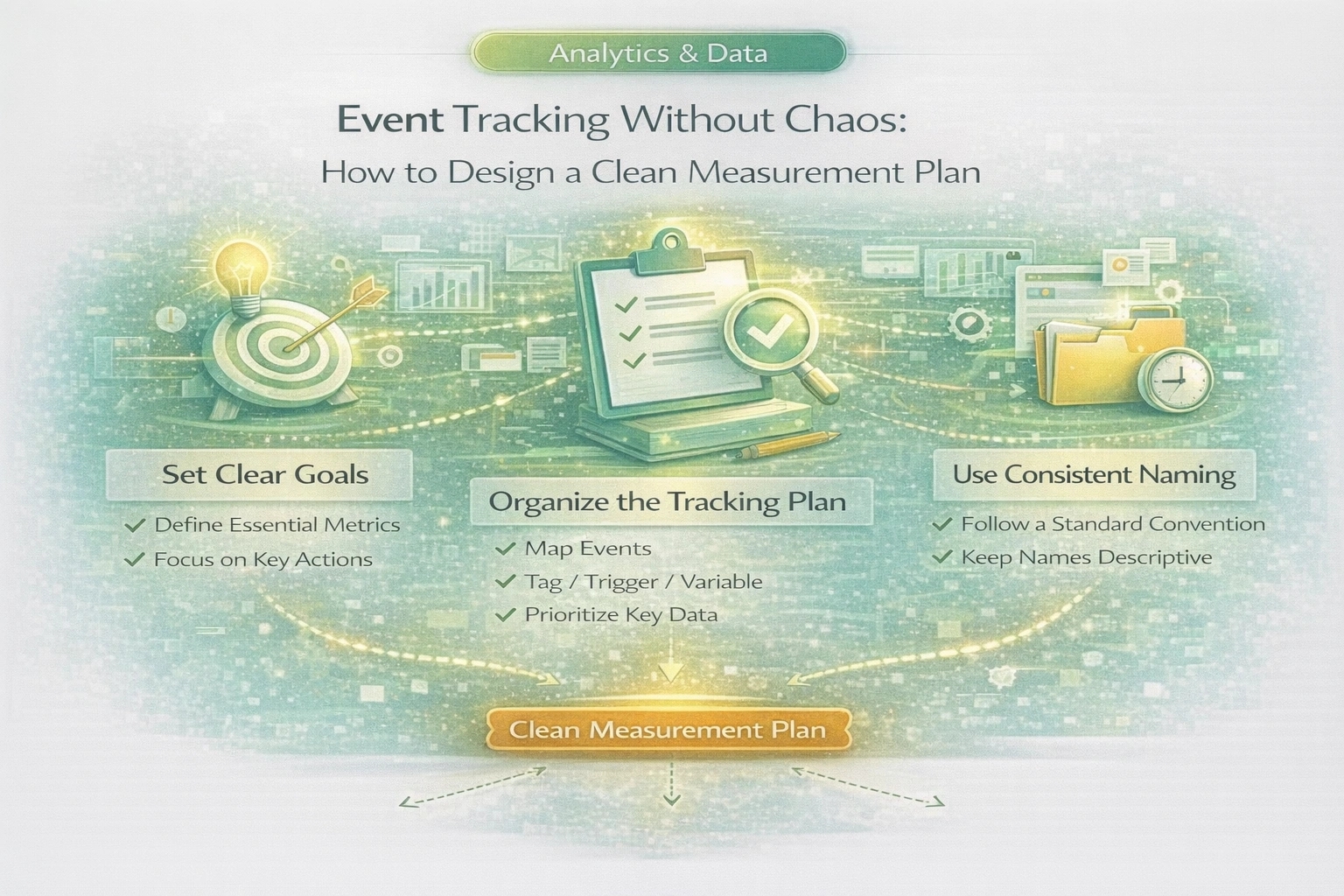
    Event Tracking Without Chaos How To Design A Clean Measurement Plan 1024x683
    Share
    Facebook Twitter LinkedIn Pinterest Email

    Introduction

    Event tracking is where most analytics implementations quietly fall apart. Not because teams don’t track enough—but because they track without structure. Buttons, scrolls, videos, forms, clicks, hovers, and impressions all get recorded, yet very little of it translates into understanding user behavior or improving decisions. The result is a noisy dataset that looks impressive but delivers limited value.

    This article explains how to design a clean, scalable event tracking plan, why most event strategies fail, and how mature organizations create measurement systems that stay understandable as products, funnels, and teams grow.

    The Core Problem: Tracking Everything Instead of Tracking Meaning

    Modern analytics tools make it easy to track almost anything.

    What this usually leads to

    • Hundreds of loosely defined events
    • Inconsistent naming conventions
    • Duplicate or overlapping signals
    • Reports no one fully understands

    When everything is tracked, interpretation becomes impossible.

    Why Event Tracking Breaks at Scale

    Event tracking problems rarely appear immediately.

    They surface when:

    • Multiple teams add events independently
    • UI changes invalidate old logic
    • Funnels evolve but tracking does not
    • Automation depends on unreliable signals

    Without structure, event data degrades over time.

    What a Measurement Plan Actually Is

    A measurement plan is not a list of events.

    It is a documented system that defines:

    • Which user actions matter
    • Why they matter
    • How they are captured
    • How they will be analyzed

    Good plans reduce interpretation. Bad plans create debate.

    Start With Business Questions, Not Events

    Every event should exist to answer a question.

    Examples

    • Where do users hesitate before converting?
    • Which content drives progression?
    • What behaviors predict high-quality leads?

    If an event does not support a question, it does not belong in the plan.

    Define Event Categories by Intent

    Events should reflect user intent, not interface mechanics.

    Intent Category Purpose Example Events
    Discovery Initial exploration content_view, article_read
    Evaluation Comparing options pricing_view, case_study_view
    Commitment Taking action form_submit, demo_request

    Intent-based grouping keeps event libraries understandable.

    Separate Core Events From Supporting Signals

    Not all events deserve equal attention.

    Core events

    • Represent business outcomes
    • Map directly to funnel stages
    • Remain stable over time

    Supporting signals

    • Provide behavioral context
    • Help interpret progression
    • Should never be primary KPIs

    This separation prevents misinterpretation.

    Design Naming Conventions That Scale

    Event names are a long-term commitment.

    Effective naming principles

    • Verb-based (action-oriented)
    • Consistent structure
    • Readable by non-technical teams

    Example structure:

    • verb_object (request_demo)
    • verb_context (view_pricing)

    Poor naming creates permanent confusion.

    Use Parameters to Add Meaning, Not Volume

    Parameters explain how and why an event occurred.

    High-value parameter examples

    • content_type
    • funnel_stage
    • traffic_group
    • lead_category

    Parameters should enrich analysis, not overwhelm it.

    Document the Measurement Plan Clearly

    Undocumented tracking does not scale.

    A complete measurement plan includes

    • Event name
    • Description
    • Trigger condition
    • Parameters
    • Related business question

    Documentation is part of the tracking system.

    Validation Is Not Optional

    Clean plans fail without validation.

    Validation practices

    • Test events in non-production environments
    • Verify parameter values
    • Check event frequency for anomalies
    • Confirm alignment with backend data

    Trust decays quickly without verification.

    Governance Prevents Event Sprawl

    Measurement plans require ownership.

    Governance essentials

    • Defined approval process
    • Limited editors
    • Regular audits
    • Clear change logs

    Without governance, plans collapse under growth.

    Real-World Pattern: From Event Chaos to Clarity

    Before

    • Over 300 events
    • Unclear funnel reporting
    • Conflicting interpretations

    Changes made

    • Reduced event set
    • Grouped by intent
    • Standardized naming
    • Introduced documentation

    After

    • Fewer events
    • Clear analysis paths
    • Higher confidence in data

    Simplicity restored trust.

    Why Clean Measurement Plans Matter More in 2026

    Modern analytics environments raise the cost of chaos.

    • AI systems depend on clean signals
    • Automation magnifies tracking errors
    • Privacy reduces tolerance for waste
    • Leadership demands defensible insights

    Only disciplined plans survive scale.

    Final Takeaway

    Event tracking should reduce uncertainty—not create it.

    Clean measurement plans:

    • Start with decisions
    • Track intent, not noise
    • Separate signals from outcomes
    • Remain understandable over time

    When event tracking is designed properly, analytics becomes a guide instead of a distraction.

    Share. Facebook Twitter Pinterest LinkedIn Tumblr Email
    yashwant160@gmail.com
    • Website

    Related Posts

    Google Tag Manager Strategy: What Should Live in GTM and What Shouldn’t

    February 2, 2026
    Leave A Reply Cancel Reply

    Don't Miss

    Personal Branding Without the Cringe: Building Professional Credibility That Actually Works

    yashwant160@gmail.comFebruary 6, 2026

    Personal branding has a reputation problem. Too often, it’s confused with self-promotion, performative posting, or…

    Career Resilience: How to Build a Job That Survives Layoffs, AI, and Market Shifts

    February 6, 2026

    From Individual Contributor to Leader: The Career Shift Most People Get Wrong

    February 6, 2026

    The Non-Linear Career: Why the Best Careers No Longer Follow a Straight Path

    February 6, 2026
    Stay In Touch
    • Facebook
    • Twitter
    • Pinterest
    • Instagram
    • YouTube
    • Vimeo

    Subscribe to Updates

    Get the latest creative news from SmartMag about art & design.

    About Us

    Results-driven digital professional with 15+ years of experience across Web Operations, Enterprise SEO, and large-scale digital platforms. I specialize in building, scaling, and optimizing complex websites where performance, search visibility, and operational reliability must work together—not in silos. My work sits at the intersection of strategy and execution, translating business goals into systems that teams can actually run.

    Facebook X (Twitter) Pinterest YouTube
    Our Picks

    Personal Branding Without the Cringe: Building Professional Credibility That Actually Works

    February 6, 2026

    Career Resilience: How to Build a Job That Survives Layoffs, AI, and Market Shifts

    February 6, 2026

    From Individual Contributor to Leader: The Career Shift Most People Get Wrong

    February 6, 2026
    Most Popular

    Top 15 popular link building methods you should consider before it’s too late

    March 24, 20180 Views

    Quality Score Demystified: What Actually Improves SEM Performance

    January 31, 20260 Views

    How SEO, SEM, Email, and Paid Social Should Work Together

    February 2, 20260 Views
    © 2026 All rights reserved. Y. K. Thakur.
    • Home
    • Technical SEO
    • World
    • Lifestyle
    • Buy Now

    Type above and press Enter to search. Press Esc to cancel.