

Introduction
Google Tag Manager is one of the most powerful—and most abused—tools in modern analytics stacks. When used correctly, GTM enables speed, control, and clean measurement. When misused, it becomes a dumping ground for scripts, patches, and logic that should never have lived there in the first place. The result is fragile tracking, performance issues, and analytics no one fully trusts.
This article explains what should live in Google Tag Manager and what should not, how to think about GTM as infrastructure instead of convenience, and how mature teams design tagging strategies that scale without chaos.
The Core Problem: GTM Treated as a Shortcut
Many teams adopt GTM to avoid development bottlenecks.
What starts as flexibility often becomes:
- Unreviewed tracking logic
- Inline JavaScript patches
- Business rules embedded in tags
- Critical functionality hidden from version control
GTM is not the problem. Unclear ownership is.
What Google Tag Manager Is Actually Designed For
GTM is a tag orchestration layer.
Its core responsibilities
- Triggering third-party scripts
- Standardizing data sent to analytics platforms
- Managing firing conditions
- Providing deployment flexibility
GTM is not an application logic engine.
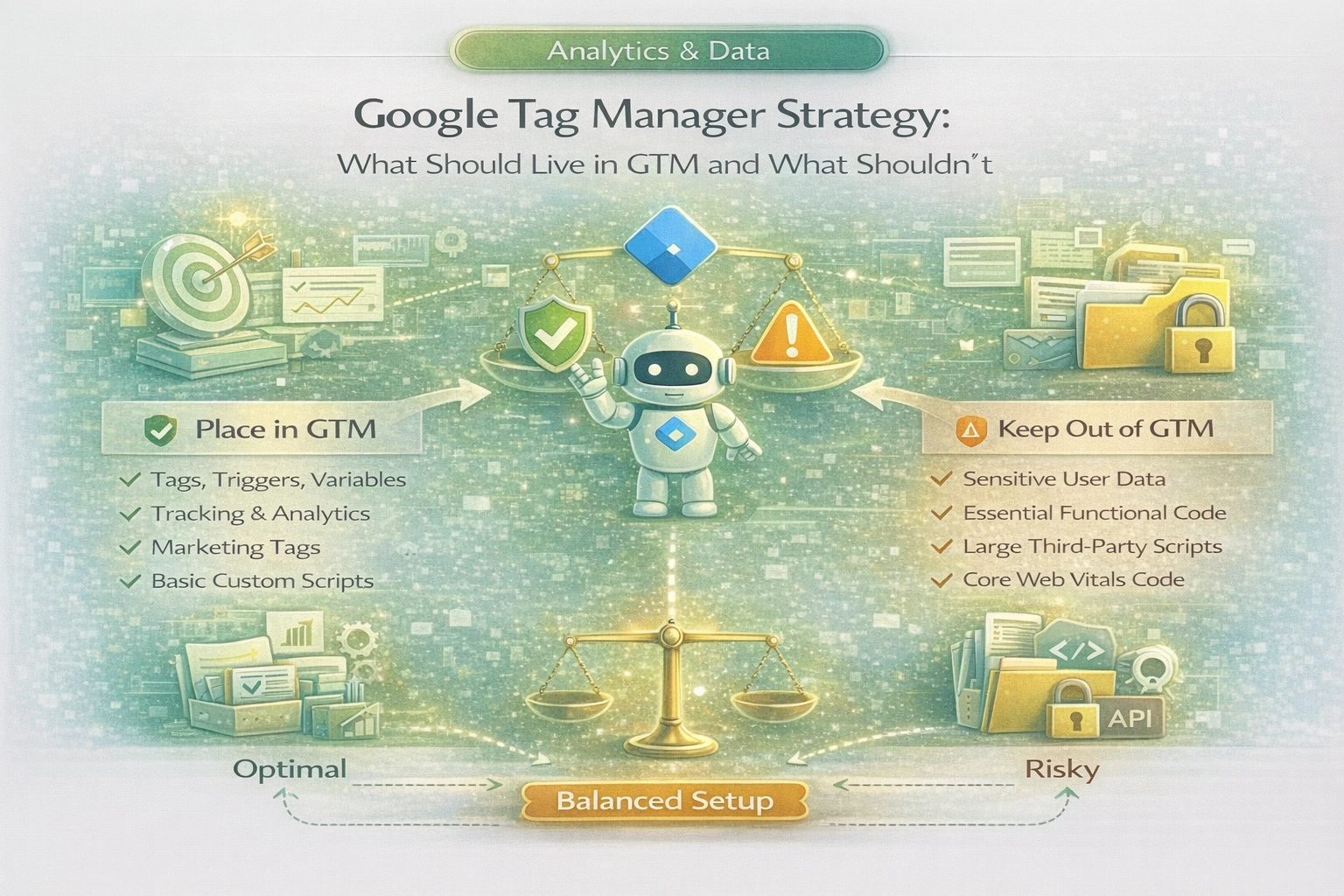
What Should Live in GTM
High-performing teams keep GTM focused and boring.
1. Analytics and Measurement Tags
- GA4 configuration and events
- Ad platform conversion tags
- Remarketing pixels
Measurement belongs in GTM because it needs controlled flexibility.
2. Standardized Event Triggers
- Form submissions
- Defined CTA interactions
- Key navigation behaviors
Triggers should map to intent, not raw clicks.
3. Data Layer Consumption
- Reading structured data layer values
- Passing clean parameters to tools
- Normalizing inputs across platforms
The data layer is the contract. GTM is the messenger.
4. Tag Firing Logic (Not Business Logic)
- When a tag should fire
- Which environment it belongs to
- Consent-based conditions
Firing logic is acceptable. Decision logic is not.
What Should Not Live in GTM
This is where most setups go wrong.
1. Core Business Logic
- Pricing calculations
- Lead qualification rules
- User state determination
If it affects how the product works, it does not belong in GTM.
2. Complex JavaScript Applications
- Large custom scripts
- DOM manipulation for functionality
- Workarounds for missing development work
GTM is not a replacement for engineering.
3. Data Creation Instead of Data Consumption
- Deriving business meaning inside GTM
- Hardcoding values that should come from the app
- Guessing user intent based on DOM structure
When GTM invents data, analytics becomes unreliable.
4. Long-Term State Management
- User lifecycle state
- Account-level attributes
- Persistent segmentation logic
These belong in backend systems or CDPs, not GTM.
The Data Layer: The Most Misunderstood Component
The data layer is not optional infrastructure.
A healthy data layer is:
- Owned by engineering
- Documented
- Version-controlled
- Stable across UI changes
GTM should consume data—not scrape it.
GTM Governance: Why Most Teams Struggle
Without governance, GTM becomes fragile.
Common governance failures
- Too many container editors
- No review or approval process
- No naming conventions
- No change documentation
Every GTM container reflects its governance maturity.
Recommended GTM Ownership Model
| Role | Responsibility |
|---|---|
| Analytics Owner | Measurement strategy and standards |
| Marketing | Request tracking needs |
| Engineering | Data layer implementation |
Clear ownership prevents GTM sprawl.
Environment Strategy: Stop Testing in Production
GTM supports environments for a reason.
Minimum recommended setup
- Development
- Staging
- Production
Testing in production is not agility—it is risk.
Performance and Security Implications
Every GTM tag has a cost.
Hidden risks
- Page performance degradation
- Third-party security exposure
- Increased attack surface
GTM should reduce risk, not introduce it.
Real-World Pattern: From GTM Chaos to Control
Before
- Hundreds of tags
- Unclear firing logic
- Frequent tracking breaks
Changes made
- Defined GTM boundaries
- Introduced governance rules
- Moved logic back to the application
After
- Fewer tags
- Improved performance
- Higher confidence in data
Stability came from restraint.
Why GTM Discipline Matters More in 2026
Modern stacks increase GTM risk:
- Server-side tracking complexity
- Privacy and consent requirements
- Automation depending on clean signals
GTM must act as infrastructure—not a playground.
Final Takeaway
Google Tag Manager is most powerful when it is invisible.
High-performing teams:
- Limit what lives in GTM
- Rely on a clean data layer
- Enforce governance
- Design for long-term stability
When GTM is disciplined, analytics becomes reliable instead of fragile.
