
Introduction
Most digital marketing strategies focus obsessively on acquisition. Traffic grows, leads increase, and dashboards look healthy—yet revenue remains volatile. The missing layer is almost always lifecycle marketing. When teams fail to design for what happens after the first visit or conversion, they are forced to reacquire the same users repeatedly, driving up costs and flattening growth.
This article explains what lifecycle marketing actually is, why it matters more than ever, and how to turn one-time visitors into long-term revenue through intentional post-acquisition systems.
The Core Problem: Acquisition Without Continuity
Many marketing teams operate with a hidden assumption:
“Once someone converts, the job is done.”
In reality, the first conversion is only the beginning.
Symptoms of weak lifecycle marketing
- High churn after initial conversion
- Low repeat engagement
- Heavy dependence on paid acquisition
- Inconsistent revenue forecasting
Without lifecycle thinking, growth resets every month.
What Lifecycle Marketing Actually Means
Lifecycle marketing is the practice of:
- Recognizing where a user is in their relationship with the brand
- Delivering messages appropriate to that stage
- Guiding progression beyond the first action
- Maximizing long-term value instead of short-term wins
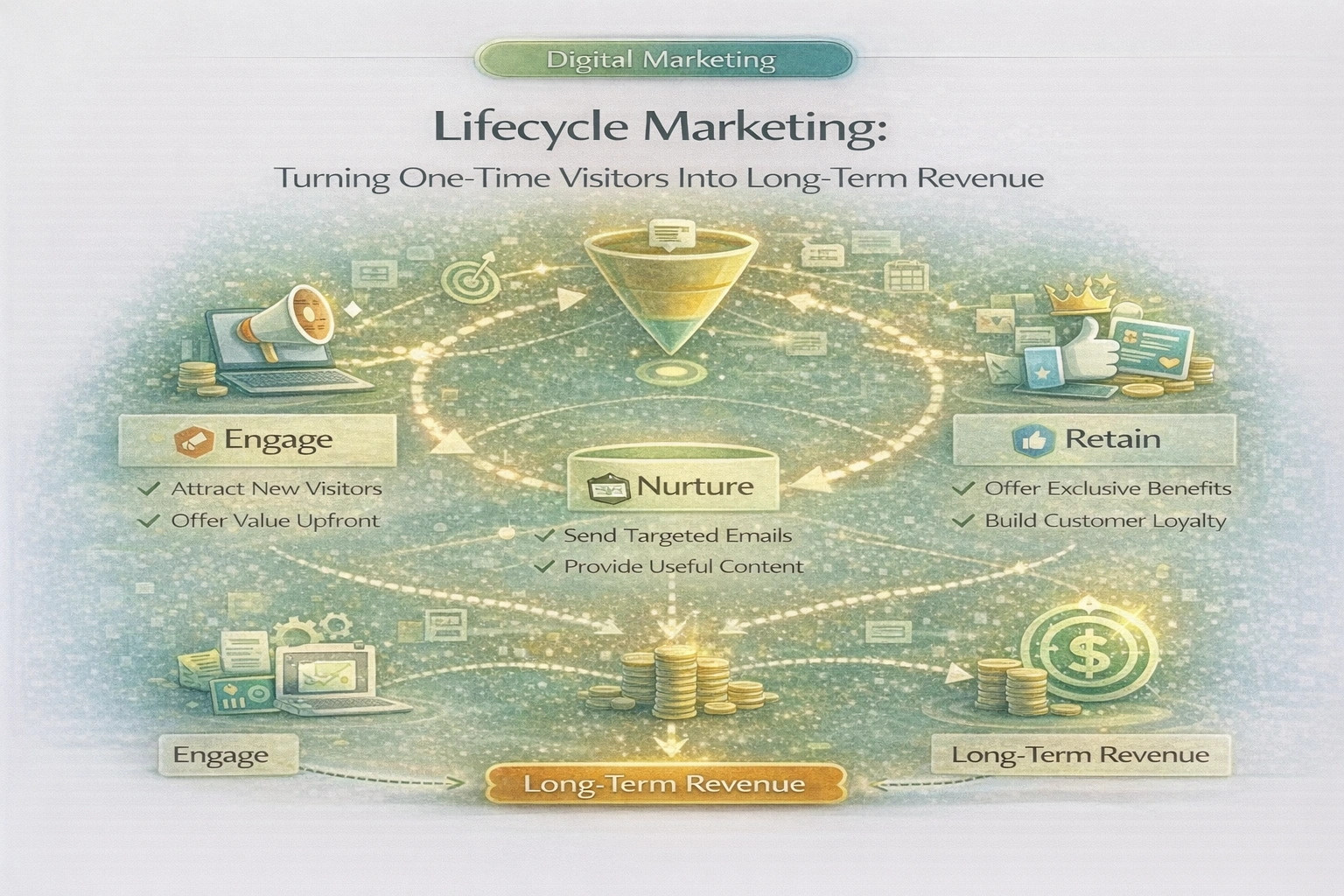
It connects acquisition, engagement, retention, and expansion into one system.
Why Funnels Alone Are Not Enough
Funnels explain how users convert once.
Lifecycle marketing explains why they:
- Return
- Engage deeper
- Upgrade
- Advocate
Funnels close deals. Lifecycle systems build businesses.
Define the Core Lifecycle Stages
Lifecycle stages should be defined by relationship depth, not assumptions.
| Lifecycle Stage | User State | Primary Goal |
|---|---|---|
| First Interaction | Curious, low trust | Clarity and reassurance |
| Initial Conversion | Interested but cautious | Reduce buyer uncertainty |
| Activation | Evaluating value | Demonstrate usefulness |
| Retention | Engaged user | Reinforce relevance |
| Expansion | High trust | Increase lifetime value |
Each stage requires different messaging and support.
Step 1: Design Post-Conversion Experiences Intentionally
Most post-conversion journeys are accidental.
Common mistakes
- No follow-up after conversion
- Generic onboarding
- Immediate upsell pressure
Post-conversion is where trust is either reinforced or broken.
Step 2: Use Behavioral Signals to Drive Lifecycle Messaging
Lifecycle marketing should react to behavior, not time alone.
High-value lifecycle signals
- Repeat visits
- Feature or content usage
- Email engagement patterns
- Periods of inactivity
Behavior reveals intent more accurately than static timelines.
Step 3: Separate Retention From Re-Acquisition
Treating returning users like new leads is expensive.
Why this fails
- Users receive redundant messaging
- Trust resets unnecessarily
- Paid budgets are wasted
Retention systems protect acquisition investments.
Step 4: Build Content for Each Lifecycle Stage
Content should evolve as the relationship deepens.
| Stage | Effective Content Types |
|---|---|
| First Interaction | Educational guides, explainers |
| Activation | Onboarding resources, walkthroughs |
| Retention | Use cases, insights, updates |
| Expansion | Advanced strategies, comparisons |
Lifecycle content sustains relevance beyond the first click.
Step 5: Use Email and Automation to Maintain Continuity
Email and automation are core lifecycle tools.
They work best when they:
- Reference past actions
- Acknowledge relationship history
- Adjust cadence based on engagement
Lifecycle communication should feel remembered, not broadcasted.
Step 6: Measure Lifecycle Health, Not Just Conversion Rate
Lifecycle success is invisible in acquisition-only dashboards.
High-value lifecycle metrics
- Repeat engagement rate
- Time between interactions
- Customer lifetime value
- Retention by acquisition channel
These metrics reveal whether growth is compounding or resetting.
Real-World Pattern: From One-Time Leads to Predictable Revenue
Before
- Strong lead generation
- Low repeat engagement
- Unstable monthly revenue
Changes made
- Introduced lifecycle stages
- Built post-conversion journeys
- Aligned content to retention goals
After
- Higher customer lifetime value
- Lower acquisition dependency
- More predictable growth
Revenue stability came from continuity, not volume.
Why Lifecycle Marketing Matters More in 2026
Modern dynamics amplify the importance of lifecycle systems:
- Rising acquisition costs
- AI-driven search reducing repeat discovery
- Higher trust thresholds
- Longer decision cycles
Retention is no longer optional—it is strategic.
Common Lifecycle Marketing Mistakes
- Ignoring post-conversion journeys
- Using one message for all returning users
- Measuring success only at first conversion
- Over-automating without intent signals
These mistakes turn growth into churn.
Final Takeaway
Lifecycle marketing is how growth compounds.
High-performing digital marketing teams:
- Design for post-conversion, not just acquisition
- Respond to behavior, not assumptions
- Build retention into the system
- Measure long-term value
One-time visitors create spikes. Lifecycle systems create businesses.
